隐私币复兴:黑镜,Zcash 与被看不见的自由
TechFlow Selected TechFlow Selected
隐私币复兴:黑镜,Zcash 与被看不见的自由
当数字监控变得无处不在,当金融隐私被逐步剥夺时,任何能提供「不可追踪性」的资产,都会被重新定价。
 Navigating Web3 tides with focused insights
Author: Revelation on the Chain

Imagine a world where people, like hamsters, are forced to pedal exercise bikes to earn points—not only their sole source of income but also the energy that sustains the entire society. Every rotation, every drop of sweat, is converted into capital for the system. And the points you earn are gradually consumed by advertisements and consumerism flashing on your screen. You think you can resist, only to realize that even resistance becomes part of the system’s data collection.
This is the digital future depicted in the acclaimed British series *Black Mirror* episode "Fifteen Million Merits"—a life completely consumed by omnipresent surveillance and point systems. But what if this "sci-fi" world is separated from us by just a thin wall?
I. Privacy Coins Resurrected: Bitcoin of 2009?
In October 2025, a sudden new narrative storm swept through the cryptocurrency space. Zcash, a long-dormant privacy coin project, suddenly became the market's focal point. Its token price surged 375% within a month, surpassing a $9 billion market cap and setting record-high trading volumes. Across social media, KOLs and institutional analysts alike compared it to "Bitcoin in 2009," drawing legions of retail investors. Privacy coins as a category captured 6% of total crypto trading volume, a historical high.
Is the revival of privacy coins merely a cyclical shift in market narratives? Or are smart investors using real money to hedge against an impending era of financial surveillance?
To understand the deeper meaning, we must return to the beginning of history.
II. Tamed Money: Seventy Years of Financial Regulation

The Forgotten Golden Age: The Anonymity of Cash
Let’s begin with a silver coin.
Prior to the birth of modern banking, anonymity was a fundamental feature of money. Whether Roman gold coins, medieval silver dollars, or paper bills during the Industrial Revolution, all transactions were based on physical exchange and inherently untraceable.
When a merchant paid for bread with a silver coin, the transaction was like a secret handshake between two people—simple, private, and leaving no trace. The silver coin was a perfect “mute”: it didn’t speak, didn’t record, and certainly never snitched. Even the most powerful king couldn’t know the “past life” of that coin.
This right to freely transact was the default setting of monetary systems for thousands of years—until one war changed everything.
The Turning Point: The Post-WWII “Transparency Experiment”
Every empire begins with the permanent institutionalization of a “temporary measure.”
The foundation of the modern financial surveillance empire was laid during a unique historical moment: the post-World War II reconstruction period. Each seemingly reasonable policy quietly wove a global surveillance net:
1970 Bank Secrecy Act: The U.S. Congress passed this law requiring banks to report cash transactions exceeding $10,000. This marked the first time governments systematically required financial institutions to monitor customer transactions.
1989 FATF Establishment: The creation of the Financial Action Task Force signaled the expansion of anti-money laundering (AML) and know-your-customer (KYC) policies from U.S.-domestic measures to global standards.
SWIFT Globalization: The Society for Worldwide Interbank Financial Telecommunication built a global financial information network, making cross-border fund flows fully transparent.
Meanwhile, over the past 70 years, credit cards gave every transaction a “memory.” Banks began demanding identity verification; governments required institutions to report “suspicious” activities. Fast forward to today, mobile payments and internet technologies have elevated surveillance to suffocating levels. Every swipe, every click, is analyzed by algorithms into digital profiles. And central bank digital currencies (CBDCs), now being promoted worldwide, are designed from the outset with built-in tracking capabilities.
The cost of these changes became evident during Canada’s 2022 “Freedom Convoy” incident. Bank accounts supporting protesters were frozen by the government—even without criminal convictions—leaving them unable to buy food, fuel, or even pay electricity bills. A bank account transformed from a symbol of wealth into a “digital ankle bracelet” in the digital age. This did not happen in some distant authoritarian state, but in a Western democracy.
When your money becomes fully digital and fully traceable, economic freedom disappears. Your bank account is no longer property, but a privilege the government can revoke at any time.
The erosion of financial privacy did not occur overnight—it was the result of 70 years of boiling the frog slowly.
III. The Transparency Trap: Bitcoin’s “New Clothes” and Big Brother in the AI Era

Bitcoin’s “Transparent New Clothes”
Ironically, when Bitcoin emerged in 2009, many believed its decentralized nature would restore anonymity in financial transactions. Reality turned out differently—Bitcoin’s transparent ledger provided unprecedented convenience for surveillance.
In October 2025, the U.S. Department of Justice seized 127,000 bitcoins from Cambodia—a move that illuminated the truth: public blockchain records allow governments to trace Bitcoin flows as easily as reading a book. Once a blockchain address is linked to a real-world identity (e.g., via exchange KYC), the entire transaction history can be reconstructed.
People suddenly realized that even the most “decentralized” Bitcoin could be fully transparent to governments. Every transaction recorded on the blockchain, every address potentially traceable to a real person. While this “transparency” may aid crime investigations, for ordinary users, it’s a privacy nightmare.
It’s as if you thought you were wearing a new decentralized outfit, only to find it’s transparent.
Big Brother in the AI Era

If traditional bank monitoring is manual review, then the combination of blockchain analytics and artificial intelligence pushes surveillance capability to the extreme, heralding an even more chilling era.
Starting in 2025, a well-known blockchain analytics tool has widely adopted AI technology. These “digital detectives” can not only automatically identify wallet behavior patterns and link IP addresses, but even predict the next destination of funds. It’s like assigning a 24/7 private investigator to every wallet address.
More terrifyingly, these AI tools don’t just see what you’ve done—they guess what you’re about to do. By analyzing transaction histories, they generate “risk profiles” and label you before you act.
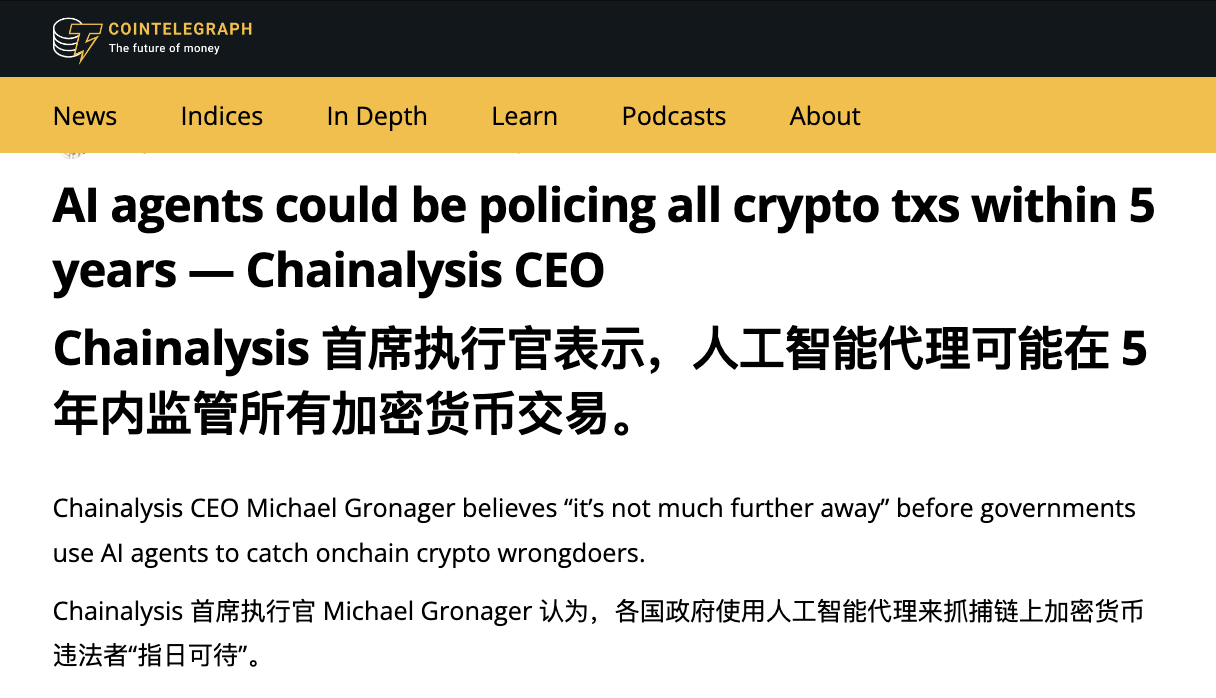
The CEO of Chainalysis boldly predicted that within five years, AI will be able to regulate all cryptocurrency transactions. These AI agents won’t just solve cases—they’ll track down crypto tax evaders. Although he noted that those who cashed out assets five or more years ago might “escape,” today, the IRS and other tax authorities are already widely using AI to detect potential tax evasion.
* On crypto taxation: In the U.S., UK, and Germany, declaring cryptocurrency taxes has become mandatory.
This means that blockchain’s transparent ledgers, powered by AI, will become the most powerful surveillance tool in human history. In a blockchain world where transparency is the default, automated, large-scale monitoring is shrinking anonymous spaces at a visible pace. This fear is the true catalyst behind the surge in privacy coin demand in 2025.
Financial Surveillance Goes Full-Scale
The “digital ankle bracelet” of financial systems is just the beginning. The logic of surveillance is expanding from finance into every corner of life:
-
Privacy Coin Crackdown (since 2023): Over 70 delistings of privacy coins across global exchanges
-
U.S. SAR Enhancement (since 2025): Treasury strengthens requirements for reporting suspicious crypto-related activities
-
EU Privacy Coin Ban (from July 1, 2027): Privacy coins classified as “anonymity-enhancing crypto assets,” fully prohibited
-
Meta Data Reuse (from April 14, 2025): Resuming use of European users’ public data to train AI models
-
EU “Chat Control” CSAR Proposal: Requires messaging apps to scan all communications—including encrypted messages—by default
As digital privacy counts down and anonymity is gradually stripped away, the market develops an almost instinctive, panic-driven demand for any asset offering “untraceability.”
IV. Privacy Coins Strike Back: Lifeboats in the Crypto Ocean

Before AI renders every crypto transaction transparent, the importance of privacy grows ever greater. These coins are not just weapons against “digital Big Brother,” but the last line of defense preserving financial freedom and privacy rights for ordinary people.
Thus, privacy-focused cryptocurrencies offer a way back to normalcy.
They enable direct, permissionless transactions between individuals—without identity verification or centralized oversight. In essence, this is a digital return to the services once provided by coins and cash.
The Tech Moat Behind Zcash’s Surge
Why has Zcash exploded in popularity? Because Zcash shares key fundamentals with Bitcoin—fixed supply and Proof-of-Work consensus.
But it adds a crucial layer of privacy protection: shielded addresses—using zero-knowledge proofs (zk-SNARKs) to hide sender, receiver, and transaction amount. Transactions between shielded addresses enter a pool holding privately transacted tokens. As the pool grows, so does the network’s anonymity set, enhancing privacy for all users.
The protected pool has reached its largest size ever, nearing 4.9 million ZEC.
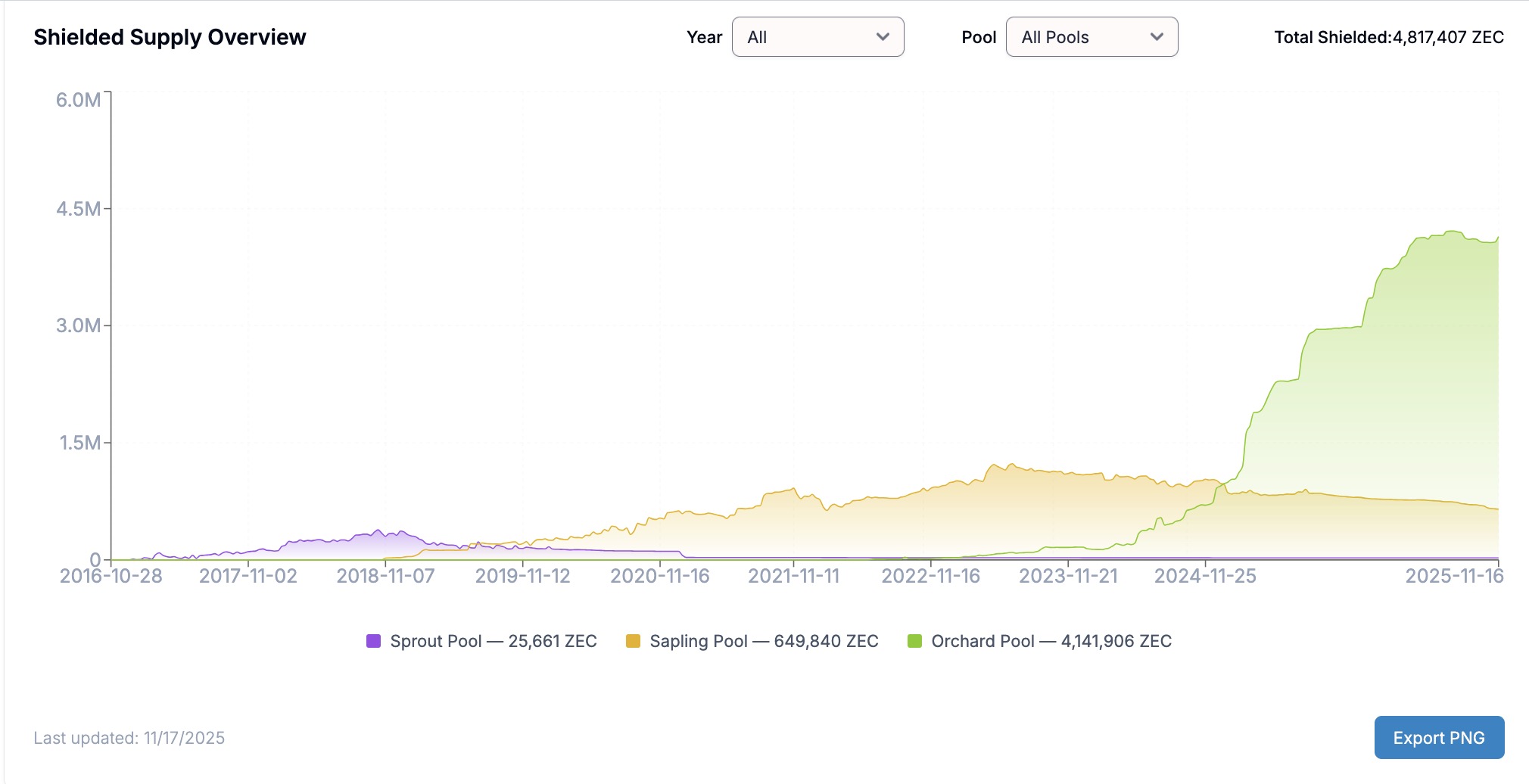
Nearly 30% of Zcash supply is shielded. Source: Zechub
The resurgence of privacy coins like Zcash reflects the market’s panic-driven hedging against risk. TYMIO DeFi platform founder stated publicly: “With tightening global regulations and exchanges required from 2026 onward to report wallet ownership to tax authorities, privacy has become one of the strongest themes in crypto.” He added, “Some major players have already started converting portions of their Bitcoin holdings into Zcash.”
KOL Amplification: The Next Bitcoin?
Source: @gazza_jenks
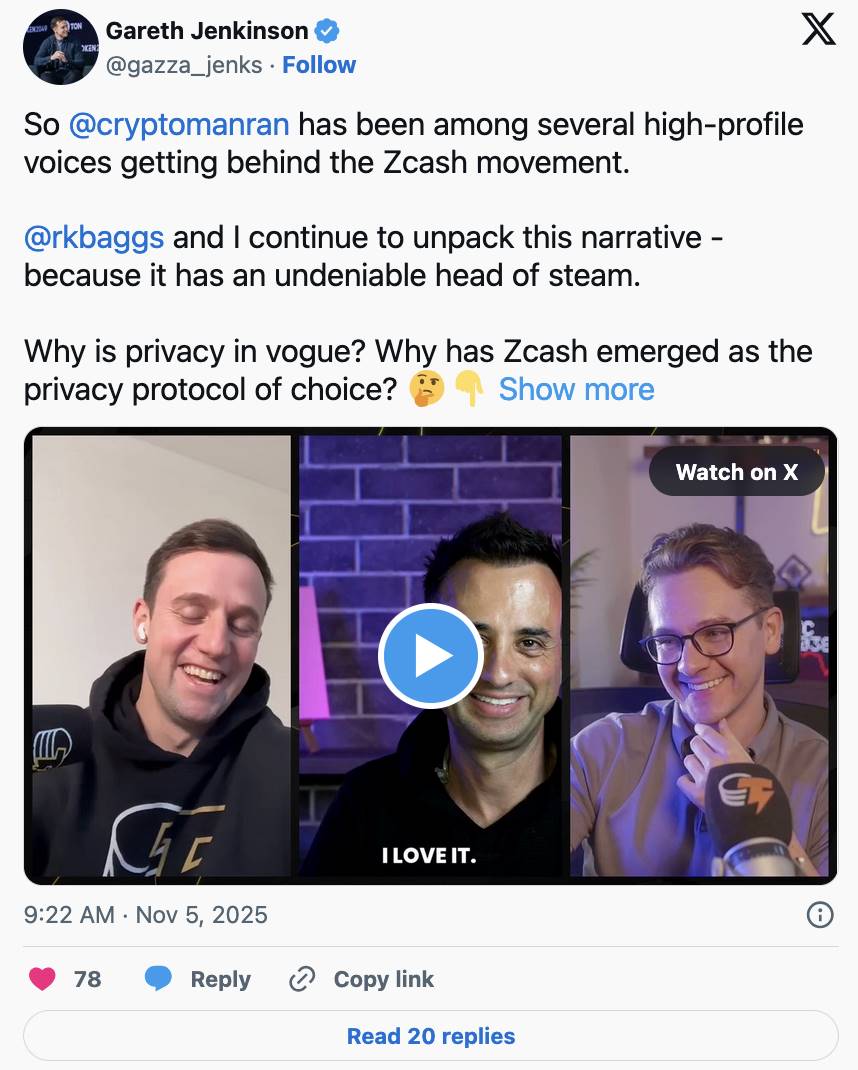
Yet technical advantages alone cannot explain Zcash’s explosive growth. Behind this privacy coin revival, influential voices in the crypto world are speaking in unison. Figures like Arthur Hayes and Naval Ravikant have consistently championed Zcash’s privacy-first design in recent months, offering optimistic price forecasts. This collective endorsement has not only driven ZEC’s outsized returns but also strengthened the privacy coin narrative.
As Ran Neuner, host of YouTube channel Crypto Banter, put it—the South African broadcaster and entrepreneur described Zcash as “the most exciting thing happening in crypto right now,” comparing it to Bitcoin’s early adoption phase from 2009 to 2017.
“Bitcoin was special for two reasons. The brightest cryptopunks—the extreme libertarians—united and self-organized around a shared goal: creating a private currency enabling peer-to-peer transfers anywhere in the world without government interference.”
“...And this time, the cryptopunks are uniting again—to fight for privacy, the very element missing from Bitcoin.”
V. Conclusion: The Last Line of Defense for Freedom
Anthropologists have long told us that privacy is a basic human need, as essential as food and sleep. We need a private space free from observation and judgment.
Not because we have shameful secrets, but because constant surveillance fundamentally alters our behavior.
When you know every transaction is recorded, analyzed, and judged, you begin to self-censor—avoid donating to controversial charities, refrain from buying “sensitive” books, or decline supporting “inappropriate” political candidates.
This is what economists call the “chilling effect”—surveillance doesn’t need to punish you; simply knowing you’re being watched is enough to change behavior. Like an invisible prison—you can’t see the bars, but you can never walk out.
When digital surveillance becomes ubiquitous and financial privacy is gradually stripped away, any asset offering “untraceability” will be revalued.
After all, once the financial system truly becomes an omniscient surveillance machine, no one’s life will ever go back to how it was.
“The right to be let alone—the most comprehensive of rights, and the right most valued by civilized men.”
Join TechFlow official community to stay tuned
Telegram:https://t.me/TechFlowDaily
X (Twitter):https://x.com/TechFlowPost
X (Twitter) EN:https://x.com/BlockFlow_News