








Shadow Bitcoin
TechFlow Selected TechFlow Selected
Shadow Bitcoin
UTXO is the only true "cash in your hand" in the Bitcoin world.
 Navigating Web3 tides with focused insights
Author: Daii
Open your exchange app and look at that "BTC balance" in your account. Do you think that's the actual Bitcoin? NO, that's just Bitcoin's "shadow."
Bitcoin is no longer what it used to be. You've heard its story before: a total supply of 21 million coins, with halvings progressively reducing new supply. It's like an incredibly hard "time rock," whose rhythm you can even measure by block height.
But in the real world, the Bitcoin that is "traded, collateralized, priced, and held" is not equivalent to the UTXOs on-chain.

What is UTXO? This is the protagonist of today's article—real Bitcoin, as opposed to shadow Bitcoin. You can think of it as the only truly "cash in your hand" in the Bitcoin world.
More precisely, UTXO stands for Unspent Transaction Output. It sounds technical, but its meaning is actually very relatable:
- In the Bitcoin system, your balance isn't a number written in an account; it's more like a handful of "change."
- Each UTXO is like a "change slip" or "cash voucher" with a denomination, stating: this amount belongs to a certain address, and only the person with the corresponding private key is eligible to spend it.
- When you "pay" Bitcoin, you don't deduct a number from an account. Instead, you hand over some of your UTXOs entirely. The system marks them as "spent" (they cease to exist) and then generates new UTXOs: part for the recipient, and the rest as "change" back to your address.
So what you truly own on the Bitcoin blockchain is not "the BTC number displayed by some platform," but a set of UTXOs that can be spent with your private key signature. They are the true form in the final settlement layer.
What you see in your exchange account, ETF shares, a DeFi lending position, or a perpetual contract position is mostly just "a right or exposure to BTC"—it looks like a balance but is essentially a contract, a certificate, or a line in a platform's ledger. They are not real Bitcoin, just its shadow, at best shadow Bitcoin.
If this still seems abstract, let's not debate concepts for now. First, look at three sets of numbers to illuminate the "shadow."
First Beam of Light: The Bulk of Trading Isn't in Spot
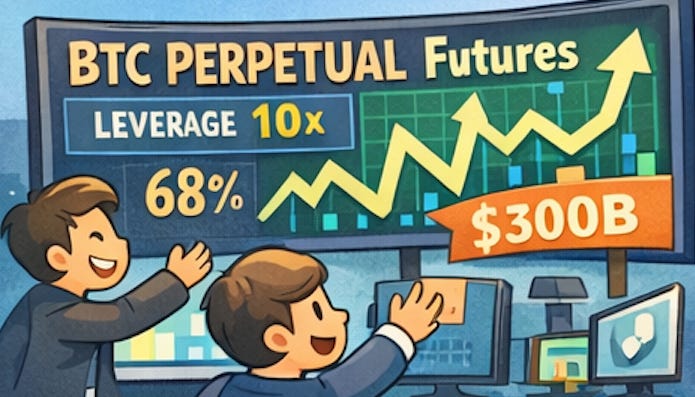
In most people's intuition, "spot trading" is the price's true form, and "contracts" are just shadows revolving around it. But in the face of data, this order is often reversed: derivatives are the main body of trading activity.
Kaiko's annual review mentions that in 2025, about 75% of crypto market trading activity occurred in the derivatives market; for Bitcoin specifically, perpetual contracts accounted for about 68% of Bitcoin trading volume. Meanwhile, the average daily trading volume for Bitcoin perpetual contracts ranged roughly between $10 billion and $30 billion. On peak days, a single platform's BTC perpetual volume could surge to the $80 billion level. (coinglass)
This means: often, the market's most "crowded" and "forceful" area is not spot, but the arena of leveraged exposure.
Second Beam of Light: ETFs Turned the "Shadow" into a Mainstream Financial Asset
If perpetual contracts are the "trading shadow," then ETFs are the "institutionalized shadow": they package BTC price exposure into securities, allowing large amounts of capital to enter in a familiar way.
Taking Bitbo's ETF tracking data as an example, the combined holdings of U.S. spot Bitcoin ETFs reached approximately 1,301,880 BTC (worth about $121.27 billion) in early January 2026, with BlackRock's IBIT holding about 770,792 BTC. (bitbo.io)
These BTC may indeed be custodied on-chain, but for most holders, you don't hold UTXOs; you hold fund shares—you own a "right to a financial asset," not "control over on-chain private keys."
Third Beam of Light: Wrapped BTC Turns "On-Chain Yield" into "On-Chain Credit"
Shadows don't only occur in centralized finance. On-chain, there's also a complete industrial system for "turning BTC into composable assets": WBTC, cbBTC, etc., turn BTC into ERC-20 tokens in the EVM world, allowing them to be lent, market-made, used as collateral, and stacked for yield.
For example, Coinbase's cbBTC, as shown on its official proof-of-reserves page: as of the morning of January 6, 2026, the total issuance was about 73,773.70 cbBTC, with corresponding verifiable information on reserves and on-chain addresses provided. (coinbase.com)
WBTC remains another large-scale wrapped BTC (figures vary by source over time; for example, CoinGecko displays its circulating/supply public data). (CoinGecko)
You'll discover a very "modern" fact: the scarcer Bitcoin becomes, the more prosperous the credit structures around it. Because scarce assets are best suited as collateral—they can compress "time value" into the spring of credit expansion.
Having read this, do you have a bit of intuitive understanding about shadow Bitcoin? However, intuition alone is not enough because we can't make decisions based on feelings. We need to understand what the essence of shadow Bitcoin really is.
1. What is Shadow Bitcoin?
Discussing "shadow Bitcoin" most easily falls into an empty statement: it seems as if anything that isn't on-chain BTC is "fake coin." This is inaccurate.
A more professional breakdown is: splitting "Bitcoin" into three types of rights—which one is the thing in your hand?
- Ownership (Finality): Can you control UTXOs on-chain with your private key to complete final settlement?
- Redemption/Claim Right: Can you redeem a certain certificate back to BTC (or equivalent cash)? What are the redemption path, rules, and priority?
- Price Exposure: Do you just want to follow BTC's price movements, not caring about redemption and final settlement?
"Shadow Bitcoin," in essence, is: the market uses contracts, custody, securitization, and wrapping to allow you to obtain redemption rights or price exposure without holding on-chain UTXOs. It is not a single species but an entire ecological niche.
However, the ghost hidden behind shadow Bitcoin should be familiar to you—leverage. Some leverage is added by you, some is added by others on your behalf. Others take the lion's share of the profits, while you receive meager returns that are extremely asymmetrical to the risk.
Next, we will focus on the core of "leverage," stratifying the "shadow," peeling it back like an onion.

2. The Ghost Behind Shadow Bitcoin—Leverage
If "shadow Bitcoin" is a layered packaging of "rights and exposure," then leverage is what suddenly makes these shadows grow fangs.
It most resembles an invisible wind: usually just rippling the water's surface, people think "this is liquidity"; but once the wind turns into a hurricane, ripples instantly become a wall of waves, flipping over the boat bottom you thought was solid. More troublesome is that the wind doesn't only come from the sails you raised yourself—often, the platform raises the sails for you, and you don't even know where that rope is tied.
Let me first place leverage within a more precise framework: it's not as simple as a "multiple." The essence of leverage is using the same underlying asset to repeatedly generate "tradable exposure" and "collateralizable credit" under different ledgers and rules. Explicit leverage lets you control a larger nominal position with a small amount of margin; implicit leverage is when the system (platform) uses your assets to build a larger balance sheet, concentrating profits at a few nodes and spreading tail risks to participants like you.
To survive in the shadow era, you must first see two pictures clearly.
2.1 First Picture: Explicit Leverage, Like a Knife
Many think contracts are just "betting on price direction." But the real magic of the contract market is: it turns Bitcoin into "infinitely replicable nominal exposure."
Kaiko's 2025 research provides a hard fact: derivatives already account for over 75% of all crypto market trading activity, with perpetual contracts making up about 68% of Bitcoin trading volume (and continuing to rise from 2024). In other words, the market's most crowded, most forceful place is not spot, but perpetuals. (Kaiko)
This is the first form of operation for the "shadow factory": not that Bitcoin has increased, but that the nominal positions around Bitcoin have become extremely large. What you see is trading volume, funding rates, liquidation data—they are essentially different facets of the same thing: the same underlying asset, tumbling on leverage upon leverage.
AMINA Bank's summary of the Q3 2025 derivatives market provides a more specific quantitative scale: average daily derivatives volume that quarter was about $24.6 billion, with perpetual contracts accounting for 78% of trading activity, and notes that derivatives volume on multiple major exchanges consistently exceeded spot volume, with ratios ranging from about 5x to 10x. (AMINA Bank)
This isn't "bustle"; it's structure: when the primary trading occurs in the leveraged market, short-term price behavior increasingly resembles the "price of leveraged products," not the "price of a spot commodity."

You don't need to believe abstract theory; just look at one extreme event. AMINA's report recorded a liquidation cascade in September 2025: within 24 hours, approximately $16.7 billion in positions were liquidated, involving over 226,000 traders; among the liquidated positions, longs accounted for a high 94%, and the report explicitly mentioned the existence of leverage as high as 125x in the market. (AMINA Bank)
In October of the same year, Reuters also reported another more intense "deleveraging" moment: during a panic triggered by macro policy shocks, the market saw over $19 billion in leveraged positions liquidated, described as one of the largest liquidation events in crypto history. (Reuters)
You'll find that the world of explicit leverage is very "logical": large positions get liquidated, high leverage gets cleared, extreme funding rates revert. It's like a knife—sharp, but at least you can see where the blade is.
But what's truly deadly in the shadow Bitcoin era is never the knife you're holding yourself; it's when you think you're just watching the spectacle, but someone has actually put the knife in your hand and signed the disclaimer for you.
2.2 Second Picture: Implicit Leverage, Like a Ghost

The most dangerous thing about implicit leverage is that it often appears wearing the cloak of "yield."
You deposit BTC and see "Earn," "wealth management," stable APY; but in accounting terms, you may have handed over control, even ownership, of the asset to the platform. From that moment, the balance you see on the platform is more like an IOU: normally it's equivalent to BTC, but only when a bank run occurs do you realize it's a debt certificate, not the on-chain asset itself.
Celsius's bankruptcy case wrote this boundary very starkly. Investopedia, citing the court ruling, mentions: the judge held that Celsius's terms caused users to transfer ownership of assets to the platform upon depositing them into its Earn accounts; when Celsius filed for bankruptcy, the Earn accounts held about $4.2 billion in assets, involving about 600,000 users. (Investopedia)
Interpretations of the same ruling by multiple legal institutions are more direct: the terms "unambiguously" transferred ownership of digital assets deposited into Earn accounts to Celsius, placing users in the position of unsecured creditors in the bankruptcy. (Sidley Austin)
This is the prototype of "asymmetry between risk and reward": rewards are given to you in the form of a few percentage points of APY, while the risk is a tail event at the balance sheet level. Once triggered, your yield loses meaning in seconds, and the priority of your principal has to queue up for fate.
FTX showcased another face of implicit leverage: not cleverly written terms, but funding paths intentionally made into a black box. The CFTC's complaint states: client fiat assets were typically held in bank accounts under Alameda's name, commingled with Alameda's own assets; FTX's internal ledger system used the "fiat@ftx" account to reflect client fiat balances, which at one point during the relevant period reached about $8 billion. (CFTC) The SEC's enforcement notice also explicitly charged it with misappropriating client funds and concealing this from investors. (SEC)
Against this historical backdrop, many exchanges began launching Proof of Reserves (PoR) after 2022, attempting to prove "I'm not using client assets." This is certainly better than complete opacity, but it's often misunderstood as "audit = safety."

The accounting firm PwC's related interpretation emphasizes a key point: PoR is typically more like a snapshot of assets at a point in time, not equivalent to a full audit, and does not necessarily cover the liability side or overall solvency. (PwC)
In plain language: PoR is more like counting the rice in the kitchen at a certain moment, not auditing the entire house's balance sheet.
You can think of PoR as a "kitchen inventory": you see how much rice is left in the jar, but you don't know how many people are queuing outside the house for a meal, nor do you know if the cook has mortgaged the pot to someone else. It increases transparency, but it cannot replace solvency guarantees in a balance sheet sense, nor can it replace payout capability under stress tests.
And a more "modern" upgraded version of implicit leverage is its entry into two stronger machines: one called DeFi's composable credit, the other called ETFs' institutionalized capital pipelines. They make the shadow more standardized, larger-scale, and easier to mistake for the "true form."
First, look at wrapping.
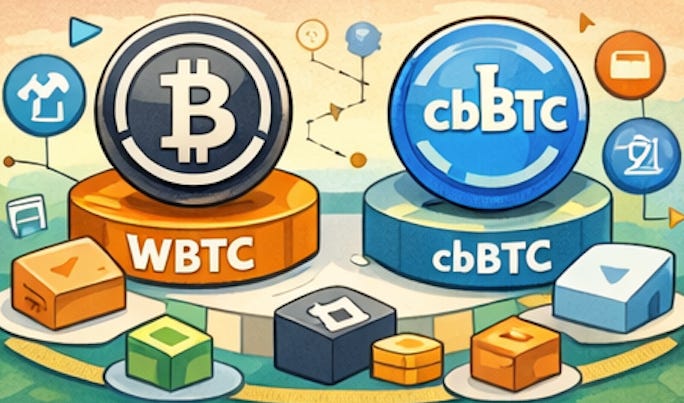
Coinbase's cbBTC proof-of-reserves page, when refreshed on January 6, 2026, showed: reserves of about 76,230.31 BTC, corresponding to a supply of about 76,219.49 cbBTC, and emphasized 1:1 backing by BTC held in custody by Coinbase. (Coinbase)
This kind of transparency is progress because you can at least see "how thick this layer of shadow is." But you must still remember: transparency does not equal no risk; it merely advances the risk from "complete black box" to "observable but still must be borne."
Now look at WBTC. BitGo announced in August 2024 the migration of WBTC-related business to a multi-jurisdictional, multi-institutional custody structure and established a joint venture arrangement with BiT Global. (The Digital Asset Infrastructure Company)
Similar structural changes immediately trigger chain reactions in DeFi's risk control layer. For example, discussions appeared on the Aave governance forum about "needing to reassess WBTC integration risks." (Aave)
This precisely illustrates: the risk of wrapped BTC never lies solely in the "1:1" concept, but in whether changes in custody and governance structures will alter your future exit rights.
Finally, look at ETFs.

Taking BlackRock's iShares Bitcoin Trust prospectus as an example, it clearly states: the trust only accepts creation and redemption requests from Authorized Participants. (BlackRock)
This means most ordinary investors hold securities shares and price exposure, not rights that can directly demand redemption of BTC. ETFs have turned shadow Bitcoin into a mainstream financial asset, which in itself isn't necessarily bad, but it also reinforces a reality: you are one step further from "final settlement of UTXOs"—you own a financial rights structure, not on-chain control.
So you'll find that the most frightening aspect of implicit leverage is not how "high" it is, but that it often appears in the form of "promises": instant deposit and withdrawal, redeemable anytime, assets 1:1, transparent reserves.
Therefore, the smoother the promise, the easier the exit, the more you must ask in return: what risk was exchanged for this certainty? Where is the risk hidden? Who is the backstop?
2.3 The Leverage Paradox: The Scarcer Bitcoin Becomes, the More Prolific the Shadows; The More Prolific the Shadows, the More the System Needs a "Cleansing Day"
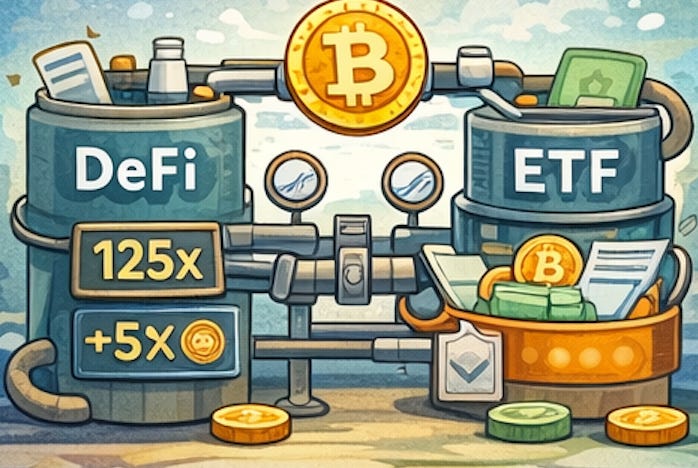
Scarce assets are naturally suited as collateral.
Here is a paradox you've already vaguely touched: the harder the collateral, the bolder the credit expansion; the larger the credit expansion, the more sensitive the system is to price volatility; and once price volatility triggers liquidation mechanisms, it reclaims leverage in the form of a "waterfall."
BIS research describes the same thing in more academic language: in DeFi lending systems, higher leverage weakens system resilience and increases the proportion of "debt close to liquidation"; leverage levels are driven by LTV requirements, borrowing costs, and price volatility, among other factors. (Bank for International Settlements)
Simply imagine: when your house is repeatedly mortgaged and re-mortgaged, the more debt supported by the same house, the more banks will swarm to demand repayment as soon as the housing price drops slightly—the same logic applies to BTC repeatedly used as collateral in DeFi.
Join TechFlow official community to stay tuned
Telegram:https://t.me/TechFlowDaily
X (Twitter):https://x.com/TechFlowPost
X (Twitter) EN:https://x.com/BlockFlow_News
 @yzdxs8


