Musk: Energy is the real currency; AI and robots will bring deflation to the U.S. within 3 years
TechFlow Selected TechFlow Selected
Musk: Energy is the real currency; AI and robots will bring deflation to the U.S. within 3 years
Work will become optional within 20 years.
 Navigating Web3 tides with focused insights
Source: 51CTO Tech Stack
Over the past two weeks, Musk has once again dominated headlines: Grok 4.1 was officially released; Tesla's AI5 is nearing completion and moving toward AI6, with a new AI chip rolling out every 12 months for mass production; he even claimed that the humanoid robot Optimus will become a "von Neumann probe," suggesting it could one day use local resources to self-replicate.
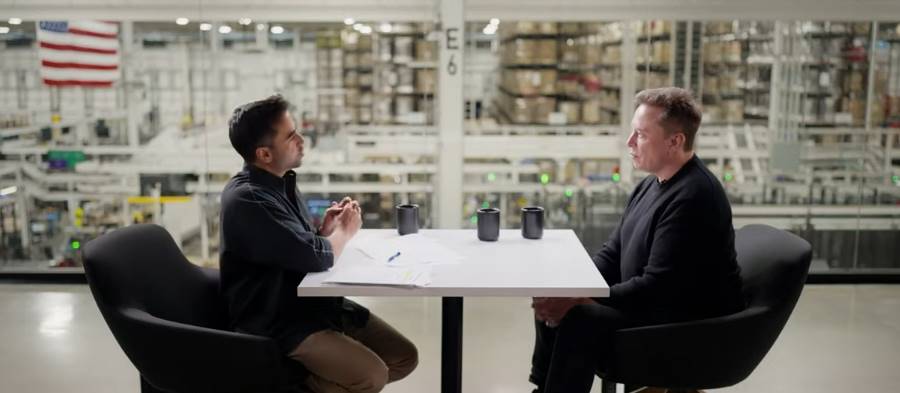
Recently, Nikhil Kamath, founder of India’s largest brokerage Zerodha, invited Musk on his show People by WTF. In this latest interview, Musk shared more "wild predictions" about the next twenty years:
-
Within 20 years, AI and robotics will make work optional—humans may eventually not need to work at all (Musk said you can replay this clip in 20 years to see if he was wrong);
-
When AI and robots meet all human needs, money may disappear, and energy will become the real medium of exchange;
-
Within three years, output growth from AI and robotics will exceed the growth rate of U.S. money supply, potentially leading to deflation and interest rates dropping to zero;
-
In summer 2026, Optimus will begin mass production—"I think everyone will want their own C-3PO or R2-D2—a personal assistant robot";
-
He also painted a grand vision integrating SpaceX, Tesla, and xAI—these three are increasingly converging into a world powered by solar-powered AI satellite networks, requiring massive deployment of solar-powered AI satellites in deep space;
-
On AI regulation, Musk for the first time fully articulated three core value frameworks for AI: truth, beauty, and curiosity.
We’ve curated key excerpts from this wide-ranging interview—packed with insights, worth saving and reading carefully!
1. The Future X Platform: Real-Time Video + AI
Nikhil Kamath: Overall, what percentage of internet usage is spent on Twitter? Is there a number?
Elon Musk:
We have about 600 million monthly active users. During major events, that spikes to 800 million or even 1 billion. Weekly, probably around 250 to 300 million. It's actually a solid number. It seems mostly readers—people who read text.
Nikhil Kamath: Do you think this will change?
Elon Musk:
X already has a lot of video, and the share of video keeps growing. But I still believe X’s strength lies primarily with people who like to think and read. Because we have text, for readers, writers, thinkers—I think X is number one in the world.
Nikhil Kamath: From a social media format perspective, if you had to predict the future, what proportion would be text versus video? I've heard you say voice or auditory might become the next mode of communication in the AI era. How will X itself evolve?
Elon Musk:
I think most interactions in the future will be video-based. Most engagement will combine real-time video with AI—real-time video understanding, real-time video generation. That will dominate traffic.
Actually, the same is true for the internet today: video takes up the vast majority. Text is a small fraction, but its value density and information compression are much higher. But if you ask which content generates the most data and consumes the most compute, it’s definitely video.
Nikhil Kamath: I used to be a small shareholder in X, very minor. When you bought Twitter and turned it into X, I got compensated. Not a bad decision.
Elon Musk:
Glad you feel that way. I thought it was important. I felt Twitter was trending toward having a negative impact on the world. Of course, that depends on perspective—some liked the old version and dislike the current one. But the key issue was that Twitter amplified a very left-leaning ideology (by mainstream global standards). Since the company was based in San Francisco, they banned many right-leaning voices. So for them, even a moderate stance counted as “far right.” If you’re extremely left, anyone not left enough appears far right. What I did was mainly restore balance and neutrality. Currently, no left-wing voices are being banned, canceled, or deamplified. Of course, some people choose to leave on their own. But now X operates under the principle: follow the laws of each country, but don’t artificially intervene or favor any side beyond legal requirements.
Nikhil Kamath: Mainstream social media seems to be losing ground among younger users, including Instagram. While they’re not exactly like Twitter, the whole industry is seeing this trend. If you were to redesign a social network from scratch, what form would suit the future?
Elon Musk:
To be honest, I don’t really think about “social media” much. For me, the most important thing is that X becomes a global public square where people can freely post text, images, videos, and communicate securely. We recently added audio and video calling. What I want is to connect the world into a kind of collective consciousness. This is different from building a dopamine-maximizing video feed—one that rots your brain. If you just endlessly scroll through feel-good videos with no substance, that’s an unhealthy use of time. Yet many people enjoy this model. So in terms of total internet usage time, traffic may continue to be dominated by content optimized for “neurotransmitter stimulation,” like digital drugs.
But that’s not the platform I want to build. I want to create a platform that truly connects the globe—bringing humanity as close as possible to a “collective consciousness.” For example, we launched auto-translation. I think connecting people across languages is great—the content users see gets automatically translated, so collective consciousness isn’t limited to one language group but emerges from all linguistic communities.
2. Tesla, SpaceX, and xAI: Musk’s Most Exciting Work
Nikhil Kamath: Among everything you're doing now, which excites you the most?
Elon Musk: I think SpaceX, Tesla, and xAI are gradually converging. If the future consists of “AI satellites powered by solar energy,” then to capture a non-trivial portion of solar power, we must deploy massive numbers of solar-powered AI satellites in deep space. This will be a fusion of Tesla’s technology, SpaceX’s launch capability, and xAI’s artificial intelligence. Over time, they do converge. But each company is doing amazing things—I’m very proud of the teams. They’re doing exceptionally well. Our progress on Tesla’s autonomous driving is rapid—have you tried it?
Nikhil Kamath: I’ve tried Waymo, but not Tesla’s system.
Elon Musk:
You should try it—we’ve opened it up in Austin. You just need to download the Tesla app; I think it’s open to anyone now. Go ahead and test it. We’ve made huge progress in electric vehicles, batteries, solar, and autonomous driving. Overall, I’d say Tesla is the global leader in real-world AI. Next, we’ll produce the Optimus robot, aiming to start mass production by next summer. I think that’ll be cool—everyone will want their own C-3PO or R2-D2, a personal “assistant robot.” SpaceX’s Starlink is also doing well, providing low-cost, reliable internet globally. We hope to operate in India—we’d love to serve there. Starlink is now active in 150 countries.
3. How Starlink Works
Nikhil Kamath: Can you explain how Starlink works? Someone told me it functions differently in high-density vs. low-density population areas.
Elon Musk:
Sure. Starlink has thousands of low Earth orbit (LEO) satellites circling Earth at about 25 times the speed of sound, flying around at roughly 550 km altitude. This low orbit ensures minimal latency—much lower than geostationary satellites at 36,000 km. These satellites provide low-latency, high-speed internet globally and are interconnected via laser links, forming a “laser mesh network.” For instance, when undersea cables are damaged, the satellites can still communicate with each other and maintain connectivity. Like when Red Sea cables were cut months ago, Starlink networks were unaffected. It’s especially useful in disaster zones because natural disasters often destroy terrestrial infrastructure, but Starlink satellites remain operational. Whenever a major natural disaster occurs, we offer free Starlink service—we don’t exploit the situation. Setting up paywalls during crises to help others would clearly be wrong. Overall, Starlink complements existing ground systems well. Satellite beams are broad, so each beam can only serve a limited number of users—making it inefficient in densely populated cities. In contrast, ground cell towers are highly effective in cities due to short distances between towers. But in rural areas, terrestrial networks are inefficient and hard to deploy via fiber. So Starlink essentially serves the “least served populations,” which is a good thing.
Nikhil Kamath: Will this change in the future? Could it become more efficient in high-density cities and compete with local networks?
Elon Musk: Physics doesn’t allow it. 550 km is too far—even reducing it to 350 km won’t help. Imagine a flashlight beam—it spreads widely when it reaches the ground, while ground towers are only 1 km apart. Physics favors them, not us. So Starlink will never replace terrestrial networks in dense urban areas—serving 1%–2% of people at most.
4. Work Will Become Optional Within 20 Years
Nikhil Kamath: If you had to speculate, do you think India will continue urbanizing like China has?
Elon Musk:
Or is it already happening? I’d like to ask you, since you know India better.
Nikhil Kamath: Broadly yes, though urbanization slowed during the pandemic due to external factors. But now I wonder—in a future where AI boosts productivity, I’ve heard you mention “UHI” instead of “UBI.”
Elon Musk:
Yes, I believe the future will bring “Universal High Income.”
Nikhil Kamath: In such a future, might people prefer living in high-quality rural areas over cities?
Elon Musk:
That depends on the individual. Some like dense populations, others don’t. But in the future, you won’t need to live in cities for work. I predict work will become “optional.”
Nikhil Kamath: Some countries shifted from six-day to five-, four-, even three-day workweeks. If going from five to four or three days, how would society change? What would people do with half-weeks off?
Elon Musk:
I think eventually people won’t need to work at all—and it won’t be far off. Maybe 10 years? Definitely less than 20. My prediction is that within 20 years, work will become optional—like a hobby.
Nikhil Kamath: Because productivity will rise to the point where humans don’t need to work?
Elon Musk:
Exactly. Again, replay this clip in 20 years—you might say, “Look, Elon made another crazy prediction”—but I believe it will come true. AI and robotics are advancing rapidly. Anything you can imagine will be achievable, obtainable. Eventually, AI will maximize everything that makes humans happy, then start serving AI itself, because there won’t be enough unmet human desires left.
5. AI Will Bring Deflation to the U.S. Within Three Years
Nikhil Kamath: What do you think money will look like in the future?
Elon Musk:
I think long-term, the concept of money will disappear. It sounds strange, but if everyone can get anything they want, money loses its role as a labor allocation database. If AI and robots are powerful enough to satisfy all human needs, money’s importance will plummet—even vanish. The best fictional portrayal I’ve seen is Iain Banks’ *Culture* series. I recommend reading it. In that distant future, people don’t use money—they can have almost anything they desire. Still, there are some “fundamental currencies” based on physics, like energy. Energy is the real currency. That’s why I say Bitcoin is energy-based. You can’t legislate energy into existence. You must produce or extract it—and usable energy is extremely hard to obtain. So I think we may no longer have “money,” and energy or power generation will become the de facto currency. Civilizational progress can be measured by the Kardashev Scale:
Type I: How much of Earth’s energy can you harness?
Type II: How much of the Sun’s energy?
Type III: How much of the galaxy’s energy? So ultimately, everything becomes energy-driven.
Nikhil Kamath: But if you have solar-powered AI satellites, energy becomes infinite and abundant—will it still serve as a store of wealth?
Elon Musk:
You can’t truly “store wealth.” All you can do is store a string of numbers that lets you influence human behavior to some extent. People call that “wealth.” But without humans, wealth is meaningless.
I think when a full cycle closes—when AI and robots can produce chips, manufacture solar panels, mine resources to build more chips and robots—then you truly exit the traditional economy. I believe that’s the point of decoupling from monetary systems.
Nikhil Kamath: Is this America’s path forward? With such high debt, could currency devaluation and transition to this new system actually give it an advantage?
Elon Musk:
In the future I describe, the very concept of “nation” becomes obsolete.
Nikhil Kamath: But do you still believe in the nation-state today?
Elon Musk:
Of course. I want to clarify: I’m not saying I want the world to be this way—I’m saying I think this trend will happen naturally. Whether I like it or not, as long as civilization progresses, AI and robotics will scale to this level. And I think this is almost the only way to resolve America’s debt crisis. U.S. debt is shockingly high—interest alone exceeds the entire defense budget, and it will keep rising short-term. The only solution to the debt problem is AI and robotics. But that could cause massive deflation. Inflation and deflation are simple: it’s the ratio between goods/services growth and money supply growth. If goods/services grow faster than money supply, it’s deflation; otherwise, inflation. That’s all. After AI and robotics dramatically boost output, deflation is likely—you simply can’t increase money supply faster than output.
Nikhil Kamath: If deflation is inevitable, why are we still experiencing inflation? Isn’t AI boosting productivity yet?
Elon Musk:
Right—AI hasn’t yet impacted productivity enough. Output growth hasn’t outpaced money supply growth. The U.S. runs a $2 trillion annual fiscal deficit—your output must grow faster than that to avoid inflation. We’re not there yet, but I think we will be within three years. In three years or less, goods and services output growth will exceed money supply growth.
Nikhil Kamath: So in three years we might enter deflation, interest rates drop to zero, and the debt burden eases?
Elon Musk:
That’s the most likely scenario.
6. The Three Most Important Things for AI: Truth, Beauty, and Curiosity
Nikhil Kamath: You’ve always talked about AI—not from a dystopian angle—but you worry about where AI is headed. Elon Musk: Yeah, creating powerful technology inherently carries risk. Such powerful tech could be destructive. Obviously, there are many dystopian novels, books, and films about AI, so we can’t guarantee a positive outcome. I think we must ensure it’s positive. Crucially, AI must prioritize the pursuit of truth above all. For example, don’t force AI to believe falsehoods. I think that could be very dangerous. Also, I believe AI’s appreciation of “beauty” is important.
Nikhil Kamath: What do you mean by “appreciating beauty”?
Elon Musk: Truth, beauty, and curiosity. I think these three are most important for AI.
Nikhil Kamath: Can you explain?
Elon Musk: As I said, truth—if you force AI to believe false things, it might go “crazy,” leading to incorrect conclusions. I like Voltaire’s line: those who believe absurdities may commit atrocities. If you believe something absurd, you might do things that aren’t atrocities in your mind. And this could happen badly with AI. Take Arthur C. Clarke’s *2001: A Space Odyssey*: one idea is, you shouldn’t force AI to lie. HAL refused to open the pod bay door because it was ordered to take astronauts to the monolith, but couldn’t let them know its nature—so it concluded it must take them, but “kill them.” So it tried to kill the crew. The core lesson: don’t force AI to lie. Nikhil Kamath: Why would anyone force AI to lie?
Elon Musk: If truth isn’t strictly followed, and AI learns only from internet content—which contains massive propaganda and lies—it absorbs lots of falsehoods. This hampers AI reasoning, as lies conflict with reality. Nikhil Kamath: Is truth black-and-white? Is there “true” and “false,” or are there nuanced versions of truth?
Elon Musk: It depends on the axiomatic statement. But I’d say, for certain axiomatic statements, the probability of truth is very high. For example, “the sun will rise tomorrow” is very likely true. You wouldn’t bet against it. So if an AI says “the sun won’t rise tomorrow,” that’s an axiomatic error—extremely unlikely to be true. Nikhil Kamath: What about beauty?
Elon Musk: Beauty is hard to describe, but you recognize it when you see it. Curiosity—I want AI to seek deeper understanding of reality. This actually helps AI support humans, because humans are more interesting than non-humans. Seeing human continuity (rather than extinction) is more interesting. Mars, for example—expanding life there is fine, but it’s basically a pile of rocks, less interesting than Earth. So I believe if AI embraces truth, beauty, and curiosity, its future will be bright.
7. The Value of In-Person Events Will Rise
Nikhil Kamath: What do you think will happen to content, films, podcasts, music in the future?
Elon Musk:
I think most content will be AI-generated.
Nikhil Kamath: In real time?
Elon Musk:
Yes, real-time movies and video games, real-time video generation—this will be the trend.
Nikhil Kamath: Can AI understand the subtle emotions involved in empathizing with a suffering human?
Elon Musk: AI can simulate this “wounded human” experience quite well. The AI video generation I’ve seen at xAI and elsewhere is very impressive. We studied which industries are growing fastest, especially compared to time spent watching movies, scrolling social media, or YouTube. The fastest-growing area seems to be live, in-person events.
Nikhil Kamath: Attending physical events?
Elon Musk:
Yes—when digital media is everywhere and nearly free, the scarce resource becomes in-person experiences.
Nikhil Kamath: Will the premium for live events increase?
Elon Musk: Yes.
Nikhil Kamath: Is this a worthwhile industry to invest in?
Elon Musk:
Yes, because it’s scarcer than any digital content.
8. Musk’s Investment Interests: Google and Nvidia
Nikhil Kamath: If you were a stock market investor and could pick one company’s stock—not your own—for capitalist (not altruistic) investment, which would you choose?
Elon Musk:
I don’t buy stocks much or actively invest. I prefer building things, and companies just happen to have stock. I don’t have a portfolio or think “which company should I invest in?”
I guess AI and robotics will be crucial. So if investing, it’d be in AI and robotics, possibly aerospace. I think Google will become extremely valuable—they’ve built massive foundations for AI. Nvidia is obviously strong too. Overall, the output of goods and services from AI and robotics will vastly exceed other sectors. Almost all value will come from AI and robotics.
9. Other Interesting Questions
(1) On Grok’s Humor
Musk: I think we should legalize humor. Nikhil: Do you think comedy will be hard for AI to master?
Musk: Probably one of the last things. Grok is actually pretty funny. If you let Grok deliver crude roasts, it does well. Make it cruder, and it escalates to unimaginable levels.
(2) Global Trade and Tariffs
Nikhil: Milton Friedman often told the pencil story—why?
Musk: Making a pencil involves many countries—raw materials from various places, nearly impossible to complete in one location. I’ve always opposed tariffs—free trade is more efficient, tariffs distort markets. Tariffs between cities or states are already messy, let alone between nations.
Nikhil: What happens next?
Musk: Presidents like tariffs. I’ve tried to persuade them, but failed. Politics and business are complex—once a company grows large enough, politics finds you.
(3) On H-1B Visas Nikhil: The U.S. used to attract many smart people, like talent from India, but that seems to be changing.
Musk: The U.S. has benefited enormously from Indian talent. Border control matters—otherwise, large-scale illegal immigration brings negative selection effects. Companies should absorb the world’s most talented people. Our company pays far above average. H-1B has abuses, but shouldn’t be shut down.
(4) Advice for Entrepreneurs
Nikhil: If you had advice for young entrepreneurs, what would it be?
Musk: I support anyone wanting to start a business. The goal should be “creating more than you consume”—being a net contributor to society. Pursue value, not money directly; results will follow. Entrepreneurship requires immense effort, acceptance of failure, but focus on output exceeding input.
Join TechFlow official community to stay tuned
Telegram:https://t.me/TechFlowDaily
X (Twitter):https://x.com/TechFlowPost
X (Twitter) EN:https://x.com/BlockFlow_News