The strangest meme—can a name change keep up with the privacy narrative?
TechFlow Selected TechFlow Selected
The strangest meme—can a name change keep up with the privacy narrative?
A token born from meme culture is trying to evolve into infrastructure.
 Navigating Web3 tides with focused insights
By: Nicky, Foresight News
Traditional privacy coins attempt to solve "hiding on-chain," but rarely address a more practical question: if money is essentially a right that can be physically transferred, how can digital currency flow off-chain?
ZERA emerges precisely at this gap. Recently, privacy-sector tokens have performed strongly, with ZERA surging over 150% this month and currently holding a market cap of approximately $27 million.
ZERA originated from M0N3Y ("Monopoly Money"), a fully community-driven meme token. The early token design emphasized circulation and community participation, with no VC allocation—100% was in circulation. As the team’s vision for privacy, zero-knowledge (ZK), and digital cash became clearer, they sought to transform the project from a purely speculative community into a long-term privacy protocol, a goal the old token system could not support.
The token migration began on September 25 and concluded on October 2. On the final day of migration, M0N3Y reached a peak market cap of $40 million, attracting significant investor attention. However, immediately after the successful migration, ZERA’s market cap stabilized around $25 million—a 37% drop. Some early investors were shocked by the sharp decline, while others viewed ZERA as one of the few projects attempting to shift a meme community toward infrastructure development.
Launched by Zera Labs and operating on Solana, ZERA positions itself as a zero-knowledge privacy layer designed to convert users’ existing assets into private, offline-transferable digital cash. Unlike traditional privacy coins, ZERA employs a direct deposit architecture, allowing users to enjoy privacy protection without converting their assets into the project’s native token.
Users can convert assets such as USDC, USDT, and SOL into cryptographically-backed "digital notes" and transfer them offline, with final settlement completed via on-chain zero-knowledge proofs. In essence, it aims to re-bridge "blockchain transactions" with "real-world delivery," giving digital currencies the portability of cash while preserving the verifiability of on-chain systems.
ZERA integrates cryptographic primitives including the Poseidon hash function, Groth16 zero-knowledge proofs, and Pedersen commitments. Its core innovation lies in enabling offline peer-to-peer transactions, allowing value transfer via NFC, Bluetooth, or QR codes—without requiring internet connectivity.
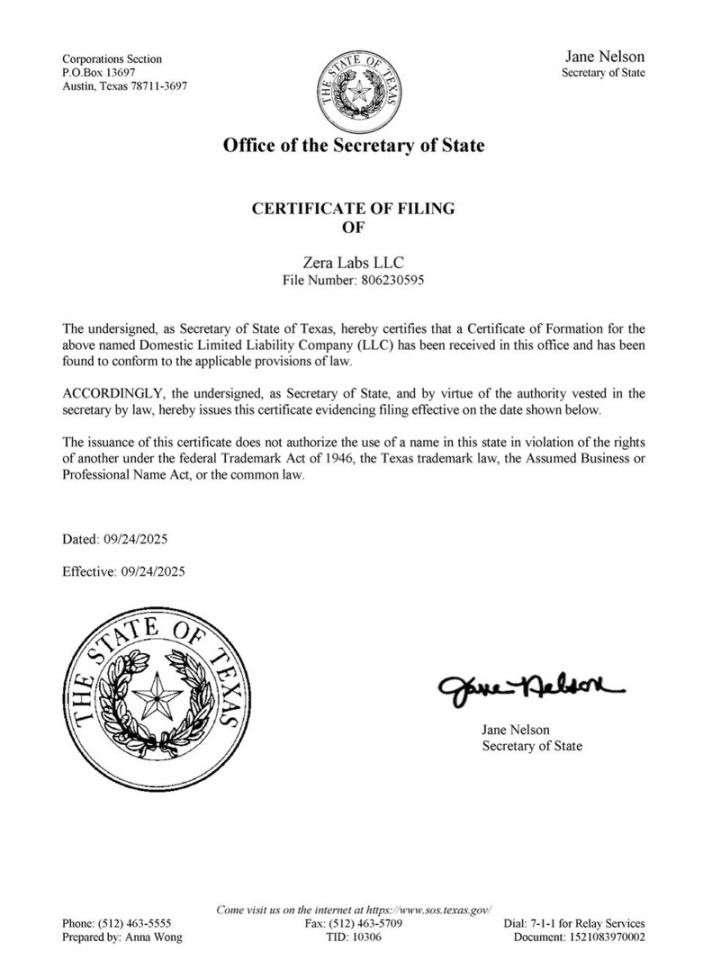
ZERA began as an academic research initiative, initially intended for publication as a doctoral thesis. However, strong community support shifted its trajectory toward commercial development, eventually evolving into a formal company led by developer Dax. Previously employed at MetaMask and tech firms including Twitter, Dax brings both financial and engineering expertise and has drawn attention from Toly, co-founder of Solana. Public information about other team members remains limited, though the team has announced plans to hire senior engineers to support future product development.

Unlike many privacy projects, ZERA does not center its narrative on defying regulation. Zera Labs is actively engaging at the policy level, including advocating for a draft “Privacy-First Digital Finance Bill” in Texas, aiming to establish a legal framework for cryptographic credentials, selective disclosure, and proof-based systems.
In terms of tokenomics, ZERA attempts to directly link "usage behavior" with "token supply contraction." When users mint assets into notes, a portion of ZERA tokens must be consumed and burned, and additional collateral may be required to protect liquidity pools. If liquidity becomes insufficient or burning pathways are constrained, the protocol retains the mechanism to repurchase and destroy tokens from secondary markets. This model remains in the parameter experimentation phase, with final ratios to be adjusted based on on-chain usage data and governance discussions.
The original M0N3Y token launched on pump.fun with a total supply of 1 billion, entirely in circulation and with no allocation for team or venture capital. In October this year, M0N3Y completed a 1:1 token migration to ZERA. The primary reason for the migration was that the old contract lacked native support for burn and buyback mechanisms, and could not flexibly adjust split ratios, verification functions, or multi-asset compatibility—limiting the protocol's ability to build supply elasticity in its new phase. The new ZERA contract allows a portion of protocol fees to be used for market buybacks and supports dynamic destruction based on usage, rather than fixed inflation or static distribution.
Meanwhile, ZERA is transitioning from initial reliance on community contributions to funding R&D through liquidity pool fees, having moved its pool from Raydium to Meteora/DAMM v2 so that fee revenue can directly fund ongoing development.

In terms of product design, ZERA does not position itself merely as "a wallet." The current demo version primarily enables asset conversion, offline transfer, and reconnection for settlement via browser. The team plans to gradually roll out desktop and mobile applications, and explore hardware devices with NFC capabilities, moving proof generation and key management to local chips to reduce dependence on centralized clients. The ultimate goal is to release a dedicated hardware wallet enabling fully offline "street commerce" scenarios.
The long-term vision is to build a complete zero-knowledge privacy stack, providing developers with SDKs and APIs to extend privacy capabilities into wallets, commerce, and decentralized finance applications. The project also plans to explore advanced features such as private exchanges, OTC settlement, and shielded liquidity provision.
ZERA originated in memes but seeks to transcend meme narratives. After the frenzy around M0N3Y, its price crash, community divisions, and migration turbulence, ZERA has chosen to shift focus from "speculative consensus" to "usability consensus"—enabling memes to be genuinely spent, even serving as an underlying settlement layer in the real world.
Join TechFlow official community to stay tuned
Telegram:https://t.me/TechFlowDaily
X (Twitter):https://x.com/TechFlowPost
X (Twitter) EN:https://x.com/BlockFlow_News
 Foresight News