Buying gold on-chain: why do you always end up paying more?
TechFlow Selected TechFlow Selected
Buying gold on-chain: why do you always end up paying more?
Tokenized gold has demonstrated that RWAs can attract capital, but it has also exposed the limitations of current tokenization models.
 Navigating Web3 tides with focused insights
Author: Yuki is short, so is life
Translation: TechFlow
Tokenized gold has attracted many crypto users into the real-world asset (RWA) space—but at what cost?
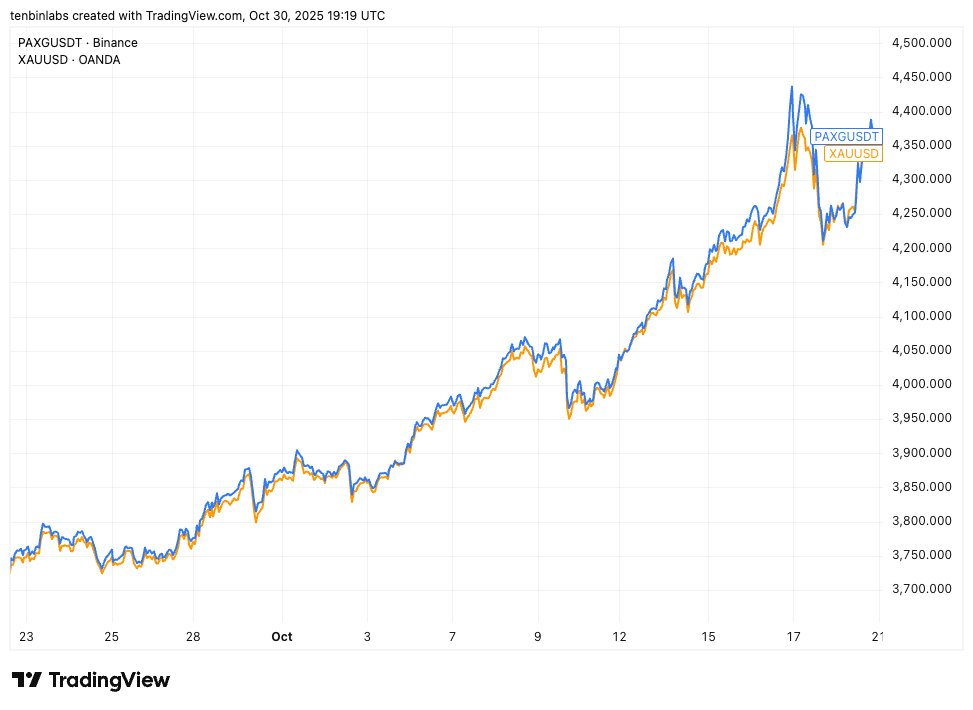
Figure: Binance PAXG price vs. spot gold price
The chart above shows a simple comparison of the price movements of one tokenized gold solution—PAXG (blue line)—against spot gold (yellow line). Each token represents one ounce of physical gold. However, during the period shown, nearly all buyers of PAXG paid a premium over the spot price.
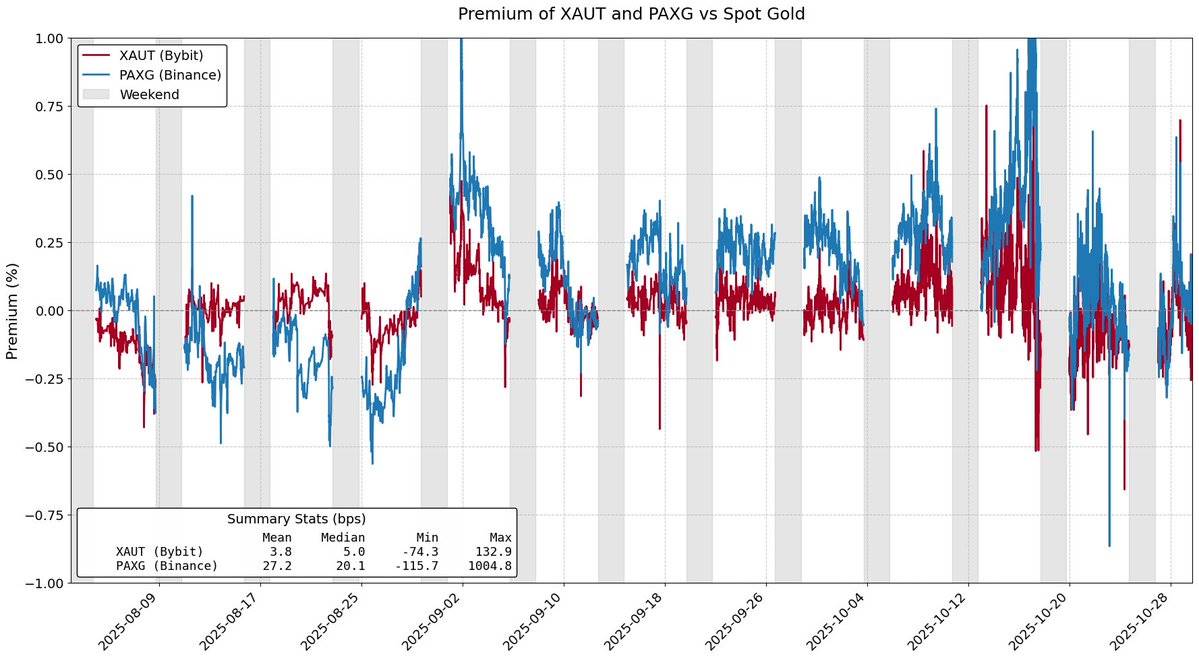
Figure: Premiums of PAXG and XAUT over spot gold
The original purpose of tokenizing real-world assets (RWA) was to allow users to access real assets at lower cost. Yet tokenized gold, which accounts for approximately 84% of the total market cap in tokenized commodities, fails to achieve this goal. The premium on tokenized gold is easily mistaken as demand-driven, but in reality, it stems from structural frictions inherent in the design of these tokens’ issuance mechanisms.
Minting and Redemption Fees
The premium of any tokenized product relative to its underlying asset is primarily driven by minting and redemption fees. These fees effectively create a "premium band" within which the tokenized product trades relative to its underlying asset.
Suppose you are a market maker for XAUt or PAXG. Gold prices are rising strongly, leading to significant inflows into tokenized gold. At what price would you sell XAUt or PAXG? To break even, you must sell at no less than the cost of acquiring these tokens as inventory—the cost defined by the token’s minting fee—which effectively sets a soft ceiling on the token’s price.
By the same logic, tokenized gold can also trade at a discount. Suppose there is an outflow from tokenized gold. As a market maker, you would only buy XAUt or PAXG at a price below what you could receive by redeeming them with Tether or Paxos. Just as minting fees constrain upward movement, redemption fees constrain downward movement.
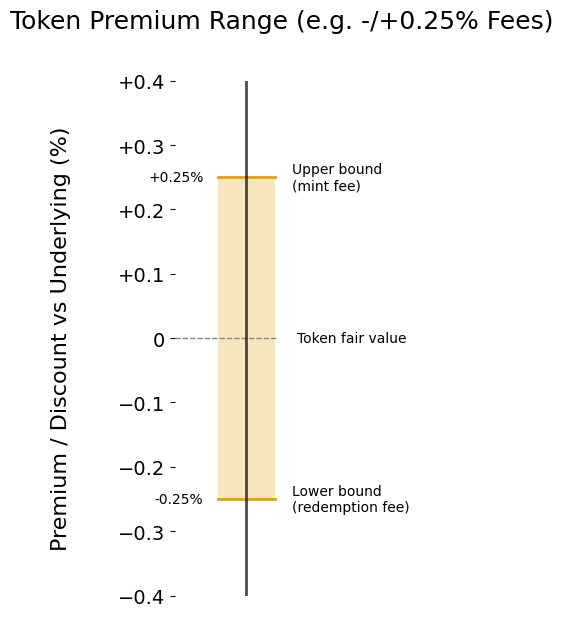
Figure: Premium band driven by minting/redemption fees
The higher the fees, the wider the premium band, and the more likely the token price will deviate from its fair value. At the time of writing, Tether charges a 0.25% fee for minting and redeeming XAUt, while Paxos has a tiered fee structure depending on minting and redemption volume: 1% for 2–25 PAXG, and only 0.125% for volumes exceeding 800 tokens.
Given the overhead and operational costs involved in tokenizing physical gold, one might argue that the minting and redemption fees charged by Paxos and Tether are reasonable. However, it is clear that reducing these fees would decrease tracking error in tokenized real-world assets (RWA), ultimately improving cost efficiency for end investors.
Structural Frictions
Minting and redemption fees set only "soft" upper and lower bounds on the price of tokenized gold. Additional frictions related to the primary issuance models can further widen the premium band significantly.
For example, Tether Gold requires a minimum minting size of 50 XAUt (approximately $200,000) and a minimum redemption size of 430 XAUt (around $1.7 million). This scale requirement poses a major barrier for market makers, forcing them to hold inventory long-term and bear substantial opportunity costs.
Another major challenge in today’s tokenized gold market is settlement delays during minting and redemption. When redeeming PAXG, Paxos states that account balance updates may take several business days, locking up funds and creating significant opportunity costs.
These frictions collectively discourage active participation by market makers unless sufficient profit margins exist. This ultimately causes the price of tokenized gold assets to deviate further from their fair value—beyond even the bounds set by minting and redemption fees.
Tokenized gold demonstrates that real-world assets (RWA) can attract capital, but it also exposes the limitations of current tokenization models. Premiums exist when trading gold on-chain, and redemption cycles are slow. These barriers effectively act asindirect taxes. If tokenized assets are to scale, users should not be penalized for choosing on-chain solutions.
Liquidity, redemption efficiency, and price consistency must go hand-in-hand—not at the expense of one another. This status quo must change.
Join TechFlow official community to stay tuned
Telegram:https://t.me/TechFlowDaily
X (Twitter):https://x.com/TechFlowPost
X (Twitter) EN:https://x.com/BlockFlow_News
 @ballsyalchemist