Vitalik praised ZKsync might truly be underestimated
TechFlow Selected TechFlow Selected
Vitalik praised ZKsync might truly be underestimated
From being universally criticized to becoming highly sought-after, ZK has迎来 its dawn.
 Navigating Web3 tides with focused insights
By Eric, Foresight News
On November 1, Vitalik referenced a tweet by the ZKsync founder about the ZKsync Atlas upgrade and praised ZKsync for doing a lot of "underrated but highly valuable work for the Ethereum ecosystem."
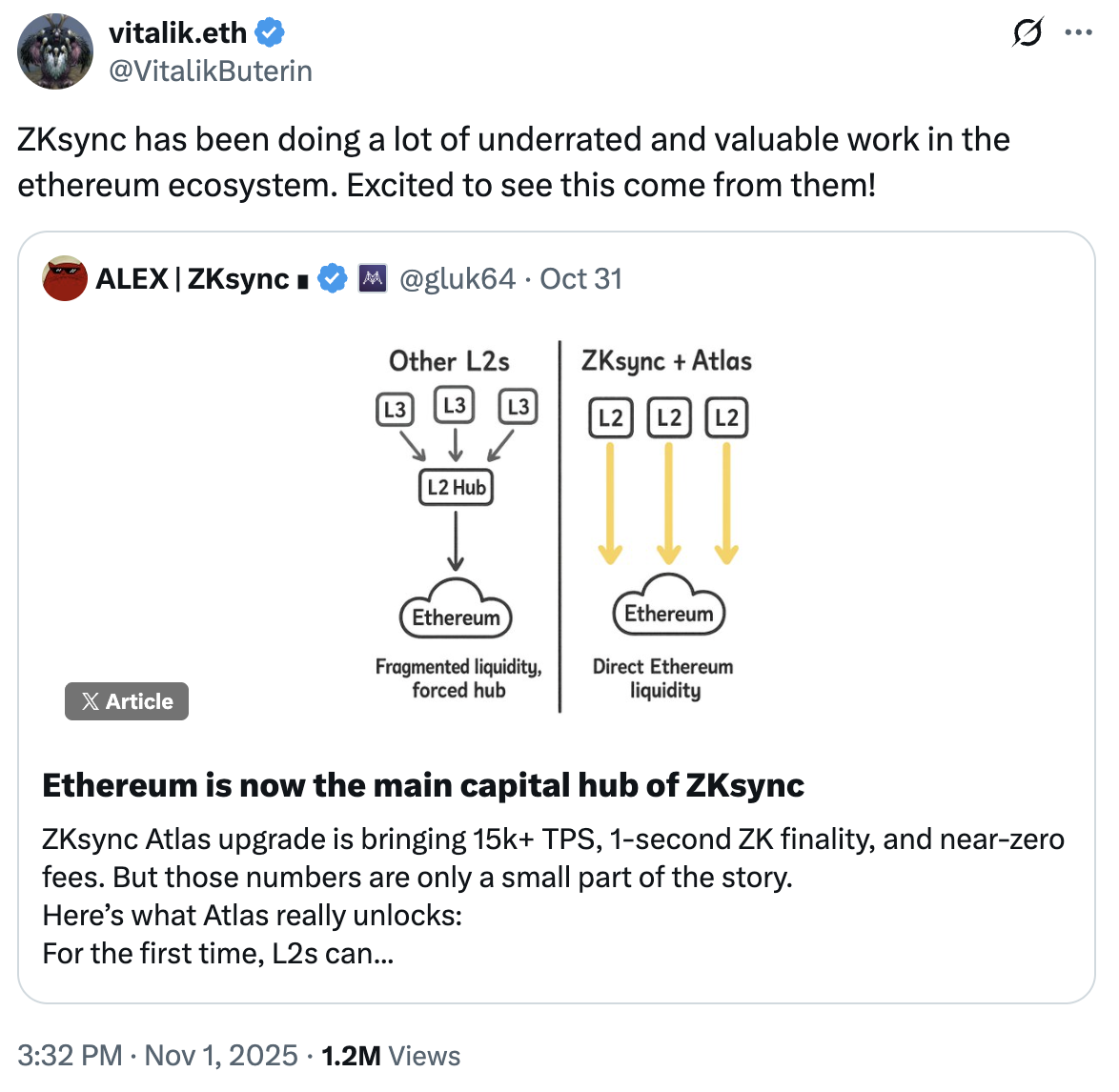
The market quickly reacted to Vitalik's comment. Over the weekend, ZK's price surged over 2.5x at its peak. Tokens within the ZK ecosystem—including ALT (AltLayer), STRK (Starknet), SCR (Scroll), and MINA (Mina)—also saw strong gains.
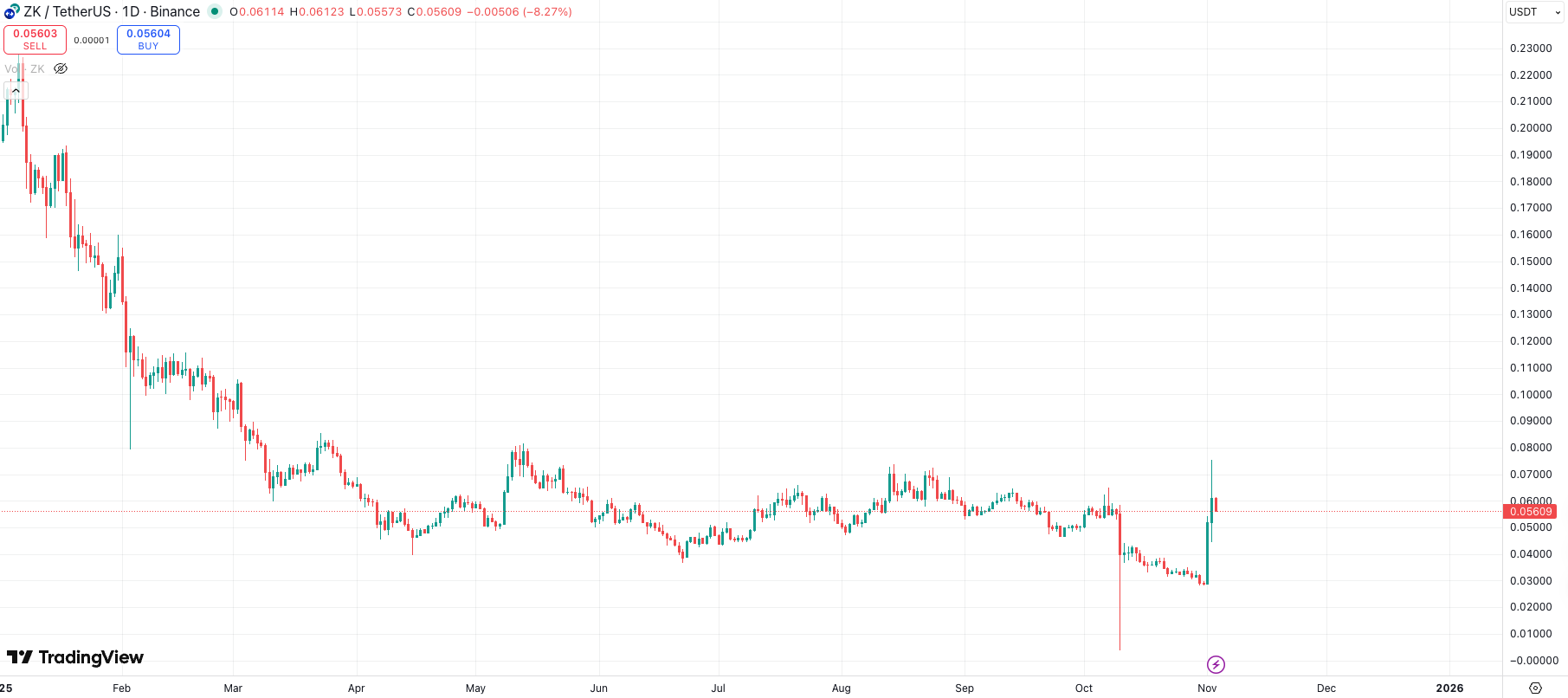
After learning more about the ZKsync Atlas upgrade, we realized that what ZKsync has achieved may indeed have been underestimated.
Fast, Small, but Expensive ZKP
The Zero-Knowledge Proof (ZKP) technology promoted early on by the Ethereum Foundation fundamentally aims to solve the problems of slow verification speed and large verification data size.
ZKP is essentially a mathematical probability problem. Here’s an imperfect analogy to illustrate the principle: Suppose someone claims to have solved the "Four Color Theorem." How can we verify this claim without them revealing the full solution? The zero-knowledge approach would be to randomly select parts of the map and check that no two adjacent regions in those parts share the same color. When enough samples are checked, the probability that the person actually solved the entire problem reaches 99.99...%. Thus, we prove they solved it—without seeing how.
This is the commonly heard idea behind zero-knowledge proofs: proving something was done correctly without revealing how it was done. The reason ZKP is heavily promoted in the Ethereum ecosystem is that its theoretical speed limit far exceeds per-transaction validation, and the generated proof itself is extremely compact in size.
The speed advantage comes from not needing to re-execute everything—only performing challenges. For example, verifying an Ethereum block today requires every node to validate each transaction (e.g., checking sender balances). But if just one node uses ZKP to verify all transactions and generate a single "proof," other nodes only need to verify that proof. Crucially, this proof is very small in data size, enabling ultra-fast transmission and verification, as well as lower storage costs.
The main reason such an advantageous technology isn't widely deployed yet is cost.
While ZKP avoids re-execution, generating the proof still consumes massive computational power. Speed could be increased by stacking GPUs like in the AI arms race, but not everyone can afford such expenses. However, if algorithmic and engineering innovations reduce the required compute and shorten proof generation time under low-power conditions to a certain threshold—balancing Ethereum's price growth driven by technological adoption against the cost of running nodes and buying GPUs—then mass deployment becomes feasible.
Hence, many ZK-focused projects and open-source developers in the Ethereum ecosystem focus primarily on generating ZK proofs faster and cheaper. Recently, the Brevis team used only half the cost (64 RTX 5090 GPUs) of SP1 Hypercube to achieve an average Ethereum block proof time of 6.9 seconds (with 99.6% of proofs completed within 12 seconds—the current average Ethereum block time)—earning widespread praise from the Ethereum community.
Although GPU costs still exceed $100,000, the fact that proof times have dropped to match non-ZKP levels marks progress. Now the focus shifts to reducing costs further.
Atlas Upgrade Achieves 1-Second ZK Finality
Few might know that ZKsync’s open-source zkVM, ZKsync Airbender, holds the record for fastest single-GPU verification among zkVMs. According to Ethproofs, using a single 4090 GPU, ZKsync Airbender achieves an average verification time of 51 seconds at a cost of less than one cent—both best-in-class results among zkVMs.
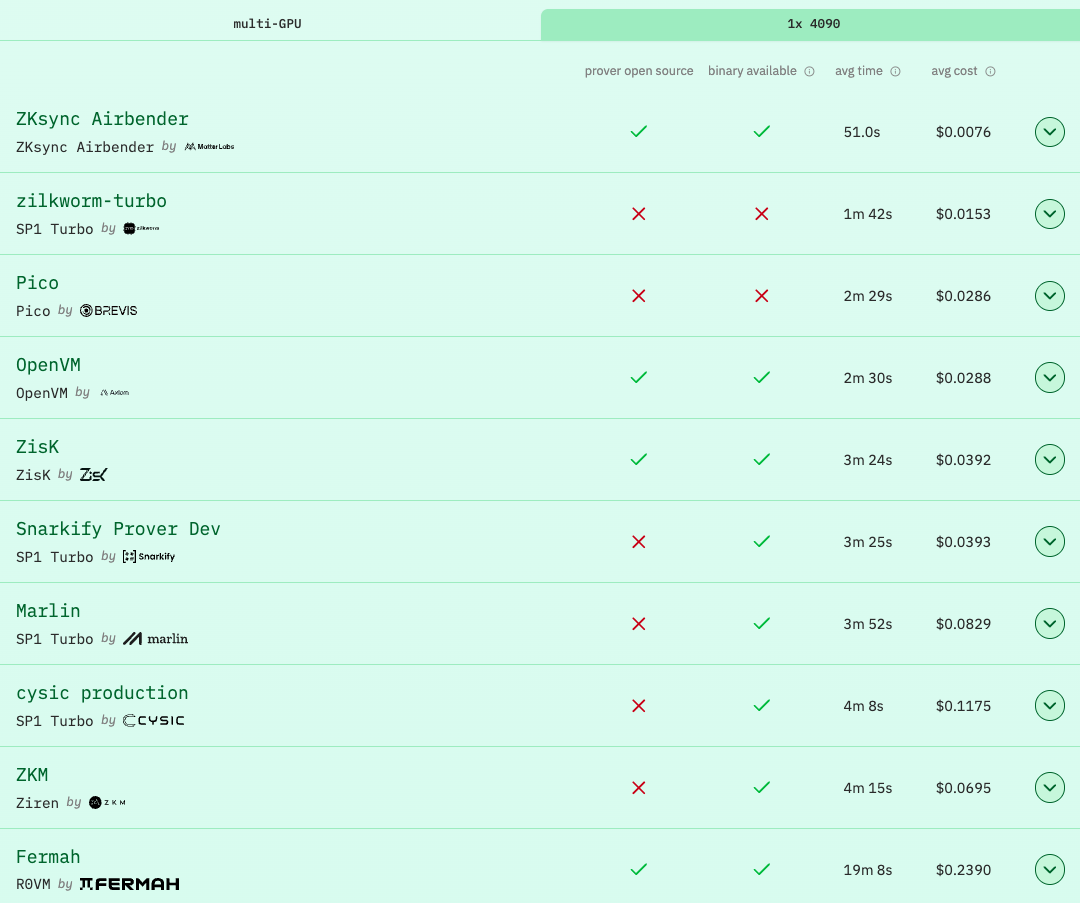
According to ZKsync’s own data, excluding recursion, Airbender takes an average of 17 seconds to verify the Ethereum mainnet using a single H100 GPU and the ZKsync OS storage model. Even including recursion, the total average time is around 35 seconds—significantly better, in ZKsync’s view, than solutions requiring dozens of GPUs to achieve sub-12-second verification. However, with only preliminary two-GPU data showing an average of 22.2 seconds, definitive conclusions remain pending.
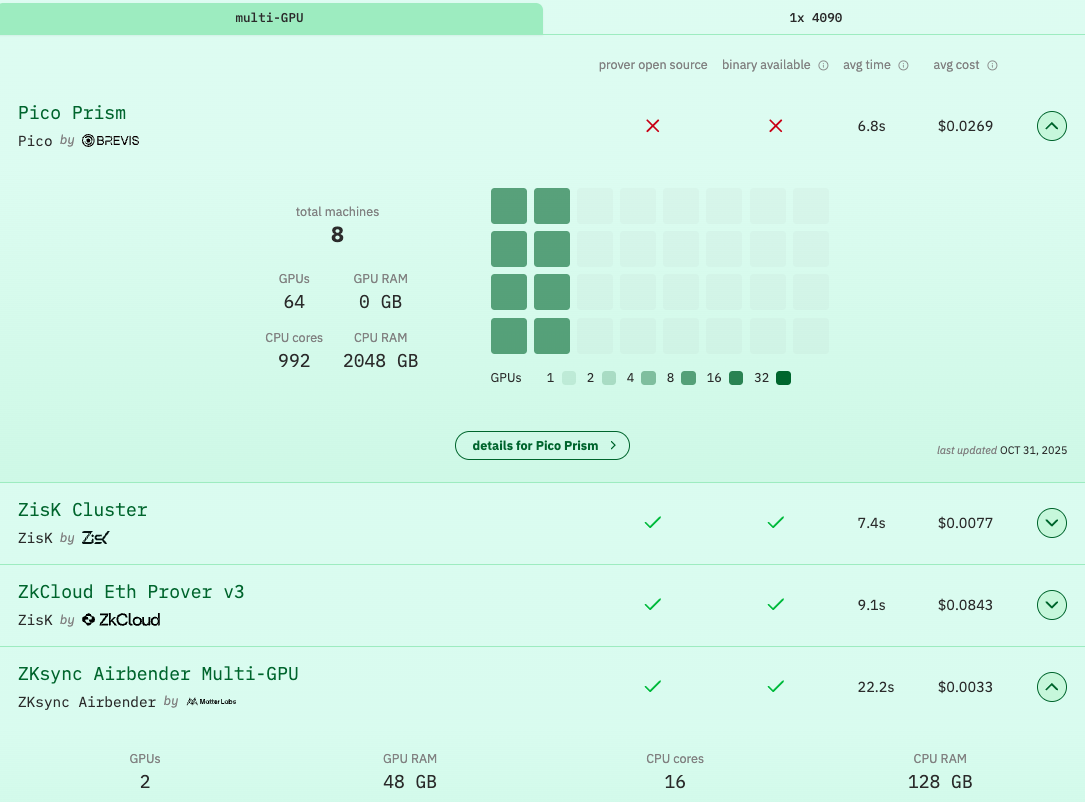
This performance isn’t solely due to Airbender. Algorithmic and engineering optimizations help, but deep integration with ZKsync’s tech stack is key to maximizing results. More importantly, it demonstrates that real-time Ethereum mainnet proving using a single GPU is possible.
ZKsync launched Airbender at the end of June and rolled out the Atlas upgrade on the second-to-last day of China’s National Day holiday. This integration significantly boosted ZKsync’s throughput, confirmation speed, and cost efficiency.
In terms of throughput, ZKsync optimized its sequencer through engineering improvements: minimizing synchronization overhead via independent asynchronous components; separating states required by the virtual machine, APIs, and those needed for generating or verifying ZK proofs on L1—reducing unnecessary component overhead.
In real-world testing by ZKsync, TPS reached 23k for high-frequency price updates, 15k for stablecoin payments, and 43k for native ETH transfers.
Another major leap came from Airbender, enabling ZKsync to achieve 1-second block finality and a per-transfer cost as low as $0.0001. Unlike verifying mainnet blocks, ZKsync only verifies state transition validity, which requires far less computation. While ZK-finalized transactions still require eventual L1 confirmation for full L1 finality, ZK validation already confirms transaction validity—L1 finality then acts more like a procedural guarantee.
In other words, transactions executed on ZKsync are fully confirmed as valid once ZKP-verified. Combined with drastically reduced costs, ZKsync enables use cases—what they call uniquely enabled by Airbender:
First, on-chain order books, payment systems, exchanges, and automated market makers. Airbender allows these systems to verify and settle extremely fast, reducing rollback risks for such applications.
Second, interoperability between public and private systems (such as ZKsync’s Prividiums) without third parties—something most current L2s cannot achieve. Prividiums is ZKsync’s infrastructure for enterprises to build private chains. Enterprises demand fast settlement and privacy. Fast settlement speaks for itself, while ZKP’s inherent privacy ensures transaction validity can be proven during cross-chain interactions without exposing the private chain’s ledger. Together, they even meet regulatory requirements for settlement times in securities and foreign exchange trading.
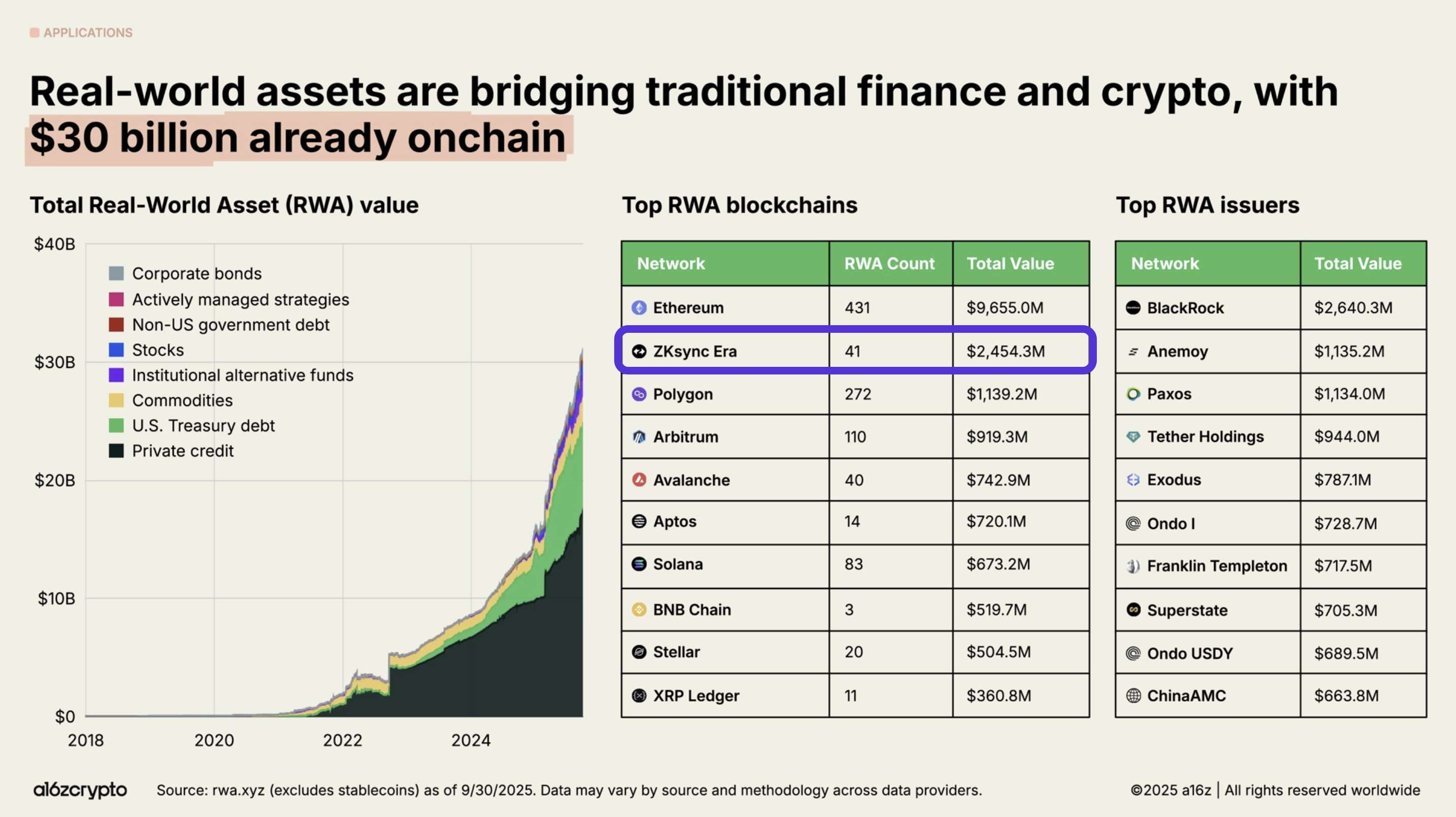
This might explain why ZKsync has become the second-largest network for tokenized RWA issuance after Ethereum.
ZKsync proudly notes that this integration is only possible with the Atlas upgrade: the sequencer enables low-latency transaction packing, Airbender generates proofs in one second, and Gateway handles verification and coordination of cross-chain messages.
Bridging L1 and L2
As highlighted in the tweet shared by Vitalik, ZKsync co-founder Alex believes the Atlas upgrade has truly bridged ZKsync with the Ethereum mainnet.
Now, ZKsync’s transaction finalization time (~1 second) is shorter than Ethereum’s average block time (12 seconds). This means institutional and RWA transactions on ZKsync are effectively synchronized with the mainnet—simply awaiting final confirmation. As a result, ZKsync doesn’t need to rebuild liquidity centers on L2 and can directly leverage mainnet liquidity. Unlike OP Rollups, ZK Rollups don’t require a 7-day challenge period for cross-chain withdrawals, and the Atlas upgrade further accelerates this process.
This alleviates the L2 fragmentation issue recently discussed in the Ethereum community. L2 and L1 are no longer isolated chains but unified through rapid confirmation and verification. For the first time, L2s can genuinely be called "scaling networks."
Recall when ZKsync and Scroll first launched their mainnets—transaction confirmation speeds and gas fees were on par with, or even higher than, the mainnet. This was because systemic algorithmic and engineering optimizations for ZKP hadn’t yet emerged, leading to slow verification and high costs, triggering a crisis of confidence in ZK Rollups. Today, Optimism and Arbitrum are gradually transitioning from OP Rollup to ZK Rollup (or hybrid models), while improvements in cost and speed by ZK Rollups like ZKsync and decentralized ZKP efforts by Scroll have transformed once-dismissed ideas into tangible, promising outcomes.
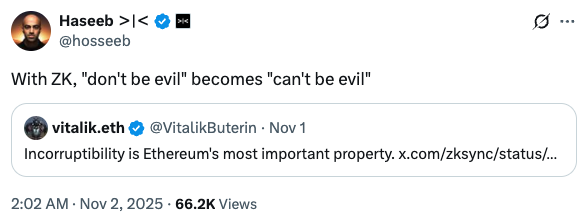
From being widely criticized to becoming highly sought-after, ZK technology has finally seen the light. Once sequencers and bridges achieve full decentralization through multi-sig, perhaps Dragonfly Capital managing partner Hasseb Qureshi’s vision of “can't be evil” will truly come to pass.
Join TechFlow official community to stay tuned
Telegram:https://t.me/TechFlowDaily
X (Twitter):https://x.com/TechFlowPost
X (Twitter) EN:https://x.com/BlockFlow_News
 Foresight News