ZKsync's Arbitrariness: Airdrops Enter an Era Without Rules
TechFlow Selected TechFlow Selected
ZKsync's Arbitrariness: Airdrops Enter an Era Without Rules
It seems major project teams have started treating airdrops as a form of power in resource allocation—one that can be used arrogantly without consequence—turning airdrops into something no longer mutually beneficial between the community and the project team.
 Navigating Web3 tides with focused insights
Author: Mia, ChainCatcher
Editor: Marco, ChainCatcher
The once-proud model of interaction between project teams and communities in the crypto space is now facing a crisis.
Interaction, on-chain contributions, and receiving airdrops—these were once defining features of the crypto world.
ZKsync, after releasing numerous airdrop criteria, delivered a blow to this tradition of trust-based engagement with a single statement: "All decisions related to airdrop distribution are solely at the discretion of the ZKsync Association."
Previously, Taiko’s co-founder, responding to criticism over its airdrop, claimed: "Rules aren’t transparent because transparency itself cannot resolve disagreements."
It appears that leading projects are increasingly treating airdrops not as mutual value exchange between users and builders, but as a power to allocate resources—arrogantly exercised without consequence.
We fear that the core crypto values of decentralization, transparency, and fairness are fading away.
Only One-Tenth of Addresses Received Airdrops
After LayerZero's anti-Sybil airdrop devastated the farming community last month, the "airdrop farmers" have suffered another major setback.
On June 11, ZKsync announced it would conduct its airdrop the following week and opened an airdrop eligibility checker, finally providing answers after four years of user interactions. According to official data, only 695,000 out of 6.827 million total ZKsync chain addresses qualified for the airdrop—just about 10%, far below the 2.05–2.9 million range predicted in TrustGo’s earlier report.
Community analysis shows that just 9,203 addresses received 23.9% of the total airdrop supply.
After four long years of anticipation, many users were left empty-handed, sharing their “Unfortunately” rejection messages across X.
ZKsync, backed by star founders and top-tier capital, had long been the "white moonlight" of the farming community.
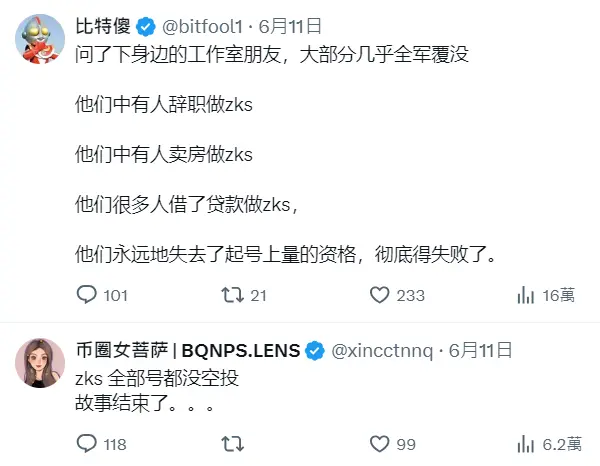
A prominent community influencer remarked, "Some quit their jobs for ZKs, some sold their homes, some took loans—all now permanently disqualified, completely defeated." It feels like a four-year relationship betrayed—after investing three years’ salary and countless late-night efforts—the beloved ZKS token walks away.
Association Retains Full Discretion Over Airdrop
Typically, airdrop eligibility hinges on activity level, duration, and transaction volume. ZKsync set seven specific thresholds:
1. Interacted with 10 non-token smart contracts on Era mainnet
2. Acted as a payer in at least 5 transactions on Era mainnet
3. Traded 10 different ERC-20 tokens on Era mainnet
4. Provided liquidity to any DEX or lending protocol tracked on Era mainnet
5. Held at least one Shengdeng NFT
6. Was active on ZKsync Lite for over 3 months before mainnet launch
7. Made donations to Gitcoin via rounds on ZKsync Lite
While overly strict rules are nothing new in the volatile farming landscape, one clause thrust ZKsync into a storm of criticism over lack of transparency.
On the airdrop claim page, ZKsync stated: "Meeting one or more of the above airdrop criteria does not confer any legal right or claim to receive the airdrop; all decisions regarding airdrop distribution are solely at the discretion of the ZKsync Association."
This declaration sparked widespread backlash from the community, with many users raising objections.
One crypto user commented: "We can accept strict airdrop rules, but we cannot tolerate unchecked arbitrary actions by the project team."
This clause completely detaches airdrop allocation from defined criteria—whether one receives tokens now seems entirely dependent on the project team’s judgment.
Moreover, ZKsync stated that addresses qualifying for the airdrop but receiving fewer than 450 tokens would have their allocations reclaimed—an announcement that upset many small holders.
"Rat Warehouse" Controversy
Despite the long time commitment and extensive tasks required, community expectations for ZKsync remained high. Strict rules or unconventional approaches might have been tolerable—but recent baffling moves by ZKsync have triggered growing skepticism and criticism.
With only ~10% of addresses qualifying, the vast majority of tokens remain under project control. Many users suspect this is essentially a strategy to reduce market liquidity and secretly hoard "rat warehouse" allocations. So far, ZKsync has remained silent, offering no response to mounting accusations.
Instead, Nansen, responsible for ZKsync’s data review, began distancing itself from the controversy.
Nansen clarified on X: "In the spirit of transparency, we want to clarify some misconceptions about the ZKsync airdrop. We did provide Matter Labs with data on specific wallet clusters, such as whales or known scammers. However, we did not conduct Sybil resistance screening nor offer advice on airdrop distribution."
Additionally, Element, a major NFT marketplace on ZKsync, stated on X that it received zero ZK token airdrops despite being one of the largest platforms on the network.
All fingers now point directly at ZKsync.
Every airdrop brings both joy and disappointment. There were indeed many who successfully claimed their tokens, and screenshots began circulating widely online—seemingly aiming to prove to the public: "The ZKsync airdrop was fair and effective; you simply didn’t meet the requirements."
David Hoffman, co-founder of Bankless, stepped in to defend the project, citing survey data from Discord indicating most participants were generally satisfied with the airdrop. He also dismissed critical voices on X as bot-generated content.
Meanwhile, Zyfi, a native ZKsync project, announced it received 1.642 million ZK tokens—further validating the legitimacy of the airdrop from certain perspectives.
However, the vast majority of professional Chinese-speaking airdrop farmers were entirely excluded, once again reduced to mere tools in the system.
Anti-Rat Warehouse Movement
As the number of eligible airdrop addresses plummeted and the "rat warehouse" controversy intensified, an anti-rat warehouse alliance emerged.
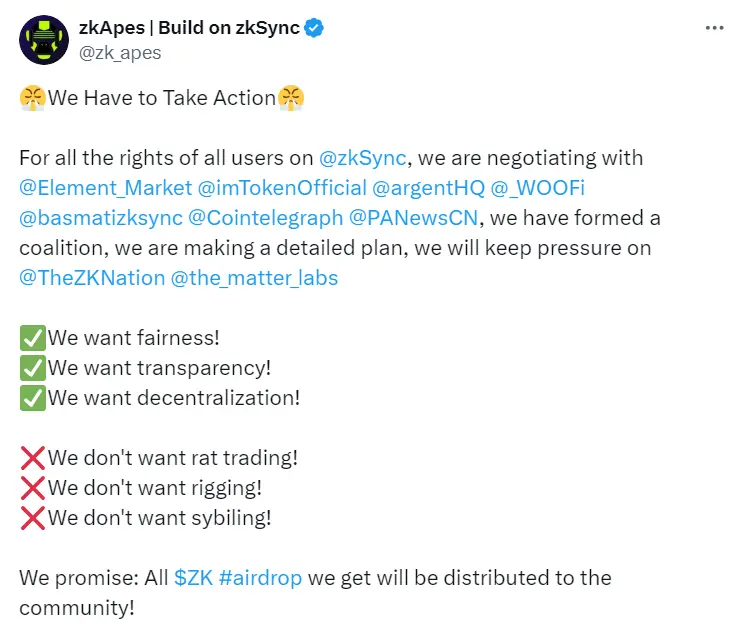
zkApes, an NFT project within the ZKsync ecosystem, announced on social media the formation of a coalition with Element, Argent, WOOFi, and others, aiming to pressure ZK Nation and Matter Labs to resist rat warehouse trading practices.
Will this dual pressure from ecosystem projects and users force ZKsync to reconsider its airdrop distribution?
The answer is double-edged. If ZKsync yields to pressure and reforms, it implicitly admits the existence of rat warehouses. But if it maintains the status quo, it risks losing most of its users and developers.
In the airdrop arena, project teams and farmers have always engaged in a balancing act. But when power tilts too heavily toward one side, the other suffers. When the scale favors project teams, farmers become disposable tools.
From recent cases like Taiko to LayerZero, angry backlash over disappointing airdrops has become commonplace. Transparency in airdrop rules should be a cornerstone of any project’s decentralization journey.
Join TechFlow official community to stay tuned
Telegram:https://t.me/TechFlowDaily
X (Twitter):https://x.com/TechFlowPost
X (Twitter) EN:https://x.com/BlockFlow_News
 ChainCatcher 链捕手