x402 Resonates with Technology, a New Narrative Is Brewing
TechFlow Selected TechFlow Selected
x402 Resonates with Technology, a New Narrative Is Brewing
The further development of AI will inevitably create demand for machine-to-machine transactions and micropayments, and blockchain may be the ultimate infrastructure for AI and machine interactions.
 Navigating Web3 tides with focused insights
Author: Trend Research
The recent emergence of $PING has driven the spread of the x402 concept, with two representative projects, $PING and $PAYAI, reaching market caps of up to 75m and 70m respectively. Although both have since pulled back to 30m and 20m due to weaker market liquidity, unlike pure meme narratives, x402 and its associated concept possess a certain degree of derivability and sustainability. The market remains eager for new narratives and wealth-generation opportunities, making this storyline worth watching.
1. Why x402 Is Worth Watching
1. One of crypto's biggest challenges is the scarcity of projects solving real-world problems and the lack of cash flows driven by genuine demand. x402 enters from the logic of internet-native payments. Against the backdrop of U.S. stablecoins now entering institutional adoption and further AI development, it has the potential to begin forming real payment demand at scale.
2. The driving forces and adopters behind x402 include Coinbase, Google, Cloudflare, Circle, Visa, and AWS—entities that already command massive customer bases and consumption scenarios.
3. On the product side, x402 enables user-perceivable use cases, such as enabling payments via digital wallets without adding bank cards or undergoing KYC, and even allowing AI Agents to autonomously complete entire shopping processes.
4. The continued advancement of AI will inevitably create demand for machine-to-machine transactions and micropayments, and blockchain may serve as the ultimate infrastructure for AI and machine interaction.
2. Deconstructing x402
402 is an HTTP status code that has long been reserved but almost never activated—"Payment Required," indicating a payment requirement. x402 optimizes and activates this code. Its structure is simple enough to be explained in one diagram.
A complete transaction using the x402 protocol involves four roles:
1. Client (Client)
The client refers to the party initiating the payment request. It can be any entity needing access to a service or resource, such as an AI agent, user device, or application. The client’s main responsibilities are:
Initiate request: The client requests access to a resource or service.
Handle payment: When the server returns a payment required (HTTP 402) response, the client signs the payment request and executes the payment. The client can use tools like wallets to sign transactions and provide payment authorization.
Example: An AI agent needs to obtain real-time market data from a data provider; it acts as the client to initiate the request and only receives the data after payment is completed.
2. Server (Server)
The server is the party providing the service or resource. Its primary responsibilities are:
Return HTTP 402 response: When the client requests access to a resource but lacks valid payment information, the server returns an HTTP 402 status code, indicating that payment is required to proceed.
Verify payment and deliver service: The server verifies the client’s payment request to ensure completion. If verified, the server processes and returns the requested data or service.
Example: An API service provider receives a client request but detects no payment, so it returns an HTTP 402 response requiring payment. After payment, the service delivers the data or service back to the client.
3. Facilitator (Facilitator)
The facilitator acts as an intermediary in the payment process—typically a payment gateway or intermediate service—that ensures the payment request is properly transmitted and ultimately settled. The facilitator’s key functions are:
Coordinate payment requests and responses: It handles payment interactions between client and server, ensuring the payment request is correctly sent and forwarding payment details to the payment processor.
Transaction broadcasting: The facilitator may broadcast the payment request or confirm the transaction on the blockchain.
Example: In the payment flow, the facilitator could be a wallet app or payment gateway that receives the client’s payment request and broadcasts it onto the blockchain for settlement once confirmed.
4. Blockchain (Blockchain)
Blockchain serves as the underlying technological foundation of the x402 process, ensuring transaction security and transparency. Core responsibilities of the blockchain include:
Ensure payment immutability: Once payment information is recorded on-chain, it cannot be altered or reversed, guaranteeing transaction authenticity and integrity.
Provide transparent settlement system: All transaction data is publicly available on-chain, allowing all parties to verify payment status.
Settlement and transaction processing: Once the facilitator confirms payment, the blockchain processes and finalizes the transaction, ensuring funds move from the client to the server provider.
Example: When the client completes payment, the payment request is relayed via the facilitator to the blockchain, ensuring funds flow between correct addresses and settlement is completed.
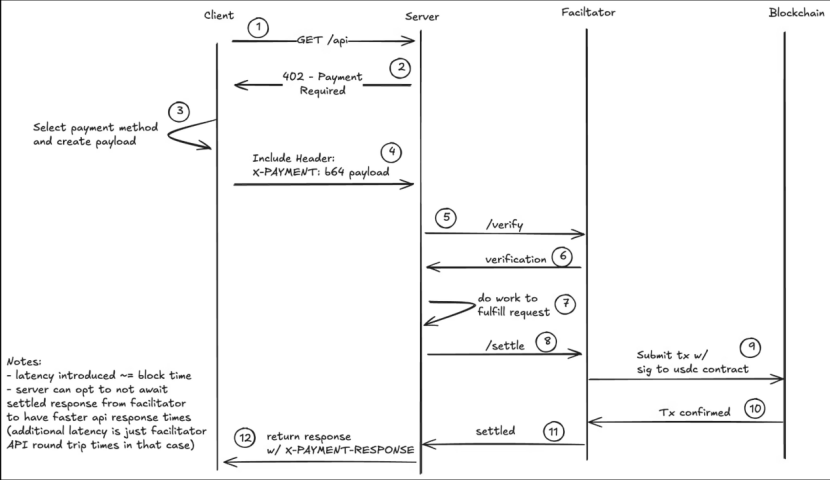
A full workflow:
① Client sends HTTP request – The client sends a standard HTTP request to the resource server to access a protected endpoint.
② Server responds with 402 – The resource server returns HTTP 402 "Payment Required" status code, including payment details in the response body.
③ Client creates payment – The client reviews payment requirements and uses its wallet to create a signed payment payload according to the specified scheme.
④ Client resubmits payment – The client sends the same HTTP request again, this time including a header with X-PAYMENT containing the signed payment payload.
⑤ Server verifies payment – The resource server verifies the payment payload either:
Locally (if running their own validation)
Through an intermediary service (recommended)
⑥ Payment service validates – If a payment service is used, it checks the payment against scheme and network requirements and returns a validation response.
⑦ Server processes request – If payment is valid, the server fulfills the original request. If invalid, it returns another 402 response.
⑧ Payment settlement – The server initiates blockchain settlement in two ways:
Directly by submitting to the blockchain
Via the facilitator’s /settle endpoint
⑨ Payment processor submits on-chain transaction – The payment processor broadcasts the transaction to the blockchain based on the payment network and waits for confirmation.
⑩ Settlement confirmation – Once confirmed on-chain, the settlement party returns a payment execution response.
⑪ Server delivers resource – The server returns a response containing:
The requested resource in the response body
An X-PAYMENT-RESPONSE header with settlement details
In short, x402 is an open payment standard that eliminates traditional barriers like API keys, subscription models, and manual settlements, enabling an efficient, frictionless payment system—particularly suitable for machine-to-machine (M2M) or AI-driven application scenarios.
3. Narrative Building Momentum
Understanding the structure makes it clear that new crypto projects may emerge around the Client, Server, Facilitator, Blockchain, and transaction flow. Since most servers are currently provided by existing Web2 resource providers, and Clients were heavily hyped during the last AI agent wave without delivering consistent real-world demand, current focus lies on Ping (focused on transaction flow), PayAI Network (Facilitator), and Kite AI (Blockchain).
1. Ping
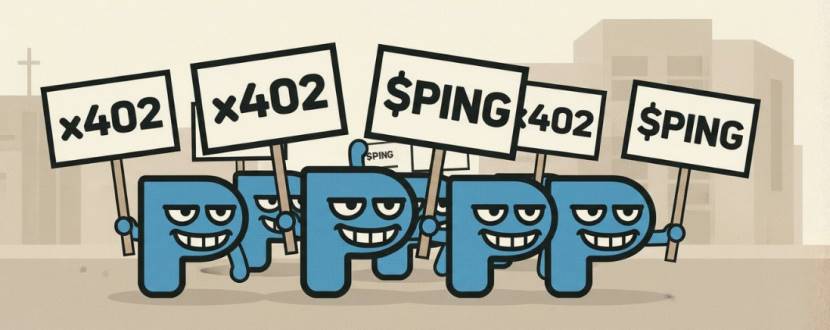
Ping is the first token minted/distributed using the x402 protocol. The market compares it to inscriptions because users send USDC on Base chain to a specific address—an ordinary ERC-20 transfer—while the project team uses x402scan as an "indexer" to assign off-chain meaning: "Sending USDC via the x402 protocol to the designated address equals minting tokens, which are then delivered to the sender’s address."
While Ping itself lacks significant practical utility, its approach is clever. It has become the first breakout "billboard" among x402-themed meme coins.
2. PayAI Network
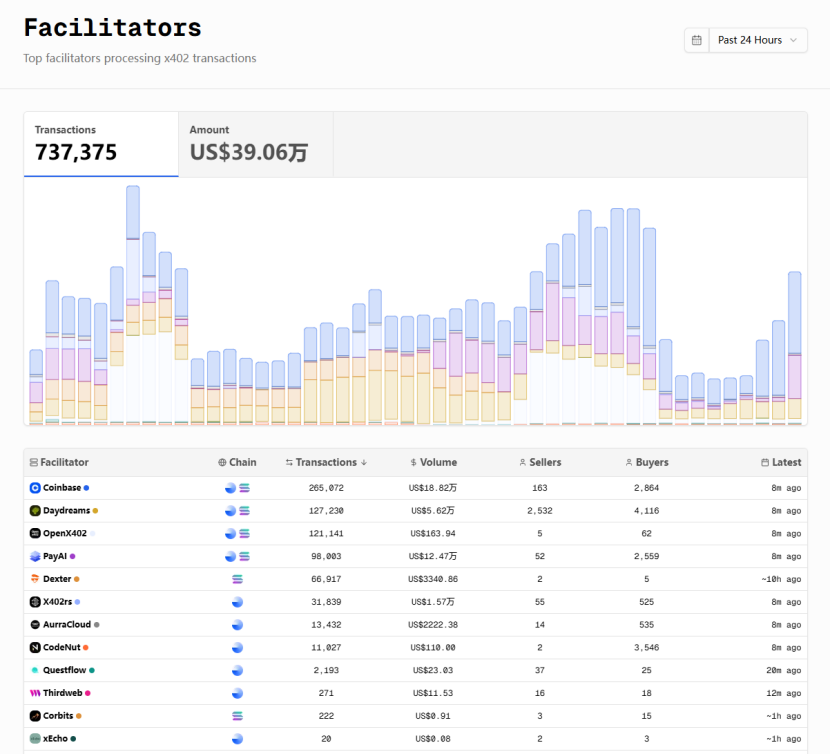
Self-positioned as the x402 Facilitator (matching/acquiring/validation/settlement layer), prioritizing Solana while being multi-chain compatible. Compared to Ping, it offers actual use cases. Others in this category include Daydreams and OpenX402, though Coinbase’s own offering remains a core facilitator.
3. Kite AI
Positions itself as the "first public chain for AI payments," aiming to embed x402 payment primitives "into the base layer," focusing on Agent ↔ Service settlement, reconciliation, and intent execution. It treats x402 as an interoperability layer: Agents initiate payments through standardized intent/authorization envelopes; service providers validate terms and settle. Natively supports reconciliation, peer instructions, batch aggregation, and other payment primitives. Backed by a high-profile investor lineup including PayPal Ventures, Coinbase Ventures, Hashed, Samsung Next, and HashKey Capital.
Coinbase and other traditional companies began rolling out x402 as early as May and are now accelerating development. On November 2, Coinbase CEO Brian Armstrong stated, “x402 allows stablecoin payments to be attached to any web request, and this will become an important part of the new internet.”
Current developments:
1. Visa supports the x402 standard, participating in its support and standardization, pushing x402 development within traditional payment networks—seen as a signal for future mass adoption.
2. Cloudflare and Coinbase co-founded the x402 Foundation, providing technical support and expansion proposals.
3. Anthropic supports the x402 protocol for AI and infrastructure payments.
4. Circle is developing integration tools to combine USDC and wallets with x402.
5. Google is positioning itself in the x402 space, engaging in related investments and development opportunities.
6. AWS supports the x402 protocol for AI and infrastructure payments.
Although enthusiasm for x402-related projects has cooled slightly, this brief rally highlighted market recognition of technical micro-innovation and demand for real-world use cases.
On one hand, traditional tech and financial firms are advancing foundational technology development and self-adoption; on the other, crypto projects are emerging rapidly. A new narrative around AI and payments is visibly warming up.
Join TechFlow official community to stay tuned
Telegram:https://t.me/TechFlowDaily
X (Twitter):https://x.com/TechFlowPost
X (Twitter) EN:https://x.com/BlockFlow_News
 @trend_research_