








Reviving 26-year-dormant code: x402 bridges Web2 and Web3—is it a technological singularity or a meme frenzy?
TechFlow Selected TechFlow Selected
Reviving 26-year-dormant code: x402 bridges Web2 and Web3—is it a technological singularity or a meme frenzy?
The concept of a "native HTTP value layer" indicated by x402 has provided profound exploration directions for empowering Web2 with Web3.
 Navigating Web3 tides with focused insights
Author: Lacie, Bitget Wallet Researcher
1. Introduction: The "Payment Divide" Between Web2 and Web3
The current digital ecosystem is being torn apart by the inherent opposition between Web2 and Web3. On one hand, Web2's convenient payment systems (such as Apple Pay and WeChat Pay) are tightly locked within the "walled gardens" of centralized platforms and geographical boundaries. On the other hand, while Web3 promises a globally open, permissionless financial future, it has become a "technological island" that mainstream users hesitate to approach due to its extreme price volatility and complex user experience.
The gap between "convenience" and "openness" has long burdened Web3 with labels like "difficult to implement" and "speculative hype." Against this backdrop, an open protocol called x402 has emerged into view. Its proposed solution is innovative: rather than building from scratch, it attempts to revive a 26-year-old internet foundational standard—HTTP 402 (Payment Required).
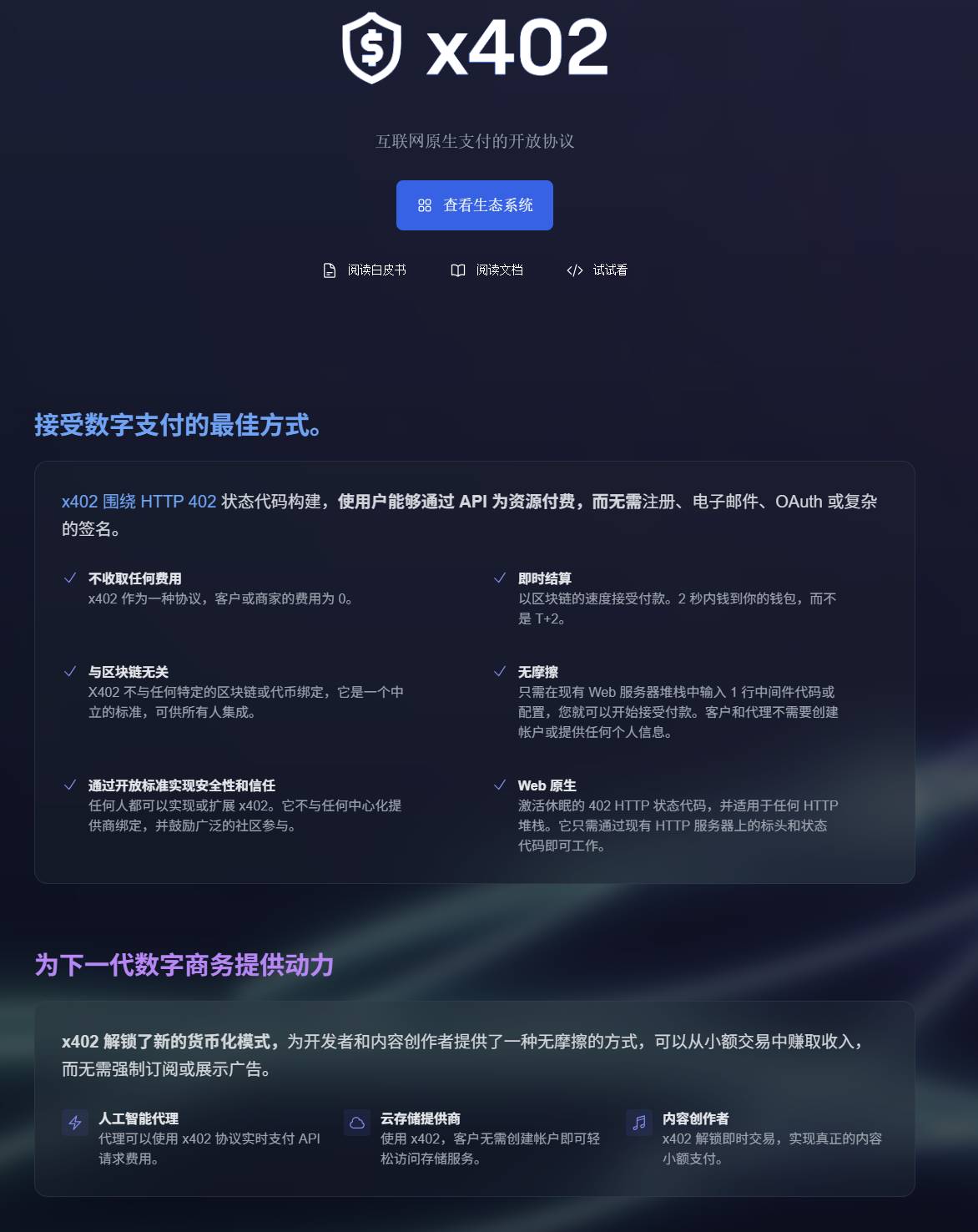
Figure: Homepage introduction image from x402 official website
Source: x402 official website (https://www.x402.org/)
Can this "reactivation" of a foundational internet protocol standard become the key to bridging the above divide? Does it herald the birth of a native, open web payment layer that fundamentally reshapes how value flows across the internet? This article will provide an in-depth analysis by Bitget Wallet.
2. Delayed Explosion: What is x402, and Why Has It Only Now "Gone Viral"?
x402 is an open protocol launched and open-sourced by Coinbase in May 2025. Its core goal is to activate the long-unused HTTP 402 status code, transforming it into a native, permissionless payment mechanism for the internet, ultimately establishing a channel between Web2 applications and Web3 value networks.
However, an interesting phenomenon is that although the x402 protocol went live in May, it remained dormant for five months before suddenly going viral. In fact, the 402 status code itself is not a "new invention" from the crypto world but a reserved code from the HTTP protocol dating back to the 1990s.
So why has this "old standard" and "not-so-new" protocol only recently sparked widespread market discussion? The table below outlines the key timeline from x402’s inception to its surge in popularity, helping us understand the facts behind this "delayed explosion."
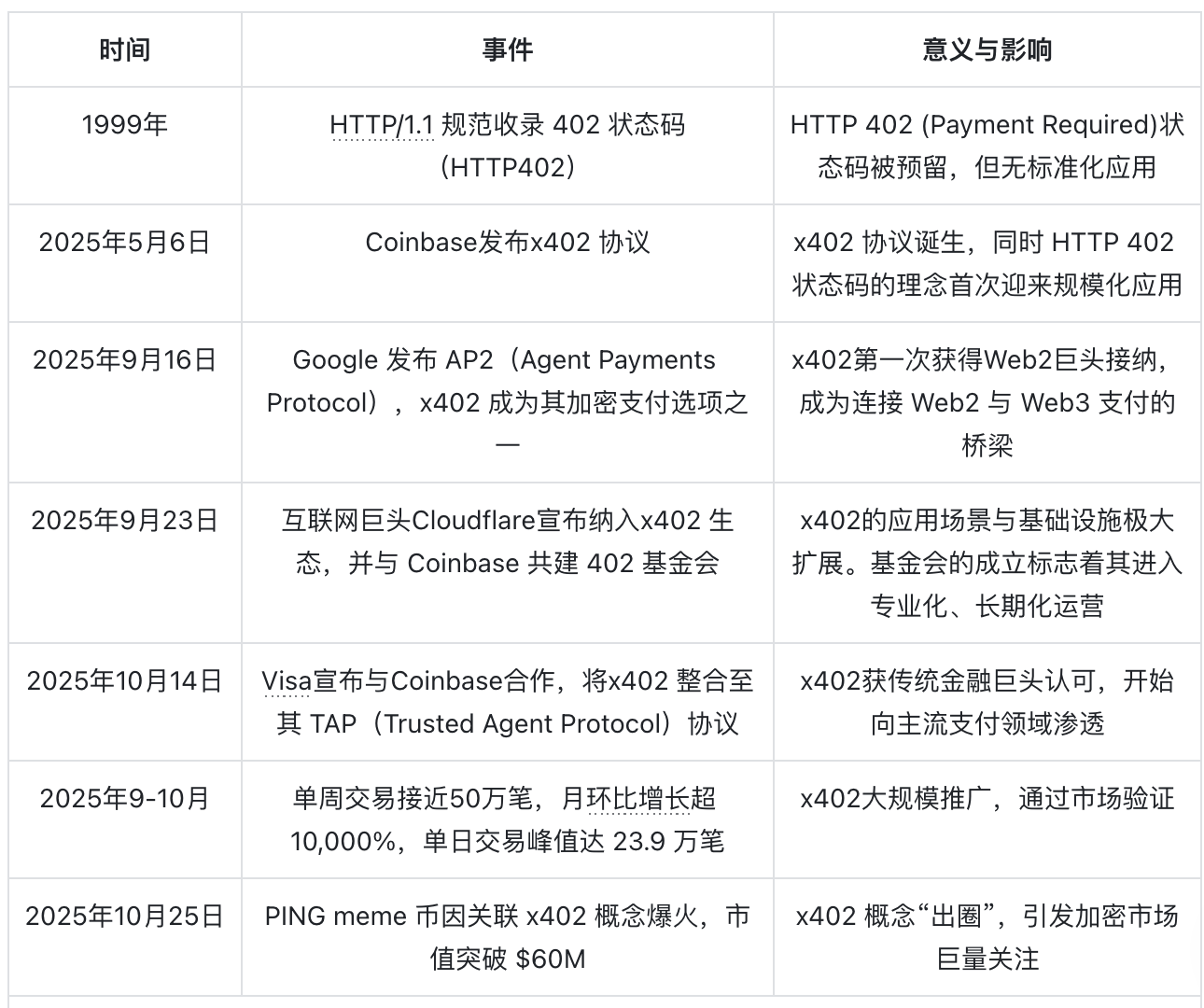
Table: Timeline of x402's emergence and application (as of October 28, 2025)
Data source: Compiled by Bitget Wallet from public data (transaction data from x402scan)
As shown in the timeline above, the evolution of x402 reveals several key facts:
First, x402 is a modern application based on the HTTP 402 status code from 1999, which had long been "sealed" due to lack of practical use cases.
Second, the x402 protocol was initiated by Coinbase and quickly gained support and integration from Web2 giants such as Google, Cloudflare, and Visa within months.
Third, despite the protocol being released months ago, what truly made it "go viral" was actually the recent surge in Meme coins leveraging the x402 concept.
In short, the current popularity of x402 is the result of both a technological vision (AI Agent payments) and speculative frenzy (driven by Meme coins). But beyond the market noise, we should focus more on its technical core—how exactly does it work?
3. Unlocking and Internalizing: How Does x402 Activate the Dormant HTTP 402?
To understand x402, we must look back to the 1990s. The internet transmits information between clients and servers via the HTTP protocol (HyperText Transfer Protocol). HTTP defines a series of response status codes (HTTP Response Status Codes) to represent specific functions, such as the well-known "404 Not Found" (page not found) or "200 OK" (request successful).
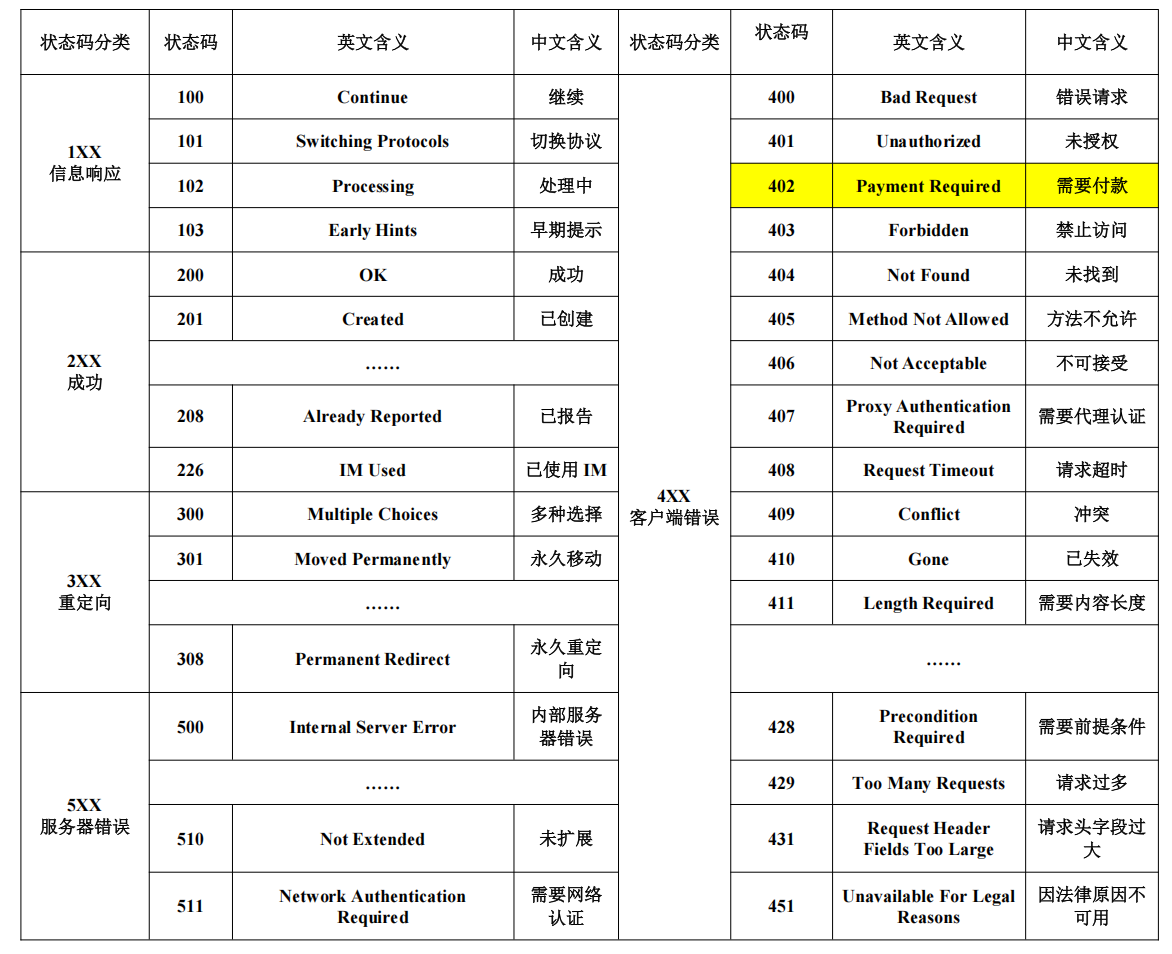
Table: Summary of HTTP status codes
Data source: Compiled by Bitget Wallet
Within this vast coding system, the 402 (Payment Required) status code stands out as particularly unique. Originally conceived as a natively protocol-based micro-payment method, it aimed to enable instant payments "as seamless as loading an image"—without intermediaries or delays. However, as the internet economy shifted toward advertising, platform models, and complex credit card forms, the vision behind the 402 status code was shelved, and the standard never saw large-scale adoption.
The emergence of x402 aims precisely to "unseal" the value of the 402 status code. Its workflow is logically elegant:
When a user requests a paid resource, the server no longer returns a "redirect" instruction (to a subscription page), but instead directly returns a 402 status code. This response contains all critical information needed to complete the payment: recipient address, payment amount, supported blockchain networks (e.g., Base, Polygon), and currency type (e.g., USDC).
A client supporting x402 (such as a browser extension or Web3 wallet) captures this 402 request and automatically "translates" it into a payment prompt, requiring only a click from the user to confirm. The wallet then completes the stablecoin payment via an efficient Layer 2 network and notifies the server upon transaction confirmation. The server verifies receipt and immediately unlocks the content for the user.
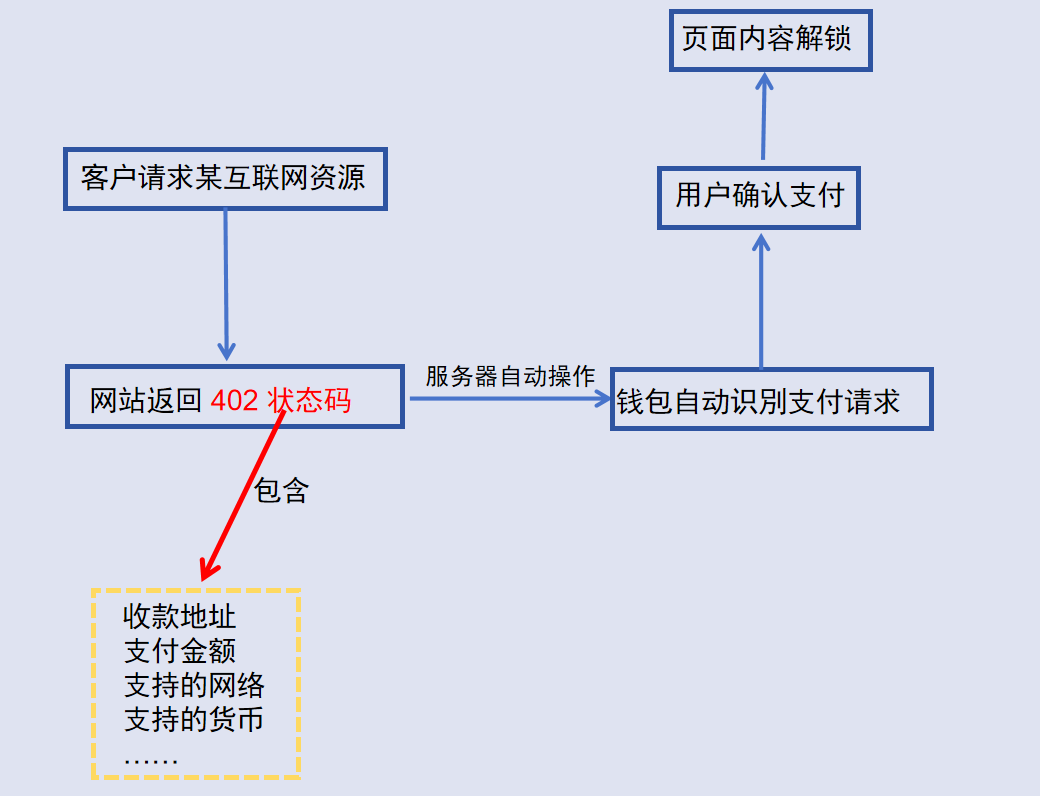
Figure: x402 workflow diagram
Source: Compiled by Bitget Wallet
The entire process "internalizes" payment as part of the HTTP protocol, making it as native an interaction as loading an image or accessing a non-existent page. It essentially embeds a native "value settlement" function into the most fundamental communication layer of the internet, enriching the underlying internet transmission protocol that has remained unchanged for over two decades at the application level.
4. Timing is Everything: Why Now?
A reasonable question arises: the HTTP 402 standard has existed for 26 years, so why has it only now, through x402, found the opportunity for real-world implementation? The answer lies in the simultaneous presence of three essential elements: supply, demand, and catalyst.
First is the explosion of demand. The rise of the "machine economy," represented by AI Agents, is accelerating rapidly. AI needs to autonomously and frequently call upon services and data from other AIs or APIs. This kind of automated, cross-platform micro-payments between machines (M2M) cannot be supported by traditional credit card systems. By embedding payments directly into HTTP requests, x402 perfectly meets the urgent need for fine-grained, per-API-call billing.
Second is the maturity of supply-side technology. Web3 infrastructure has evolved dramatically. The missing "digital cash rails" that were absent when the 402 standard was first conceived are now filled by Layer 2 solutions, high-performance public blockchains, and widely circulated stablecoins. Their ability to deliver second-level confirmations and extremely low costs makes native internet micro-payments economically viable.
Finally, powerful advocates serve as a crucial catalyst. Coinbase open-sourced the protocol specification, Google and Visa have endorsed it, and infrastructure giants like Cloudflare have jointly established the x402 Foundation. Together, these forces are working to establish x402 as a new "open internet standard," greatly lowering integration barriers and accelerating ecosystem formation.
It is precisely at this intersection of technological readiness (supply) and emerging demand (AI), amplified by industry giants' backing (catalyst), that x402 has seized the moment when infrastructure is finally ready, transforming a long-dormant idea into a real-world application.
5. Singularity and Pitfalls: The Potential and Three Key Challenges of x402
As described in the x402 whitepaper (shown below), the most direct application of the x402 protocol is opening the door to the "machine economy" for AI Agents. In the future, AI agents will undoubtedly become primary participants on the internet. This native, programmable payment protocol naturally aligns with the economic needs of M2M (machine-to-machine) interactions. It enables an AI agent to autonomously invoke another AI's API service and automatically pay a fee of 0.0x dollars via x402, without human intervention or pre-funding, drastically reducing friction costs between services.
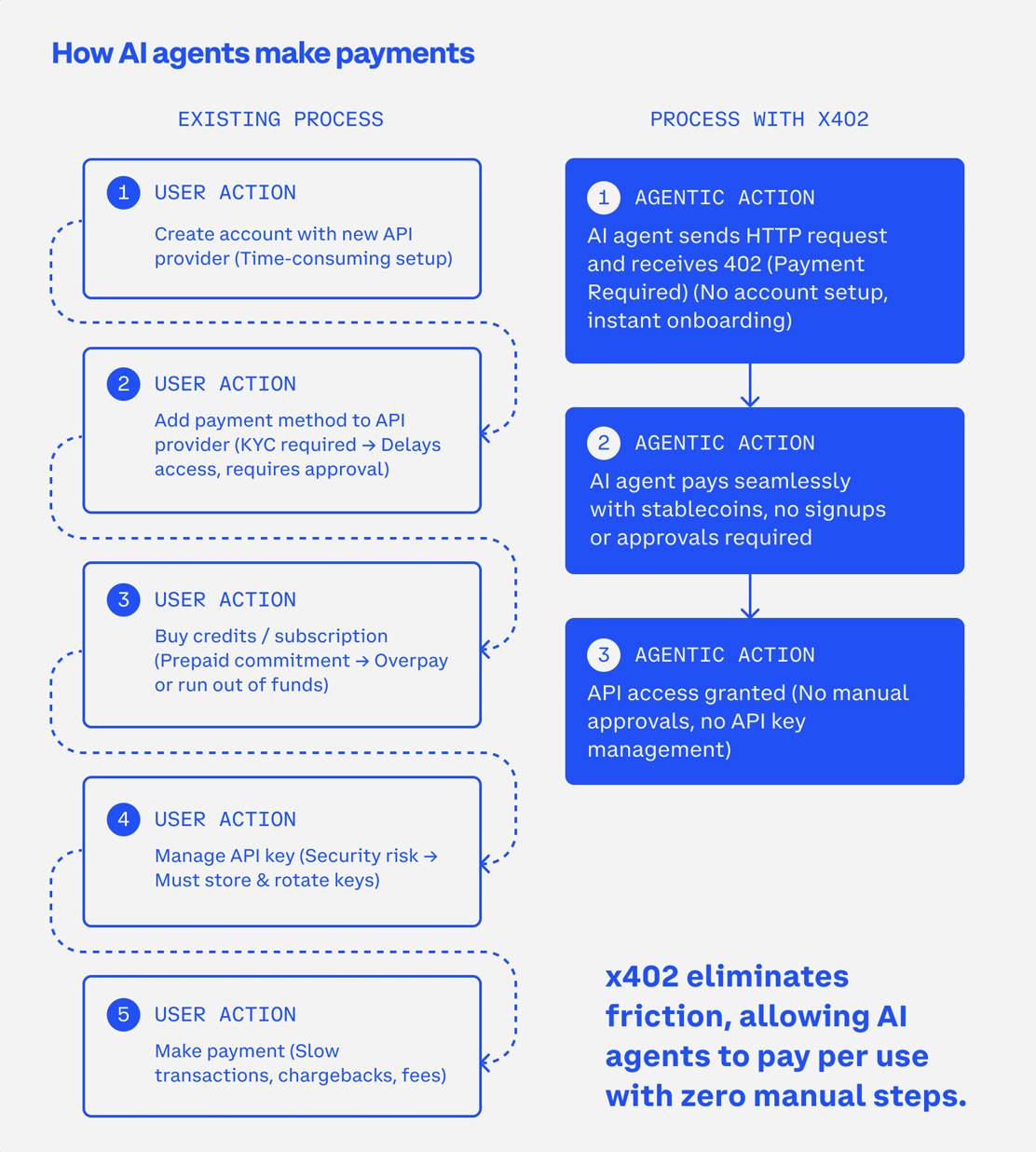
Figure: Comparison between existing AI agent payment flow and x402 pay-per-use model
Source: x402 Whitepaper
Its deeper significance lies in this: x402赋予每一次HTTP请求同时具备“数据传输”与“价值传输”的双重属性。 This means integrating the dimension of "value" into the foundational information protocols of the internet’s early days, potentially revolutionizing the traditional web architecture that has been used for over two decades at the application level.
Moreover, this may finally answer a long-standing pain point in Web3: How can the crypto world empower the real world and create change? For a long time, the crypto world has been criticized for lacking genuine mainstream applications, and x402 could very well be that singularity—it doesn’t start from scratch but attempts to "inject" Web3's value settlement capabilities into the vast Web2 ecosystem, becoming a true bridge between the two worlds. This is the fundamental logic behind why the protocol is so widely celebrated and discussed.
Yet, beneath the optimistic vision, the challenges facing x402 are equally significant.
First is the internal concern within the HTTP protocol itself. HTTP 402 remains an "unstandardized" reserved code. As noted in MDN Web Docs (developer documentation), it is defined as "reserved but undefined." This means it hasn't been fully adopted by mainstream web standards and poses compatibility issues at the protocol level. Therefore, x402's current implementation largely relies on custom HTTP headers like X-PAYMENT, rather than the actual standardized 402 status code, casting a shadow over its long-term standardization prospects.
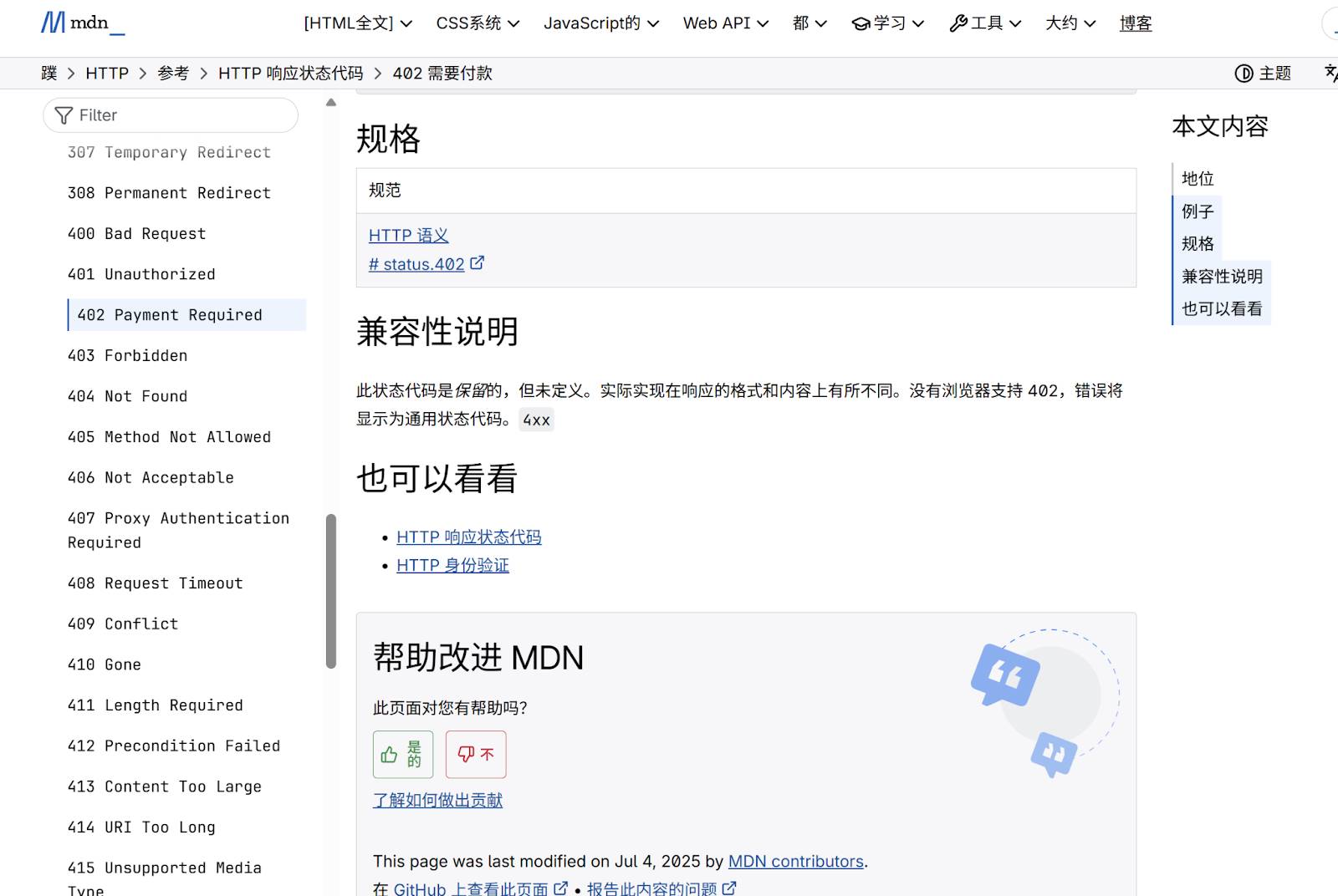
Figure: HTTP 402 status code flagged for compatibility issues in developer documentation
Source: MDN Web Docs
Second, the future stance of major traditional internet companies remains to be seen. Although giants like Google have announced their acceptance of the protocol within AI frameworks, the x402-promoted concept of "bypassing platforms for peer-to-peer payments" fundamentally opposes the current business models of internet giants who profit from "walled gardens" and payment commissions. The combination of x402 and AI Agents resembles a declaration of war against the traditional internet ecosystem—whether these giants genuinely embrace it or are merely using it temporarily remains to be observed.
Finally, and most concerning, is the risk of backlash from speculative bubbles. Since the x402 protocol itself has not issued any tokens, all current market tokens associated with it (such as PING) are experimental meme projects. While the meme craze has objectively boosted x402's visibility, it raises serious questions: Will this movement fall into the trap of false prosperity driven by "speculative narratives," ultimately undermining genuine technological ideals when the bubble bursts? This is a persistent dilemma in the crypto world. (The figure below shows the x402 ecosystem landscape.)
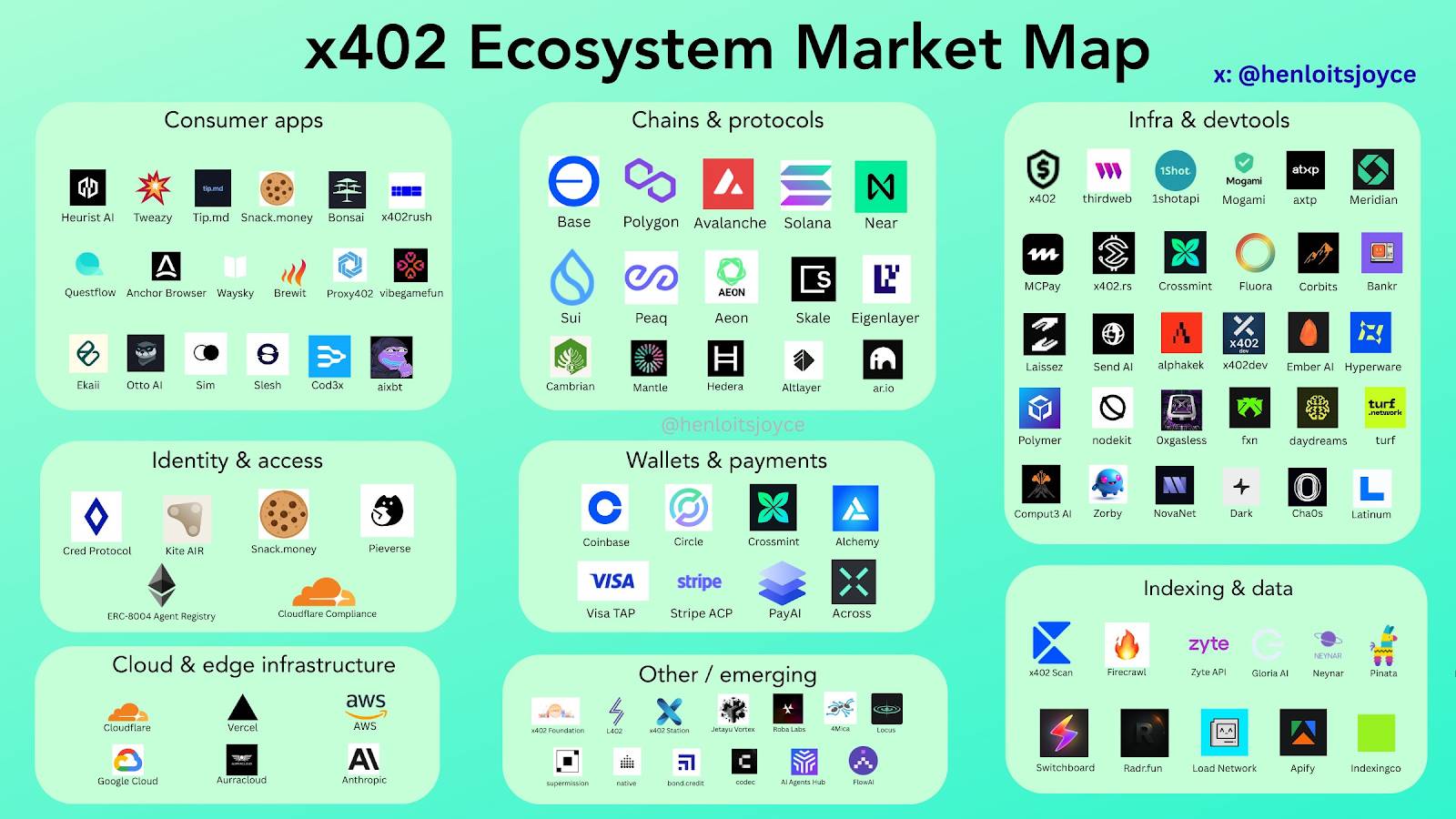
Figure: Overview of the x402 ecosystem
Source: X @henloitsjoyce
6. Conclusion: Beyond the Hype, What Value Remains?
x402 offers an extremely pragmatic solution for AI Agent payments—it does not require users to abandon the existing internet, but instead aims to complete a critical upgrade of "payment" at the most foundational protocol layer. Looking back at the entire development of x402, there is a deeply ironic point: what truly made x402 "go viral" was not its sophisticated technical vision, but the speculative frenzy around Meme coins in late October. This implies that many current analyses touting x402’s disruptive potential are engaging in "seeing the bubble first, then retroactively justifying meaning."
The current x402 boom is less driven by technological breakthroughs and more rooted in speculative narratives. This leads to a central question: Is x402 a milestone in the convergence of Web3 and Web2, a true singularity pushing the internet into a "value layer"? Or is it merely a last-minute lifeline that the crypto market has accidentally grabbed while searching for the next "100x story"?
The answer still awaits the test of time. Yet regardless, the concept of a 'native HTTP value layer' pointed to by x402 has provided profound direction for how Web3 can empower Web2. The value of this forward-looking vision far outweighs the temporary noise of market speculation.
Join TechFlow official community to stay tuned
Telegram:https://t.me/TechFlowDaily
X (Twitter):https://x.com/TechFlowPost
X (Twitter) EN:https://x.com/BlockFlow_News
 @BitgetWallet






