"Fed Whisperer": Powell's "unusually hawkish" press conference highlights Fed "internal turmoil," December rate cut "far from certain"
TechFlow Selected TechFlow Selected
"Fed Whisperer": Powell's "unusually hawkish" press conference highlights Fed "internal turmoil," December rate cut "far from certain"
The path of future monetary policy is filled with high uncertainty, and the easiest part of this easing cycle may have already ended.
 Navigating Web3 tides with focused insights
By: Ye Zhen
Source: Wall Street Horizon
The Federal Reserve cut interest rates as expected, but Chairman Powell's hawkish signals at the post-meeting press conference poured cold water on the market's widespread expectation of another rate cut by year-end.
Nick Timiraos, a Wall Street Journal reporter known as the "New Fed Whisperer," said in his latest article that Powell’s unusually strong stance not only highlights growing divisions within the FOMC but also indicates that the path of future monetary policy is highly uncertain amid a data vacuum.
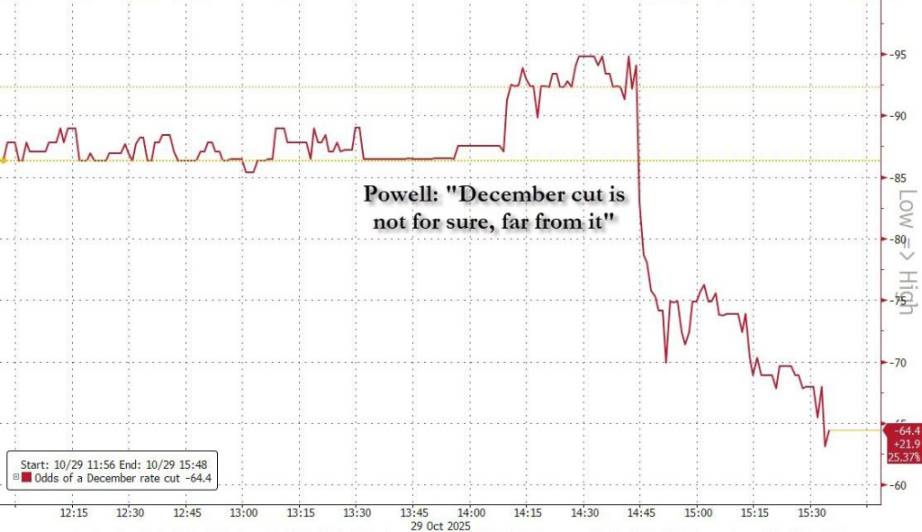
On Wednesday local time, the Fed announced a 25-basis-point cut in its benchmark rate, lowering the federal funds rate target range to 3.75%–4.0%, the lowest level in three years, marking the second consecutive rate-cutting meeting. However, attention quickly shifted during the press conference to Powell’s view on future policy. He explicitly rejected market assumptions that a December rate cut was "already locked in," stating bluntly that such an outcome was “far from certain.”
Powell’s comments immediately reversed market optimism, slashing the probability of a December rate cut from 95% to 65%. The Dow Jones Industrial Average and S&P 500 erased intraday gains, with the Dow closing down 0.2% and the S&P 500 ending slightly lower. The yield on the two-year U.S. Treasury note, most sensitive to rate outlooks, surged 0.092 percentage points to 3.585%, the largest single-day jump since early July.
Timiraos analyzed that Powell’s remarks made it clear that as an increasing number of officials question the need for further easing—what Powell called “more and more officials”—the easiest part of this easing cycle may already be over. At the same time, with each successive rate cut, the question of when to stop becomes increasingly urgent.
Internal Divisions Emerge, Decision Vote Splits Three Ways
The latest rate decision passed 10–2, with voting details revealing deep fissures within the committee. Kansas City Fed President Jeffrey Schmid dissented, favoring holding rates steady; while Fed Governor Stephen Miran took a different position, advocating a larger 50-basis-point cut.
This three-way split confirms Powell’s comment that there are “strongly differing views” within the committee. Powell acknowledged at the press conference the presence of a “growing chorus” among policymakers who are skeptical about the need for further monetary easing.
Although a slight majority of officials projected two additional cuts this year in the September economic forecasts—leading markets to lean toward a high likelihood of a December cut—a significant portion of officials believed no further action should follow the September cut. These officials are more concerned about inflation, which has remained above the Fed’s 2% target in recent years and stopped declining this year, partly due to Trump-era tariffs pushing up goods prices.
Powell’s tough stance surprised markets, which had heavily priced in a December cut, leading analysts to diverge in their outlooks.
Vincent Reinhart, chief economist at BNY Mellon Investment Management and former senior Fed adviser, argued that given the data void, “data would have to prove further easing unjustified—which is a very high bar.” He added, “It’s really hard for them not to cut in December. It’s easier to keep going than to stop.”
However, James Bullard, dean of Purdue University’s business school and former St. Louis Fed president, said the prospect of a December cut “is more nuanced than the market currently thinks.” He noted that strong consumer spending and economic growth, combined with recent inflation setbacks, could justify slowing the pace of cuts. “You’re placing too much bet on the payroll report slowing,” Bullard said. He also questioned whether policymakers have truly adapted to a new normal where adding 50,000 jobs per month is “perfectly acceptable.”
Government Shutdown Causes Data Blackout, Uncertainty Complicates Rate Cuts
Compounding the difficulty of decision-making is the economic data blackout caused by the government shutdown. Powell noted that if missing data leaves officials facing “very high uncertainty” about the economic outlook, that alone could be a reason “to proceed cautiously.”
Typically, economic reports between meetings help bridge differences among officials. But now, especially with key labor market indicators unavailable, they lack the information needed to resolve disagreements.
Citing William English, professor at Yale School of Management and former senior Fed adviser, Timiraos wrote that the data gap means “they’ve learned little since September, so their stance may be similar to what it was in September—but with a wider range of uncertainty around it.”
In this context, Wall Street Horizon previously noted that Bank of America outlined several potential scenarios:
Scenario One: If the government reopens by late November, markets might see an outdated September jobs report before the December meeting. A weak report could reduce the risk of hawkish opposition, but even strong data might fail to convince Powell to pause due to its outdated nature.
Scenario Two: If the shutdown ends in early November, allowing the Bureau of Labor Statistics to release both September and October reports before the meeting. In this case, if unemployment remains stable and economic activity stays solid, a “pause on rate cuts” in December would become a real option.
Scenario Three: In the most ideal scenario, if the government reopens quickly and the BLS releases full employment reports for September, October, and November before the meeting. Bank of America proposed a decision-making “rule of thumb”: if the November unemployment rate is below or equal to 4.3%, the Fed would likely hold steady; if above or equal to 4.5%, it would prompt another cut; if at 4.4%, the decision would be a “toss-up.”
Balancing Inflation Concerns Against Job Market Slowdown
Timiraos noted that the core of the Fed’s current policy debate lies in balancing inflation control against signs of economic slowdown. On one hand, some officials do not want to ease too aggressively, fearing it could overstimulate the economy and keep inflation persistently above target. Recent stock market highs driven by rate-cut expectations have also heightened concerns about financial stability.
On the other hand, others worry that policymakers should not ignore the impact of changing trade policies and the lagged effects of past rate hikes on interest-sensitive sectors like housing, which are squeezing spending by low-income consumers and small businesses. In recent weeks, several major U.S. employers have announced plans to cut white-collar staff.
The job market sits at the center of this debate. Although inflation readings have held up slightly better, sharp slowdowns in summer labor reports prompted the Fed to resume cutting rates. Data show that in the three months through August, average monthly job gains were about 29,000, far below 82,000 a year earlier. Policymakers are trying to determine whether the slowdown stems from fewer people entering the labor force or declining labor demand.
Timiraos said that without clear evidence of a material deterioration in the labor market, it would be difficult to build sufficient support for a rate cut larger than 25 basis points. At the same time, with each successive rate cut, the question of when to stop becomes increasingly pressing.
Join TechFlow official community to stay tuned
Telegram:https://t.me/TechFlowDaily
X (Twitter):https://x.com/TechFlowPost
X (Twitter) EN:https://x.com/BlockFlow_News