Gold Selling in Shuibei: 300 Days Witnessing Wealth, Desire, and Humanity in the "Golden Chaos"
TechFlow Selected TechFlow Selected
Gold Selling in Shuibei: 300 Days Witnessing Wealth, Desire, and Humanity in the "Golden Chaos"
At this moment, Shenzhen's Shuibei, China's largest gold trading market, has fallen into an unexpected silence.
 Navigating Web3 tides with focused insights
By Gu Lingyu, Tencent Finance
On October 22, gold prices dropped 30 yuan in a single day. Zhai, owner of "Shenzhen Shuibei Jinnuo Jewelry," found her WeChat flooded with messages.
This was the biggest drop in gold prices in four years. Some customers saw it as a "golden opportunity" — a final chance to get on board; others regretted buying too early and asked whether they could get compensated for the price difference; still others lost patience and wanted to sell immediately.
However, while many asked questions, few actually traded. By the second day of the price plunge, Zhai’s business had “suddenly vanished.”
Zhai, however, remained calm. She had been waiting for such a sharp decline for a long time. With no obvious market news triggering the drop, she believed this would be the lowest point before year-end, so she rushed to banks to free up capital and stock up more inventory.
In Shuibei, every 1% fluctuation in gold prices affects the fate of many. Many merchants believe themselves to be bold traders riding the waves of turbulent times, skillfully managing both physical goods and futures. But when gold prices move irrationally, even these seasoned players break into cold sweats.
Meanwhile, customers always expect another kind of answer from merchants: Will the Fed cut interest rates? Can gold outperform Tesla stock?
Between rises and falls, some familiar faces quietly disappear from Shuibei — but new wealth stories may also begin here.
The higher the gold price, the thinner the profit margin
Contrary to popular belief, when gold prices rise, Shuibei merchants don’t necessarily earn more.
"Annual turnover reaches hundreds of millions, but profit margins are paper-thin," said Yu Fang, owner of Jinsheng Jewelry, describing today's gold trade.
Shuibei is where Yu Fang built her fortune from scratch. Sometimes, she reminisces about the good old days when she first arrived in Shuibei in 2023.
Shortly after earning her master’s degree in medicine, she sold a property in Chongqing and, with an additional 500,000 yuan from family support, pooled over three million yuan with a partner. The two rented a 3.5-meter counter in Shuibei.
That was also Shuibei’s golden era. At the time, branded jewelry stores typically priced gold above 550 yuan per gram, while Shuibei prices were over 100 yuan cheaper. Customers paid readily, rarely haggling.
Three years later, she now employs ten customer service staff and has expanded her store to 120 square meters — yet she admits, “I’m not earning as much as I did back in 2023.”
The shift began as gold prices remained persistently high.
In March 2008, international gold prices stood at $1,000 per ounce. Twelve years later, they broke $2,000. It took another five years to climb from $2,000 to $3,000. Yet by October 2025, gold surged past $4,000 in just seven months.
Such a dramatic rise allowed some investors to recover losses from the property market simply by selling gold. But for ordinary people, demand for purchasing gold was suppressed.
Data from the World Gold Council shows that in Q2 2025, Chinese consumer demand for gold jewelry fell 20% year-on-year. This marks the fifth consecutive quarter of double-digit declines since 2024, dropping to levels last seen in Q1 2020 at the onset of the pandemic. Meanwhile, investment demand rose sharply — bar and coin investments totaled 239 tons in the first half, up 26% year-on-year, making it the strongest first-half performance since 2013.
"Two years ago, gold was cheap, and buyers just snapped it up mindlessly. Now that prices have doubled, many who wanted jewelry are being priced out. Those still buying are mainly driven by fear of further price increases and lack of alternative investment options — they’re essentially forced into investing," said Yu Fang.
Ironically, merchants cannot stop increasing their investments.
First, they must give a cut to upstream suppliers.
As the “Huaqiangbei of the gold industry,” Shuibei operates on a low-margin, high-turnover model similar to Huaqiangbei. Merchants act as middlemen sourcing materials from the Shanghai Gold Exchange, raw material suppliers, and showrooms, then distributing them through online and offline channels to jewelry stores, banks, or end consumers nationwide.
As gold becomes more expensive, upstream suppliers hoard inventory and raise prices, charging 5 to over 10 yuan extra per gram — sometimes requiring buyers to queue.
In Shuibei, gold is sold by weight. Merchants purchase raw materials based on international prices and sell downstream at “international price + processing fee.” In other words, their profits come solely from processing fees — a few to dozens of yuan per gram for jewelry, and only one or two yuan per gram for gold bars.
Under this model, rising prices mean merchants must front more capital. As gold prices increase, their capital pressure intensifies dramatically.
“When gold prices skyrocketed in early September, everyone in Shuibei was recycling gold — our cash reserves were nearly drained,” said Yu Fang.
The market changes fast — falling behind by even a step means losing money. Sometimes, merchants queue at suppliers’ warehouses, and despite agreeing on a price upon arrival, find the price changed by the time they're served. With daily swings of 20–30 yuan, if they fail to restock immediately after a sale, the deal becomes meaningless — or even results in losses minutes later.
Meanwhile, new gold rushers keep pouring in.
“Previously, one pie was split among 100 people; now it’s divided among 200,” said Yu Fang. As gold prices soared and short-video platforms amplified exposure, Shuibei — once a closed network relying on personal referrals — suddenly opened its doors to all.
To compete for customers, price wars intensified. Merchants adopted internet-style tactics, introducing group-buying models — gathering orders via live streams and slashing processing fees from 20–30 yuan per gram down to just over ten yuan, or even lower.
In Yu Fang’s view, group buying is destroying the entire ecosystem. Photo by Gu Lingyu
“Once consumers get used to low prices, they’ll never pay full price again,” said Yu Fang, who disapproves of group buying. “This model sacrifices profit for traffic and is destroying the entire ecosystem.”
Bigger scale, thinner margins; larger market, fewer opportunities. This is the harsh reality of Shuibei today.
Licking blood off blades, chaos everywhere
As gold prices oscillate at high levels, disorder begins to surface everywhere.
Since September, rumors have spread within the industry about a wave of raw material suppliers fleeing Shuibei. By October, panic deepened. One large supplier allegedly collected deposits from over a hundred downstream merchants before vanishing, leaving a hole of tens of millions.
Multiple merchants told me the “fleeing wave” was greatly exaggerated. “How many are really running away?” said a longtime Shuibei trader. “Some always want shortcuts. But most still run honest businesses.”
“Running an honest business” is also Zhai’s creed — yet in such volatile markets, staying upright isn’t easy.
Nearly 50, Zhai is still relatively new to Shuibei. A year ago, she was a technical expert in the new energy sector, charging consulting fees by the minute and reviewing billion-yuan-scale projects.
She believes running a small gold business excites her more than working in new energy.
This wasn’t a spur-of-the-moment decision. Before entering the market in 2025, Zhai spent nearly a year observing Shuibei. Whenever she saw a stall closing, she’d ask around: Where did the owner go? How did they lose their capital?
She concluded that for middle-aged career changers, the priority should be avoiding losses and achieving stable gains. Ultimately, she realized: playing by the rules may not bring instant riches, but it ensures longevity. Those who truly lose everything almost always succumb to greed and moral failure.
For high-value transactions like gold, leverage allows controlling larger volumes with less capital.
For example, a supplier might take orders at 840 yuan per gram, collecting a deposit upfront and delivering later. If gold prices fall, the supplier pockets the difference — a common form of leverage.
But if prices rise instead — say to 900 yuan per gram — the supplier must buy materials at a higher cost to fulfill original contracts, resulting in a 60-yuan loss per gram. For 1,000 grams, that’s a 60,000-yuan deficit.
The risk lies in some suppliers holding no actual inventory, taking minimal deposits while accepting massive orders — leveraging up to tenfold.
“That’s called licking blood off a blade. Using 100,000 yuan to run a million-yuan business. When the market moves your way, you make fortunes overnight. But if you bet wrong, even vast wealth gets wiped out.”
To manage risk, Zhai insists on cash-and-carry transactions, even if it costs one or two yuan more per gram — meaning an extra 1,000–2,000 yuan for each kilogram.
To her, this isn’t a cost — it’s insurance.
She must be cautious. From surges to crashes, a clear trend emerges: extreme price volatility amplifies people’s risk appetite.
In Shuibei, many dissatisfied with slim margins start seeking alternative gains. Originally using futures to hedge physical risks, they gradually shift toward profiting purely from futures trading — until they destroy themselves.
Some suppliers originally defrauded fellow Shuibei merchants, but seeing gold’s popularity, launched online gambling platforms targeting ordinary consumers betting on gold price movements.
On October 11, the Shenzhen Gold & Jewelry Association issued an official warning stating that three Shenzhen Shuibei jewelry companies had been investigated for suspected illegal casino operations.
Beyond gambling, various complex gold trading schemes exist in Shuibei.
Some buy gold and leave it with suppliers, earning monthly interest — thousands per kilogram; others profit from recycling old gold or lending gold; some avoid physical goods altogether, speculating solely on futures, chasing overnight wealth amid price swings.
Here, gold is not merely a commodity — it’s a chip in a wealth game, a test of human nature.
“There are especially many韭菜 (naive investors) this year,” said a young Chaoshan woman who had just arrived in Shuibei a month earlier, referring to how price volatility fuels gambling mentality. “Everyone thinks they can ride the gold wave to success — but then what?” She pointed at an empty stall nearby. “The gold remains, but the person hasn’t been seen in ages.”
Newcomers flood in while veterans depart
Wild price swings silently reshape Shuibei’s climate and challenge its structural foundations.
At 3 p.m. on October 24, I met He Yi, director of a listed jewelry company, in Shuibei.
Compared to a week earlier, foot traffic was noticeably lighter, though the area still buzzed with activity. Ignoring the blinding golden glare from street displays and stacks of red hundred-yuan bills inside stalls, the scene resembled any typical Chinese wholesale market filled with spicy snacks and crying babies — except that instead of vegetables, elderly women’s carts overflowed with pure gold bangles as thick as donuts.
Yet upon closer inspection, undercurrents stir.
A stall owner invited his neighbor for drinks, only to be flatly refused: “Too busy lately, no time.” A man sat behind his counter, repeatedly sending the same voice message: “We’ll replenish right after sales. Whether prices rise or fall next, nobody knows.” Another heavyset boss ran into a friend at a café, shouting angrily, “I just left the factory — our materials are stuck.”
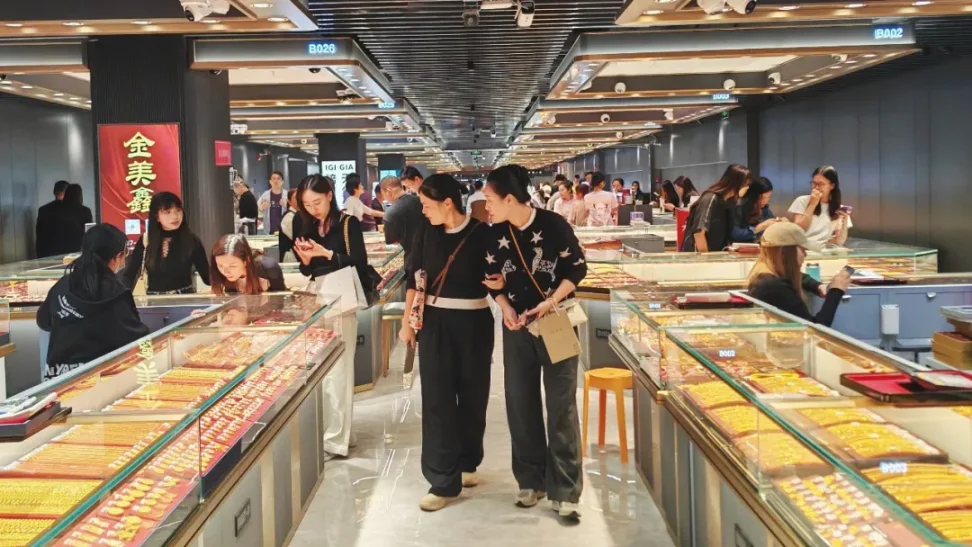
Despite the hustle, fewer people are buying gold. Photo by Gu Lingyu
In great uncertainty, everyone seeks their own anchor.
He Yi sees cycles in both gold and Shuibei. “Shuibei was probably hottest two years ago, when everyone competed in the low-end market. Recently, premium brands gained popularity, so now everyone fights over the high-end segment.”
She’s been in Shuibei nearly 20 years. In the 1990s, Shuibei Village was just an ordinary Shenzhen village. As Hong Kong’s jewelry industry shifted northward, factories and wholesale markets emerged, gradually forming an industrial cluster. She watched Shuibei evolve from a purely wholesale hub — “back when unpaved muddy roads made walking impossible” — into China’s central gold distribution center, and post-pandemic, become the largest retail market as intermediaries directly reached end consumers online.
The market’s efficiency and low cost relied for years on a trust system built on personal relationships and verbal agreements. But when gold prices rollercoaster, making someone rich overnight or bankrupting them the next, this decades-old trust becomes unsustainable.
Price volatility is forcing Shuibei to build a more standardized and transparent trading order. Over the years, He Yi has seen friends come and go — newcomers charge forward relentlessly, but she senses more veterans have already left.
Many understand implicitly: the outlook for the gold market remains bright, but Shuibei’s gold sellers will undergo a brutal shakeout.
All they seek is confidence
On October 28, international gold prices continued falling, hitting 891.80 yuan per gram at press time — the lowest since October 10.
Some analysts believe that although gold remains fundamentally strong long-term, short-term corrections may persist.
In recent days, Yu Fang’s investor clients have dwindled, as most wait and watch during the downturn. Her most frequent customer question: “Will it keep falling? Is now a good time to buy?”
She always replies: Buy physical gold when it drops, gradually entering the market in batches.
Yu Fang isn’t afraid. If gold sales slow, she quickly shifts to silver and platinum. “If gold doesn’t sell, push silver; if silver fails, there’s still pearls and jade.” Recently, one client made over 10,000 yuan overnight during a silver surge.
She’s also decided to let go of price-sensitive customers. She knows those fixated on pricing either have limited budgets or are novice investors — both highly vulnerable to market swings. The higher gold prices climb, the more she focuses on decisive, repeat buyers with strong purchasing power.
A harsh truth: ordinary people are exiting gold trading. Only those who understand market trends and act wisely can profit.
Yu Fang believes that as long as future uncertainties persist, the long-term bullish logic for gold remains unchanged.
Zhai shares this view: despite the recent pullback, breaking 1,000 yuan per gram before year-end won’t be difficult.
Gold reflects the opposite of confidence. The harder times get, the more people turn to gold as a reliable haven. Geopolitical tensions, global economic uncertainty, expectations of Fed rate cuts, and continuous central bank gold purchases — these factors driving gold upward won’t vanish soon.
Still, she never underestimates risk. She reminds everyone to clarify their purpose before buying gold. Investors must psychologically prepare for price swings — can they bear it if the price drops 100 yuan after buying high?
The word “disappointment” frequently haunted her early entrepreneurial days. But this time, seeing upstream suppliers hold inventory instead of dumping, and downstream consumers refraining from mass sell-offs, her confidence swelled like a balloon.
After years of selling gold, Zhai sees three sides of human nature: greed, stubbornness, and a third — embodied by customers endlessly asking “what comes next” amid wild price swings. She knows they aren’t truly seeking answers, but rather, just a sense of confidence.
(He Yi is a pseudonym)
Join TechFlow official community to stay tuned
Telegram:https://t.me/TechFlowDaily
X (Twitter):https://x.com/TechFlowPost
X (Twitter) EN:https://x.com/BlockFlow_News