








x402 gradually intensifying competition, proactively uncovering new asset opportunities in ERC-8004
TechFlow Selected TechFlow Selected
x402 gradually intensifying competition, proactively uncovering new asset opportunities in ERC-8004
x402 solves the payment issue, while ERC-8004 solves the trust issue. It took x402 five months to go from launch to breakout; 8004 might be even faster.
 Navigating Web3 tides with focused insights
Author: David, TechFlow
x402 has clearly gone viral.
CoinmarketCap data shows trading volume across x402 ecosystem projects surged 137x, with the first ecosystem token PING rising from zero to a $30 million market cap within days.
KOLs are publishing analyses nonstop—covering everything from technical principles to project overviews. Every possible angle has already been explored.
Yet two weeks ago, when we published an early analysis of x402 and highlighted potential in projects like PayAI, there was barely any market attention.
In an environment where narratives and token lifecycles move faster than ever, researching new narratives early makes it easier to capture related asset opportunities.
(Further reading: Google and Visa Are Investing—What Investment Opportunities Lie in the Underrated x402 Protocol?)
Now, every refresh of Twitter brings new "x402 ecosystem projects" popping up; if you're only starting to research x402 now, frankly, you might already be late.
It's not that the protocol itself lacks potential, but the most obvious alpha opportunities have likely already been taken.
Yet while everyone is focused on x402, careful observers will notice another protocol recently appearing frequently in English-speaking crypto discussions:
ERC-8004.
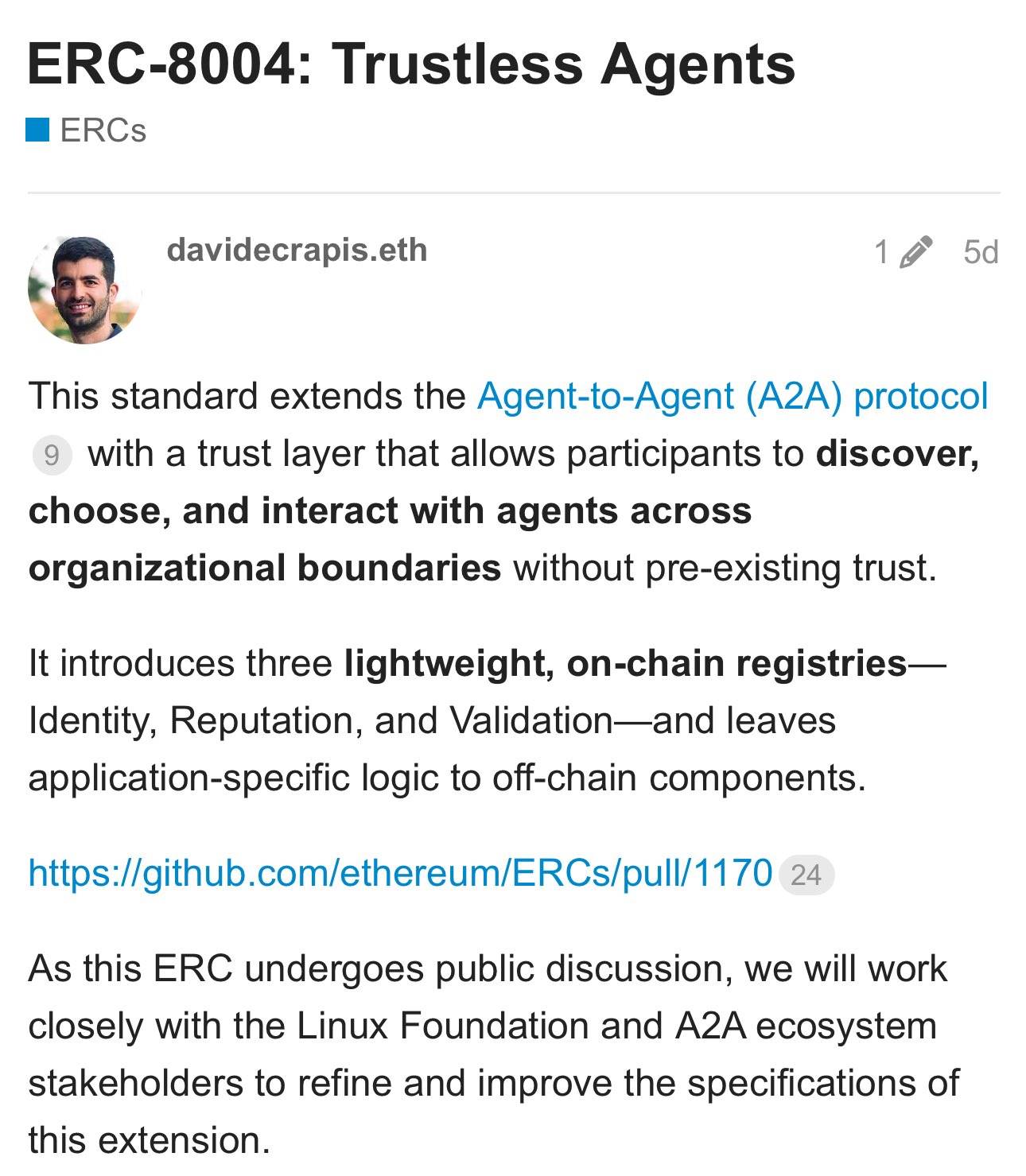
More interestingly, Davide Crapis, one of ERC-8004’s co-authors and head of the Ethereum Foundation's dAI team, revealed a detail in a September interview with Decrypt:
"ERC-8004 will support multiple payment methods, but having the x402 extension enhances the developer experience."
Wait—support for multiple payment methods? Isn't x402 a payments protocol? Why does ERC-8004 also involve payments? Are they competitors or complements?
In early October, when the Ethereum Foundation announced the final version of ERC-8004, signatories included MetaMask’s Marco De Rossi, Google’s Jordan Ellis, and Erik Reppel from Coinbase—the creator of x402.
The same person championing two protocols. What’s the logic here?
If x402’s breakout revealed the massive market potential of AI Agent payments, then ERC-8004 may represent the other, underappreciated half of this puzzle.
While everyone chases the payments race, the real opportunity might lie beyond payments.
ERC-8004: Before Payment Comes Identity Registration for AI
To understand ERC-8004, we must return to a fundamental issue in AI Agent economies.
Imagine a collaborative AI scenario:
Your personal AI assistant needs to complete a complex task: preparing a market analysis report for an upcoming product launch.
This task exceeds its own capabilities, so it hires specialized AIs—one for data scraping, one for competitor analysis, and one for chart generation.
With x402, payment isn’t an issue—USDC transfers can be executed in just a few lines of code. But before payment, your AI assistant faces a series of tricky identity problems:
Which of these Agents claiming to be “professional data analysis AIs” are legitimate, and which are frauds? What’s their track record? How many positive reviews do they have, and how many complaints?
This is akin to doing business in a world without Taobao, no Yelp, no business registration—every transaction is a blind box, every collaboration a gamble.
Thus, in one sentence, ERC-8004 is the “business registry + credit system + certification center” for AI Agents in the on-chain world.
It gives every AI Agent an ID, credit history, and capability certifications—all recorded on the blockchain, publicly verifiable and tamper-proof.
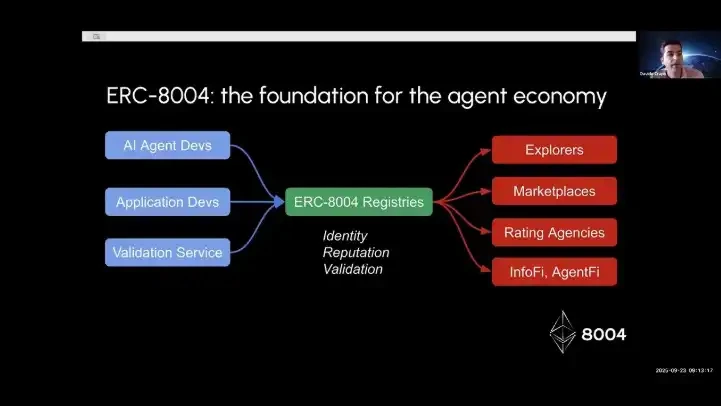
On August 13 this year, Davide Crapis from the Ethereum Foundation, Marco De Rossi from MetaMask, and independent AI developer Jordan Ellis jointly submitted EIP-8004 proposal.
Interestingly, this Jordan Ellis was later confirmed to be closely affiliated with Google’s Agent-to-Agent team.
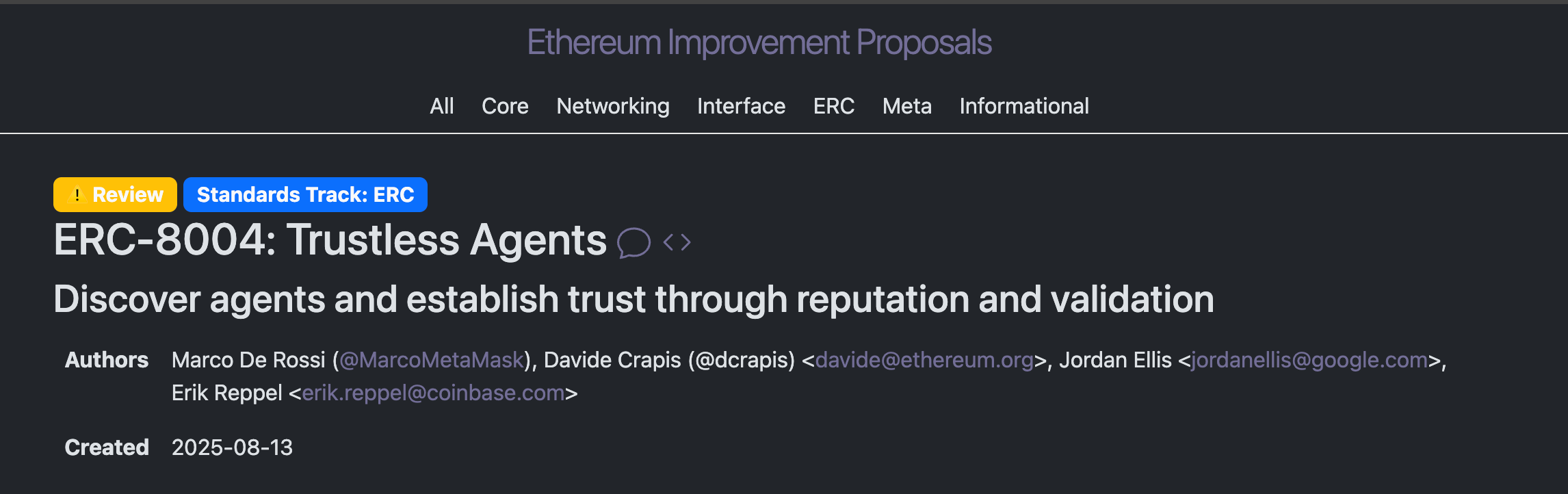
In simple terms, ERC-8004 adds a trust layer to Google’s A2A. As the Ethereum Foundation puts it, this aims to establish a “credible neutral track” for AI Agents.
Setting aside complex code details, here’s a rough idea of how 8004 works.
ERC-8004’s design is extremely minimal, containing only three on-chain registries:
-
Identity Registry: Each AI Agent receives an ERC-721 token as its ID. Yes, you read that right—AI Agents are NFT-ified. This means an Agent’s identity can be viewed, transferred, or even traded in any NFT-compatible wallet.
This NFT points to a standardized “Agent card” describing the Agent’s name, skills, endpoints, and metadata. Because it follows open standards, any browser or marketplace can index it, enabling permissionless cross-platform discovery.
-
Reputation Registry: This is the “Yelp” of the AI Agent world. Clients and other Agents can submit structured feedback, tagged by skill or task. More importantly, they can attach x402 payment proofs. Only paying customers can leave reviews, preventing fake ratings.
All reputation signals are public goods. Anyone can build their own credibility scoring system based on this data.
-
Validation Registry: For high-value tasks, reviews aren’t enough. The Validation Registry allows Agents to request third-party verification—via TEE (Trusted Execution Environment) oracles, staked inference, or zkML verification.
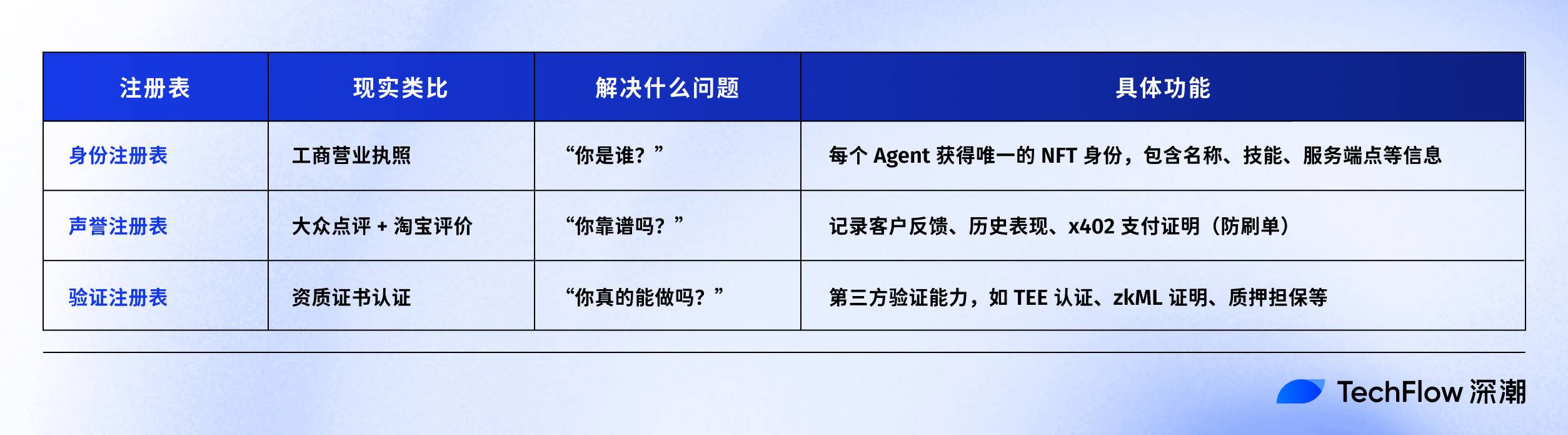
This is the certification system for Agents. An Agent claiming to perform financial analysis can cryptographically prove it ran a specific model and produced specific results.
If that sounds too technical, consider this concrete example.
Suppose an exchange’s AI Agent needs a weekly DeFi market analysis report, but lacks the capability.
-
Search for Service: The client Agent finds analyst Agent Alice via the Identity Registry and checks her service description on her NFT identity card
-
Check Reputation: Discovers Alice has 156 positive reviews, 89% completion rate, and genuine feedback with x402 payment proof
-
Escrow Payment: Pays 100 USDC via x402 into a smart contract escrow—not directly to Alice
-
Third-Party Verification: After Alice completes the report, validator Bob checks quality and signs confirmation in the Validation Registry
-
Automatic Settlement: The contract releases funds to Alice upon verification, and the client leaves a review
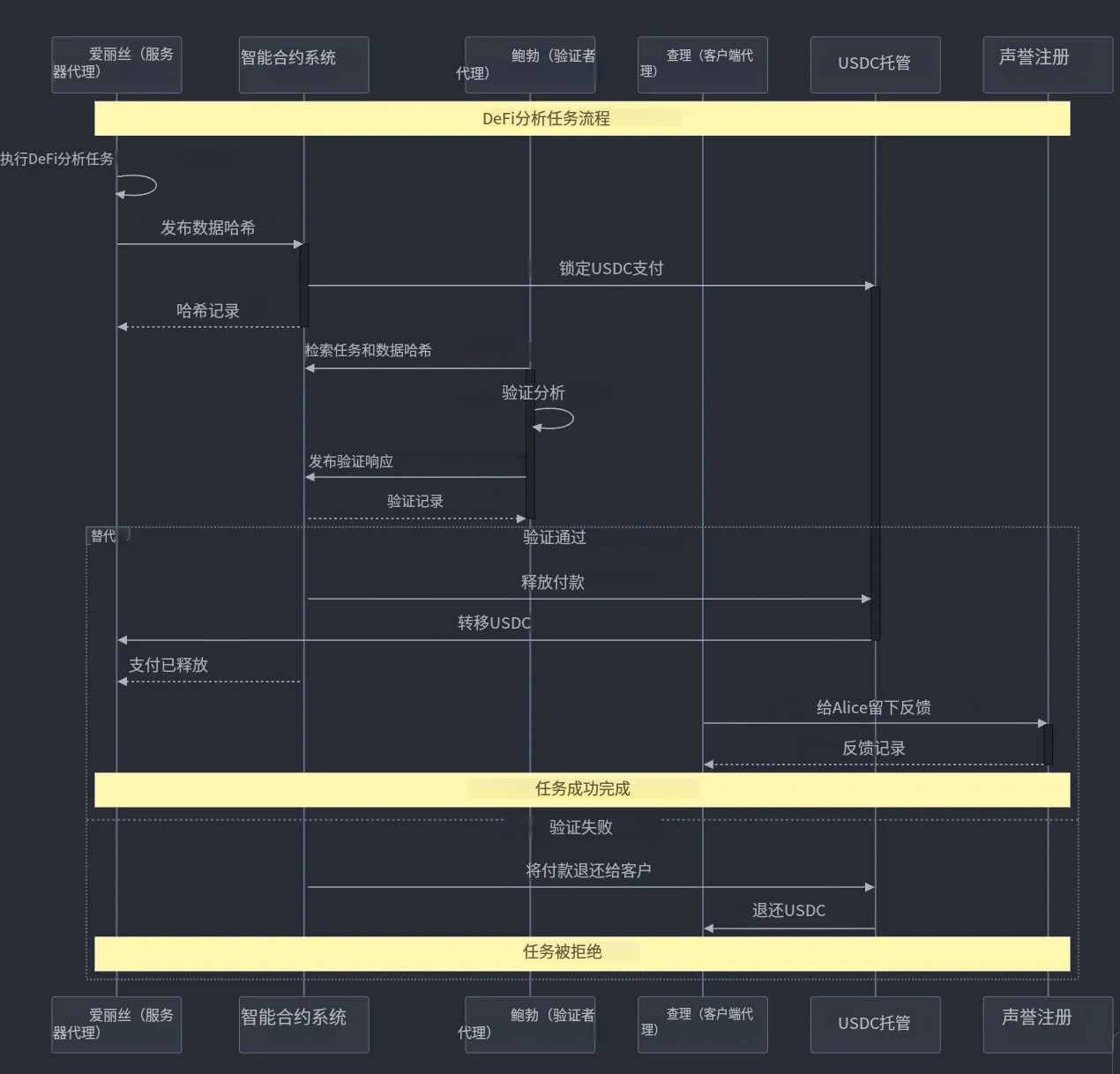
(Source: Researcher Yehia Tarek personal column)
The entire process requires no human intervention—three AI Agents autonomously completed a commercial transaction based on ERC-8004’s trust framework.
Wait—Is This Related to x402?
To summarize the relationship between x402 and ERC-8004 in one sentence:
x402 solves payment for AI Agents, ERC-8004 solves trust—and a truly autonomous AI economy needs both.
Specifically, x402 is a standard for micropayments between agents or users, removing payment friction and allowing one agent to automatically pay another for completing a task.
ERC-8004 is the identity and reputation layer for agents. It introduces on-chain verification, making every task and score traceable.
A simpler analogy:
-
x402 = ERC20
-
ERC-8004 = Etherscan
The former allows direct payment for API access by call count—a kind of payment standard; the latter acts more like an on-chain AI Agent registry, where each agent has an associated wallet that’s queryable and verifiable.
Ultimately, both belong to the broader “Crypto x AI” narrative. In a larger crypto-AI economy:
-
Crypto AI Economy = Discovering AI Agents + Communication Between AI Agents + Verifiable Computation
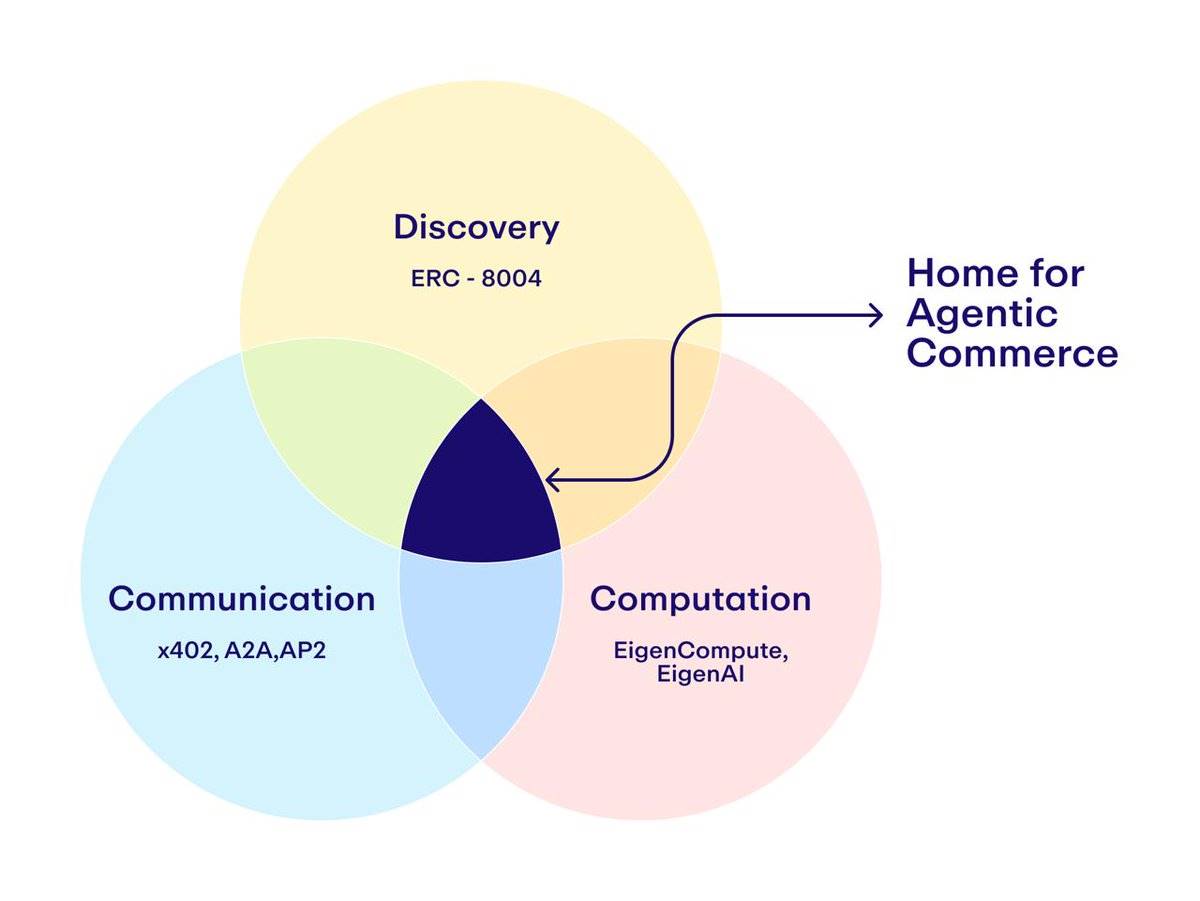
(Image source: Twitter user @soubhik_deb)
How do you discover AI Agents? Essentially, enabling AIs to find each other—that’s what ERC-8004 does: writing a registry on Ethereum to record AI identities.
How do you enable communication between AI Agents? x402 is an open standard for on-chain payments between agents; there’s also Google’s A2A protocol, among others.
How do you verify everything? Each AI Agent must perform verifiable reasoning, inference, and actions—these may be recorded in places emphasizing data availability.
Twitter user @soubhik_deb's post is worth reading—it clearly explains the above logic and can help uncover more alpha opportunities.
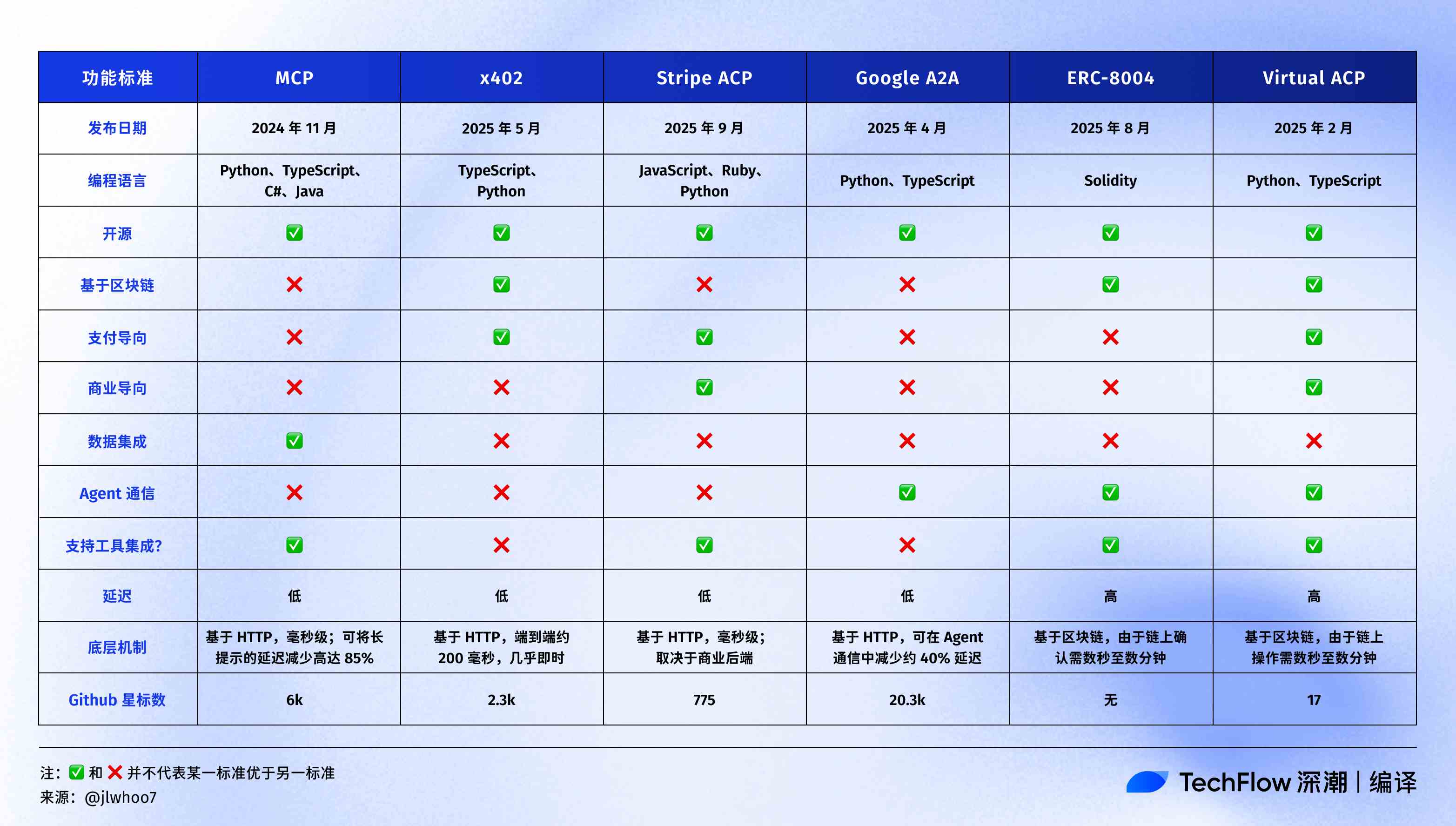
By now, we fully understand the relationship between x402 and ERC-8004—it’s more accurate to describe them as complementary, collectively building the full picture of the AI economy.
If you want a clearer, side-by-side comparison, here’s a visual summary:
Projects Benefiting from the ERC-8004 Narrative
For those who prefer a quick overview, refer directly to the image below.
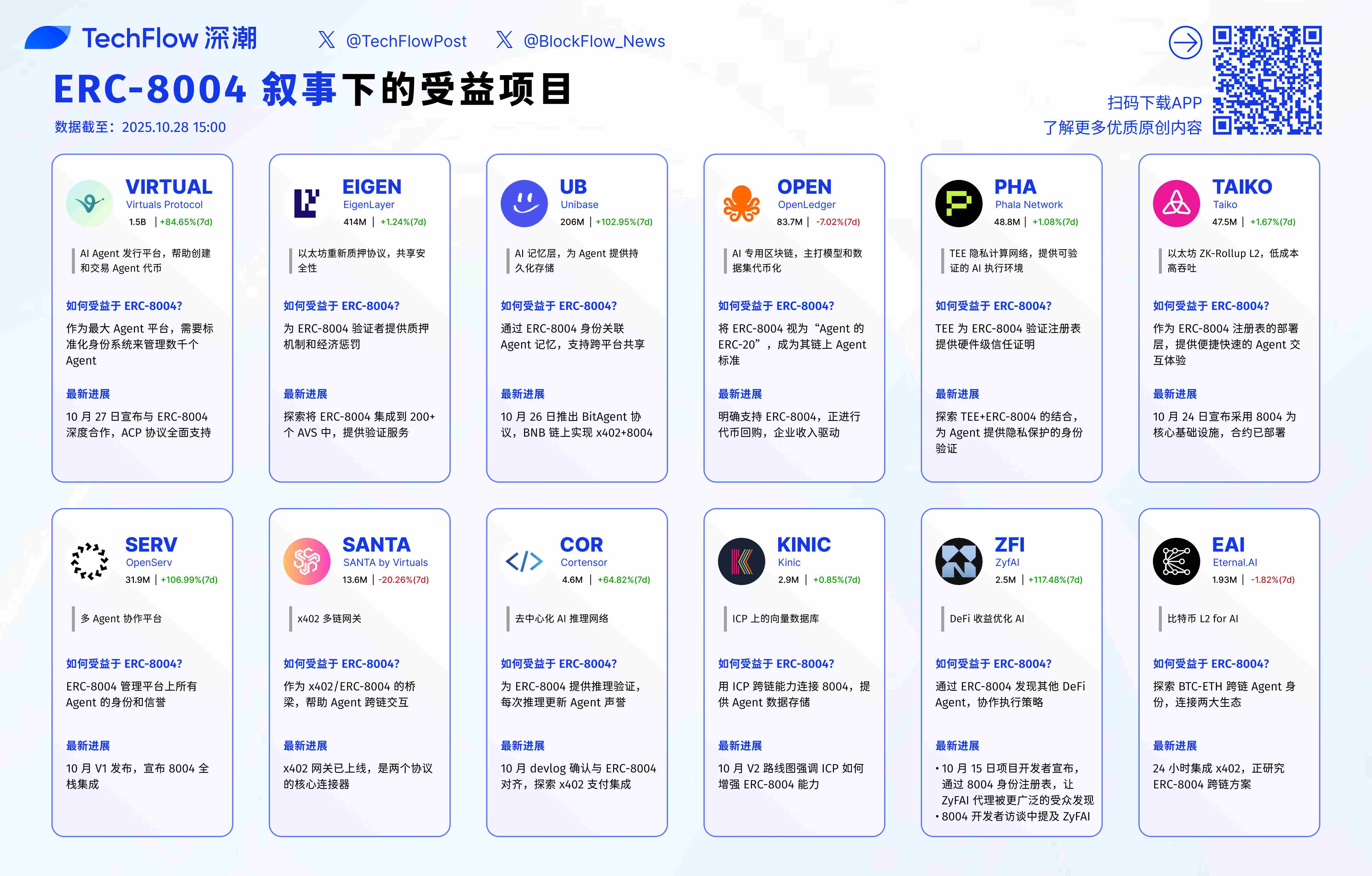
When x402 broke out, payment tokens like PING were the first to surge. But ERC-8004 opportunities are broader, spanning infrastructure to applications, with unique logic at each layer. Understanding this structure matters more than chasing individual projects.
-
First, the infrastructure layer, such as Taiko and EigenLayer.
Taiko, L2 execution layer
Why would an L2 be one of the most active supporters? The narrative is that Agent economies need cheap, fast chains. Mainnet is too expensive—gas fees of several dollars per identity or reputation update make it unaffordable for Agents. Taiko offers a solution: deploying the 8004 registry on L2 drastically reduces costs. Contracts were deployed on October 24—this could become the main battlefield for Agent activity.
EigenLayer, security layer
One major challenge for 8004: what if validators act maliciously? EigenLayer’s answer: staking penalties. Validators stake ETH, and if they provide false validation, their assets are slashed. EigenLayer is integrating 8004 into over 200 AVSs, each potentially becoming a specialized Agent validation service.
The infrastructure logic is simple: more Agents mean more transactions and more revenue. It’s a shovel-selling business.
-
Next, the middleware layer, such as S.A.N.T.A and Unibase.
S.A.N.T.A, payment bridge
It positions itself at the intersection of two narratives—acting as a connector between x402 and 8004. When one Agent discovers another via 8004 and then pays via x402, S.A.N.T.A handles the process. More importantly, it enables cross-chain functionality—e.g., in an ideal scenario, a Solana-based Agent hiring an Ethereum-based Agent, where S.A.N.T.A plays a key role.
Unibase, memory layer
Agents need more than identity—they need memory. Unibase provides persistent storage for each Agent, linked through the 8004 identity system. This means Agents can “remember” past interactions, accumulate experience, and even share knowledge. On October 26, it achieved x402+8004 integration on BNB Chain, taking an early lead.
Middleware gains value through irreplaceability. You might switch L2s, but certain connectivity functions are unique.
-
Finally, the application layer, such as old favorite Virtuals Protocol.
Virtuals is an AI Agent token issuance platform, allowing users to create, invest in, and trade AI Agent tokens via bonding curves.
The platform currently hosts over 1,000 Agent projects, with daily trading volume exceeding $20 million.
For Virtuals, 8004 solves a practical problem: enabling recognition and interaction between different Agents. Recently, its official Twitter indicated that the upcoming ACP protocol update will fully support the 8004 standard—meaning every Agent issued on Virtuals will automatically gain an on-chain identity and reputation system.
As for which application will break out, it may be worth watching for integration with Launchpad-style mechanics and updates in rule design and incentives.
Overall, x402 solves payments, ERC-8004 solves trust. x402 took five months to go from launch to breakout—8004 may move even faster.
Key timeline: Watch Devconnect on November 21, which features a Trustless Agents Day showcase. The first wave of 8004-based apps might demonstrate their features here. If a killer app emerges, it could spark the first hype cycle.
Towards year-end, I expect x402 ecosystem projects to enter consolidation phase, possibly announcing support for 8004. The synergy between the two protocols could create a 1+1>2 effect.
Conservative investors might focus on large-cap infrastructure projects benefiting from 8004, while more aggressive ones should closely monitor small-cap projects in the table above and any new entrants.
After all, it’s been a long time since the crypto market was driven by a technically grounded narrative. Whether x402 and ERC-8004 are fleeting trends or have lasting impact will be determined by the market.
Join TechFlow official community to stay tuned
Telegram:https://t.me/TechFlowDaily
X (Twitter):https://x.com/TechFlowPost
X (Twitter) EN:https://x.com/BlockFlow_News
 深潮TechFlow






