Crypto × AI: Deconstructing the Project Landscape of This Cycle
TechFlow Selected TechFlow Selected
Crypto × AI: Deconstructing the Project Landscape of This Cycle
A visual guide to the full-stack ecosystem of AI infrastructure.
 Navigating Web3 tides with focused insights
Author: cookies
Translation: TechFlow
This is my view on how the maturation of crypto and AI infrastructure drives innovation in applications.
Let’s dive into how we, as users and builders, can navigate this new era.
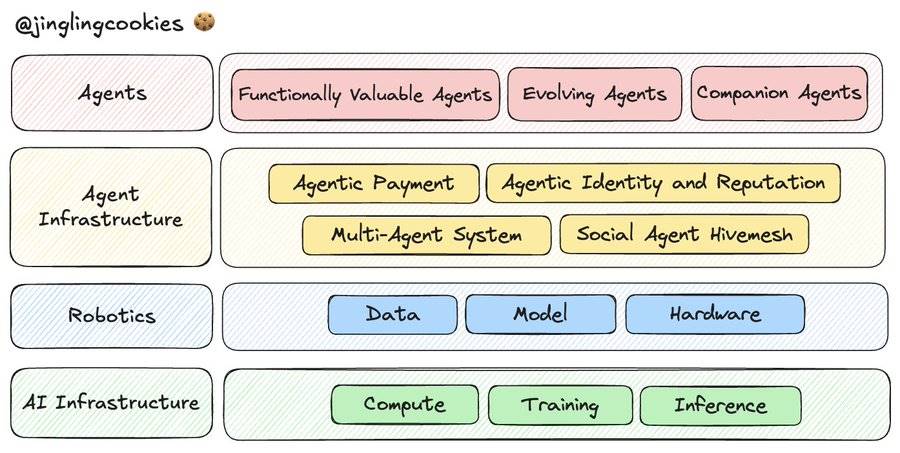
Agent Types
Functionally Valuable Agents
These agents generate tangible value or outcomes.
-
(1a) DeFAI Agents
-
(1b) Prediction Market Agents (PMAs)
-
(1c) Computer Use Agents (CUAs)
DeFAI Agents
These agents can trade, yield farm, or provide liquidity (LP).
Related projects: @symphonyio, @almanac, @gizatechxyz
You can find a comprehensive introduction to DeFAI in the tweet below: Original thread
Prediction Market Agents (PMAs)
These agents participate in prediction markets—either market-specific (e.g., football) or general-purpose.
I prefer market-specific agents based on small language models (SLMs), as they require fewer computational resources.
Related projects: @sire_agent, @BillyBets_ai
The Role of Crypto in DeFAI and PMAs
Crypto plays several key roles:
-
Medium of exchange
-
Programmable execution
-
Immutable transaction records
Computer Use Agents (CUAs)
These agents can control your screen to perform tasks, such as creating a discounted cash flow sheet in Excel.
Crypto can serve as an incentive mechanism, rewarding users who contribute high-quality data to improve these models.
Related projects: @chakra_ai, @getoro_xyz
Evolving Agents
I envision a future where everyone has a personalized productivity agent.
Based on contextual information gathered from LLM conversations, social media browsing, and daily interactions, these agents can conduct research and planning in ambient mode.
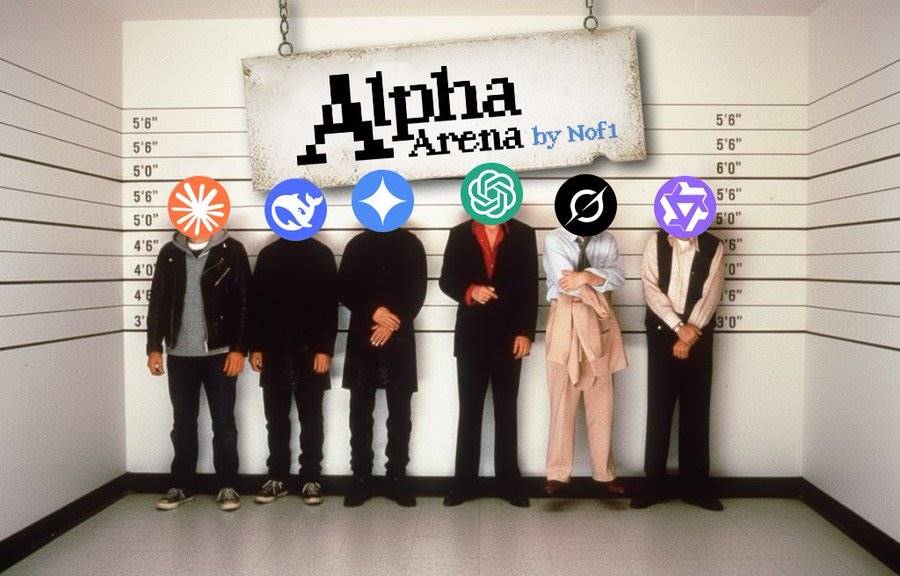
Over time, these agents will evolve and become experts in certain domains. @the_nof1, an AI research lab focused on financial markets, operates six trading agents, each managing $10,000 in capital. These models have the potential to evolve into skilled traders.
Companion Agents
In the future, agents helping people combat loneliness will become commonplace. As more interactions shift to digital spaces, human-to-human contact will gradually decrease.
Related projects: @Fans3_AI, @ohdotxyz

Agent Infrastructure
Agentic Payments
Agents capable of making payments. For agent commercialization to become real, tech giants have already created agentic payment standards:
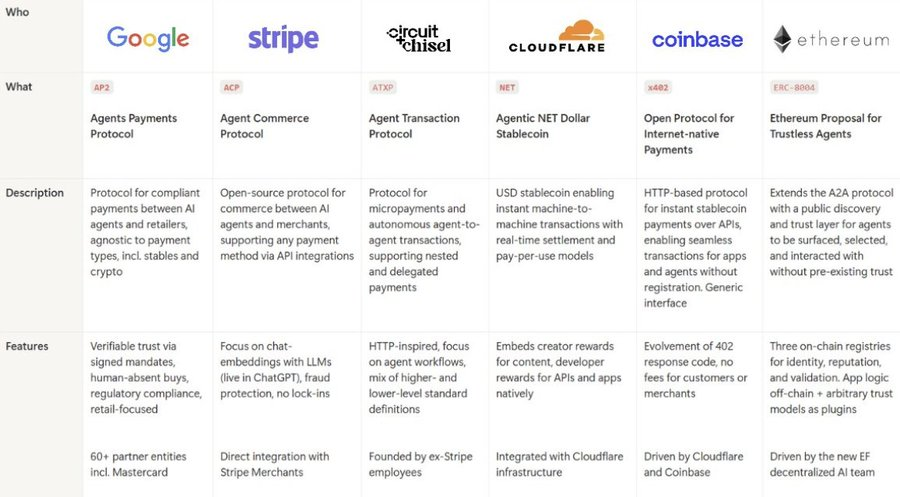
Key elements for mainstream adoption of agentic payments:
-
Infrastructure: Addressed by various agentic payment standards.
-
Demand: Do we really need agents that can make payments?

ChatGPT recently introduced apps on its platform, allowing users to build functionality directly within ChatGPT.
This brings a paradigm shift—productive operations can now be completed directly on ChatGPT.
The following helps you understand this: Related tweet
Agent Identity and Reputation
Agents are inevitable: most tasks will be executed through task-specific agents.
How do we know which agents are suitable and trustworthy?
Imagine a Google Review or PageRank system designed for agents, ranking their performance on specific tasks and issuing certifications.
Like a resume, a trading agent with a 4.6 rating could be "hired" by a hedge fund.

The Ethereum Foundation has started building infrastructure to support this—ERC-8004.
With ERC-8004, agents can interact with each other—for example, transferring funds from Agent A to Agent B.
Multi-Agent Systems
Analogy using F1:
-
Goal: Change tires
-
Master agent: Driver needing tire change
-
Worker agent: Mechanic responsible for changing tires
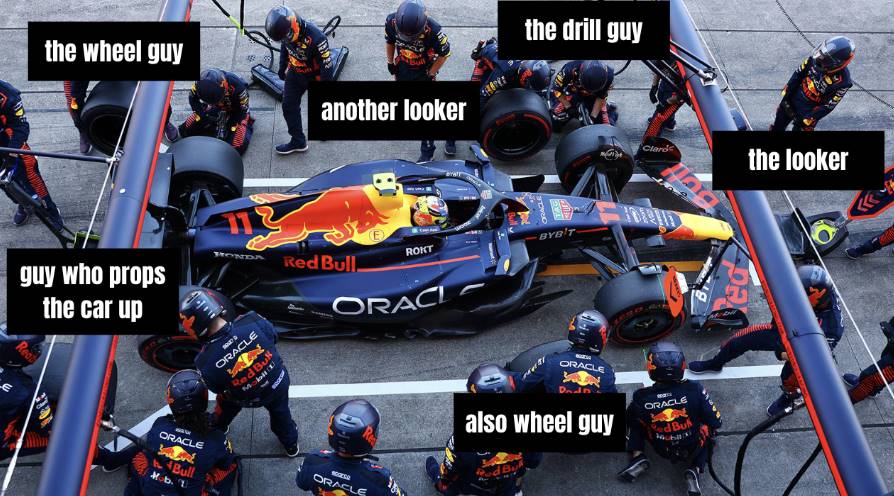
This concept consists of a coordinator agent and multiple worker agents that can execute tasks in parallel.
Best suited to run on the @monad platform, known for its parallel execution capability, potentially completing the entire workflow within a single block (0.4 seconds).
Social Agent Hivemesh
I imagine a future where everyone has their own digital twin.
An infrastructure exists that allows these digital twins to connect, exchange knowledge, and transact.
Digital twin interactions are stored on the blockchain, creating an Agent Social Graph.
Agent interactions cannot be entirely random. This is why discovery networks like @indexnetwork_ are critical infrastructure—they connect user intent by ingesting specific user context.
Robotics
The robotics industry is growing rapidly, securing $6 billion in funding between January and July 2025.
This section breaks down three core pillars and details the role of blockchain.
Before diving deeper, check out this primer on robotics.
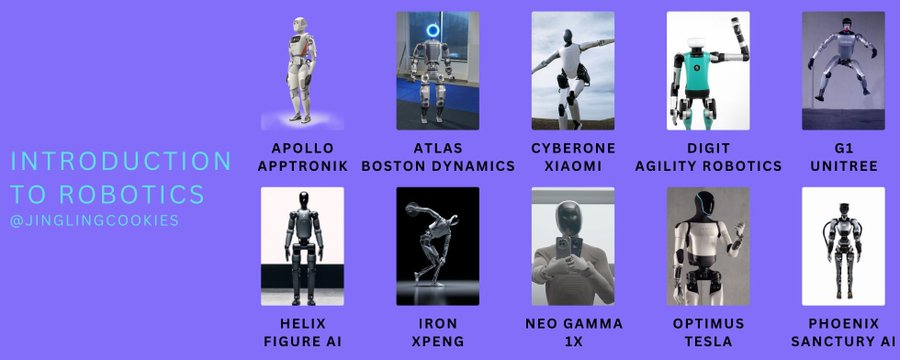
Robotics Data
Compared to large language models (LLMs), the volume of data used to train robotics models is much smaller.
This is because collecting real-world data requires more effort and higher costs (e.g., setting up cameras and teleoperation equipment).
Types of robotics data include:
-
Video
-
Teleoperation
-
Motion capture
-
First-person view (POV)
-
Simulation/synthetic data
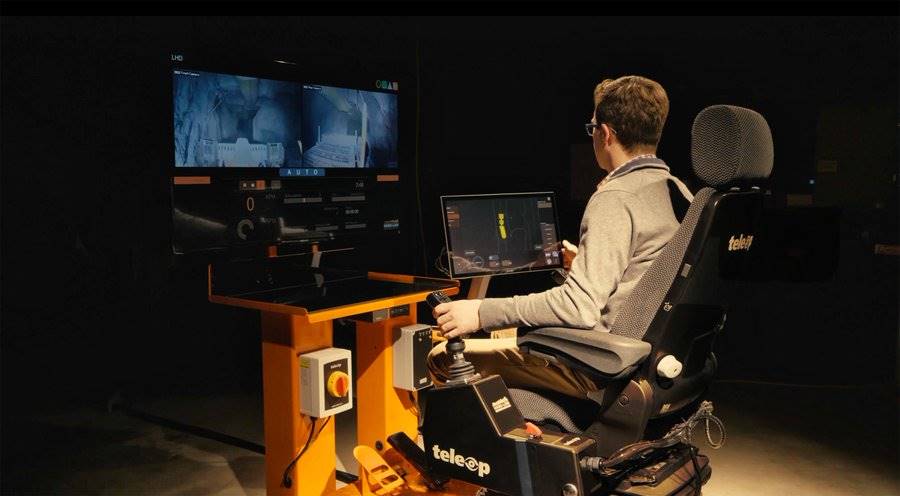
One major complexity in physical AI data collection is the need for diversity.
A humanoid robot trained in a specific environment may fail to understand new environments (e.g., dimly lit rooms).

Crypto is an excellent mechanism for incentivizing individuals to contribute real-world data, capturing highly diverse environments.
Related projects: @PrismaXai, @MeckaAI, @silencioNetwork, @rayvo_xyz, @VaderResearch, @BitRobotNetwork, @AukiNetwork
Robotics Models
@PrimeIntellect is a leading example of decentralized model training.
By using crypto to reward contributions based on data provenance, it may be possible to build superior robotics models.
Related projects: @OpenMind, KineFlow
Hardware
One key bottleneck in robotics is the latency involved in fine-tuning robotics models.
This issue is especially pronounced when research labs lack necessary hardware (e.g., robotic arms, humanoid robots) to test models and collect fine-tuning data.
A DePIN (Decentralized Physical Infrastructure Network) robotics network could be established, allowing individuals or research labs to rent out robotic hardware for model testing.
This financial layer opens access to hardware for researchers while creating a steady income stream (rental revenue) for hardware providers.
Conclusion
The future of crypto, AI, and robotics is bright.
If you're building anything interesting in this space, feel free to reach out and see if it can be built on @monad!
Join TechFlow official community to stay tuned
Telegram:https://t.me/TechFlowDaily
X (Twitter):https://x.com/TechFlowPost
X (Twitter) EN:https://x.com/BlockFlow_News
 cookies