Betting on the real world: What business are these 8 prediction markets in?
TechFlow Selected TechFlow Selected
Betting on the real world: What business are these 8 prediction markets in?
The real turning point for this sector lies not in product form, but in institutional boundaries.
 Navigating Web3 tides with focused insights
Author: Viee, Core Contributor at Biteye
Editor: Denise, Core Contributor at Biteye
*Approximately 3800 words, estimated reading time 10 minutes
Recently, the prediction market sector has seen a sharp rise in attention. In early October, ICE, the parent company of the New York Stock Exchange, announced an investment of up to $2 billion in Polymarket, valuing the company at around $9 billion post-investment. Days later, U.S.-compliant prediction market Kalshi also secured $300 million in funding, pushing its valuation to $5 billion.
Accompanied by substantial funding, trading volumes on leading platforms like Kalshi and Polymarket have surged. Kalshi expects its annualized trading volume this year to reach $50 billion, capturing over 60% of the global market share—surpassing Polymarket for the first time.
At a time when crypto narratives are cooling and regulatory scrutiny is intensifying, why are prediction markets being revisited? Has their product form truly undergone a qualitative transformation? And which next-generation projects are attempting to move beyond the old path of being mere "games of speculation"?
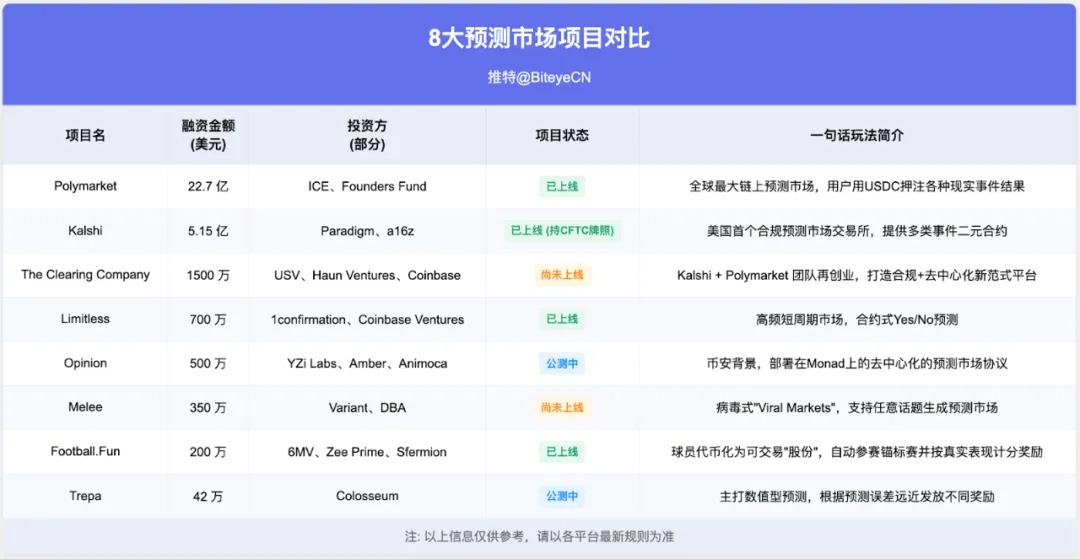
Below are eight representative project samples, offering insight into different approaches across product design, regulatory navigation, and funding logic within this sector.
01 Ploymarket, @Ploymarket
Polymarket is currently the largest global prediction market platform, having raised $2.279 billion in massive funding. In October, ICE, the parent company of the NYSE, committed to investing up to $2 billion in Polymarket, giving it a pre-investment valuation of $9 billion.
Polymarket was founded in 2020 by Shayne Coplan. Having participated in the Ethereum ICO during high school, Shayne is regarded as a prodigy in the crypto space. Facing regulatory pressure, Polymarket acquired QCEX, a derivatives exchange holding a CFTC license, for $112 million in 2025, thereby obtaining legal operating status in the U.S.
Polymarket follows the classic prediction market model, allowing users to bet on real-world event outcomes using cryptocurrency. Users participate by purchasing "prediction shares," where each share represents a bet on a specific outcome. Once the event result is confirmed, users holding shares corresponding to the correct outcome receive payouts. All transactions occur on-chain and are settled in USDC, ensuring financial stability and enhancing transparency.
02 Kalshi, @Kalshi
Kalshi is the first licensed and compliant comprehensive prediction market exchange in the United States, having raised $515 million with lead investments from Paradigm and a16z.
Kalshi was founded in 2018 by Tarek Mansour and Luana Lopes Lara at MIT. The founders chose a difficult but compliant path, engaging in prolonged negotiations with the Commodity Futures Trading Commission (CFTC), ultimately becoming the first prediction market platform to obtain regulatory approval from the CFTC.
Kalshi opened access to the U.S. market in 2021, offering contracts on political elections, economic indicators, sports events, and more. In 2024, it won a legal case granting it the right to list U.S. presidential election contracts, filling a key compliance gap.
03 The Clearing Company, @theclearingco
The Clearing Company is a prediction market launched by former team members of Kalshi and Polymarket, having raised $15 million in funding. CEO Toni Gemayel previously served as Platform Growth Lead at both Kalshi and Polymarket.
The platform is still in preparation and development, with the team placing strong emphasis on simplifying user experience. Their goal is to make the new product as easy to use as Robinhood or Coinbase for average users, while also prioritizing compliance in product design. Conceptually, such products aim for a middle ground—staying within regulatory boundaries while lowering the barrier to user understanding. However, whether they can build a viable market ecosystem remains to be seen.
04 Limitless, @trylimitless
Limitless is a high-frequency prediction market offering short-term price prediction contracts ranging from minutes to daily expiries. It has raised approximately $7 million in funding from prominent crypto investors including 1confirmation and Coinbase Ventures, and was founded in 2023 by CJ Hetherington and others.
Limitless officially launched on Base mainnet in May 2025, later expanding to Arbitrum and other Layer 2 networks. Its product resembles a traditional derivatives exchange, allowing users to place "Yes/No" bets on short-term price movements with predefined expiration times, with results determined by on-chain oracles upon settlement.
In terms of data performance, Limitless has created numerous ultra-short trading scenarios, with some users leveraging rapid resolution for short-term arbitrage. However, this has also drawn criticism: users have pointed out that the platform once listed markets with predetermined or nearly impossible outcomes without charging fees—for example, BTC price markets expiring within 1.5 hours. These so-called "transparent markets" were exploited by arbitrageurs to inflate trading volume. The team has responded that it has since optimized market creation rules to prevent such occurrences.
05 Opinion, @opinionlabsxyz
Opinion Labs (O.LAB) has raised $5 million in funding, led by YZi Labs, with additional investors including Echo, Animoca Ventures, Manifold Trading, and Amber Group.
Currently, Opinion has launched a prediction market on the Monad testnet to gather community feedback and has a collaborative background with Binance Labs.
06 Melee, @meleemarkets
Melee is a rising prediction market backed by Variant Fund, aiming to create "Viral Markets"—enabling any topic to become a prediction market and gaining traction through viral sharing. It has raised $3.5 million in funding from Variant and DAO Builders Alliance (DBA). Co-founder and CEO Max previously served as Head of Strategy at Ava Labs and founded a short-video influencer brand, bringing unique insights into community engagement and business strategy.
To date, Melee remains in development and pre-launch phase, with no official product release yet. The website currently only offers a waitlist registration, accessible by linking an X account. According to official statements, Melee's "viral market" concept features three core elements: any topic can become a market, creators can monetize directly, and early participants are incentivized. Positioned at the intersection of social and prediction markets, it aims to drive broad participation through a UGC (user-generated market) model.
07 Football.Fun, @footballfun
Football.Fun centers on player predictions, tokenizing real-world professional athletes into tradable "shares." Users can hold player cards and earn points and settlement rewards based on the athletes' actual game performances. Founder Adam is a member of the WolvesDAO community and has completed a $2 million seed round with investors including 6th Man Ventures, Zee Prime, and Sfermion.
08 Trepa, @trepa_io
Trepa focuses on numerical prediction, allowing users to forecast specific values such as macroeconomic indicators and receive variable payouts based on the accuracy of their predictions. It has raised approximately $420,000 in funding, led by Colosseum, a fund created by the former growth lead at the Solana Foundation.
The Trepa team was established in Singapore in 2024, with core members possessing cross-disciplinary backgrounds. Currently in public beta, users can select a prediction topic—mostly macroeconomic or financial data such as a country's inflation rate or quarterly GDP growth—and submit forecasts by dragging a numerical slider or entering a value directly. Unlike traditional binary markets with only "right/wrong" outcomes, Trepa uses a continuous reward mechanism: the closer the prediction is to the actual result, the higher the payout, with partial rewards even for slightly inaccurate guesses.
09 Compliance Risk: The Sector’s Greatest Uncertainty
Reviewing the above eight projects, it's evident that prediction markets have already diverged significantly in product design and technical implementation. Yet regardless of model, a shared challenge remains: how regulators will define their legal status.
Prediction markets inherently carry characteristics of "speculation + gambling," making them sensitive in most jurisdictions. In the U.S., a few projects like Kalshi have obtained compliance licenses, while Polymarket has attempted to establish a legal pathway through acquisition. However, many other projects remain in regulatory gray areas.
Moreover, even on-chain platforms face unavoidable risks:
Market manipulation: A small number of actors with significant capital may influence price direction, undermining informational efficiency
Oracle risk: Data sources may be incorrect or attacked, leading directly to settlement errors
Smart contract security: Some newer platforms lack full audits, leaving funds vulnerable to theft
Liquidity exit challenges: Some markets have limited liquidity, posing risks of trapped capital
Based on experience, prediction markets generally should not be approached with all-in bets. Instead, a diversified strategy of small, multiple wagers is recommended to hedge against uncertainty in individual markets. For those eager to participate, beginners should consider starting with compliant platforms that offer strong user experience—Polymarket is a solid starting point.
Beyond that, the biggest barrier for newcomers lies in understanding the trading mechanics and technical usage. In prediction markets, placing a bet isn't as straightforward as simply buying "up" or "down." Users must interpret probabilities embedded in odds or prices. For instance, a price of 0.20 implies a 20% market-estimated probability of the event occurring—an understanding that requires some learning compared to traditional odds. It's advisable to spend time reading platform guides or online educational content to grasp profit-and-loss calculations in binary markets.
10 Final Thoughts: Tool or Speculative Variant?
Prediction markets are not new. As early as the 2000s, think tanks and economists viewed them as tools for "information aggregation and social consensus formation." Yet in reality, over the past two decades—whether in Web2 or blockchain applications—prediction markets have failed to achieve widespread breakthroughs. On one hand, compliance barriers limit user scale; on the other, their speculative nature hinders broad institutional support.
The recent resurgence of interest in Polymarket and Kalshi may reflect capital chasing a new narrative cycle—or merely signal an incremental addition to existing market tools. Either way, it hardly qualifies as a force capable of "transforming market structure."
The true turning point for this sector does not lie in product innovation, but in regulatory boundaries. Until robust risk management and access frameworks are established, cautious observation remains essential.
Join TechFlow official community to stay tuned
Telegram:https://t.me/TechFlowDaily
X (Twitter):https://x.com/TechFlowPost
X (Twitter) EN:https://x.com/BlockFlow_News
 @BiteyeCN