








He Yixin's new article: Being an entrepreneurial cultivator in the new era
TechFlow Selected TechFlow Selected
He Yixin's new article: Being an entrepreneurial cultivator in the new era
Come! Let's cultivate immortality together!
 Navigating Web3 tides with focused insights
Author: Yi He
I usually don't like playing daddy for others, unless someone comes to play daddy on me.
If we look back, Bitcoin was born against the backdrop of the 2008 financial crisis. At that time, no one could have imagined that a whitepaper and an open-source codebase would become the single best-performing asset over the past 17 years. Times are changing—the concept of money is changing, the idea of assets is evolving, policies are shifting. On a path where no one has walked before, we in this industry went from being labeled as "running pyramid schemes" by others, to calling ourselves "honorable Wall Street traders." Along this journey, our community has grown larger and larger, facing fork after fork. Each choice becomes a filtering process—some people grow closer, while others drift further away.
As an entrepreneur who believes in "value investing" and "long-termism," I believe only businesses that solve real user problems and can charge users for it qualify as true startups and real construction. The fundamental reason I've held Bitcoin and BNB long-term for many years is because I'm bullish on the entire industry. Within this industry, BTC is the top-tier decentralized asset, and Binance is the project with the largest user base and strongest team. If this team isn't already among the world's elite, then I'll make it into one.
Binance has never been some high-and-mighty, perfect team. We've stumbled along the way, fixing the plane while flying it. We once paid a huge price, which is why today we put compliance first. Binance has invested massive resources into compliance—so much so that even third-party auditors call us the gold standard in the industry. Our compliance spending exceeds product investment by more than five times, heavier than traditional finance. Many of Binance’s services weren’t the first in market—because when you're leading, following is often the better strategy. In sailing, if you're ahead, just mirror the turns behind you—it works every time. I wasn't the first to launch an exchange; we weren't first in futures; not first in P2P; not first to integrate on-chain wallets into products. But we were the first to require KYC even for on-chain wallets 😂. Our products all started from "not even a dog would use it." We grew up at village corners in Africa, walked with users through Latin America's Darien Gap, enjoyed cozy coffees at small Australian shops, and endured classic East Asian grind culture. We don’t have F1-style extravagance. We’re with nearly 300 million users, moving fast in small steps, shaped by community criticism and user suggestions. In other industries, when时代 leaves you behind, it doesn’t even bother saying goodbye. Luckily, in our industry, if you don’t run fast enough, the community will teach you a lesson—we “know shame and then become brave.”
I once believed leverage in futures amplifies human weaknesses, and firmly swore never to do futures—until the 2019 bear market, when every coin was crashing and users were crying out in pain. That’s when I frantically studied finance, learning what hedging and risk protection really meant. Later, I forced two futures teams into a horse-race competition. But we never forgot to make futures users pass tests before trading, nor did we forget to impose cooling-off periods for those recklessly going all-in. My moment of being slapped in the face was crafted entirely by myself.
I once thought MEMEs were conspiracy schemes wrapped in subculture, believing only serious projects taking real responsibility for their holders were the right path. Then I saw those seemingly trustworthy, well-connected, polished teams—publicly preaching dreams and ideals—only to treat Binance as their final liquidity exit before dumping everything. Seeing retail investors defenseless against professional players, getting rekt in spot or blown up in futures—I understood their anger. Yet I felt powerless to change the structural flaws of the industry. Once, during a 6-hour AMA, I choked up—because I didn’t know how to ensure both retail and pros could get a fair share. What if we made our users the first stop instead? That’s where Alpha began. Eventually, I made peace with myself: most users don’t expect to win forever. What they want—what they truly crave—is fairness, fairness, and goddamn fairness. Users aren’t trading “Binance Life” or “Customer Service Xiao He,” but rather chasing that tiny bit of fairness, opportunity, and consensus built brick by brick under these contract addresses (CAs). Let me also ungracefully remind everyone: MEMEs come with no accountability, lack long-term value support, and are often filled with hidden syndicates—mind your investment risks. Just because a CA contains references to Binance or me, or quotes my tweets, doesn’t mean Binance or I endorse it. For MEME players, Binance, me, dogs, pigs, frogs, memes—all exist in the same quadrant, utterly indistinguishable. Oppose MEMEs, understand MEMEs, and ultimately become a MEME. The clown was me all along.
Compared to the entire financial market, crypto is still a drop in the ocean. The market is big enough to accommodate many giants. That’s why we don’t attack competitors. We learn from other entrepreneurs and projects—if we can’t grasp it, we invest or acquire. Because at the end of the day, real business warfare is about who better serves users, not hair-pulling or spitting matches. YZi Labs plans to invest 1 billion USD to support the ecosystem and developers, aiming to incubate a batch of outstanding projects—that’s real competition. Over the years, countless piles of crap have been thrown at us, yet we’ve used them all to grow beautiful flowers. When our wallet sucked, we kept improving until it didn’t. From not understanding why MEMEs existed, to immediately debunking rumors and strictly distancing ourselves whenever a CA mentioned Binance, back to focusing on what we should do—this path hasn’t left our Dao heart unscathed.
As a startup cultivator in this new era, thank you for spending time reading this information-light long post. After thinking hard, I had to forcefully inject some value—it’s consistent with our long-standing ethos of benefiting others.
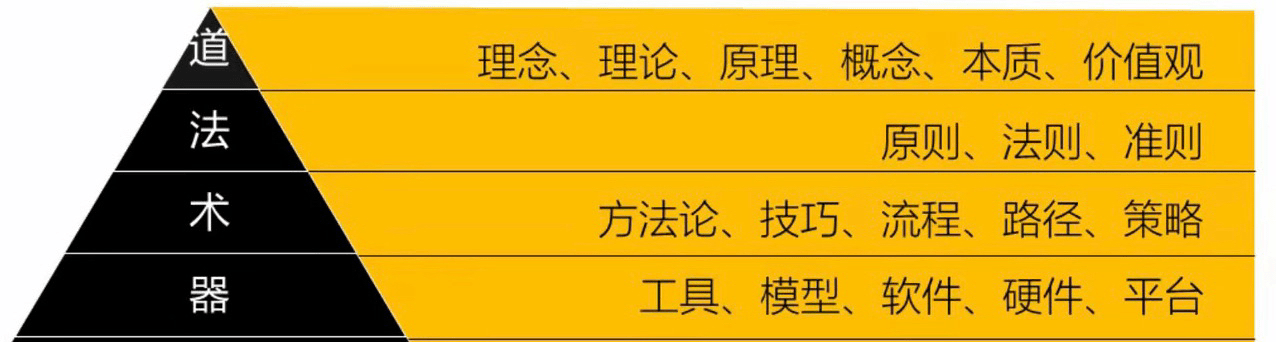
Startup building, trading, making money, and Dao cultivation are essentially the same thing—they all revolve around Dao, Fa, Shu, and Qi.
If you haven’t figured it out, any money you made blindly will eventually be lost just as blindly. After all, people can only earn money within the limits of their own understanding.
Dào (道) refers to the operating rules of the world—only what aligns with these natural laws can last long and go far. Just like our industry thrives not because one individual is brilliant, but because it follows the trajectory of global evolution.
Fǎ (法) means principles—the cultural values unique to each company and organization. For Binance, it’s user-centricity, freedom, collaboration, hardcore execution, and above all, humility.
Shù (术) refers to tactics. People easily obsess over tricks, power plays, and marketing gimmicks—but these are merely minor paths.
Qì (器) stands for tools and products. In mobile internet, tool-based products are the easiest to replace.
Every person, company, and organization has its strengths. Excelling in just one area is enough to achieve great results—everyone can find their place. Ultimately, our Binance sect still lacks talent. So yes, this remains a job posting. Come join us and cultivate together.
Join TechFlow official community to stay tuned
Telegram:https://t.me/TechFlowDaily
X (Twitter):https://x.com/TechFlowPost
X (Twitter) EN:https://x.com/BlockFlow_News
 Yi He
Yi He


