









Boom, Fall, and Escape: The Disillusionment of Classical VC in Web3
TechFlow Selected TechFlow Selected
Boom, Fall, and Escape: The Disillusionment of Classical VC in Web3
Crypto is never a belief, just a footnote of cycles.
 Navigating Web3 tides with focused insights
By: Ada & Liam, TechFlow
"All in Crypto"!
In 2021, Neil Shen, the head of Sequoia China, typed those words into a WeChat group. The screenshot quickly spread across countless investment groups, like a war drum pushing market enthusiasm to new heights.
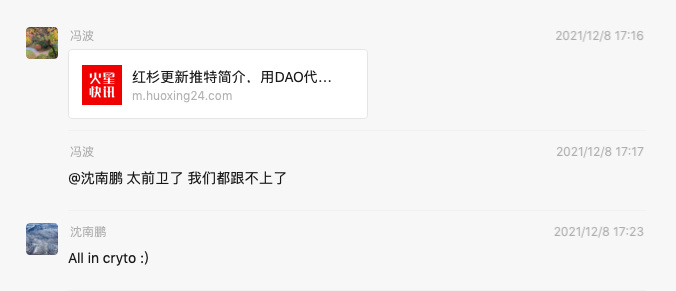
The market atmosphere back then was nearly euphoric. Coinbase had just listed on Nasdaq, FTX was still hailed as the "next Wall Street giant," and nearly every traditional VC rushed to brand themselves as "crypto-friendly."
"This is a technological wave once every thirty years," someone described it. Sequoia's declaration became the most iconic footnote of that bull run.
Yet, only four years later, those words now sound ironic. Many institutions that once swore "All in Web3" have quietly exited, drastically downsized, or pivoted toward chasing AI.
Capital’s flip-flopping is essentially a harsh reminder of cycles.
So how are those Asian traditional VCs who once charged into Web3 doing today?
Pioneers of the Wild West Era
In 2012, Coinbase had just been founded—Brian Armstrong and Fred Ehrsam were merely two startup kids in San Francisco. Back then, Bitcoin was still seen as a geek toy, priced at just over a dozen dollars.
At a YC demo event, IDG Capital cast its angel round vote for Coinbase. By the time Coinbase went public on Nasdaq in 2021, the return on that investment was estimated to be over a thousandfold.
The Chinese story was equally remarkable.
In 2013, OKCoin received investments from Tim Draper and Mai Gang. That same year, Huobi secured funding from ZhenFund. The following year, it attracted Sequoia China, which held a 23.3% stake in Huobi according to disclosures in 2018, making it the second-largest shareholder after founder Li Lin.
Also in 2013, Lightspeed Venture Partners partner David Cao first introduced Bitcoin to a man named Changpeng Zhao during a poker game. "You should dive into Bitcoin or blockchain entrepreneurship," Cao told Zhao.
Zhao sold his house in Shanghai and went all-in on Bitcoin. The rest is history—he founded Binance in 2017, and within just 165 days, Binance became the world’s largest cryptocurrency spot trading platform. Zhao later became the wealthiest person in the crypto space among ethnic Chinese.
Compared to the other two exchanges, Binance’s early fundraising journey wasn’t smooth. It mainly received backing from Fenbushi Capital (founded by Kuaidi Dache’s Chen Weixing), Blackhole Capital (backed by富力 heir Zhang Liang), and several internet and blockchain founders.
A small anecdote: In August 2017, Sequoia China had an opportunity to acquire around 10% of Binance at an $80 million valuation, but the deal fell through due to reasons on Binance’s side. Afterwards, Sequoia even sued Binance, leading to a highly unpleasant rift between the two parties.
In 2014, angel investor Wang Lijie invested 200,000 RMB in the domestic blockchain project NEO (Ant), marking the most important investment of his life.
From 2012 to 2014, when native crypto VCs were still in their infancy, it was traditional VCs that carried half the weight of Web3—whether it was the three major exchanges, Bitmain, imToken... all bore the marks of established players like Sequoia and IDG.
Everything went crazy in 2017.
Under the ICO wave, countless tokens surged in value. Wang Lijie, already having made significant profits, chose to sell his NEO holdings at 1.5 yuan per token. But NEO kept rising, eventually peaking above 1,000 yuan—a cumulative gain of over 6,000x in three years.
Deeply shaken, Wang Lijie began aggressively betting on blockchain projects, claiming he’d “sleep at 1 a.m. and wake up at 5 a.m., meeting founders and reading whitepapers all day, investing an average of $2 million worth of Ethereum daily.” So much so that when someone invited him for tea, he replied: "You’re wasting my time making money."
In January 2018, Wang Lijie said at a blockchain summit in Macau: "I’ve earned more in the past month than I did in the previous seven years combined."
Also in early 2018, ZhenFund founder Xu Xiaoping delivered a speech in a 500-member internal WeChat group with strict instructions: “Do not share this.” He declared that blockchain was a revolutionary technological shift where “those who follow will thrive, those who resist will perish,” far more rapid and thorough than the internet or mobile internet revolutions, urging everyone to embrace it.
The statements of these two individuals became the most famous peak indicators of that bull cycle.
In 2018, the ICO bubble burst. Thousands of tokens dropped close to zero. Once-celebrated star projects saw their market caps evaporate. Bitcoin also plunged from near $20,000 to just over $3,000—a decline of more than 80%.
By the end of that year, “crypto” had become a dirty word in investment circles.
"I attended a startup event in Beijing. A VC partner joked, 'If your startup fails, no worries—you can just launch a token.' Everyone laughed, but I felt nothing but embarrassment and panic," recalled former blockchain entrepreneur Leo.
In the second half of 2018, the entire industry seemed to hit pause. Once-bustling WeChat groups fell silent overnight. Project discussion groups were flooded with Pinduoduo referral links. On March 12, 2020, the market suffered another single-day crash, halving in value. Bitcoin briefly lost 50% of its price, as if the apocalypse had arrived.
"It wasn't just that traditional VCs looked down on crypto—I myself thought the industry was dead," said Leo.
Both entrepreneurs and investors were treated as jokes by mainstream narratives. As Su Zhixiong recalled, he would never forget the look of “scam artist” in Wang Xiaochuan’s eyes when sizing him up.
In 2018, the crypto world fell from the center of wealth creation myths to the very bottom of the鄙视 chain.
Traditional VCs Return
In hindsight, March 12, 2020 marked the darkest valley point for the crypto industry in the past decade.
WeChat Moments were flooded with blood-red K-charts. People thought this was the final blow—the end of the industry.
But the turnaround came unexpectedly and fiercely. The Federal Reserve unleashed massive liquidity, reviving the near-death market. Bitcoin took off from its lows, gaining over sixfold within a year, transforming into the most dazzling asset in the post-pandemic era.
Yet what truly made traditional VCs take crypto seriously again might have been Coinbase’s IPO.
In April 2021, the nine-year-old exchange rang the Nasdaq bell. It proved that “crypto companies can go public,” delivering thousandfold returns to early investors like IDG.
Coinbase’s bell echoed between Wall Street and Liangmaqiao. According to crypto media insider Liam, many traditional VC professionals reached out to him afterward, seeking offline meetings to understand the overall state of cryptocurrency.
But in Leo’s view, the return of traditional VCs wasn’t solely driven by wealth effects.
"These people naturally wear elite masks. Even if they secretly bought some crypto during bear markets, they wouldn’t admit it publicly," he said. "What truly helped them remove those masks was the upgrade in narrative: from Crypto to Web3."
This conceptual shift was largely driven by Chris Dixon, head of a16z crypto. Saying “investing in cryptocurrencies” was equated with speculation in many minds, but rephrasing it as “investing in the next-generation internet” instantly added a sense of mission and moral legitimacy. Condemning Facebook and Google’s monopolies while championing decentralization and fairness earned applause. The DeFi craze and NFT explosion could easily be framed within this grand narrative.
The popularization of the Web3 narrative allowed many traditional VCs to shed their moral burdens.
Will, a fintech investor at a top-tier firm, recalled: "We underwent a cognitive shift. Initially, we saw it as an extension of consumer internet, but that logic was proven false. What truly changed our perspective was fintech."
In his view, the surge in Web3 interest coincided precisely between the tail end of mobile internet and the dawn of AI. Capital needed a new story, so blockchain was forcefully squeezed into the internet framework. But what truly pulled the industry out of its death spiral was the awakening of its financial nature. "Look at the successful projects—how many aren’t tied to finance? Uniswap is an exchange, Aave is lending, Compound is wealth management. Even NFTs are essentially financialization of assets."
Another catalyst came from FTX.
Founder SBF emerged as a “financial prodigy,” capturing the hearts of nearly all major traditional VCs. His heroic image and rapidly inflating valuation ignited global VC FOMO.
At venture capital drinking sessions in Beijing, big-name investors were constantly asking, “Who can get me pre-IPO shares of FTX or Opensea?” envying those lucky enough to have already acquired them.
During this period, an interesting phenomenon emerged: talent mobility between traditional VCs and crypto-native funds.
Some left Sequoia and IDG to join emerging crypto funds; others moved from crypto VCs into traditional firms, directly taking titles like “Head of Web3.” This two-way flow of capital and talent brought crypto into the mainstream investment narrative for the first time.
The 2021 bull market was like a carnival.
WeChat groups were buzzing—but this time, they included traditional VCs, family offices, and tech giants.
NFTs were hot, and VC partners replaced their avatars with high-value NFTs like monkeys and Punks. Even Zhu Xiaohu, who had previously dismissed crypto, switched to a monkey avatar. At offline conferences, alongside native crypto founders, one began seeing polished traditional VC partners.
Traditional VCs entered Web3 in various ways: directly investing in crypto projects, sending valuations soaring; acting as LPs in crypto funds—Sequoia China, once embroiled in legal disputes with Binance, even became an LP in Binance Labs after reconciliation; or buying Bitcoin directly in secondary markets...
Crypto VCs, traditional VCs, exchanges, and project teams intertwined, driving valuations ever higher. Everyone anticipated a brighter bull market. Yet beneath the noise, risks quietly brewed.
VCs Fall
If 2021’s bull market was heaven, then 2022 was instant hell.
Rise and fall by FTX. The collapse of LUNA and FTX didn’t just destroy market confidence—it dragged down a batch of traditional VCs. Institutions like Sequoia Capital and Temasek suffered heavy losses, with Temasek, as state capital, even facing parliamentary scrutiny in Singapore.
After the bull bubble burst, numerous once-high-valued crypto projects reverted to reality. Unlike native crypto VCs, who tested waters cautiously via syndicates, traditional VCs were accustomed to large bets—single investments often reaching tens of millions of dollars. They also bought large quantities of SAFTs from crypto VCs, becoming key exit liquidity in the previous cycle.
What chilled traditional VCs even more was how rapidly the crypto narrative shifted, exceeding their investment logic. Projects once full of promise could be completely abandoned by the market months later, leaving investors stuck with illiquid equity and deep losses.
Ethereum L2 is a classic case. In 2023, Scroll raised funds at an $1.8 billion valuation, with Sequoia China and启明创投 on its investor list. Yet on September 11 this year, Scroll announced the suspension of its DAO governance and core team resignations. Its total market cap now stands at just $268 million—VC investments down 85%.
Meanwhile, the dominant position of exchanges and market makers made VCs appear increasingly redundant.
Investor Zhe bluntly stated: "For projects valued under $30–40 million, if they can list on Binance, you might still make a profit—double or triple after lock-up ends. But if they're pricier and can only list on OKX or smaller exchanges, you’re guaranteed to lose."
In his view, profitability no longer depends on the project itself, but on three factors:
Whether it can list on Binance;
Whether the token distribution favors investors;
Whether the team is willing to “feed the meat.”
"Exchanges hold all the power—they eat the biggest slice. What’s left is just luck."
Zhe’s words reflect the pain of many traditional VCs.
They realized their role in primary markets had become increasingly like “porters”: paying to invest, only to see exchanges reap the lion’s share, leaving them with scraps. Some even lamented: "Honestly, there’s no need for primary markets anymore. Projects can earn money just by listing on Binance Alpha—why share profits with VCs?"
As capital logic failed, traditional VCs also shifted focus. As Will put it, Web3’s rise occurred precisely between the end of mobile internet and the beginning of AI—an “interim period.” But when ChatGPT exploded onto the scene, a true North Star emerged.
Capital, talent, and narratives instantly rerouted toward AI. On WeChat Moments, VC professionals who once enthusiastically shared Web3 funding news swiftly rebranded themselves as “AI investors.”
According to former traditional VC Zac, during the 2022–2023 peak, many traditional VCs were actively looking at Web3 projects. But now, 90% have stopped. He predicts that if the Asia-Pacific crypto primary market remains as cold as it is now for another six to twelve months, even more will abandon it.
No More Big Bets
In 2025, the Web3 primary market overall resembles a shrinking chessboard.
The excitement has faded. Few players remain, yet the landscape is quietly being reshaped.
As a barometer for traditional VCs, Sequoia’s moves remain noteworthy.
According to Rootdata, Sequoia China invested in seven projects in 2025: OpenMind, Yuanyi Tech, Donut, ARAI, RedotPay, SOLO, and SoSoValue. Following closely were IDG Capital, GSR Ventures, and Vertex Ventures. Previously active启明创投 made its last Web3 investment in July 2024.
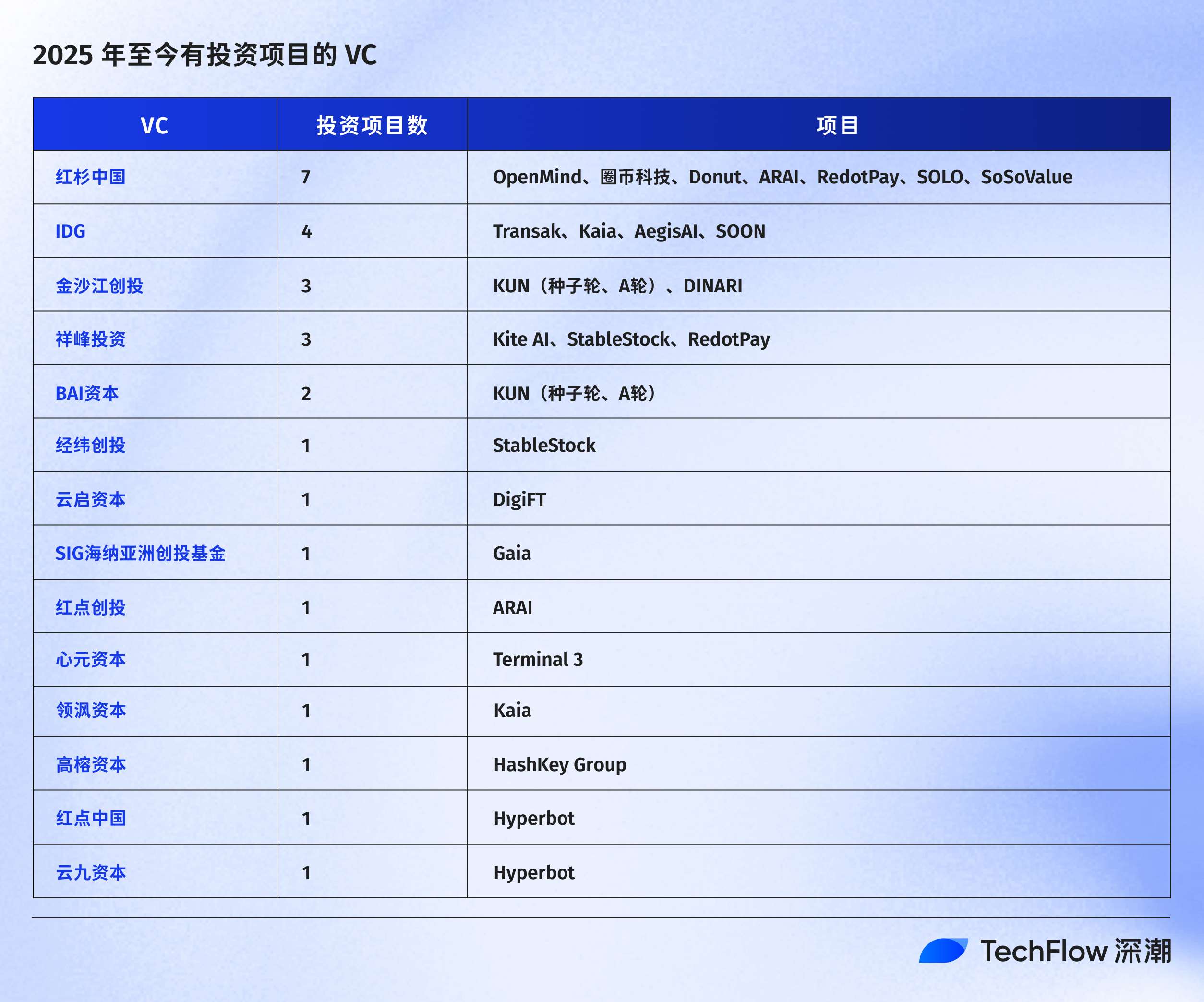
Based on Zac’s observation: "Nowadays, the number of traditional VCs still looking at Web3 projects can be counted on one hand."
In his view, the quality of crypto projects has severely declined.
"Teams genuinely striving for PMF and creating long-term user value receive far less positive feedback than those mastering attention economics and active market-making," Zac said.
Besides, crypto treasury firms represented by MicroStrategy and BMNR have become a new investment option, further draining the already-drying crypto primary market.
"Do you know how many PIPE deals are out there now?" asked Dragonfly Capital partner Wang Yuehua. "At least 15, each needing about $500 million—that’s $7.5 billion total. The big money is almost all on Wall Street, and they’re going into PIPEs."
PIPE (Private Investment in Public Equity) refers to public companies issuing stocks or convertible bonds at a discount to select institutional investors for fast fundraising.
Many上市公司 unrelated to crypto have raised large sums via PIPE, then used the funds to buy substantial BTC, ETH, SOL, etc., transforming into crypto treasury firms. Investors who enter at discounted prices often reap rich rewards.
"That’s why the primary market has no money left," said Wang Yuehua. "Big funds prefer the higher certainty of PIPE. Who wants to risk early-stage investments anymore?"
While some leave, others stay. Will chooses to believe and persist. He believes in Web3, in AI, and is even willing to invest in seemingly “non-commercial” public goods.
"Not everyone needs to do business," said Will. "Truly great projects often start as simple public goods. Like Satoshi Nakamoto creating Bitcoin—he did no pre-mine, no fundraising—yet created the most successful financial innovation in human history."
Glimmers of the Future
Several major events in 2025 are changing the rules of the game.
Circle’s IPO acted like a spark, igniting both stablecoins and RWA (Real-World Assets).
The stablecoin issuer listed on the NYSE at a ~$4.5 billion valuation, offering traditional VCs a rare “non-tokenized” exit case. Soon after, Bullish, Figure, and others followed, boosting investor confidence.
"We don’t touch pure token-based primary or secondary markets, but we do look at stablecoins and RWA," several traditional VCs said with similar views. The reason is simple: large market size, visible cash flows, clearer regulatory paths.
Stablecoin business models are more “bank-like”—earning from reserve interest spreads, issuance/redemption/settlement fees, and compliant custody and clearing network services—naturally capable of sustainable profitability.
RWA brings receivables, government bonds, mortgages/real estate, fund shares, and more “on-chain,” generating revenue from fees and spreads across issuance, matching, custody, and circulation.
If the previous generation of crypto companies listed on U.S. stock exchanges were mainly exchanges, miners, and asset managers, the new wave of IPOs belongs to stablecoins and RWA.
Meanwhile, the line between stocks and tokens is blurring.
The “MicroStrategy model” of corporate treasury strategies has attracted followers. Public companies raise capital via equity financing or PIPEs, allocate to top assets like BTC/ETH/SOL, and transform into “crypto stocks.”
Behind the leaders in this space, one sees figures like Peter Thiel and many traditional VCs. Some institutions have even joined directly—for example, Huaxing Capital announced a $100 million purchase of BNB, choosing to participate in crypto allocation via public markets.
"Traditional finance is embracing crypto," said Wang Yuehua. "Look at Nasdaq investing $50 million in Gemini—this isn’t just a capital move, but a shift in attitude."
This change is also evident at the LP level. According to multiple sources, sovereign wealth funds, pension funds, university endowments, and other traditional LPs are reassessing the allocation value of crypto assets.
Ten years of capital history—rising and falling like tides. Asian traditional VCs once pushed exchanges onto the stage and shouted “All in” during bull markets, only to end up as marginal players in the crypto world.
Today, despite the current chill, the future may still hold glimmers of light.
As Will firmly believes: "Traditional VCs will inevitably allocate more to crypto-related fintech investments."
Will traditional VCs re-enter en masse? No one dares claim that. The only certainty is that the crypto world will keep moving forward.
Join TechFlow official community to stay tuned
Telegram:https://t.me/TechFlowDaily
X (Twitter):https://x.com/TechFlowPost
X (Twitter) EN:https://x.com/BlockFlow_News
 深潮TechFlow


