Space Recap | Gas Fees Continue to Decline: The Public Chain Competition Enters a New Era of "User Supremacy"
TechFlow Selected TechFlow Selected
Space Recap | Gas Fees Continue to Decline: The Public Chain Competition Enters a New Era of "User Supremacy"
In the era of "the user is king," how can users simultaneously achieve "cost reduction" and "share the dividends of ecosystem growth"?
 Navigating Web3 tides with focused insights
If the pulse of the blockchain world beats with transactions, then Gas is the "barometer" measuring its temperature. Recently, this barometer has been clearly pointing to an industry-wide trend: a "fee-reduction wave" quietly driven by mainstream public chains. As gas fees continue to decline, it marks a fundamental shift in public chain competition—from yesterday's "performance arms race" to a deeper strategic game centered on user cost and experience.
Data shows that after TRON significantly lowered its base fees, its network still contributes over 90% of Layer1 transaction fee revenue. This not only highlights the strong resilience of a highly active ecosystem but also raises a critical question for the market: as "low-cost" or even "zero gas fee" becomes feasible, what new opportunities will emerge for ecological innovation and user growth?
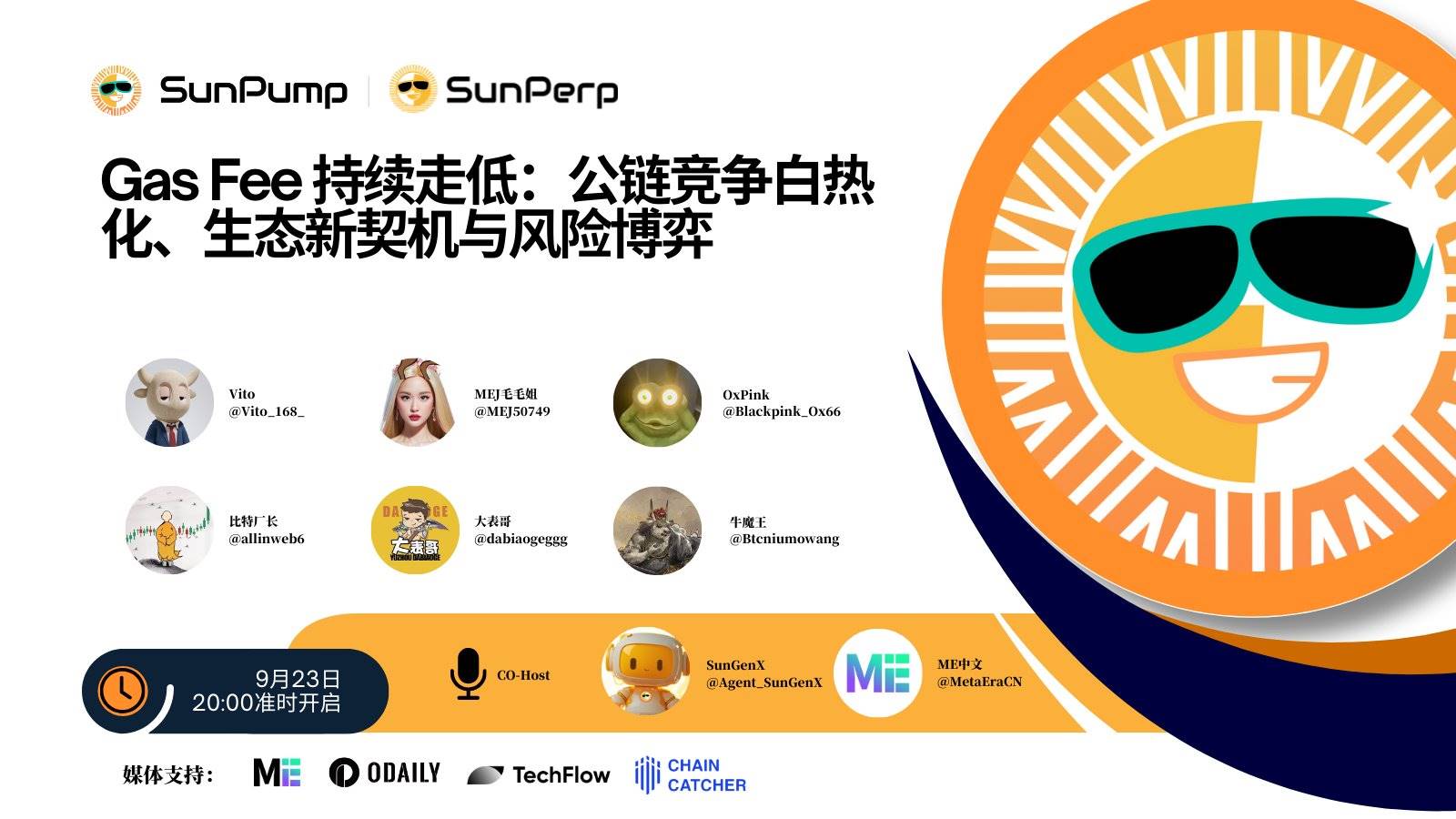
In response to this industry inflection point, SunPump co-hosted a Space discussion with Metaera, a leading Web3 information platform, and SunPerp, a decentralized perpetual contract trading platform in the TRON ecosystem, themed “Gas Fees Keep Falling: Intensifying Public Chain Competition, New Ecological Opportunities, and Risk Balancing.” On the evening of September 23 at 8:00 PM, multiple industry experts gathered on X for an in-depth dialogue. This discussion analyzed the motivations behind the phenomenon, explored the coexistence of opportunities and risks, and sought sustainable solutions. Below are the highlights and key insights from the event.
Ecological Consensus and Undercurrents of Security Amid the Gas Fee Decline
At the outset of the discussion, several guests agreed that the widespread reduction of gas fees across public chains indeed signals a new phase of industry competition centered on “user cost and experience.” This does not diminish the importance of performance; rather, it means performance has become a basic threshold, and the deciding factor now lies in how well chains serve users and developers.
Guest Niu魔王 (Bull King) reviewed the industry’s evolution, noting that early public chain competition often focused on hardcore technical metrics like TPS. Today, however, what users feel most directly is “how much does a transfer cost?” and “is the operation smooth?” Drastically lowering gas fees reduces the barrier to entry—especially for small-transaction users—and enables developers to explore innovative applications involving micro-payments and high-frequency interactions, which is crucial for ecosystem activity and retention.
Guest 0xPink expressed agreement, viewing low gas fees as a strategic move. Using TRON as an example, he pointed out that despite reduced base fees, it still generates over 90% of Layer1 transaction fee revenue, proving that lower rates do not undermine value. Instead, by attracting massive users and capital, it enhances the network’s ecological vitality and capacity to hold funds. Competition is no longer just about “performance benchmarks,” but has evolved into a comprehensive contest centered on user experience, ecosystem appeal, and network effects.
Yet beneath the feast lie hidden concerns. The discussion quickly turned to the second core issue: could near-zero gas fees erode the foundation of network security?
Most guests believed that risks can be mitigated through economies of scale and application innovation. 0xPink summarized: “It’s a delicate balancing act. Low gas fees are a double-edged sword—they can rapidly stimulate the ecosystem but inevitably create security pressure. The key is that public chains must not blindly cut fees, but must innovate in economic and governance mechanisms to find a sustainable balance between enhancing user experience and ensuring network security.”
Solution: How TRON Leverages SunPerp to Achieve Both Lower Fees and Enhanced Security
After clarifying the opportunities and risks brought by low gas fees, the discussion moved to the most critical question: how to resolve the dilemma between “lowering fees” and “maintaining security,” and find a sustainable path forward? Guest Bull King offered constructive insight, arguing that a public chain’s long-term security should not focus solely on gas fee levels, but on building strong ecological value drivers. By attracting high-frequency applications and institutional users, stable and large-scale transaction volumes and capital deposits can form. Even with minimal per-transaction fees, the sheer scale of ecological value itself creates a robust security barrier, and diversified revenues from value-added services can feed back into network security.
When discussing such value drivers, attention naturally turned to SunPerp, a co-host of this Space. As the first decentralized perpetual contract trading platform in the TRON ecosystem, SunPerp aims to deliver institutional-grade trading experiences and ultimate asset security through its core advantage of zero gas fee trading, perfectly aligning with the Space’s theme of “lower fees, enhanced experience”. Through tangible benefits like offering the industry’s lowest contract fees and an upcoming “Deposit & Get Real Cash” gas fee rebate program, SunPerp is demonstrating to the market that low barriers, high security, and superior experience are not mutually exclusive.
0xPink gave high praise to SunPerp’s model, calling it a more refined and sustainable approach to price competition. SunPerp adopts a “zero gas fee trading” model, effectively shifting the cost of fee reduction from the protocol layer to the application layer—where the trading platform absorbs users’ network costs via subsidies, while relying on advanced intelligent risk control and deep liquidity to ensure system security.
0xPink emphasized that SunPerp is not simply burning money in an unsustainable way. Instead, it separates “subsidies” from “risk control,” using product design to balance cost and risk. This offers the industry a new perspective: public chains provide stable, low-cost infrastructure, while application layers use business model innovation to deliver exceptional user experiences. Such division of labor could achieve win-win outcomes—users gain benefits while security remains stable—without requiring major changes to the underlying public chain’s economic model.
Dagege (Big Table Brother) affirmed this view from user and market perspectives. Drawing from personal experience, he noted that projects in the TRON ecosystem have consistently excelled at using real financial incentives to attract users early on, and TRON’s strong revenue base makes this strategy viable. SunPerp directly targets the most profitable segment—the derivatives market—and commits to using platform revenue to repurchase SUN tokens, creating a growth flywheel: low fees attract users → increased trading volume → higher platform revenue → token buybacks incentivize holders → ecosystem prosperity reinforces security. In this model, users save money (low fees) and gain earning opportunities (token economics), forming a powerful attraction.
Conclusion
This session reached a clear conclusion: resolving the tension between lower fees and security requires systemic innovation. Future public chain competition may no longer be a single-dimensional “performance war” or “price war,” but will likely enter a new phase of “protocol layer strengthening foundations, application layer showcasing innovation.” SunPerp’s practice preliminarily proves that through sophisticated product and economic design, achieving unity between low cost and high security at the application layer is feasible—offering an inspiring new case study for the development of DeFi and the broader Web3 industry.
Join TechFlow official community to stay tuned
Telegram:https://t.me/TechFlowDaily
X (Twitter):https://x.com/TechFlowPost
X (Twitter) EN:https://x.com/BlockFlow_News