Four Cents' Ambition: How DeFi Could Disrupt the Stablecoin Market Through Verticalization?
TechFlow Selected TechFlow Selected
Four Cents' Ambition: How DeFi Could Disrupt the Stablecoin Market Through Verticalization?
A stream of interest flows from U.S. government debt, redirected through protocols to tokens, DAOs, and blockchains.
 Navigating Web3 tides with focused insights
Author: Prathik Desai
Translation: Block unicorn
Billions of dollars are at stake, but the final return is only about four cents. That's how much one dollar of U.S. Treasury debt generates in annual returns.
For nearly a decade, decentralized finance (DeFi) protocols have relied on USDT and USDC as pillars of their products, while allowing Tether and Circle to capture yield from their reserves. These companies have earned billions through the world’s simplest yield strategy. Now, DeFi protocols want that yield for themselves.
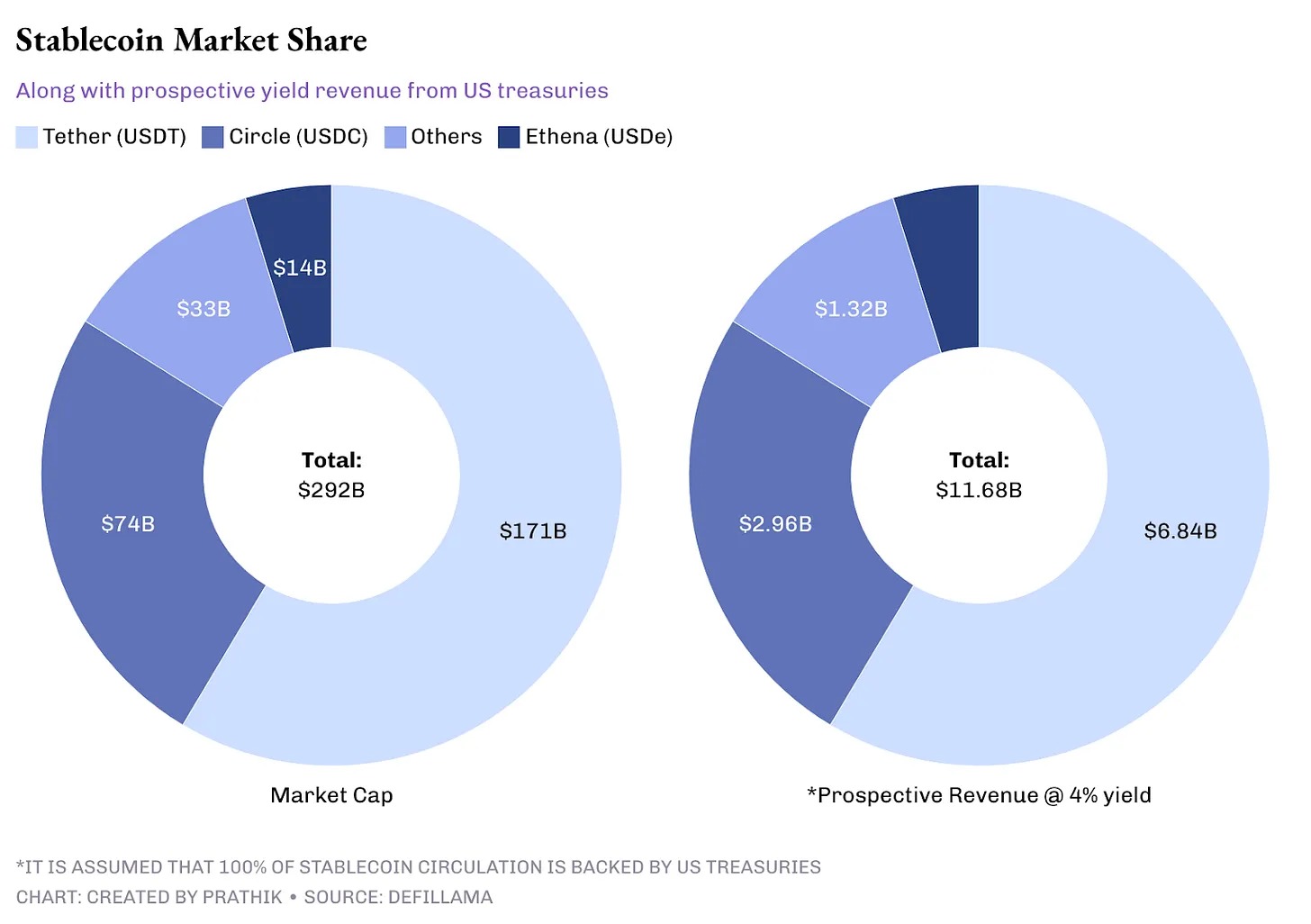
Tether, the stablecoin leader, currently holds over $100 billion in reserves, generating more than $4 billion in interest income annually—exceeding Starbucks’ global coffee profit of $3.761 billion last fiscal year. Tether achieved this simply by investing its reserves in U.S. Treasuries. Circle followed the same approach when it went public last year, highlighting float income as a core revenue stream.
Currently, over $290 billion in stablecoins are in circulation, generating around $12 billion in annual revenue—a sum too large to ignore. This has sparked a new war in DeFi, where protocols no longer accept letting issuers capture this yield. They now want ownership of both the product and its infrastructure.
Earlier this month, Hyperliquid launched a bid for its native stablecoin USDH, requiring winners to return yield. Native Markets, Paxos, Frax, Agora, and Ethena all participated. Native Markets emerged victorious, pledging that 100% of USDH treasury income will flow back to the blockchain: half for HYPE token buybacks, and half for ecosystem funding.
Currently, Hyperliquid’s Layer-1 holds $6 billion in USDC, potentially generating $240 million in revenue. This income, previously held by Circle, may now be redirected toward token burns and developer incentives. For reference, Hyperliquid generated $260 million in net revenue from trading fees in June, July, and August combined.
Ethena is growing faster and larger.
In just two months, its synthetic stablecoin USDe surged from $5 billion to nearly $14 billion in circulation, surpassing Maker’s DAI to become the third-largest USD-pegged stablecoin after USDT and USDC.
In August, Ethena generated $54 million in revenue, a record high for 2025 so far. With its long-awaited fee conversion mechanism now live, up to $500 million annually could be allocated to ENA buybacks, tightly linking the ENA token’s fate to the system’s cash flows.
Ethena’s model involves going long on spot crypto, short on perpetual contracts, and distributing Treasury and staking yields. As a result, sUSDe stakers have enjoyed APYs exceeding 5% in most months.
Veteran Maker was among the first to use U.S. bonds as stablecoin reserves.
It once held over $1 billion in short-term Treasuries, enabling an 8% DAI Savings Rate—briefly higher than the average yield on U.S. junk bonds. Excess funds flowed into its surplus buffer, used for buybacks that destroyed tens of millions of MKR tokens. For token holders, this transformed MKR from a mere governance badge into a claim on real income.
Frax operates on a smaller scale but with sharper focus.
Its supply hovers below $500 million, a fraction of Tether’s $110 billion, yet it remains a money-making machine. Founder Sam Kazemian designed FRAX to reinvest every dollar of reserve income back into the system. Part is burned, part shared with stakers, and the rest deposited into sFRAX, a vault tracking the Fed rate. Even at current scale, the system generates tens of millions annually.
Aave’s GHO stablecoin was built with verticalization in mind.
Launched in 2023, it now has $350 million in circulation. The principle is simple: borrowers pay interest directly to the DAO instead of external lenders. With borrowing rates at 6–7%, this generates about $20 million in revenue, half shared with AAVE stakers and the rest going to the treasury. The new sGHO module offers depositors up to 10% APR—subsidized by reserves—making the offering even more attractive. In effect, the DAO uses its own capital to make its stablecoin resemble a savings account.
Some networks use stablecoin yield as raw infrastructure.
MegaETH’s USDm is backed by tokenized Treasuries, but its income doesn’t go to holders—it covers rollup sequencer fees. At scale, this could mean millions annually spent on gas, effectively turning Treasury coupons into public goods.
All these efforts share one trait: verticalization.
Each protocol refuses to rely on others’ dollar rails. They’re minting their own money, capturing interest once reserved for issuers, and recycling it into buybacks, Treasuries, user incentives, and even subsidizing blockchain operations.
Though Treasury yields seem dull, in DeFi they’ve become sparks for self-sustaining ecosystems.
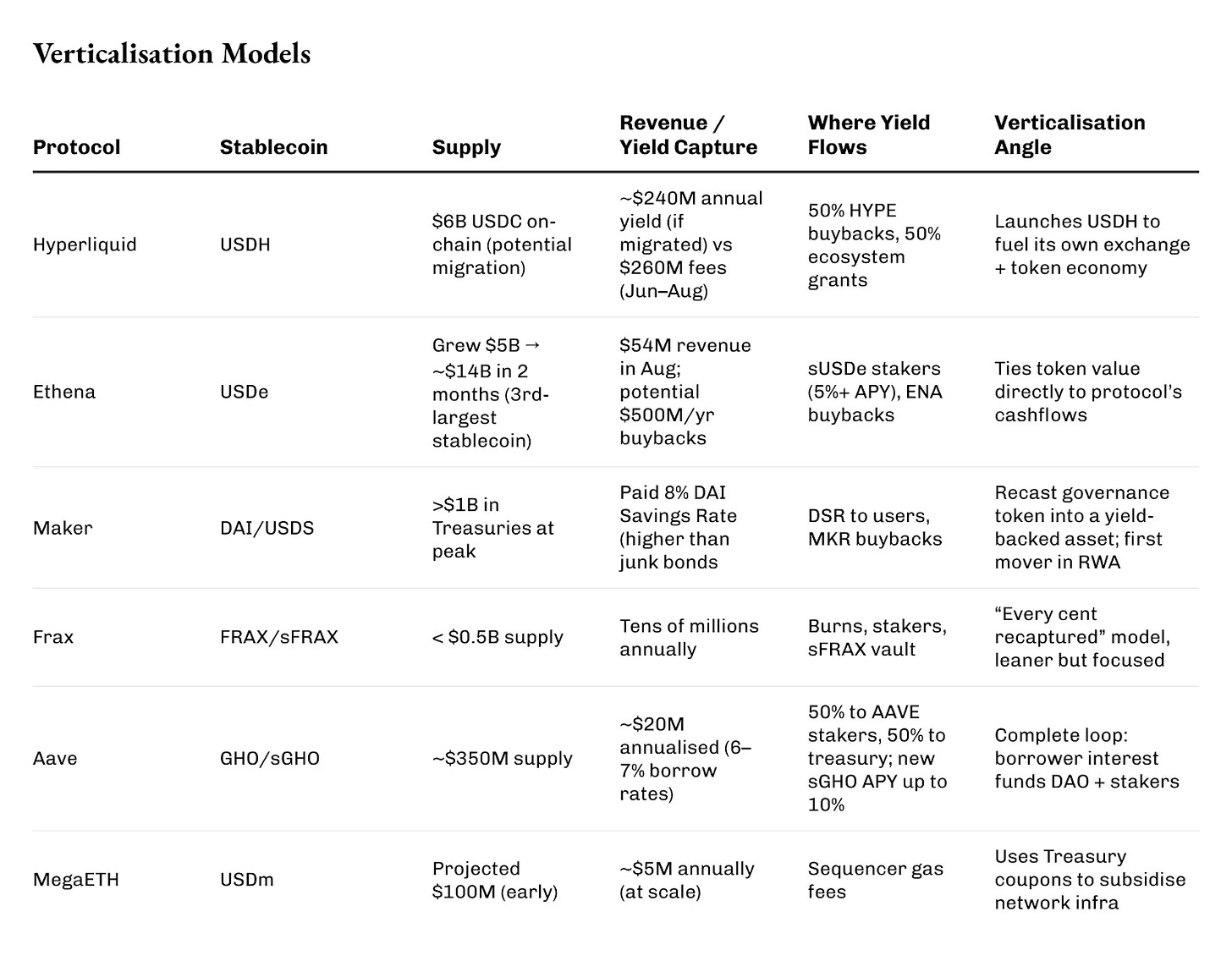
Comparing these models reveals each protocol setting different valves into the 4% yield stream: buybacks, DAOs, sequencers, users.
Yield is passive income. It makes everyone reckless. Each model has its bottlenecks.
Ethena’s peg relies on perpetual funding staying positive. Maker suffered real-world loan defaults and had to cover losses. After Terra’s collapse, Frax withdrew funds and shrank issuance to prove it wouldn’t be next. All depend on one thing: U.S. Treasuries held by custodians like BlackRock. These are decentralized wrappers around highly centralized assets—and centralization brings collapse risk.
New regulations also pose challenges.
The U.S. GENIUS Act outright bans interest-bearing stablecoins. Europe’s MiCA sets limits and licensing requirements. DeFi found workarounds, labeling yield as “buybacks” or “sequencer subsidies,” but the economics remain identical. If regulators choose to act, they certainly can.
Yet this approach helps build sustainable business models—an area crypto has long struggled with. So many models now operating show the immense potential DeFi protocols possess. Today, players are fighting over the world’s most boring yield. But the stakes are high. Hyperliquid ties it to token burns, Ethena to savings and buybacks, Maker to a central bank-style buffer, MegaETH to rollup operating costs.
I wonder if this movement will erode giants’ market share, pulling liquidity from USDC and USDT. If not, it will surely expand the market, creating a yield-bearing stablecoin layer alongside zero-yield ones.
No one knows yet. But the war has begun, across a vast battlefield: a stream of interest flowing from U.S. government debt, rerouted through protocols to tokens, DAOs, and blockchains.
The extra few cents of yield once pocketed by issuers now drives DeFi’s latest evolution.
Join TechFlow official community to stay tuned
Telegram:https://t.me/TechFlowDaily
X (Twitter):https://x.com/TechFlowPost
X (Twitter) EN:https://x.com/BlockFlow_News