Variant Investment Partner: 4 Crypto Trends We're Interested In
TechFlow Selected TechFlow Selected
Variant Investment Partner: 4 Crypto Trends We're Interested In
Stablecoins, prediction markets, tokenized equities, and new ways to earn online.
 Navigating Web3 tides with focused insights
Author: Alana Levin, Variant
Translation: TechFlow
The crypto industry has undergone significant transformation over the past year.
On regulation, the U.S. Congress has made notable progress on the GENIUS Act and establishing clear rules around stablecoins. The White House formed the Working Group on Digital Asset Markets, which has engaged with many industry participants and is working to provide clearer regulatory guidance. Meanwhile, the SEC announced its "Project Crypto," aiming to make the U.S. a hub for cryptocurrency by exploring initiatives such as tokenizing broader assets in financial markets.
Builders in the crypto space have also made substantial advances. There are now multiple large and liquid prediction markets, with more new platforms expected to launch soon. Stablecoin supply and usage have reached all-time highs, spreading across more regions. Many on-chain protocols generate eight- to nine-figure revenues, with several serving as developer platforms hosting vibrant startup ecosystems—startups that themselves generate revenue! It’s arguably one of the best times to be a builder in crypto.
One of my favorite quotes is: “The total addressable market (TAM) for digital assets is simultaneously the largest today and the smallest in the future.” This feels especially true right now. Given these developments, I’ve compiled a list of startup ideas that excite me. If you’re a builder exploring these areas, feel free to reach out!
Stablecoin-Powered Markets
Current discussions about stablecoins often center on payments. However, historically, it's been new markets that actually require stablecoins that have driven their adoption and growth. For example, the rise of Asian crypto exchanges played a key role in Tether’s (USDT) ascent: traders chose to hold USDT as a store of value on exchanges rather than converting crypto profits into local fiat. Similarly, the 2020 DeFi boom created new use cases for USDC, helping it gain traction on platforms needing digital dollars.
Today, the total supply of circulating stablecoins is nearing $300 billion, fueling interest in payment applications. Yet, payments appear more like an opportunity for existing enterprises, as their distribution and infrastructure give incumbent fintech companies an edge over new startups.
I’m looking for new markets uniquely enabled or created by stablecoins. We currently have two stealth investments aligned with this theme: one building infrastructure to make all stablecoins feel interchangeable to end users; the other focused on creating native liquidity markets.
What are potential application areas for stablecoin-powered markets? Here are three ideas:
-
New leveraged tools requiring instant funding
Stablecoins enable 24/7 transfers, allowing users to instantly deposit additional collateral into accounts (unlike traditional finance, where exchanges may need to pre-fund margin accounts while waiting for bank transfers).
-
Intercompany lending
I believe many companies will eventually hold portions of cash and cash equivalents in stablecoins. With 24/7 transferability—versus days-long, costly transfers in traditional finance—stablecoins not only allow companies to earn yield through broader, more creative means (e.g., short-term capital markets like overnight repos or on-chain liquidity provision), but also significantly improve capital efficiency.
-
Global lotteries
Crypto provides channels for receiving, pooling, and distributing funds globally. Beyond scaling lotteries, stablecoins’ programmability allows deposits and payouts to be used in more innovative and engaging ways.
Stablecoin-powered markets can emerge in several ways: a) stablecoins as part of at least one leg of a transaction; b) products built atop large pools of (idle) stablecoin capital; c) new markets leveraging stablecoins for global scale advantages.
Second-Order Prediction Market Opportunities
There are already multiple large and growing prediction market platforms, with several new ones expected to launch this fall. Trading volume has remained strong year-round, disproving critics who argue that prediction markets only achieve product-market fit during election seasons.
This landscape opens up more pioneering opportunities for entrepreneurs to build around prediction markets—leveraging new liquidity, broad user distribution, and fragmented platforms. Here are some products I’d especially love to see:
1. Conditional betting. In sports betting, “parlays” are common. But in prediction markets, where users bet against each other instead of a house, this becomes difficult. This difference means bettors must engage multiple counterparties rather than a single one (the bookmaker). As a result, closing bets when one leg fails becomes harder, and pricing and risk management grow more complex.
A possible solution is enabling users to effectively bet against a single counterparty. For instance, a third-party service could operate across open prediction markets, acting like a bookmaker. It could use market liquidity to set odds and offer parlay products, operate across platforms, and accept third-party liquidity to support its strategies (similar to Hyperliquid’s HLP). If parlays focus on areas like Bitcoin price movements, the service could hedge overall risk using other mechanisms.
2. Betting on users. A key feature on platforms like Polymarket is leaderboards, ranking traders by profit and volume and allowing third parties to view top users’ positions. Suppose I believe a particular trader will perform well—my “bet” would be that this trader’s bets succeed. Currently, my main option is manually copying their trades. Future products might let users deposit funds into a pool managed by expert traders for their betting activities. This design space becomes even more exciting with the emergence of AI agents participating in market betting—humans could provide capital via pools and contribute information and feedback for these agents to use.
Growing liquidity, rising user interest, and expanding supporting platforms create numerous second-order opportunities. Leverage, exposure to market size, and market popularity (user engagement) are all promising areas.
Tokenized Equity Coordinators
We are in the early stages of equity tokenization. A range of architectures is emerging, making this increasingly clear.
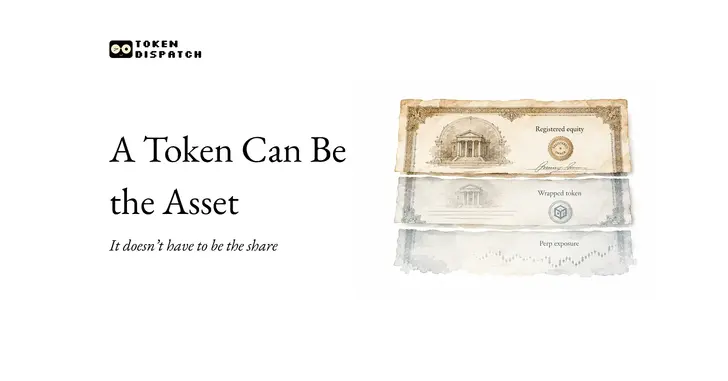
Some products, like Robinhood’s stock tokens, are designed solely to provide price exposure to real-world stocks. These tools are entirely synthetic: they track price movements via structured derivatives without holding actual shares.
Others, like BackedFi’s xStocks, custody the underlying stocks and create digital representations (similar to how stablecoin issuers hold fiat dollars and create tokenized wrappers). These products not only offer a more direct and secure link to asset prices but also allow redemption of the underlying stock.
Finally, there are more natively on-chain stocks. Last week, Superstate announced it had issued Galaxy Digital common stock directly on-chain—a tokenized asset with equivalent rights and benefits to traditional stock.
These represent various “tokenized stock” constructs. It remains unclear which structure will follow a power law and emerge as the winner. Consumers may use many of these tools without fully understanding their underlying construction. Thus, interfaces will be responsible for selecting and listing different tokens. I suspect liquidity and compliance will become primary listing factors, but as long as multiple tokenized stock structures meet an interface’s standards, integration across multiple backends is feasible. We could easily end up in a world where an interface offers BackedFi’s xAPPL but Superstate-issued GLXY, because each transfer agent provides the most liquid on-chain market for their respective stock. To consumers, these should all look like regular stocks.
A similar pattern exists in the stablecoin space. There are many different stablecoins aiming to replace the dollar, yet they aren’t all interchangeable. Hence, networks have emerged to coordinate different stablecoins, making them feel simply like dollars to end users. As the tokenized equity category continues to grow and evolve, there’s an opportunity to build similar infrastructure for tokenized equities.
The Next Big Frontier: New Ways to Earn Online
A striking and recurring theme I heard this summer is that many recent college graduates are struggling to find jobs. I assumed AI would take years to erode more complex entry-level roles, but I was wrong.
As a result, I believe how people spend their time will shift dramatically in the coming years. People will have more free time and a stronger desire to earn creatively. This could manifest in many ways: greater participation in financial markets, financialization of entertainment, expanding types of content people can create and monetize online, and more.
Crypto offers some of the most practical pathways for building such products and services. It enables low-cost global money movement, meaning the potential customer base is nearly infinite. Anyone, of any age, with a wallet and internet access can build and earn revenue.
Many companies in Variant’s portfolio align with these themes. Zora gives creators new tools to monetize media. Remix helps players of all ages create, publish, and monetize games. The Clearing Co is working to build and expand tradable markets.
The design space for new products and services helping people earn online remains vast. Earning through content, creativity, investing, entertainment, or other means has always been a killer app—and crypto provides the best infrastructure for individuals to achieve it.
Join TechFlow official community to stay tuned
Telegram:https://t.me/TechFlowDaily
X (Twitter):https://x.com/TechFlowPost
X (Twitter) EN:https://x.com/BlockFlow_News
 Variant