Vitalik's latest article: Low-risk DeFi for Ethereum is like search for Google
TechFlow Selected TechFlow Selected
Vitalik's latest article: Low-risk DeFi for Ethereum is like search for Google
Compared to Google's search and advertising business, focusing more on low-risk DeFi enables us to sustain the ecosystem economically while maintaining consistency in culture and values.
 Navigating Web3 tides with focused insights
Author: Vitalik
Translation: CryptoLeo, Odaily Planet Daily
For a long time, the Ethereum community has faced a key tension: the conflict between applications that generate sufficient economic activity to sustain the entire ecosystem—whether in maintaining ETH's value or supporting individual project valuations—and those applications that fulfill the original motivations for joining Ethereum.
Historically, these two categories have been highly disconnected: the former consisting of NFTs, memecoins, and a form of DeFi sustained by temporary or recursive forces—people borrowing to capture protocol incentives, or circular logic such as "ETH has value because people use the Ethereum chain to trade and leveraged ETH." Meanwhile, non-financial and semi-financial applications (e.g., Lens, Farcaster, ENS, Polymarket, Seer, privacy protocols) were attractive but saw extremely low usage or minimal user spending (or other forms of economic activity), insufficient to support a $500 billion economy like ETH’s.
This disconnect has fueled numerous conflicts within the community, with much of its momentum driven by a theoretical hope for an application that satisfies both conditions. In this article, I will argue that as of this year, Ethereum already has such an application—one that plays for Ethereum the same role that search plays for Google: low-risk DeFi aims to democratize global access to payments and savings in valuable asset classes (such as major currencies with competitive interest rates, stocks, bonds).
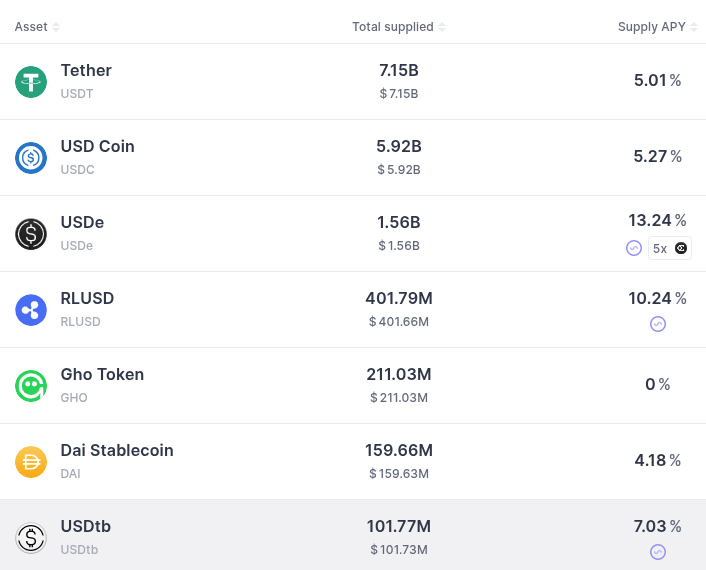
Image source: Aave
The analogy between Ethereum’s low-risk DeFi and Google Search is as follows. Google contributes many interesting and valuable things to the world: Chromium-based browsers, Pixel phones, AI work including open-sourced Gemini models, the Go language, and more. But from a revenue perspective, they are not highly profitable—or may even be loss-making. Instead, Google’s largest revenue source is search and advertising. Low-risk DeFi can play a similar role for Ethereum. Other applications—including non-financial and more experimental ones—are crucial to Ethereum’s role in the world and its culture, but they do not need to serve as revenue generators.
In fact, I hope Ethereum can do better than Google. Google is often criticized for losing direction and becoming similar to the antisocial profit-maximizing companies it aimed to replace. Ethereum’s decentralized ethos is deeply rooted in both its technical and social layers, and I believe low-risk DeFi creates a strong alignment between “doing good” and “doing well”—an alignment absent in the advertising space.
Why Low-Risk DeFi?
By “low-risk DeFi,” I mean both basic functions like payments and savings, as well as easy-to-understand tools such as synthetic assets, fully collateralized lending, and the ability to exchange between these assets.
There are two reasons to focus on these applications:
-
These applications provide irreplaceable value to Ethereum and its users;
-
These applications align culturally with Ethereum community goals, both at the application level and in the L1’s technical characteristics.
Why Is DeFi Valuable Now?
Historically, I was skeptical of DeFi because it didn’t seem to offer substantial services. Instead, its main “selling point” appeared to be making money through trading highly speculative tokens (the highest single-day Ethereum fee revenue on record came from a poorly designed BAYC Otherdeeds auction) or earning 10% to 30% yields via liquidity mining incentives.
One reason for this state of affairs lies in regulatory barriers. People like Gary Gensler deserve harsh criticism for creating a regulatory environment where the less useful your application is, the safer you are; the more transparent your actions and the clearer guarantees you offer investors, the more likely you are to be deemed a “security.”
Another reason is that in early stages, risks—protocol code vulnerabilities, oracle risks, general unknowns—were too high to enable more sustainable use cases. If risks are high, then only applications with higher returns are worth adopting, and those returns can only come from unsustainable subsidies or speculation.
But over time, protocol security has improved, reducing risks.
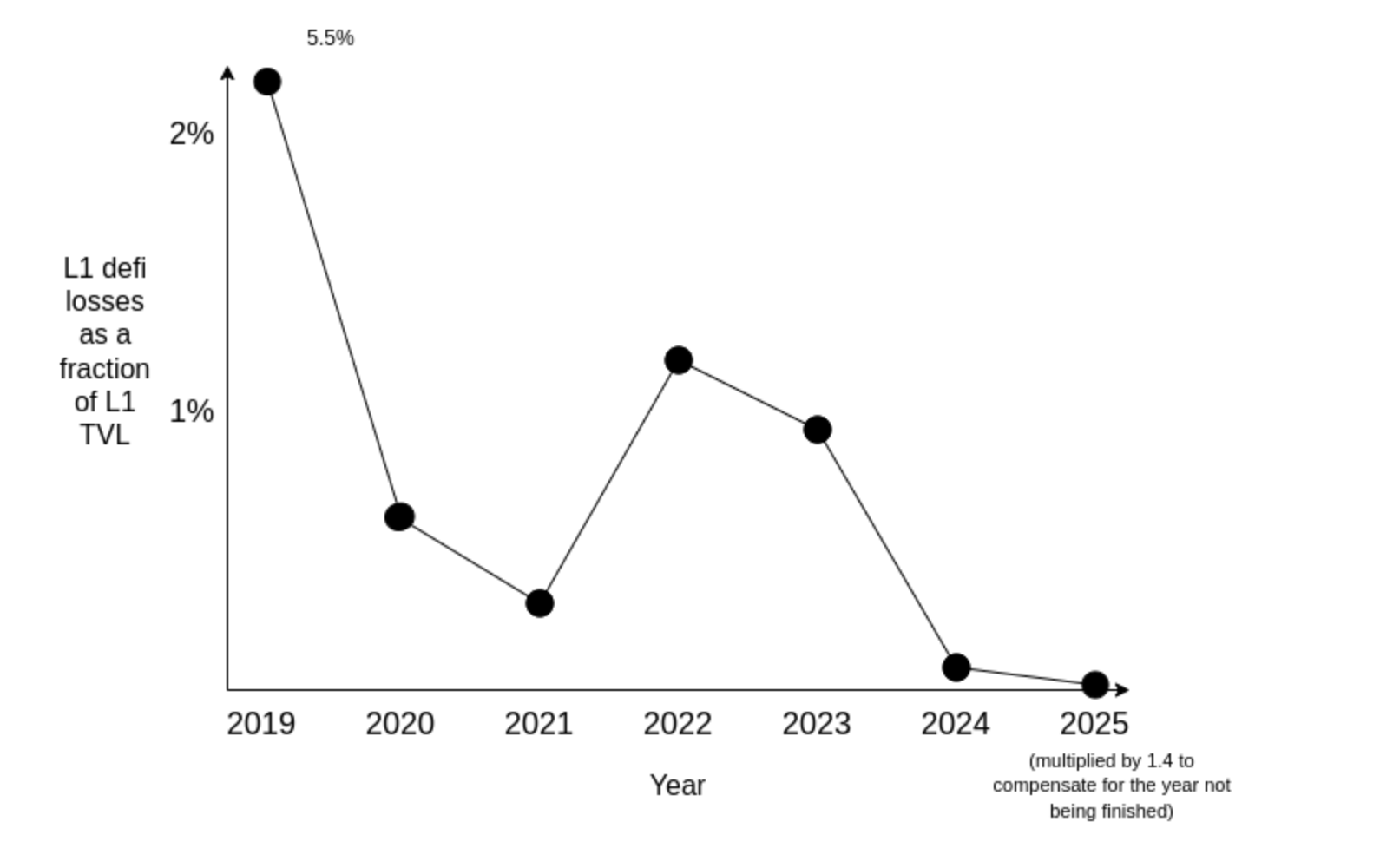
The Decline of Ethereum DeFi
DeFi attacks and losses still occur frequently. But these incidents are increasingly pushed to the fringes of the ecosystem—a space for more experimental and speculative users. More robust core applications are now forming. While tail risks cannot be entirely eliminated, traditional finance (TradFi) also faces such tail risks—and given increasing global political instability, for many people worldwide, TradFi’s tail risks now exceed those of DeFi. In the long run, the transparency and automated execution of mature DeFi ecosystems could make them more stable than traditional finance.
Who benefits most from these “ouroboros”-type users? Essentially individuals and enterprises wanting to enter global markets to buy, hold, and trade mainstream assets, but who lack reliable traditional financial channels to achieve these goals. Cryptocurrency cannot sustainably generate higher yields, but it does have the unique ability to allow permissionless access to existing economic opportunities on a global scale.
Why Does Low-Risk DeFi Align Culturally with Ethereum Community Goals?
Low-risk DeFi has several excellent properties that make it an ideal fit:
-
It contributes economically to the Ethereum ecosystem and token by using ETH as collateral and paying high gas fees;
-
It serves a clear, noble, and valuable purpose: enabling people to engage in economic interactions and wealth accumulation globally and permissionlessly through positive-sum mechanisms;
-
It does not create perverse incentives for Ethereum L1 (e.g., excessive centralization in pursuit of efficiency for high-frequency trading, which is better suited for L2).
These are some very good attributes.
Returning to the Google analogy, a major flaw in its incentive alignment is that ad revenue incentivizes the company to collect as much data as possible from users and retain ownership of that data. This contradicts the historically idealistic values of openness and positive-sum cooperation (where all parties benefit). For Ethereum, the cost of such misalignment would be even higher, since Ethereum is a decentralized ecosystem—no activity on Ethereum can be decided behind closed doors by a few; it must function as a cultural rallying point to be viable.
Revenue-generating projects don’t have to be Ethereum’s most innovative or exciting applications, but at least they shouldn’t appear unethical or embarrassing. If Ethereum’s biggest applications were political memecoins, you couldn’t seriously claim to care about the ecosystem. Low-risk DeFi, aiming to deliver global permissionless payments and optimal savings opportunities, represents a form of finance actively changing the world—something many people in underserved regions can attest to.
What Could Low-Risk DeFi Evolve Into?
Another important feature of low-risk DeFi is its ability to naturally synergize with, or evolve into, many more interesting future applications. Examples include:
Once we build a mature ecosystem of on-chain financial and non-financial activities (see: Balaji’s concept of the ledger as a record), exploring reputation-based, low-collateral lending becomes meaningful—it could become a stronger driver of financial inclusion. The low-risk DeFi and non-financial technologies (like ZK identity proofs) we’re building today help make this possible.
If prediction markets mature further, we might begin seeing their use in hedging. If you hold stocks and believe a certain global event might, on average, increase stock prices, and if a liquid and efficient prediction market exists for that event, then betting on that event becomes a statistically sound hedging strategy. Having prediction markets and traditional DeFi operate on the same platform would make participating in such strategies easier.
Low-risk DeFi often focuses on making the US dollar more accessible. But most people entering crypto aren’t doing so to promote dollar adoption. Over time, we can start shifting the ecosystem toward other stable value forms: baskets of currencies, CPI-indexed “stablecoin-like” assets, “personal tokens,” etc. The low-risk DeFi we build today, along with more experimental projects like Circles and various “stablecoin” initiatives, all help make this outcome more likely.
For all these reasons, I believe focusing on low-risk DeFi—as opposed to Google’s search and advertising model—enables us to sustain the ecosystem economically while preserving cultural and value alignment. Low-risk DeFi is already supporting the Ethereum economy and synergizing with many of the more experimental applications being built on Ethereum. It is a project we can all be proud of.
Join TechFlow official community to stay tuned
Telegram:https://t.me/TechFlowDaily
X (Twitter):https://x.com/TechFlowPost
X (Twitter) EN:https://x.com/BlockFlow_News
 @VitalikButerin