TRON Ecosystem Cross-Chain and Yield Guide: How to One-Click Bridge Assets to TRON to Capture Ecosystem Alpha Opportunities?
TechFlow Selected TechFlow Selected
TRON Ecosystem Cross-Chain and Yield Guide: How to One-Click Bridge Assets to TRON to Capture Ecosystem Alpha Opportunities?
Such a massive scale of funds and user base has made TRON a "gold rush land" in the crypto field, continuously attracting substantial capital and developers into its ecosystem in search of wealth opportunities.
 Navigating Web3 tides with focused insights
As a core battleground for global stablecoins, the TRON network handles massive daily capital flows: $82.7 billion worth of USDT in circulation on-chain, stablecoin daily trading volume consistently around $30 billion, and over 330 million users across its blockchain ecosystem.
This vast scale of capital and user base has made TRON the "gold rush" destination in the crypto space, continuously attracting significant investments and developers into its ecosystem seeking wealth opportunities. Developers aim to freely deploy cross-chain DApp applications between TRON and multi-chain ecosystems to unlock greater capital flow and reach broader user groups; users, meanwhile, desire seamless movement of their crypto assets across multiple chains to promptly capture Alpha opportunities within the TRON ecosystem.
As of September 18, the total value locked (TVL) in crypto assets on the TRON blockchain reached approximately $28.4 billion. Among these, JustCrypto—a cross-chain protocol under JUST, an all-in-one DeFi solution within the ecosystem—has stood out particularly, with over $4.5 billion worth of high-quality crypto assets such as BTC and ETH locked, ranking third in TVL among TRON-based applications. The top two positions are held by TRX Staking, a TRX staking application, and JustLend DAO, a lending hub.
To lower user barriers for cross-chain interactions, TRON has been accelerating its cross-chain expansion: In July, the meme coin TRUMP was successfully deployed cross-chain onto the TRON network; on August 26, the multi-chain cross-chain protocol deBridge fully integrated into the TRON ecosystem; on September 8, TRON's native stablecoin USDD was officially deployed on the Ethereum network alongside a 12% high-yield incentive program; on September 16, TRON announced full integration with Near’s multi-chain transaction protocol NEAR Intents, among other initiatives.
"Gold Rush" for On-Chain Capital: What Are the Alpha Opportunities in the TRON Ecosystem?
The TRON ecosystem not only leads in asset scale and user volume but also continues to generate wealth opportunities, making it a prime "gold rush" ground in the crypto sector. Whether through a steady stream of viral Meme projects, comprehensive DeFi infrastructure covering all scenarios, or a multidimensional stablecoin ecosystem, TRON offers users abundant Alpha opportunities.
In terms of on-chain financial infrastructure, TRON has built a complete matrix of DeFi applications ranging from "asset trading" to "yield enhancement," fully catering to diverse investment and trading needs of different users.
For asset exchange and trading, the one-stop trading center Sun.io integrates DEX functionality via SunSwap, supporting crypto asset swaps and liquidity mining, while also offering SunCurve (a low-slippage stablecoin trading tool) and PSM (a stablecoin conversion tool). Notably, PSM enables 1:1 fee-free conversion between USDD and USDT, significantly reducing transaction costs.
For enhancing asset yields, the lending platform JustLend DAO provides multiple yield pathways:
First, earn interest by depositing coins: Users can directly deposit assets such as TRX, SUN, BTT, ETH, BTC, and various stablecoins (USDT, USDD, USD1) to earn fixed returns;
Second, collateralized borrowing: Allows users to use assets like TRX or stablecoins as collateral to flexibly borrow other digital assets, improving capital efficiency;
Third, on-chain TRX staking rewards and capturing超额 returns: Through the staking product sTRX, users can stake TRX to receive a liquid staking token sTRX, which can further participate in DEX market-making, lending, or minting stablecoins, enabling compound yield growth. Additionally, users can use sTRX as collateral to mint USDD and leverage the "sTRX + USDD" super-mining combo to boost overall returns above 15%, capturing超额 returns. In July this year, publicly listed company TRON already pledged 365 million TRX via JustLend DAO.
Regarding the stablecoin ecosystem, TRON has established a diversified product matrix comprising "USDT (mainstream stablecoin) + USDD (native decentralized stablecoin) + USD1 (compliant stablecoin)," and leveraging robust DeFi infrastructure, created a full-scenario ecosystem covering "trading – yield generation – cross-chain investment" that supports using stablecoins in trading, storage, collateralized lending, and other DeFi activities. This clear yield-generation path meets users’ varying demands for security and decentralization. For example, the DEX hub Sun.io offers low-slippage conversions and crypto purchasing services for stablecoins, while JustLend DAO supports earning interest on deposited stablecoins or using them as collateral for loans.
For stablecoin yield enhancement, TRON’s ecosystem features the RWA product stUSDT, providing stablecoin holders access and channels to invest in traditional financial markets, achieving cross-domain asset appreciation. On September 17, stUSDT achieved an annualized yield of 5.11%. Moreover, USDD is set to launch a new yield-bearing product called sUSDD, a decentralized savings tool designed to help USDD holders earn steady interest, further expanding stablecoin yield possibilities.
In the Meme sector, the TRON ecosystem frequently spawns breakout assets, demonstrating strong wealth-generation effects. The Meme issuance platform SunPump acts as a "breakout incubator," consistently launching new projects and high-potential assets. Previously, mainstream Meme projects such as SUNDOG and PePe successfully entered Binance Alpha Zone, gaining recognition from leading global exchanges, offering retail investors a crucial early-entry window into quality Meme assets.
The wealth narrative of the TRON ecosystem continues. Recently, TRON founder Justin Sun has repeatedly hinted on X about "preparing major moves soon to be revealed." Many community members speculate that TRON may be poised for a new round of product iteration and ecosystem expansion, warranting sustained market attention.

How Can Assets Be One-Click Cross-Chain Into the TRON Ecosystem?
As the ecosystem grows and more Alpha opportunities emerge, "transferring assets cross-chain into the TRON ecosystem" has become a core user demand for asset growth. Although withdrawing via CEX exchanges to the TRON network remains an option, today's explosion of on-chain applications and concentrated wealth opportunities means capital increasingly circulates on-chain. According to Bridge WTF data from September 17, daily on-chain cross-chain transfer volumes reached as high as $640 million, making cross-chain asset interaction and circulation the dominant method.
Currently, infrastructure supporting cross-chain transfers to the TRON network falls into two main categories: native cross-chain infrastructure and third-party cross-chain tools.
Native Cross-Chain Infrastructure BTTC: As an in-house cross-chain infrastructure, BTTC offers dual capabilities for asset bridging and application deployment: enabling users to quickly bridge assets from other public chains to the TRON network for seamless fund transfers, and allowing developers to deploy their applications cross-chain to the TRON ecosystem with one click, lowering multi-chain development barriers.
Third-Party Cross-Chain Bridge Tools: Offering broader public chain coverage, these provide users with more choices. According to data from cross-chain aggregation platform ChainSpot, 17 third-party cross-chain solutions currently support the TRON network, enabling asset interoperability between Bitcoin, Ethereum, Solana, BNB Chain, Layer2, and other major blockchains. The four most commonly used tools include Meson, Symbiosis, rhino.fi, and Allbridge Core.
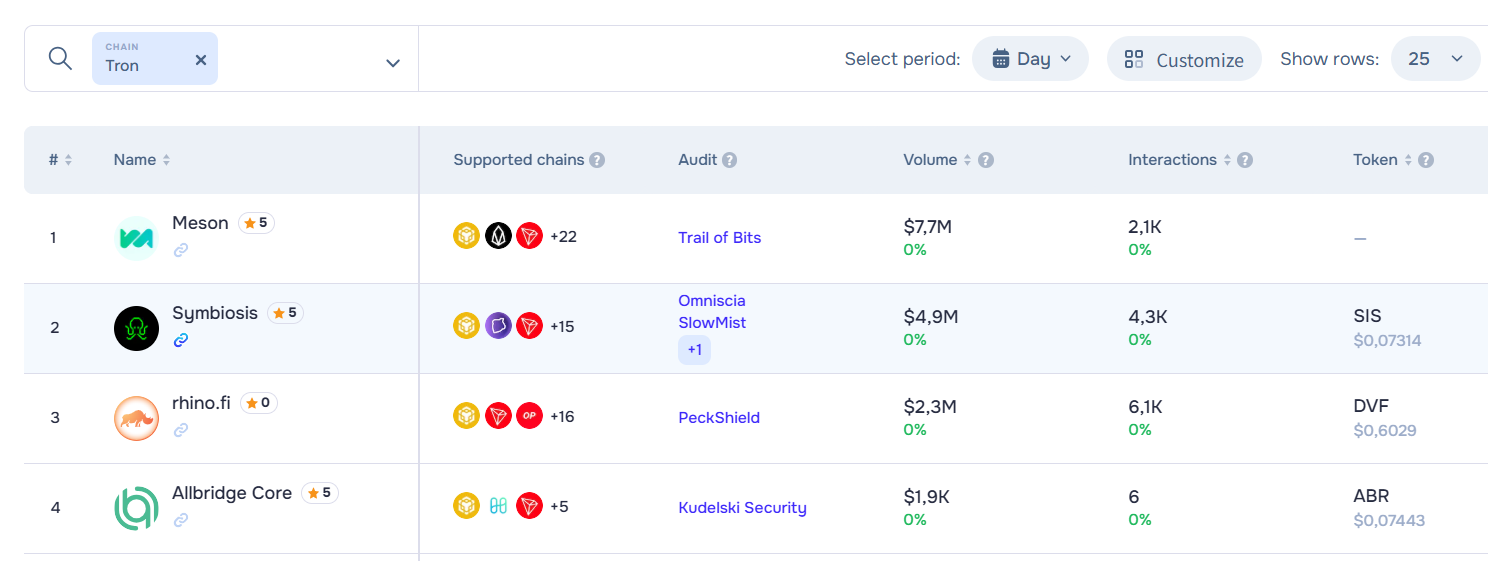
Additionally, TRON has recently expanded its cross-chain partnerships, further enriching cross-chain channels: On August 26, the multi-chain protocol deBridge fully integrated into the TRON ecosystem, helping TRON achieve instant connectivity with 25 major blockchains including Ethereum and Solana, building a larger liquidity network; On September 16, TRON formed a strategic partnership with NEAR, fully integrating the multi-chain transaction protocol NEAR Intents, advancing cross-chain operations into a new intelligent era of "intent-driven" execution where users simply submit simple cross-chain requests and the system automatically matches optimal paths, delivering a true "one-click direct" cross-chain experience.
Reviewing Six Major Cross-Chain Tools Supporting the TRON Network
1: Native Cross-Chain Protocol: BTTC (BitTorrent Chain) Aims to Become the Control Center of a Multi-Chain Operating System
BTTC (BitTorrent Chain) is a cross-chain solution jointly launched in 2021 by the TRON Foundation and BitTorrent. As an EVM-compatible Layer2 scaling network using PoS consensus, BTTC is positioned as the "Layer2 cross-chain scaling protocol for the TRON ecosystem," aiming to solve scalability and interoperability issues across blockchain networks. It currently supports asset interoperability between Ethereum, BNBChain, and the TRON network—the three major public chains.
In June this year, BTTC upgraded to version 2.0, reducing the total BTT supply and setting the staking yield at 6%, further strengthening network security and token value.
BitTorrent is the world's largest decentralized P2P file-sharing network, with over 100 million active users. Acquired in July 2018 by TRON founder Justin Sun for approximately $120 million, it has evolved into a full ecosystem encompassing data transmission protocols (BitTorrent), decentralized storage (BTFS), cross-chain protocols (BTTC), and native tokens (BTT).
In terms of cross-chain implementation, BTTC adopts a "connect rather than custody" model. Through modular layered design, it breaks down the entire cross-chain process—from initiating requests on the source chain to execution on the target chain—into standardized logic and components, enabling bidirectional interoperability of assets and data across multiple chains. Its architecture consists of three layers:
Root Contracts (Root Chain Contract Layer): A cluster of smart contracts deployed on TRON, Ethereum, and BNB Chain responsible for managing cross-chain assets/data and providing user interaction interfaces—the initiation and reception points for user cross-chain requests;
Delivery (Delivery Relay Layer): The relay hub for consensus and data, performing the intermediary function of transmitting state information between the source and target chains. As a relay, it monitors source chain events (such as asset locking and staking), generates "checkpoint" snapshots, and after achieving multi-signature consensus from over two-thirds of nodes, synchronizes them to the target chain;
BitTorrent Chain (Execution Layer): The platform for running DApps, processing cross-chain messages and verification, receiving snapshots from the Delivery layer, and executing operations such as asset release and contract triggering.
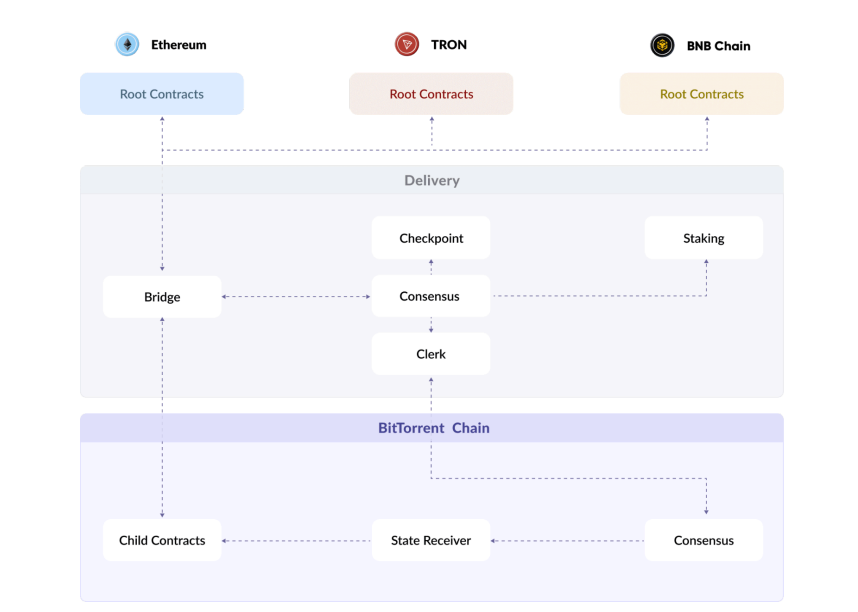
For example, taking "bridging ETH from Ethereum to TRON," the specific steps are broken down as follows: The user locks ETH in the BTTC smart contract on Ethereum, triggering a cross-chain event → The Delivery layer verifies the legitimacy of the event, generates a snapshot, and reaches node consensus → The BTTC execution layer mints the corresponding BTTC-version ETH and sends it to the user’s TRON address.
BTTC's goal extends beyond asset bridging—it aims to enable underlying information and data interoperability across multiple chains. As stated in its latest whitepaper released in May, "Building a better cross-chain bridge is the starting point of transformation; BTTC’s ultimate goal is to become the control layer of a multi-chain operating system."
In terms of products, BTTC launched BitTorrent Bridge, focusing on asset transfers between EVM chains. It currently supports interoperability of assets such as TRX, BTT, USDD, JST, SUN, WIN, NFTs, and ETH between TRON, Ethereum, and BNB Chain, with plans to expand to more chains and assets in the future.
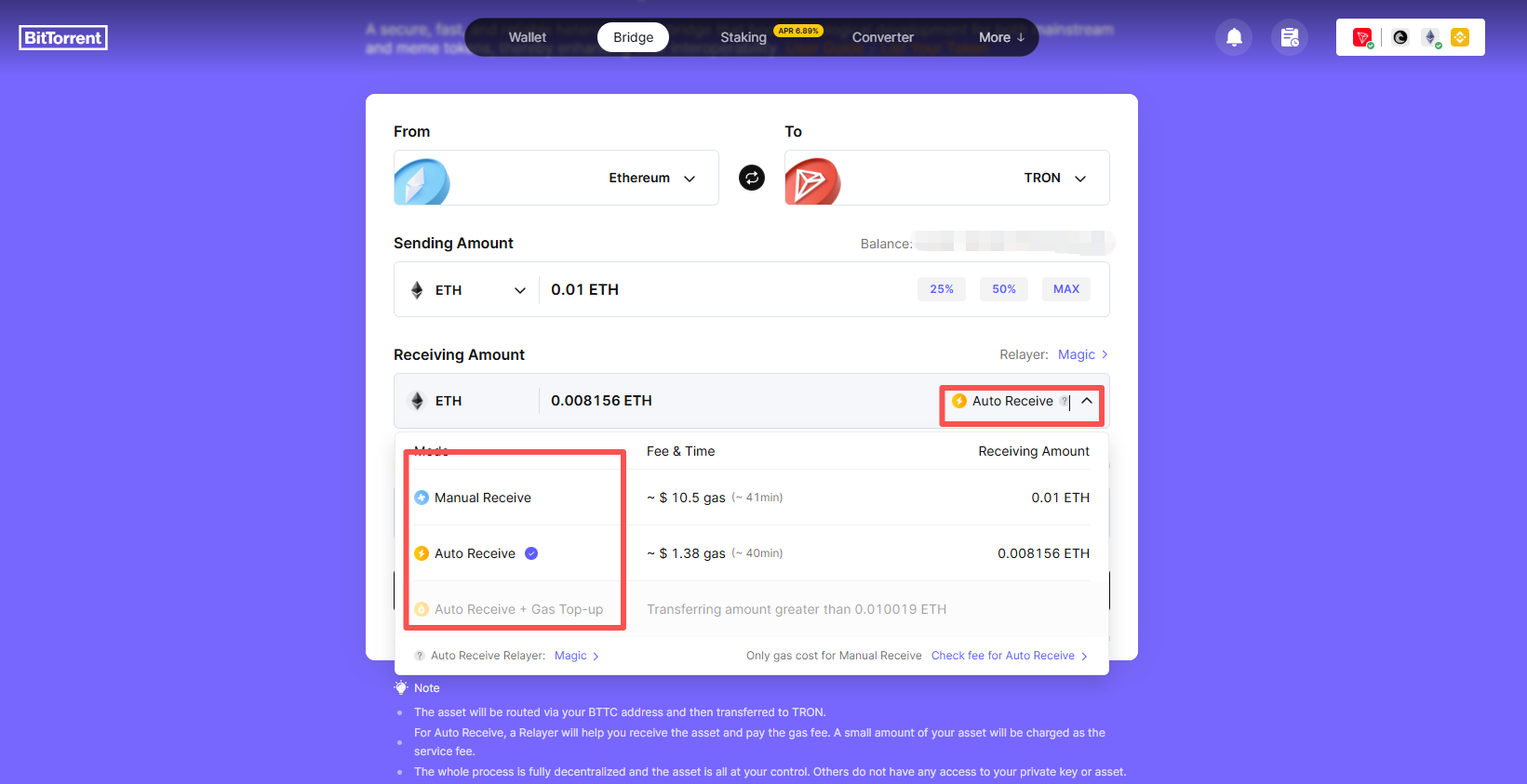
To enhance user experience, BTTC offers an Auto Receive mode, where the Relayer pre-pays the gas fee on the target chain, allowing users to quickly receive bridged assets and avoid asset lock-ups due to lack of gas tokens. Note that under this mode, the gas fee is deducted directly from the transferred amount, so the final received amount reflects this deduction.
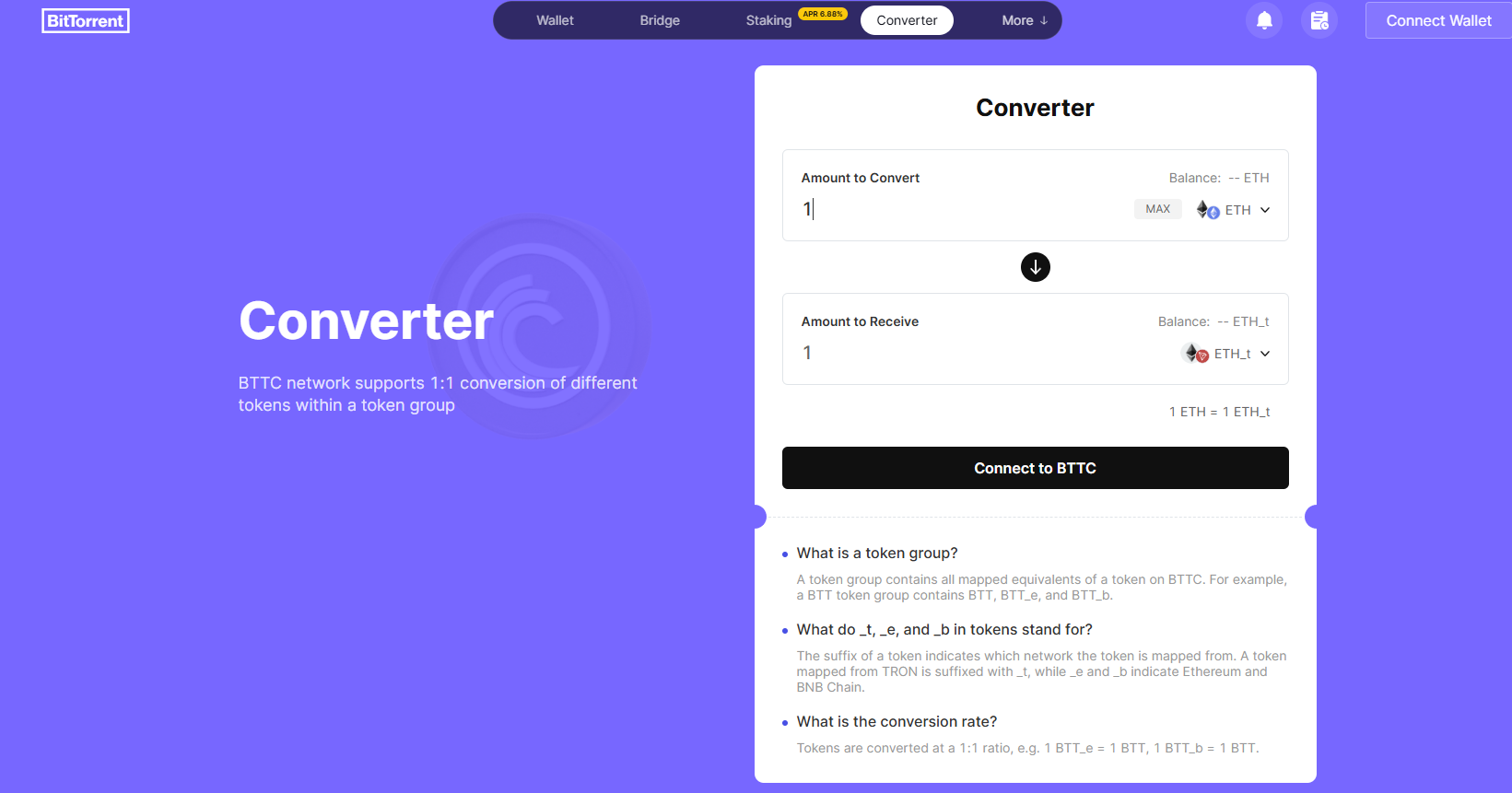
In addition, BTTC launched a 1:1 same-type token converter, Converter, enabling fee-free swaps of identical assets across BNB Chain, Ethereum, and TRON networks—for example, 1ETH_e (Ethereum) can be exchanged 1:1 for 1ETH_b (BNB Chain).
As the official Layer2 cross-chain scaling protocol for TRON, BTTC inherits the security of its mainnet. Using BitTorrent Bridge for cross-chain transfers incurs no transaction fees—users only pay gas fees—making it the preferred cross-chain product for TRON users. Furthermore, BTTC is EVM-compatible and supports Solidity programming language, enabling one-click migration and deployment of existing EVM-network DApps.
2: Third-Party Cross-Chain Tools Supporting the TRON Ecosystem
1. Meson: Focused on Stablecoin Cross-Chain Transactions
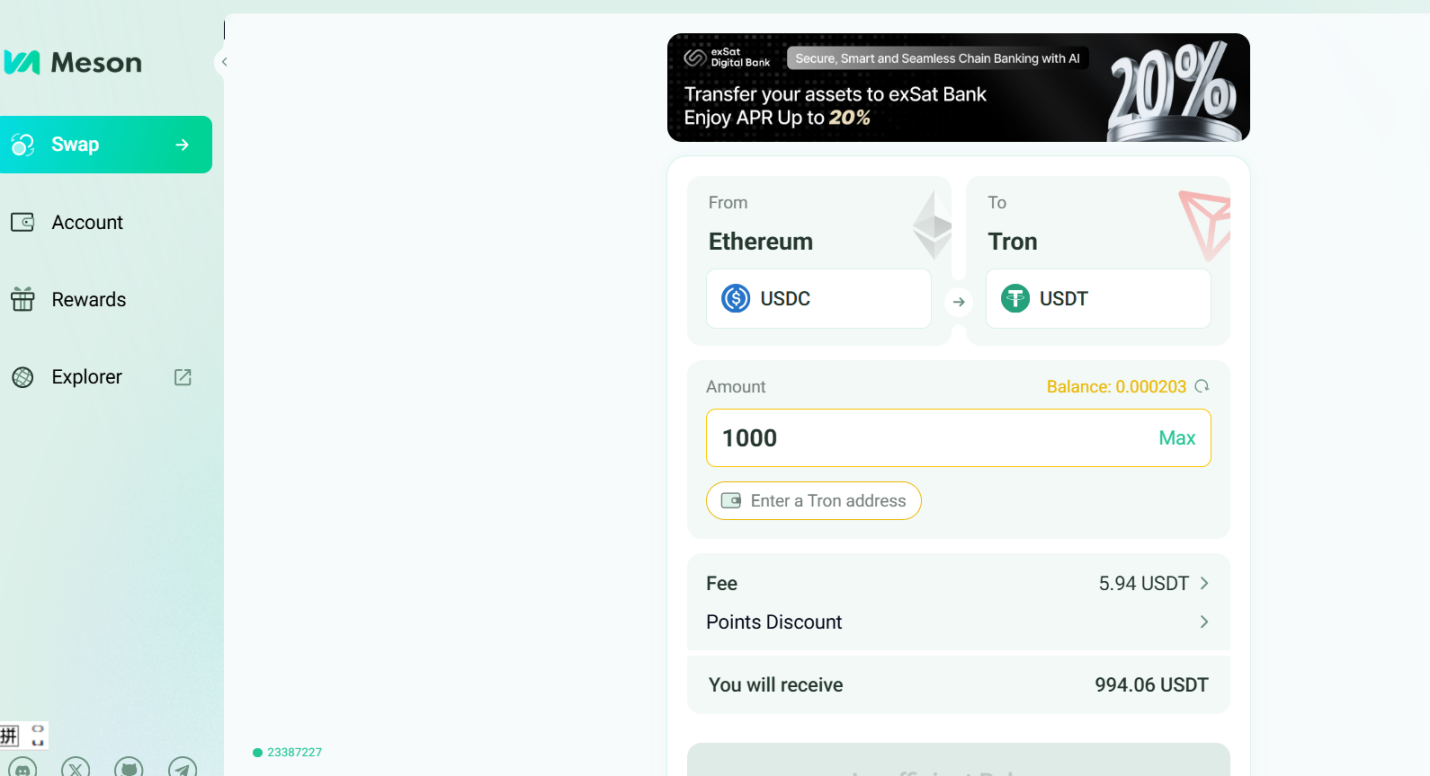
Meson is a multi-chain stablecoin cross-chain transaction protocol primarily focused on enabling native stablecoin swaps between EVM, non-EVM, and Layer2 networks, such as USDT, USDC, USD1, and DAI.
Through the Meson platform, users can now quickly convert stablecoins like USDC, USD1, and USDT from chains such as Ethereum, Arbitrum, and Solana into TRC20-USDT on the TRON network.
2. Symbiosis: Cross-Chain Swap DEX
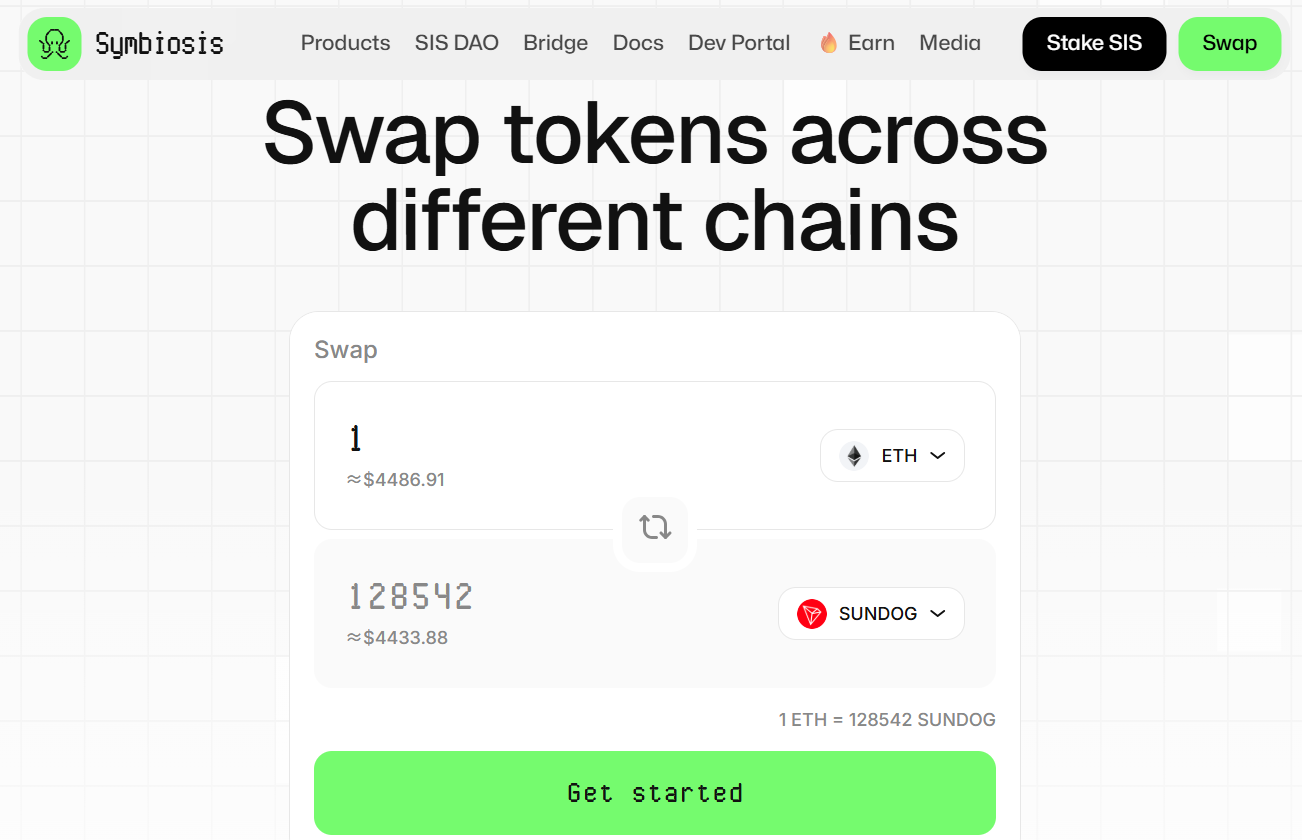
Symbiosis is an AMM-based decentralized cross-chain swap DEX protocol. It supports not only cross-chain transfers of homogeneous assets but also cross-chain swaps of any token pair. Users simply select the source chain asset and target chain asset on the Symbiosis interface, and the protocol automatically completes steps including converting the source asset into an intermediate stablecoin, transferring it cross-chain, and then converting it into the target asset. For instance, users can directly convert ETH on Ethereum into USDT, TRX, or SUNDOG on the TRON network.
Currently, the Symbiosis platform supports dozens of TRON network assets for cross-chain swaps, including TRX, BTT, SUN, JST, and SUNDOG.
3. Rhino.fi: Cross-Chain DeFi Infrastructure Focused on Stablecoin Liquidity
Rhino.fi is a cross-chain DeFi infrastructure aimed at solving liquidity fragmentation in multi-chain ecosystems. In its latest product roadmap announced in June, Rhino.fi explicitly outlined plans to build a stablecoin liquidity layer, unifying global stablecoin liquidity to resolve fragmentation and cross-chain interoperability pain points. It also launched a developer toolkit Bridge+, offering a complete suite of stablecoin interoperability solutions to help developers efficiently manage stablecoin payments and multi-chain integrations.
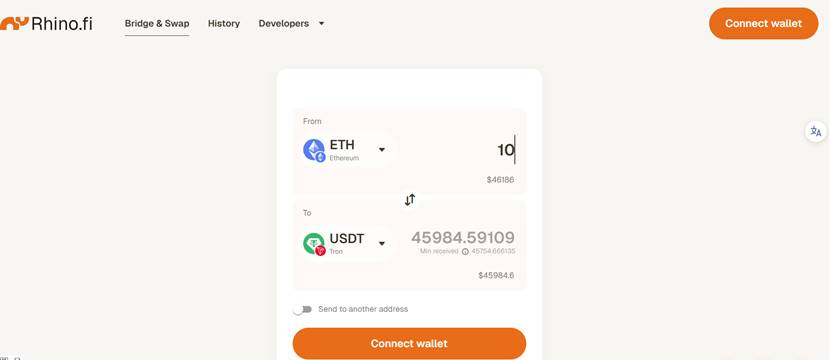
To meet user cross-chain asset needs, Rhino.fi developed the Bridge&Swap feature—a hybrid of cross-chain and trading functions, essentially a "cross-chain DEX"—that allows direct conversion of asset b on chain A to target asset d on chain C. For example, it enables one-click cross-chain conversion of ETH on Ethereum into USDT on the TRON network, greatly simplifying the cross-chain and trading processes.
4. Bridgers: Cross-Chain Liquidity Aggregator
Bridgers (also known as AllChain Bridge) is a cross-chain liquidity aggregator that calculates optimal execution paths by pooling liquidity from external DEXs and bridges, then uses smart contracts to execute trades—such as directly converting ETH on Ethereum into TRX on the TRON network.
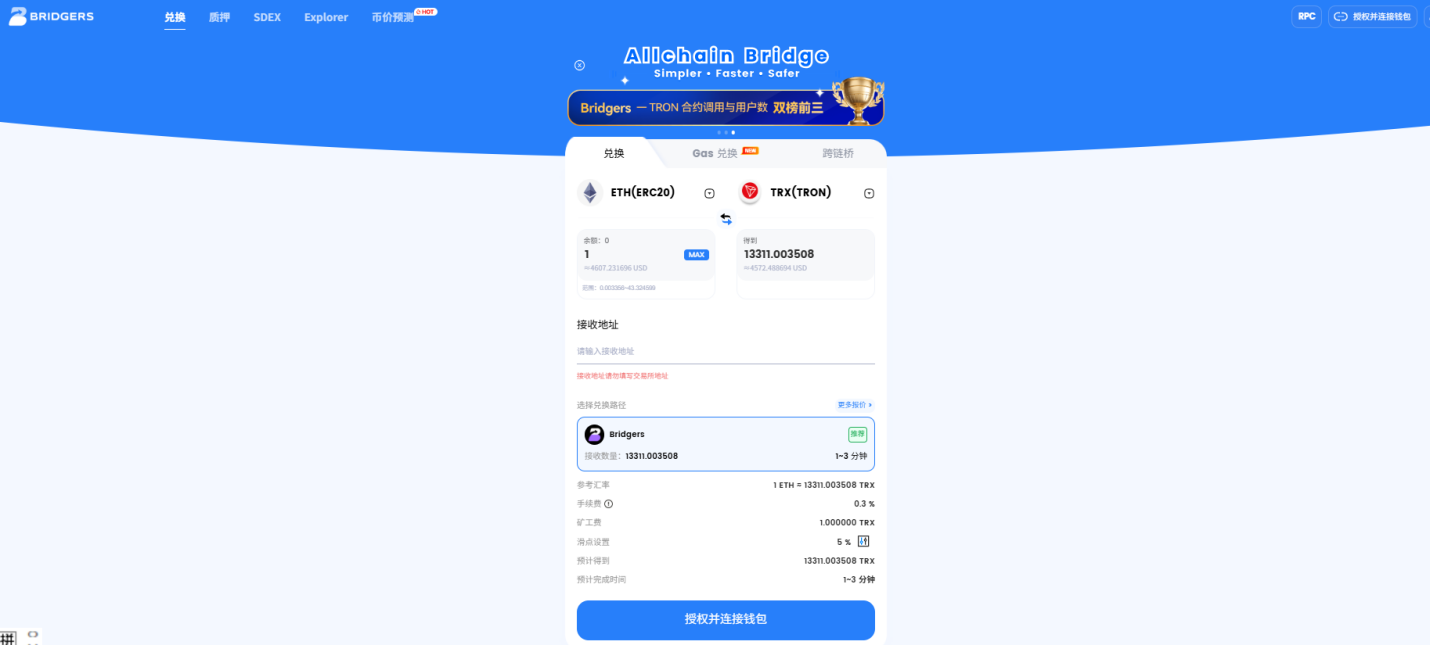
Bridgers is a frequently used cross-chain application among TRON ecosystem users. According to TRONSCAN explorer data, Bridger contract calls rank among the top three in the TRON ecosystem.
5. deBridge: Cross-Chain Interoperability Infrastructure
deBridge is a general-purpose cross-chain interoperability infrastructure and message-passing protocol supporting the transfer of arbitrary messages, data, and assets between different blockchains. Beyond offering cross-chain liquidity networks and related services, it provides developers with a full suite of tools to build various cross-chain applications (deApps).
To address asset cross-chain needs, deBridge launched its core product, the cross-chain token bridge dePort, primarily used for cross-chain asset transfers and trading exchanges between different blockchains—supporting both homogeneous asset transfers and one-click cross-chain trading.
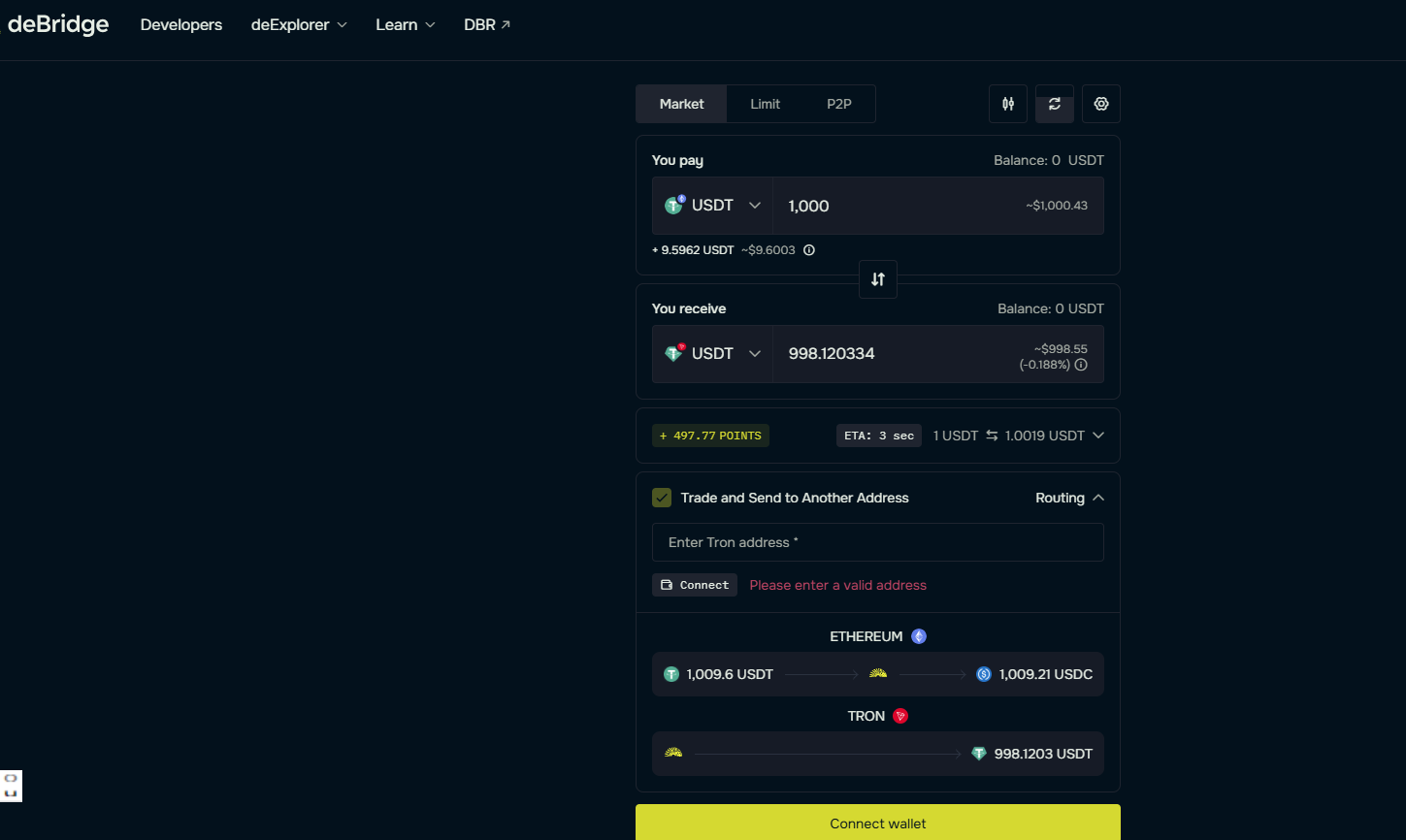
On August 26, deBridge announced full integration into the TRON ecosystem, enabling users to bridge assets from other supported public chains directly into the TRON ecosystem. According to deBridge’s official data from September 18, since its integration with TRON, assets flowing from the Ethereum network alone have reached $4.28 million, demonstrating the strong appeal of the TRON ecosystem.
Join TechFlow official community to stay tuned
Telegram:https://t.me/TechFlowDaily
X (Twitter):https://x.com/TechFlowPost
X (Twitter) EN:https://x.com/BlockFlow_News