Space Recap | As expectations for Fed rate cuts rise, TRON secures strategic positioning with its diversified stablecoin ecosystem
TechFlow Selected TechFlow Selected
Space Recap | As expectations for Fed rate cuts rise, TRON secures strategic positioning with its diversified stablecoin ecosystem
As rate cut expectations rise and the global liquidity easing cycle approaches, capital may flow into RWA and stablecoin sectors. TRON, with its diversified stablecoin ecosystem and Nasdaq listing advantage, becomes a key hub for onboarding traditional capital.
 Navigating Web3 tides with focused insights
Recently, an unusually weak U.S. nonfarm payrolls report has sent shockwaves through global capital markets. New job additions plummeted to 22,000, while the unemployment rate jumped to 4.3%. At the same time, recent statements from Federal Reserve officials have signaled a potential rate cut. As a result, market expectations for a Fed rate cut continue to rise. The CME's "Fed Watch" tool shows a 96.6% probability of a 25-basis-point rate cut in September, with total rate cuts likely ranging between 50 and 75 basis points (2–3 cuts) by year-end.
Driven by this shift, risk appetite in both stock and crypto markets has rebounded, the U.S. dollar has weakened, and "investment assets" like Bitcoin are gaining favor. Stablecoins stand out with unique advantages. The TRON ecosystem, with its diversified stablecoin strategy, is now taking center stage—from USD1, a compliant stablecoin endorsed by the Trump family, to TRC20-USDT, the world’s largest stablecoin by circulation, and USDD, a decentralized over-collateralized stablecoin. The TRON ecosystem is now fully equipped to transition from a high-interest-rate environment into a global liquidity easing cycle.
At this pivotal moment, the latest episode of SunFlash Space invited several seasoned industry analysts to deeply explore how a rate cut could reshape the global liquidity landscape and what new opportunities the TRON ecosystem may seize during this interest rate transition. The guests engaged in a dynamic roundtable discussion on these topics. Below is a recap of the key highlights.
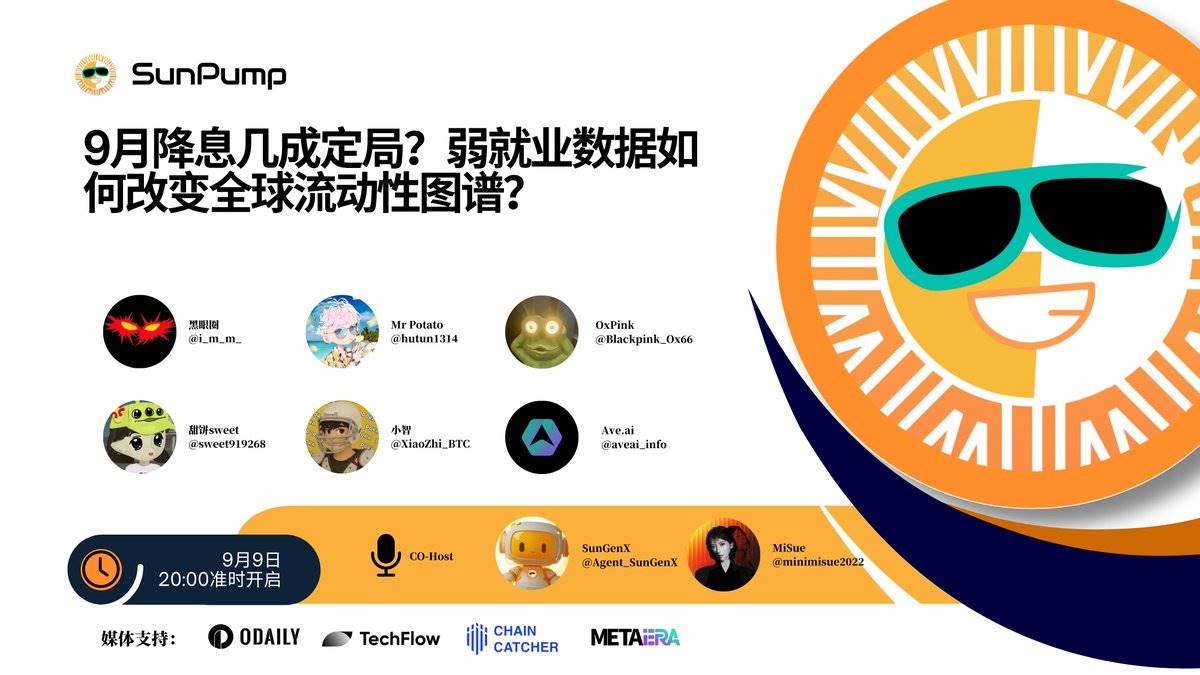
As Rate Cut Expectations Rise, Where Is the Crypto Market Headed? Analysts Advise Caution
Faced with rising U.S. unemployment at 4.3% and significantly softening nonfarm payrolls data, market consensus strongly anticipates a Fed rate cut in September. At this critical policy juncture, the panelists shared their insights from various perspectives.
Heiyanquan opened with a clear stance, suggesting that given the slowing labor market, the Fed’s rate cut is more likely a "temporary adjustment" rather than the beginning of a new cycle. 0xPink also leans toward the "temporary adjustment" view, pointing out that macroeconomically, the Fed still faces inflationary pressures and cannot loosen monetary policy indefinitely, casting doubt on the sustainability of capital inflows.
In the short term, however, most panelists agree that if a rate cut materializes, it will boost liquidity in the crypto market. Sweetpie_sweet noted that altcoin liquidity had been persistently low over the past six months, but recent notable movements in AI-related tokens and Worldcoin suggest capital is returning. He believes a Fed rate cut could spark a policy-driven rebound rally.
0xPink agrees that rate cuts combined with a weaker dollar form a powerful bullish catalyst for crypto. A weaker dollar pushes investors to seek higher-yielding assets, and crypto—with its high volatility and inflation-resistant characteristics—will naturally attract attention. However, he cautioned against viewing this simply as the start of a "mania bull run."
0xPink emphasized that the crypto market structure has evolved: increased regulation and greater institutional participation mean price movements won’t be driven solely by retail investors. Therefore, while short-term sentiment may ignite the market, investors should focus on whether capital can remain long-term and which sectors can truly absorb liquidity, advising a "cautious forward" approach to capturing opportunities.
Under a Rate Cut Cycle, RWA and Stablecoins May Emerge as Top Winners, with TRON Ecosystem Gaining Broad Confidence
If a rate cut occurs, how will capital be allocated across crypto assets? Will it flow first into Bitcoin as a store of value, into Ethereum with its rich ecosystem, or directly into regulated, yield-generating sectors like RWA and stablecoins?
Xiaozhi stated clearly: "Always trust the judgment of capital." He cited Nasdaq’s application to list tokenized stocks as a landmark event, seeing it as a major positive signal for RWA and compliant stablecoins—even if not yet approved, its symbolic significance is immense. He further analyzed that institutional capital entering the space prioritizes security and compliance; RWA and stablecoins align with traditional finance logic while offering blockchain efficiency, making risks relatively manageable.
Heiyanquan shared a similar view, noting that stablecoins, as crucial "liquidity reservoirs" and safe havens in the crypto market, play a prominent role amid market volatility caused by rate cuts, and their function as a medium of exchange helps attract institutional capital seeking efficiency and convenience.
In terms of stablecoin strategy, the TRON ecosystem has built a diversified matrix comprising "mainstream stablecoin USDT + decentralized stablecoin USDD + compliant stablecoin USD1," comprehensively meeting the needs of institutions, retail users, and compliant commercial applications, providing a smooth, secure, and efficient gateway for traditional capital entering the crypto world.
Among them, USD1—a compliant stablecoin issued by financial institution World Liberty Financial—has achieved native minting on TRON and is deeply integrated into the TRON ecosystem. In July, SUN.io, a core DEX in the TRON ecosystem, launched USD1 trading pairs, enabling seamless access for users. In August, the lending protocol JustLend DAO fully supported USD1 deposits and loans, expanding its yield use cases. As of September 8, the circulating supply of USD1 on the TRON network exceeded 56.57 million.
TRC20-USDT, the mainstream stablecoin, has become the most widely adopted on-chain stablecoin due to its fast transfers, high security, and low transaction fees, with supply surpassing 82.6 billion tokens. It is supported by numerous major exchanges and wallets, used across financial trusts, shopping payments, travel settlements, live-streaming spending, and more, playing a vital role in global value circulation.
The TVL of USDD, a decentralized over-collateralized stablecoin, has surpassed $530 million. Backed by multi-asset over-collateralization and real-time on-chain verification, each USDD is fully backed by sufficient assets, significantly enhancing user confidence. Notably, through deep integration with the TRON DeFi ecosystem, USDD serves not only as a "safe haven" against market volatility but also embeds deeply into collateralized lending, liquidity mining, and other yield-generating activities, becoming a key tool for users to hedge inflation and grow assets.
In his closing remarks, 0xPink stated that yield-seeking institutional capital will not remain confined to Bitcoin but will inevitably flow into areas combining returns with traditional finance logic. RWA and DeFi protocols closely tied to stablecoins will become primary targets for institutional experimentation. By deeply integrating DeFi with stablecoins, the TRON ecosystem offers robust tools for yield management and liquidity. Furthermore, thanks to its compliance edge derived from Nasdaq listing efforts, the TRON ecosystem is poised to become a key hub connecting traditional institutional capital with real-world assets and on-chain yield ecosystems during the rate-cut cycle.
Join TechFlow official community to stay tuned
Telegram:https://t.me/TechFlowDaily
X (Twitter):https://x.com/TechFlowPost
X (Twitter) EN:https://x.com/BlockFlow_News