Chris Larsen: The Pioneer Rebuilding Cross-Border Payments
TechFlow Selected TechFlow Selected
Chris Larsen: The Pioneer Rebuilding Cross-Border Payments
Ripple, international payments, regulatory arbitrage, and the strange case of earning billions of dollars.
 Navigating Web3 tides with focused insights
Author: Thejaswini M A
Translation: Block Unicorn
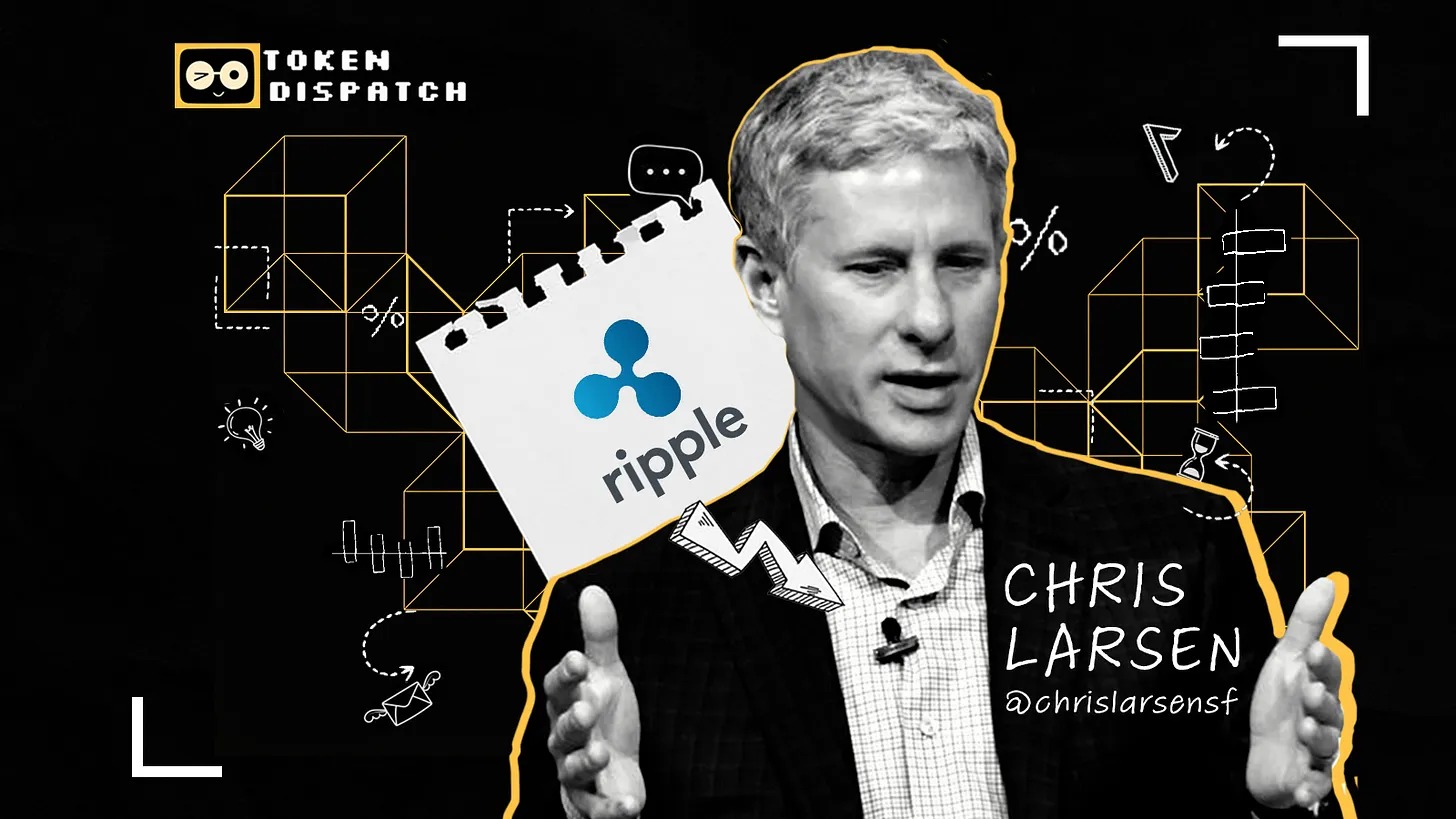
Introduction
The check bounced.
Fifteen-year-old Chris Larsen discovered that getting paid was harder than doing the work itself.
He ran a car dent repair business from his family's driveway in San Francisco. Neighbors brought their dented cars, and he used borrowed tools and teenage determination to hammer out the damage.
He worked honestly and charged fairly. But when clients didn't pay, 15-year-old Larsen learned his first harsh lesson about how the financial system operates.
His father repaired airplane engines at San Francisco International Airport, receiving a paycheck every two weeks like clockwork. His mother illustrated for clients but often waited months—or never got paid. Both understood money flowed easily to those who already had it, while being stingy toward everyone else.
The system was designed that way.
This frustration simmered for decades, driving him to found three billion-dollar companies. Each challenged parts of the financial system that treated ordinary people as inconveniences rather than customers.
The Mechanic’s Son Who Saw Through the System
1960, San Francisco.
Chris Larsen was born into a family that deeply valued stable work. Growing up in a working-class household meant experiencing the financial system from the customer’s side—not the bank’s. When his parents needed auto loans or mortgages, they faced bank clerks making decisions behind closed doors. The process was opaque, slow, and often unfair.
Why could some people easily get loans while others couldn’t? Why did banks charge different interest rates to different customers for the same service? Why did decisions that could be made in minutes take so long?
These were personal frustrations faced by millions of families, yet few with the power to change things had lived through them firsthand.
After high school, Larsen began studying aviation at San Jose State University, aiming for a practical path toward stable engineering jobs. But he found the curriculum too narrow. He transferred to San Francisco State University, switching to international business and accounting.
After graduating in 1984, Larsen joined Chevron as a financial auditor. The job took him to Brazil, Ecuador, and Indonesia. Exposure to global business operations gave him a front-row view of how the international financial system worked.
But he needed deeper understanding to truly change it.
In 1991, Larsen earned an MBA from Stanford Graduate School of Business. His professor Jim Collins taught him how to build companies that outlive their founders. These lessons stuck. Larsen wasn’t interested in short-term wins or trendy business models. He wanted to build infrastructure that would matter decades later.
Combining the Internet with Finance
1996, the internet boom was just beginning.
While most entrepreneurs rushed to build websites for pet supplies or grocery delivery, Larsen saw a different opportunity. What if the internet was applied to the most traditional industry—mortgages?
He co-founded E-Loan with Janina Pawlowski.
The idea was simple: put mortgage applications online so borrowers could apply without dealing with brokers charging unnecessary fees.
At the time, most financial institutions still operated like it was 1976, requiring borrowers to visit physical bank branches, fill out paper forms, and wait weeks for approval decisions that software could make in minutes.
E-Loan launched its website in 1997, allowing borrowers to compare rates, submit applications, and track progress online. The company eliminated broker commissions and reduced processing times from weeks to days.
But Larsen made one pivotal decision: E-Loan became the first company to offer consumers free access to their FICO credit scores.
This was revolutionary. For decades, banks and credit card companies used these scores to approve loans, yet consumers couldn’t see their own scores. Credit scoring was a black box determining whether you could buy a home or car, with no visibility inside. This move forced the entire credit industry toward transparency. If borrowers could see their scores, they could understand why they were offered specific rates and take steps to improve their creditworthiness.
In 1999, at the peak of the dot-com boom, E-Loan went public. At its height, the company was valued at around $1 billion. But Larsen wasn’t interested in chasing bubbles. In 2005, he sold E-Loan to Banco Popular for $300 million.
E-Loan succeeded because it automated processes banks handled manually. But shouldn’t we rethink how these processes should work in the first place?
Breaking Free from Banks
In 2005, Larsen was already thinking about his next target: banks themselves.
What if ordinary people could lend directly to each other, completely bypassing banks?
He co-founded Prosper Marketplace with John Witchel, the first peer-to-peer (P2P) lending platform in the U.S.
The concept? Borrowers could post loan requests stating what they needed funds for and the interest rate they were willing to pay. Individual investors could browse these requests and choose which loans to fund. Interest rates would be set by market supply and demand—not by banks’ opaque formulas.
The platform democratized lending for both sides. Creditworthy individuals could earn higher returns than savings accounts. People with imperfect credit could access loans traditional banks wouldn’t offer.
But Prosper faced a challenge E-Loan never encountered: regulatory uncertainty. Securities laws were written decades ago, before anyone imagined ordinary people lending money to strangers online. In 2008, the U.S. Securities and Exchange Commission (SEC) ruled that P2P loans were securities requiring registration and disclosure. Many companies might have fought regulators or sought loopholes. Larsen chose a different path.
Instead of fighting authorities, he worked with them. Prosper filed a prospectus with the SEC and adjusted its business model to comply with securities regulations. This allowed the company to survive regulatory challenges and keep growing.
Because building better technology isn’t enough. You also have to help regulators understand why new rules are needed.
In 2012, Larsen stepped down as CEO of Prosper but remained chairman. He was already thinking about his next project. P2P lending showed him that technology could replace traditional financial intermediaries. But the truly ambitious goal wasn’t domestic lending.
It was international payments.
Building the Internet of Value
The idea for Ripple came from a simple observation: cross-border money transfers are still harder than sending an email.
International wire transfers take days, cost a lot, and often fail for unclear reasons. In an era where information circles the globe in milliseconds, moving money feels stuck in the 1970s.
In September 2012, Larsen co-founded OpenCoin with programmer Jed McCaleb. Their goal was to build a payment protocol that could settle transactions between any currencies in seconds, not days. The company changed names several times—OpenCoin became Ripple Labs in 2013, then simplified to Ripple in 2015. But the mission never changed: building what Larsen called the “Internet of Value.”
Ripple’s approach differed from Bitcoin, which was designed as an alternative to traditional money. Ripple developed technology to make traditional money flow more efficiently. Banks could use Ripple’s network to settle international payments without maintaining accounts in every country they operated. The system uses Ripple’s native digital currency, XRP, as a bridge asset.
Instead of converting dollars to euros through multiple intermediaries, a bank could convert dollars to XRP, transfer XRP to another bank, which then converts XRP to euros. The entire process completes in seconds.
During Larsen’s tenure as CEO, Ripple signed partnership agreements with major financial institutions including Santander, American Express, and Standard Chartered. You could call them pilot programs or experiments. But banks were using Ripple’s technology to process real customer payments worth millions of dollars.
As the cryptocurrency markets exploded in 2017 and 2018, XRP became one of the world’s most valuable digital assets. At its peak, Larsen’s stake was worth over $59 billion on paper, briefly making him one of the wealthiest people in the U.S.
But Larsen had learned from his previous companies that scaling requires different skills from founding. In 2016, he stepped down as CEO to become executive chairman, hiring Brad Garlinghouse to handle day-to-day operations while he focused on strategy and regulatory relationships.
Success brings scrutiny.
The Regulatory Test
December 2020. The phone call every crypto executive fears.
The U.S. Securities and Exchange Commission sued Ripple, alleging XRP was an unregistered security and that the company raised $1.3 billion through illegal securities offerings.
The lawsuit created nearly five years of uncertainty. XRP’s price plummeted, and exchanges delisted the token to avoid regulatory risk. Ripple faced potentially massive fines and fundamental changes to its business model.
Larsen could have quickly settled and moved on to other projects. Many crypto entrepreneurs would have done exactly that. But he chose to fight.
Ripple spent tens of millions of dollars on legal fees arguing that XRP was money, not a security. The company’s lawyers pointed out that Bitcoin and Ethereum had been deemed non-securities by regulators, and XRP functioned similarly.
This strategy proved correct—but vindication took years.
In 2023, Judge Analisa Torres ruled that programmatic sales of XRP to retail investors did not constitute securities offerings. It was a partial victory that helped clarify the regulatory status of digital assets.
In 2025, the SEC dropped its appeal, settling for $125 million—a substantial fine, but far less than many expected. The legal win validated Larsen’s long-term strategy in building a cryptocurrency company.
Unlike many crypto firms operating in regulatory gray zones, Ripple had collaborated with regulators from the start. When regulatory crackdowns came, the company was prepared.
Throughout the legal battle, Ripple continued expanding. In April 2025, the company acquired top-tier brokerage Hidden Road for $1.25 billion, adding trading and custody services. Ripple is also pursuing a national bank charter and partnering with BNY Mellon to provide custody services for its RLUSD stablecoin reserves.
Silent Influence
Today, Larsen’s impact extends far beyond the companies he founded.
In 2019, he and his wife Lyna Lam donated $25 million worth of XRP to San Francisco State University—the largest cryptocurrency donation ever received by a U.S. university at the time. The gift established endowed professorships in fintech and innovation and funded global programs for students. Universities have strict procedures for accepting and managing donations. By collaborating with such institutions, Larsen helped normalize cryptocurrency philanthropy.

He also funded privacy advocacy through the Californians for Privacy Now coalition. The group successfully pushed California to pass a financial privacy law requiring companies to obtain consumer consent before sharing personal data. The campaign collected 600,000 signatures and lobbied major financial firms to withdraw opposition.
More recently, Larsen has turned attention to crypto’s environmental impact. In 2021, he launched the “Change the Code, Not the Climate” initiative, funding efforts to persuade Bitcoin miners to shift from energy-intensive proof-of-work mining to more efficient alternatives.
This stance put him at odds with Bitcoin purists who argue proof-of-work is essential for network security. But Larsen believes that for crypto to achieve mainstream adoption, climate concerns must be addressed.
“This movement isn’t anti-Bitcoin—it’s anti-pollution,” Larsen explained. “We need to clean up our industry. The issue isn’t, as some suggest, powering Bitcoin with clean energy. We need finite clean energy for other critical uses. The issue is changing the code to drastically reduce energy consumption. That’s the environmentally responsible path forward.”
His willingness to challenge crypto orthodoxy reflects the same mindset that defined his career: popularity doesn’t always mean best.
Now 64, Larsen still works six days a week, pursuing hobbies that mirror his systematic approach to complex problems. He restores classic 1960s cars with his sons, taking them apart and rebuilding them from the frame up. These multi-year projects reflect the meticulous attitude that has characterized his professional life.
He envisions a future where sending $100 from San Francisco to Lagos takes seconds and costs pennies, where small businesses can access global markets without navigating complex banking relationships.
His three companies each challenged different parts of the financial system that failed to serve ordinary people well.
E-Loan made mortgage shopping transparent. Prosper democratized lending. Ripple accelerated international payments.
Each succeeded by building infrastructure others could use, rather than trying to control entire markets. This approach demands patience and long-term thinking—rare qualities in an industry known for hype and quick profits.
In an era when cryptocurrency is often associated with speculation and volatility, Larsen has proven that patient infrastructure building can drive lasting change. His work isn’t finished, but the foundation for a financial system that serves users—not institutions—has been laid.
Money is becoming more like information—faster, cheaper, and more accessible to people previously excluded from financial services.
This transformation is still unfolding, but the direction is clear. Chris Larsen has been building the rails that enable it.
This concludes the story of Chris Larsen. See you in the next article.
Join TechFlow official community to stay tuned
Telegram:https://t.me/TechFlowDaily
X (Twitter):https://x.com/TechFlowPost
X (Twitter) EN:https://x.com/BlockFlow_News