DeFi Beginner's Guide (1): How an AAVE whale used $10 million to achieve 100% APR through interest rate arbitrage
TechFlow Selected TechFlow Selected
DeFi Beginner's Guide (1): How an AAVE whale used $10 million to achieve 100% APR through interest rate arbitrage
Quick Start to DeFi: Analyzing the Returns and Risks of Different Strategies Using Real Trading Data from DeFi Whales.
 Navigating Web3 tides with focused insights
Abstract
Recently, with changes in the regulatory environment, DeFi protocols have achieved interest rates far exceeding those in traditional financial wealth management scenarios, fueled by on-chain traders' enthusiasm for crypto assets. This has positive implications for two groups of users. Firstly, for some Traders, after most blue-chip crypto asset prices have surpassed historical highs, appropriately reducing leverage and seeking low-alpha-risk wealth management scenarios is a good choice. Simultaneously, as the macro environment enters a rate-cutting cycle, for most non-crypto office workers, allocating idle assets into DeFi can also yield higher returns. Therefore, the author intends to start a new series of articles to help friends quickly get started with DeFi, and analyze the returns and risks of different strategies by combining them with the actual trading data of DeFi whales. I hope for your support. For the first installment, the author wishes to start with the recently popular interest rate arbitrage strategy and analyze the opportunities and risks of this strategy by examining the capital allocation of large AAVE holders.
What Are the Typical Scenarios for Interest Rate Arbitrage in the DeFi World?
First, we need to introduce what interest rate arbitrage is for friends unfamiliar with finance. So-called interest rate arbitrage (Interest Rate Arbitrage), also known as carry trade (Carry Trade), is a financial arbitrage strategy whose core is to profit from interest rate differences between different markets, currencies, or debt instruments. Simply put, conducting this business follows a path: borrow at low interest, invest at high interest, and earn the spread. In other words, arbitrageurs borrow low-cost funds and then invest in higher-yielding assets, thereby earning the spread profit in between.
Taking the strategy most favored by hedge funds in traditional financial markets as an example, that is the US-Japan Carry Trade. We know that Japan, under its YCC policy environment, has had extremely low bond interest rates, with real interest rates even at negative levels. Meanwhile, the US dollar remains in a high-interest environment, creating an interest rate spread between these two different funding markets. Hedge funds choose to use US Treasuries, a high-interest-yielding asset, as collateral to borrow Japanese yen from various funding channels. They then either purchase high-dividend assets of Japan's five major trading companies or convert it back to US dollars to buy other high-return assets (PS: one of Warren Buffett's favorite strategies). The benefit of this strategy is that it can increase capital leverage efficiency. This single arbitrage path alone involves capital scales large enough to affect global risk asset prices, which is why, after the Bank of Japan abandoned YCC over the past year, every interest rate hike significantly impacted risk asset prices.
In the DeFi world, the core innovations fall into two major categories. The first is decentralized exchange platforms (DEXs), and the second is decentralized lending protocols (Lending). The former guides "price arbitrage strategies," which we won't discuss in this article, while the latter is the primary source of "interest rate arbitrage strategies." So-called decentralized lending protocols enable users to use one crypto asset as collateral to borrow another crypto asset. Specific subdivisions vary based on liquidation mechanisms, collateral ratio requirements, and interest rate determination methods. However, without delving further, we will focus on the currently most mainstream "over-collateralized lending protocols" to introduce this strategy. Taking AAVE as an example, you can use any supported crypto asset as collateral to borrow another crypto asset. In this process, your collateral still earns native yield and the platform's lending yield, represented by the Supply APY. The reason is that most lending protocols adopt a Peer To Pool model. Your collateral automatically enters a unified liquidity pool, serving as the source of the platform's lending funds. Therefore, borrowers needing your collateral asset type also pay interest to this pool, which is the source of the lending yield. What you need to pay is the borrowing interest corresponding to the asset you borrowed, indicated by the Borrow APY.
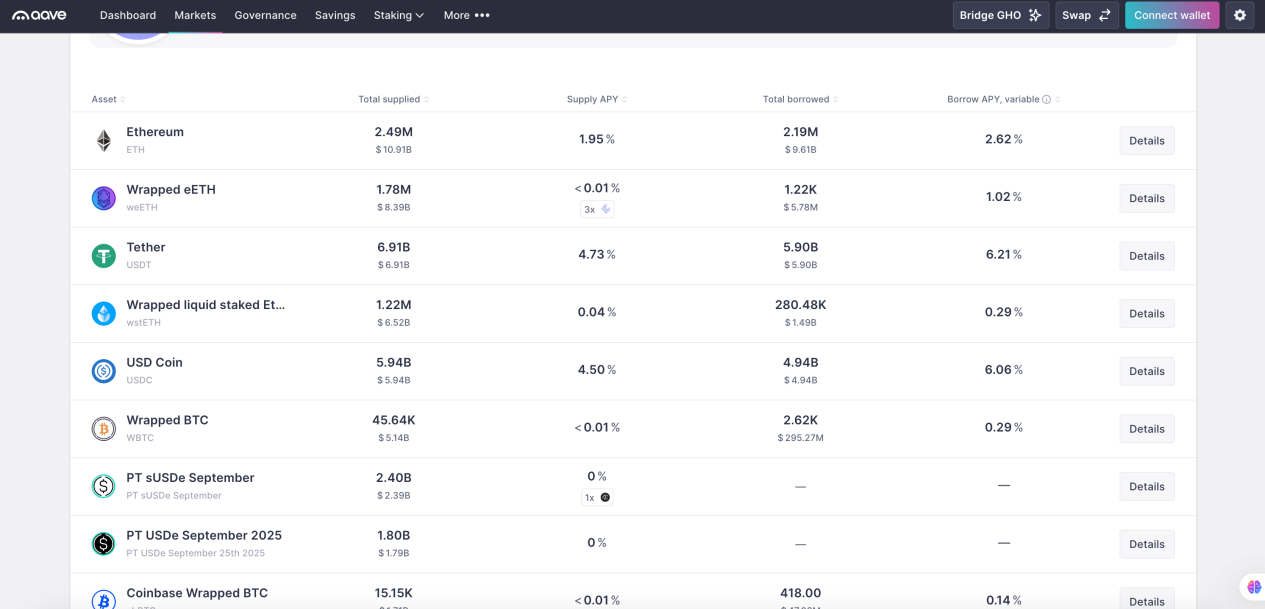
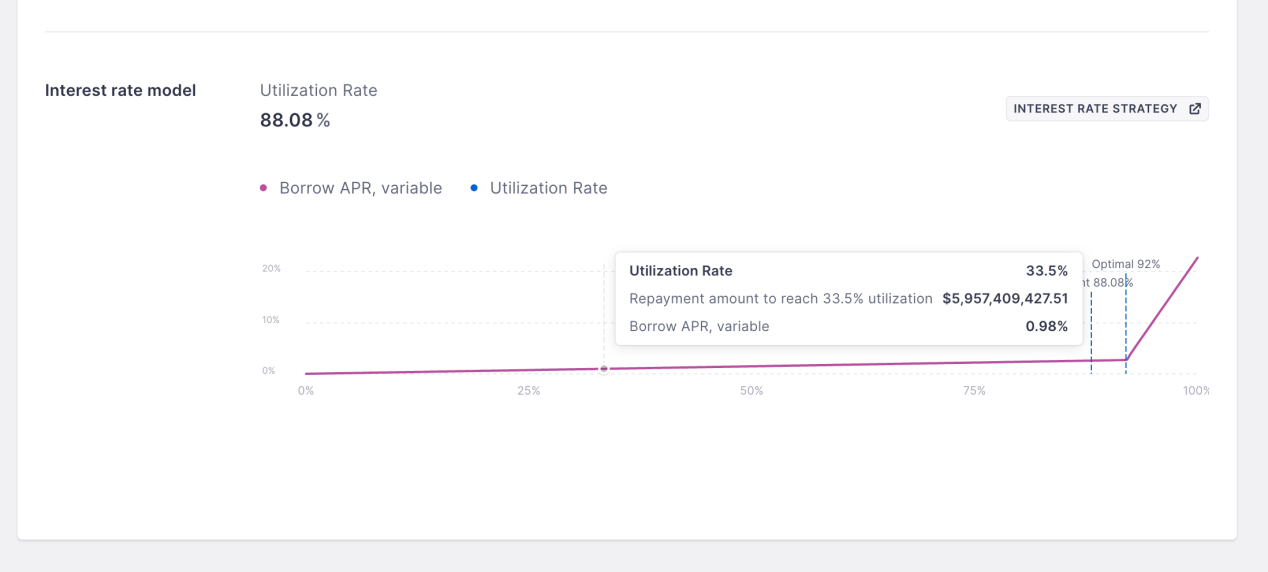
These two interest rates are variable and determined by the interest rate curve in AAVE. Simply put, the higher the pool utilization rate, the higher the corresponding interest rate level. The reason for this design is that in Peer To Pool lending protocols, borrowing does not have a maturity date concept like in traditional financial markets. The benefit is simplifying protocol complexity while providing lenders with higher liquidity, as they don't need to wait for debt maturity to reclaim principal. However, to sufficiently constrain borrowers to repay, the protocol requires that once the remaining liquidity in the pool decreases, the borrowing interest rate increases. This elevated rate pressures borrowers to repay, ensuring the pool's remaining liquidity remains in dynamic equilibrium, best reflecting the market's real demand.
After understanding these basics, let's introduce how interest rate arbitrage is achieved. First, find assets with high native asset yield + Supply APY as collateral. Second, find a suitable borrowing path with low Borrow APY to borrow assets. Finally, use the borrowed funds to purchase the collateral again in the secondary market and repeat the above operation to increase capital leverage.
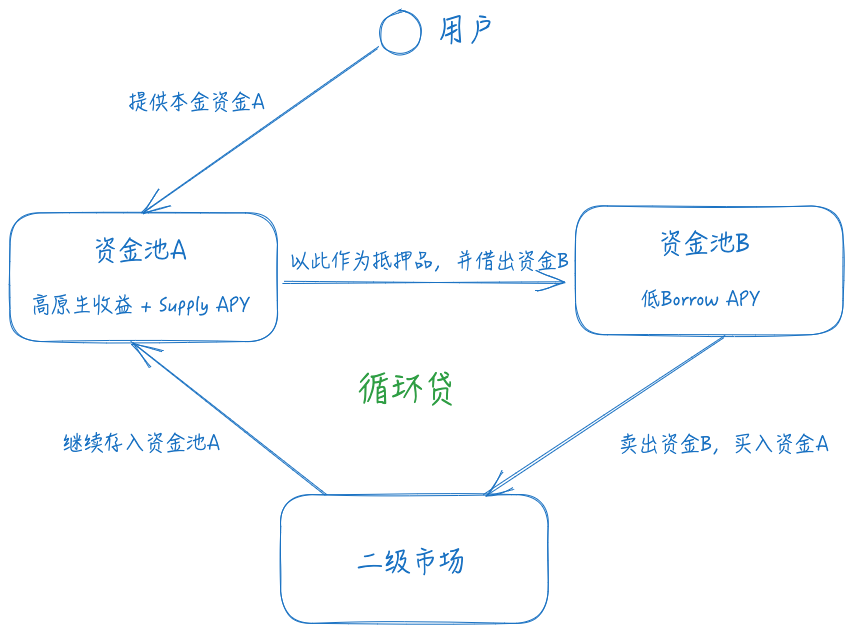
Friends with financial knowledge can easily identify two risks in this path:
- Exchange Rate Risk: If Asset A depreciates relative to Asset B in price, liquidation risk can arise. Imagine your collateral is ETH, and the borrowed asset is USDT. If the ETH price drops, your collateral ratio becomes insufficient, leading to potential liquidation.
- Interest Rate Risk: If the Borrow APY of Pool B is higher than the total yield of Pool A, this strategy is in a loss-making state.
- Liquidity Risk: The exchange liquidity between Asset A and Asset B determines the establishment and exit costs of this arbitrage strategy. If liquidity significantly decreases, the impact remains substantial.
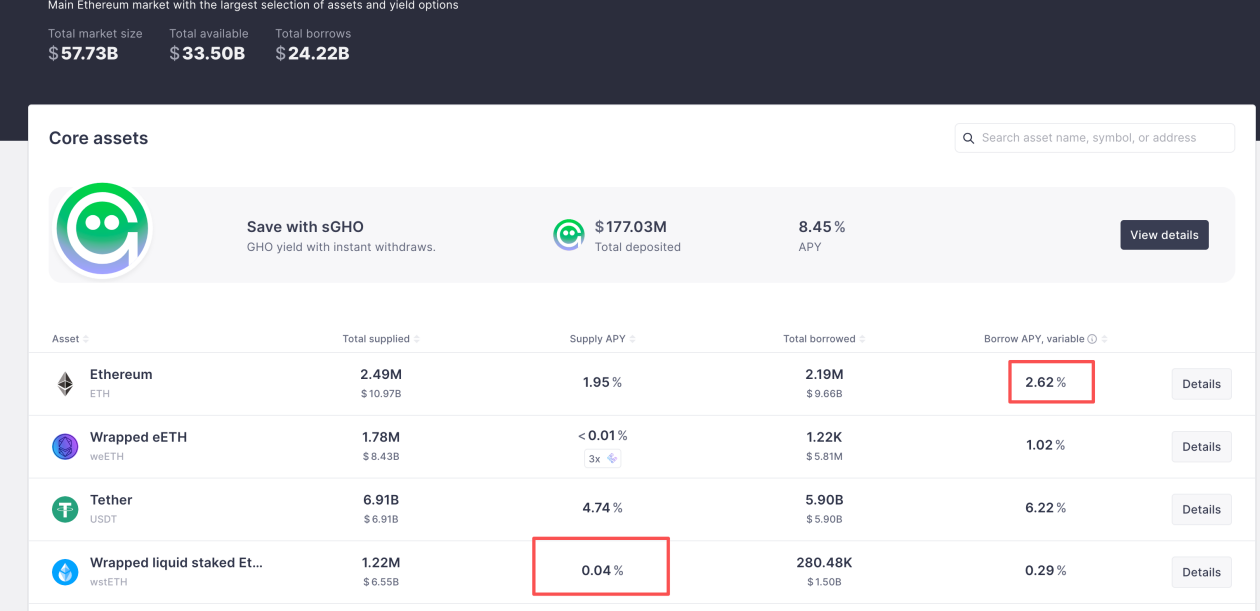
To address exchange rate risk, we see that in most DeFi interest rate arbitrage designs, the two assets involved need to have a certain price correlation, avoiding significant deviation. Therefore, there are two main types of asset choices in this sector: the LSD path and the Yield Bearing Stablecoin path. The difference depends on the denomination of the managed capital. If it's risk asset-denominated, besides interest rate arbitrage, it retains the ability to capture the native asset's Alpha returns, for example, using Lido's stETH as collateral to borrow ETH. This arbitrage path was very popular during the LSDFi Summer. Additionally, choosing correlated assets has another benefit: a higher maximum leverage multiple. This is because AAVE sets a higher Max LTV for correlated assets, the so-called E-Mode. With a setting of 93%, the theoretical maximum leverage is 14x. So, based on current yields, taking AAVE as an example, the lending yield for wsthETH is ETH native yield 2.7% + 0.04% Supply APY, while the Borrow APY for ETH is 2.62%. This means there is a 0.12% spread, so the strategy's potential yield is 2.74% + 13 * 0.12% = 4.3%.
As for interest rate risk and liquidity risk, they can only be mitigated by continuously monitoring the bilateral interest rates and related liquidity. Fortunately, these risks do not involve immediate liquidation, so timely liquidation is sufficient.
How an AAVE Whale Achieved 100% APR with $10 Million Through Interest Rate Arbitrage
Next, let's look at a real case to see how a DeFi whale uses interest rate arbitrage to achieve excess returns. As introduced in a previous article, AAVE accepted PT-USDe issued by Pendle as collateral several months ago. This completely unleashed the profitability of interest rate arbitrage. We can observe on the AAVE official platform that PT-USDe is consistently at its supply cap, indicating the popularity of this strategy.
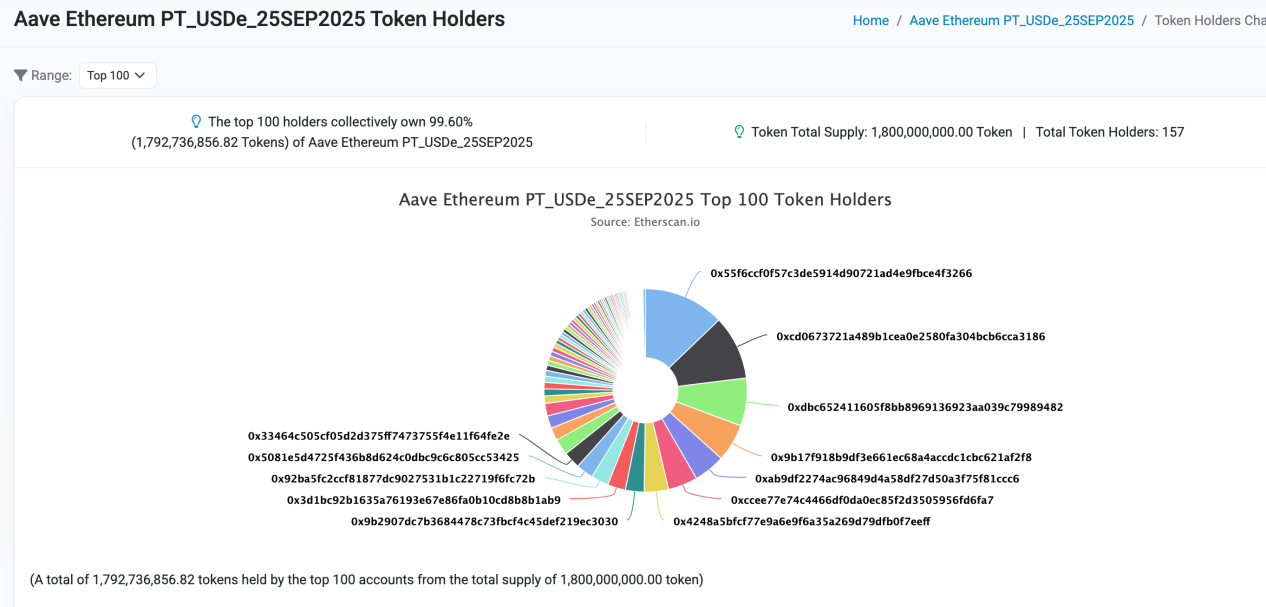
We select the DeFi whale with the largest collateral scale in this market, 0x55F6CCf0f57C3De5914d90721AD4E9FBcE4f3266, to analyze their capital allocation and potential yield. This account's total asset size reaches $22M, though most of it is allocated to the aforementioned strategy.
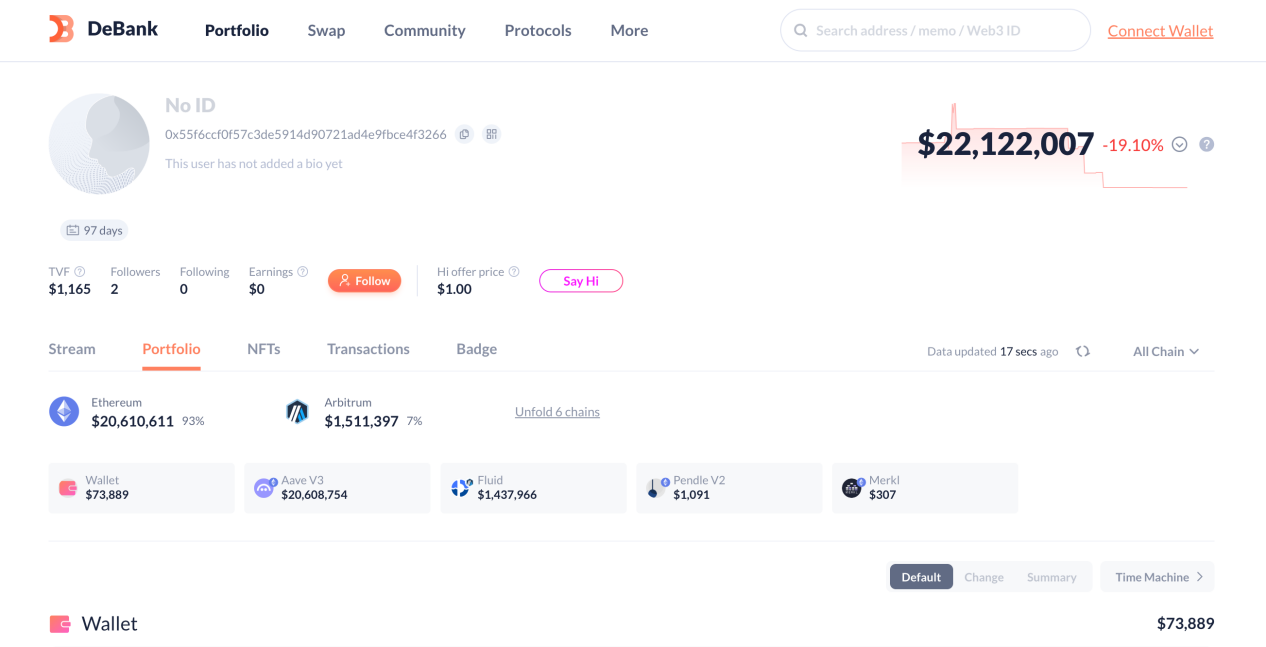
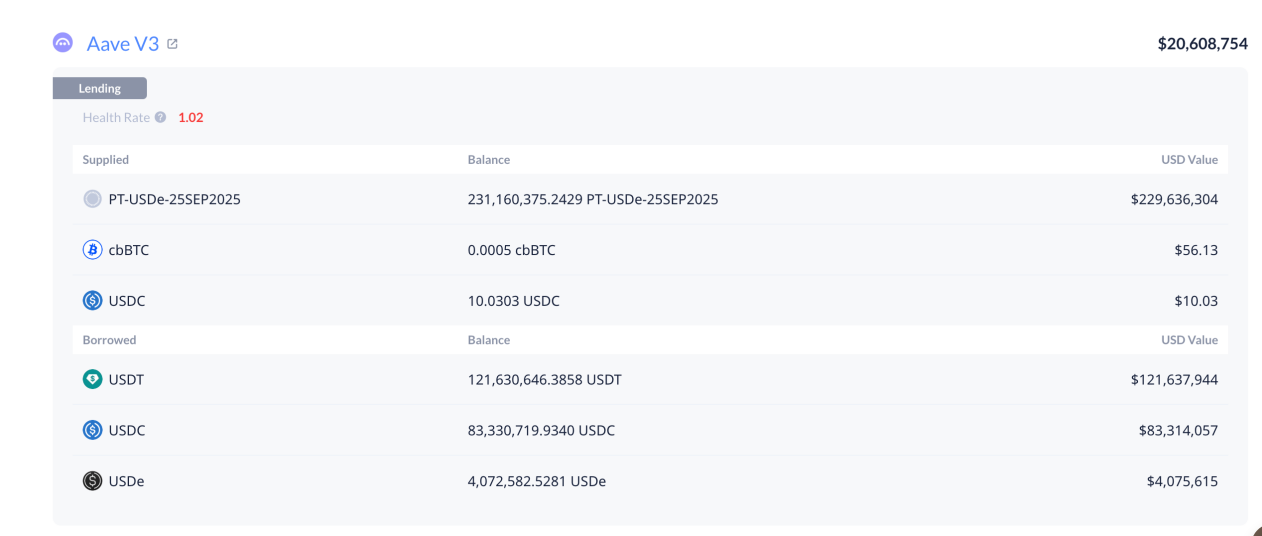
It can be seen that the account allocates capital through two lending markets, with $20.6M allocated within the AAVE ecosystem and $1.4M allocated in Fluid. As shown in the figure, this account uses $20M in principal to leverage approximately $230M in PT-USDe asset size within AAVE, with corresponding borrowings allocated as $121M USDT, $83M USDC, and $4M USDe. Next, let's calculate its APR and leverage multiple.
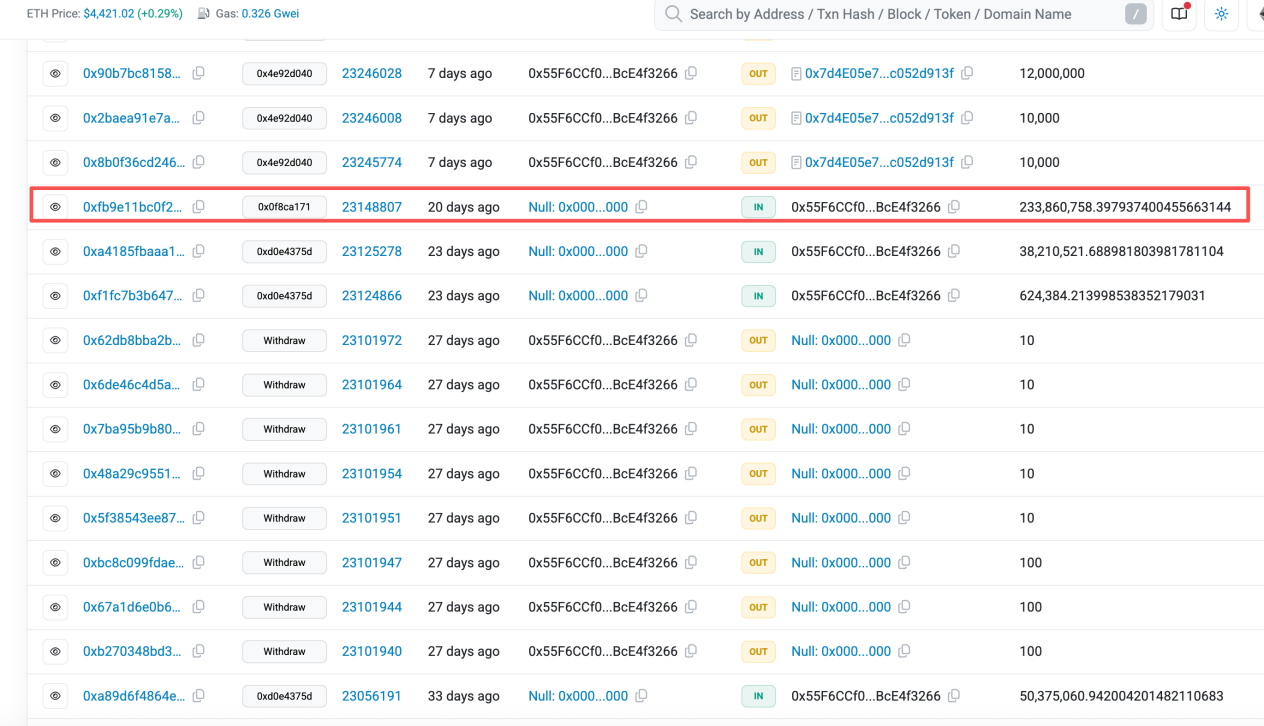
According to the PT-USDe interest rates at the time of their position opening. Their main interest rate lock occurred on August 15, 20:24, meaning the account's entry interest rate was 14.7%.
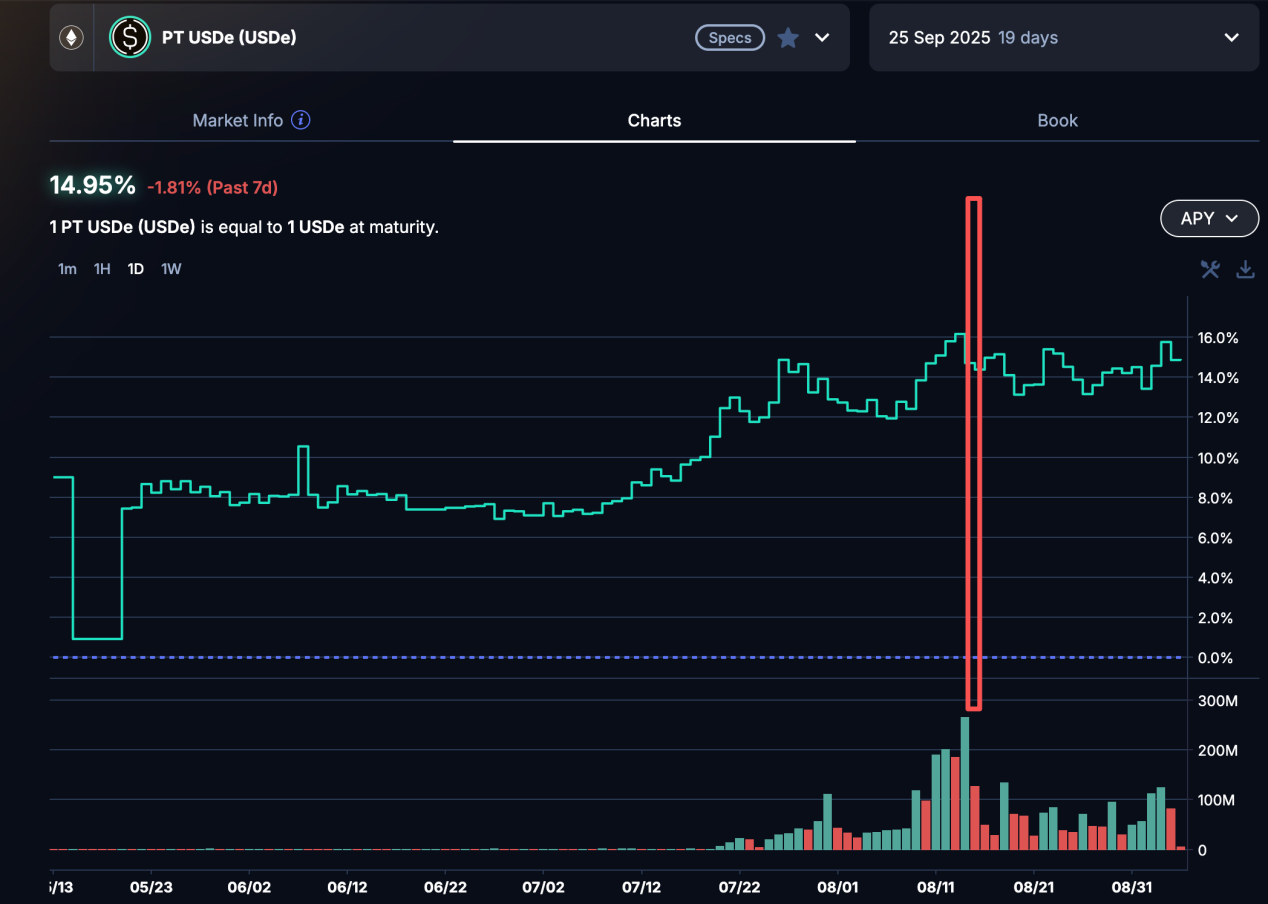
Currently, the borrowing interest rate for USDT in AAVE is 6.22%, for USDC is 6.06%, and for USDe is 7.57%. We can calculate their leverage multiple and total yield as 11.5x and 104%. What attractive numbers!


How DeFi Beginners Can Replicate the Big Player's Strategy
In fact, for DeFi beginners, replicating such an interest rate arbitrage strategy is not difficult. Currently, there are many automated interest rate arbitrage protocols in the market that can help ordinary users avoid the complex looped lending logic behind it, enabling one-click position opening. Here, as the author stands from the buyer's market perspective, specific project names won't be introduced; everyone can search the market themselves.
However, the author needs to remind about the risks of this strategy, mainly divided into three aspects:
- Regarding exchange rate risk, a previous article introduced the AAVE official community's design logic for the Oracle of PT assets. Simply put, once the oracle is upgraded to capture price changes of PT assets in the secondary market, this strategy needs to control the leverage multiple to avoid liquidation risk when the maturity date is far and market price fluctuations are large.
- Regarding interest rate risk, users need to continuously monitor changes in the interest rate spread and adjust positions promptly when the spread narrows or even becomes negative to avoid losses.
- Regarding liquidity risk, this mainly depends on the fundamentals of the target yield-bearing asset project. If a major crisis of confidence occurs, liquidity will quickly dry up, and the slippage loss suffered when exiting the strategy will be significant. Users should also maintain some vigilance and keep an eye on project developments.
Join TechFlow official community to stay tuned
Telegram:https://t.me/TechFlowDaily
X (Twitter):https://x.com/TechFlowPost
X (Twitter) EN:https://x.com/BlockFlow_News
 @web3_mario