Can practicing spoken language get you free airdrops? A detailed look at Poseidon, the AI voice input project led by a16z
TechFlow Selected TechFlow Selected
Can practicing spoken language get you free airdrops? A detailed look at Poseidon, the AI voice input project led by a16z
"The AI industry is facing a 'data exhaustion' bottleneck, which is exactly the core problem Poseidon aims to solve."
 Navigating Web3 tides with focused insights
Written by: Umbrella, TechFlow
In recent days, a trend of practicing spoken language has swept through the crypto community.
A project named Poseidon, an AI voice input platform, has officially launched, currently allowing users to earn points daily by submitting voice inputs, contributing toward future airdrop allocations.
Incubated by Story Protocol and led by a16z in its funding round, Poseidon targets the current scarcity of high-quality, clear AI voice data, aiming to help train AI systems to understand speech across different languages, dialects, and environments.
After trying it out, the author summarizes the background of the Poseidon project and how to participate—this might just be hiding the next "free high-value airdrop" opportunity.
Project Background
According to its official website, Sandeep Chinchali, Chief Scientist of the project, holds a PhD from Stanford University and is currently an Assistant Professor at the University of Texas at Austin, specializing in edge computing, artificial intelligence, and generative AI.
Sarick Shah, Product Manager of Poseidon, previously worked as a software engineer at LotusFlare and Roadz, with an academic background from Johns Hopkins University. Before joining Poseidon, he led AI engineering efforts at Story.
LJW, Operations Lead of Poseidon, formerly served as Co-Director of Harvard University’s Cryptoeconomics Lab and Senior Researcher at Harvard Business School, bringing extensive experience in AI and Web3 business model operations.
SY Lee, Project Lead of Poseidon, is also the Founder and CEO of Story Protocol. His first startup, Radish, a mobile serialized novel app with millions of downloads, was sold in 2021 for $440 million to South Korean tech giant Kakao. He then served as Global Strategy Officer at Kakao Entertainment and became a venture partner at Hashed, South Korea's largest blockchain fund.

Poseidon’s significant attention is also due to its incubation under Story Protocol. As an ecosystem focused on on-chain IP, Story Protocol provides substantial support for Poseidon’s future development. Moreover, the relationship goes beyond mere incubation—SY Lee, co-founder of Story Protocol, personally leading Poseidon underscores its strategic importance within the Story ecosystem.
The recent funding announcement further boosted market interest and confidence in Poseidon. On July 23, the team revealed a $15 million seed round led by renowned crypto investment firm a16z.

Why would a16z invest in a voice data collection project?
The answer lies in one of the core challenges facing the AI industry today—usable data. In a16z partner Chris Dixon’s research report on Poseidon, he指出 that the AI industry is hitting a “data exhaustion” bottleneck—exactly the problem Poseidon aims to solve.
More specifically, AI training today faces three major data challenges:
Slowing data growth: The rate of internet content production is far slower than AI’s learning and consumption speed. The day when AI runs out of data to learn from may come sooner than expected. In 2024, former OpenAI scientist Sutskever pointed out that the growth rate of internet data is slowing down—this "fossil fuel" driving AI advancement is gradually depleting.
Scarcity of high-quality data: Compared to text data, clean multilingual speech data is even more of a “scarce resource.” Higher-quality voice content enables AI to better understand human speech in conversations, improving efficiency.
Lack of diversity: Most existing online voice data is in standard “Mandarin” or similar standardized forms. Data covering various dialects, accents, and real-world environments is severely lacking in this field.
Poseidon directly addresses these pain points by incentivizing users to contribute multilingual voice data from real-life scenarios, providing AI models with richer and higher-quality training material.
This model of “everyone contributes data, everyone gets rewarded” not only meets AI companies’ data needs but also creates an opportunity for ordinary users to share in the benefits of AI development.
Participation Guide
Besides the web version, Poseidon has also launched a mini-app on the World Coin App. Users can add and log in via the World Coin App, though this method involves a more complex process compared to the official website. This article will use the web interface as the example.
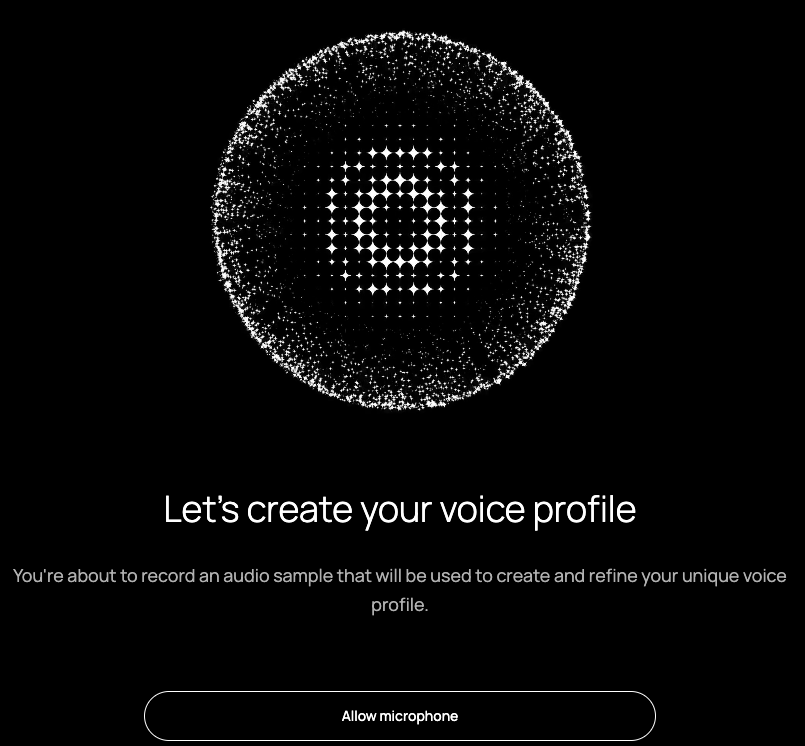
Visit the official website and register using an email address. No need to connect a crypto wallet at this stage, making it very beginner-friendly. Upon first login, users must grant microphone access and complete a short voice recognition task by reading several English words.
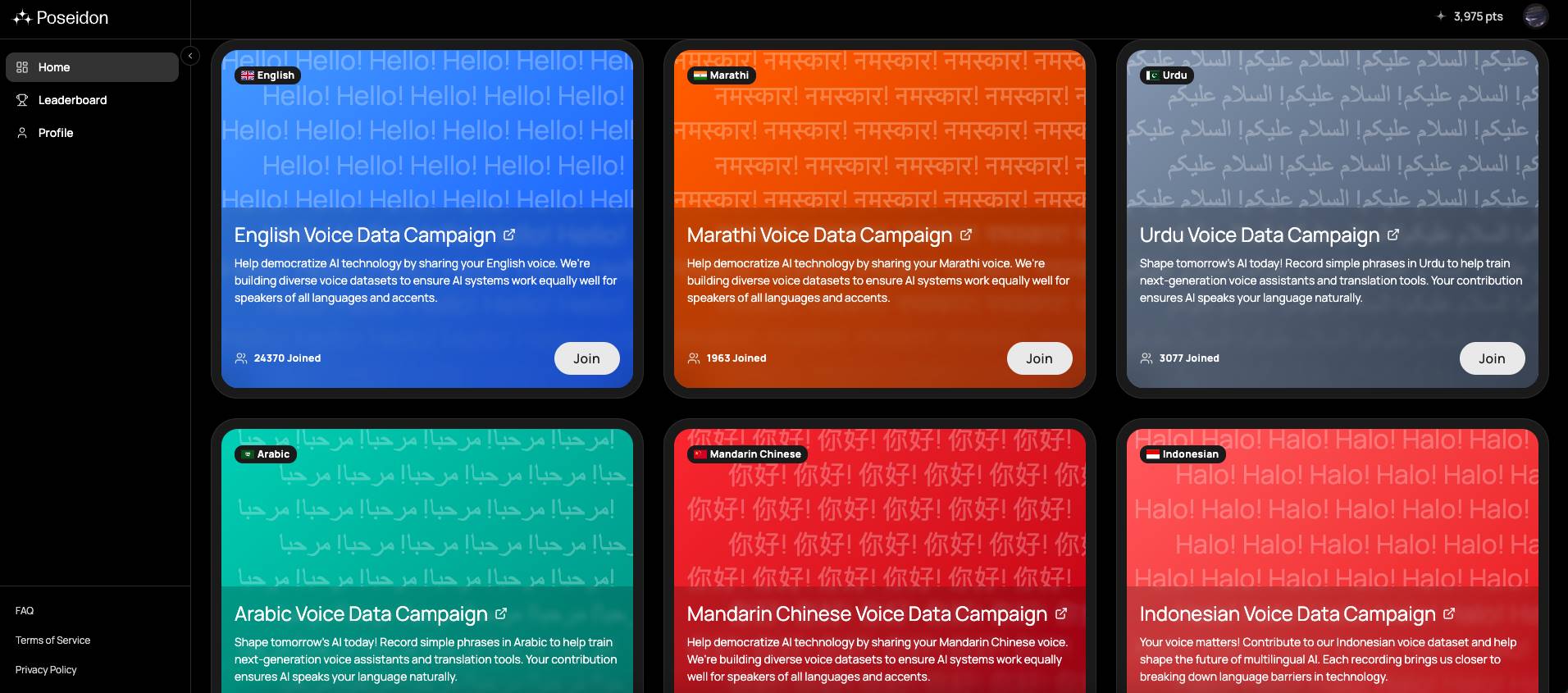
Once verified, users enter the main interface. From the left sidebar under “Home,” select the desired language. Currently, Poseidon supports 16 languages including English, Chinese, German, and Japanese. English has the most participants, exceeding 24,000 users.
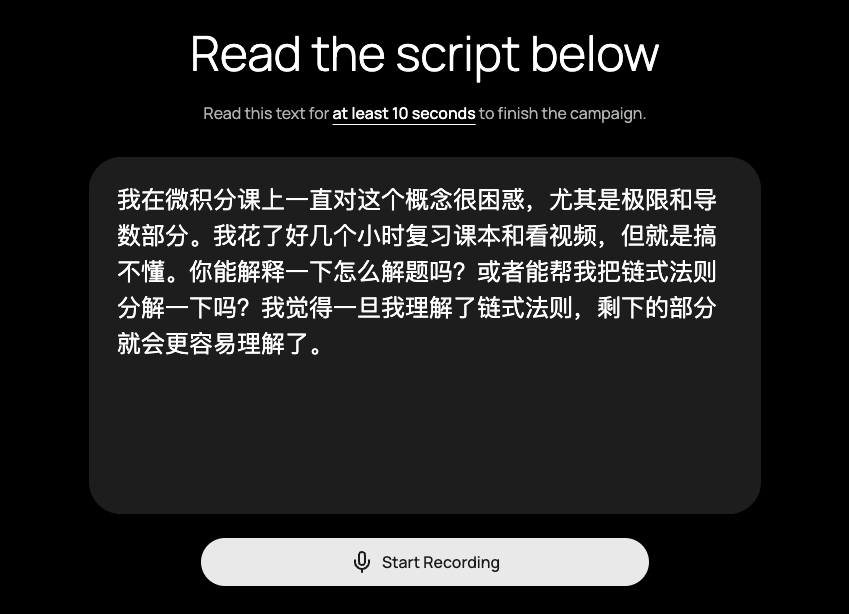
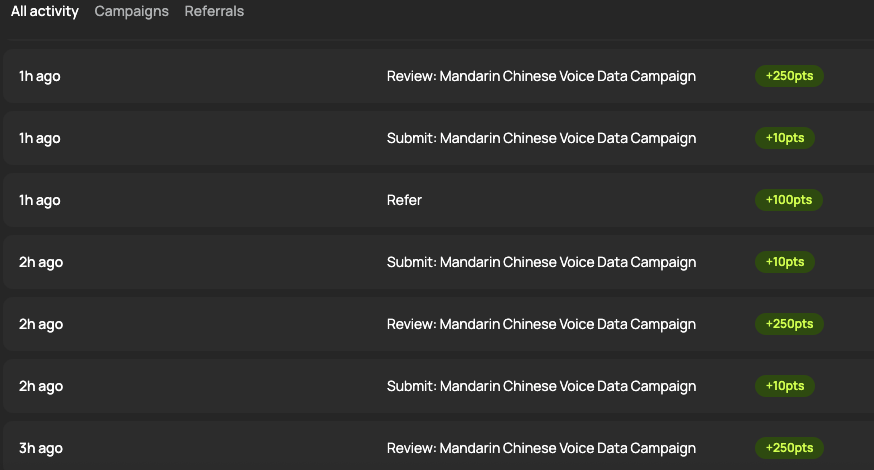
After selecting a language, users proceed to the reading interface. Click “Start Recording” to begin reading aloud. After recording for at least 10 seconds, click “Submitting” to receive 10 points.
After submission, AI will review the audio. If approved, users receive an additional 50–250 points.
Points Earning Strategy
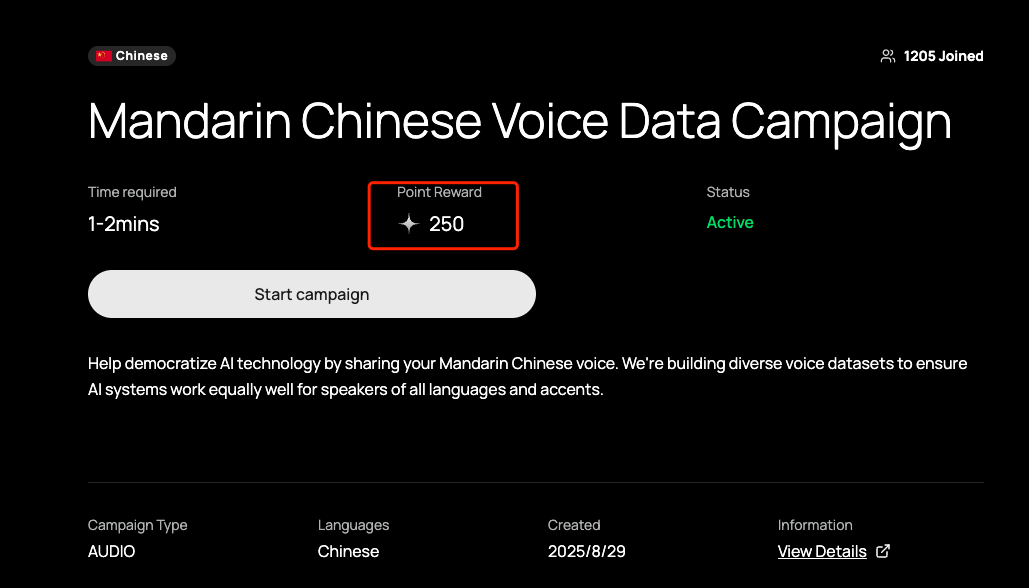
According to current point rewards listed on the Poseidon website, English—the most participated language—offers the lowest reward: 10 (on submission) + 50 (on approval). Other languages, including Chinese, offer 10 + 250 points. Therefore, for Chinese-speaking users, choosing to submit in Chinese is both easier and more rewarding.
Note that the daily limit for voice submissions is 5 times. However, through active engagement (such as submitting high-quality recordings), users can increase their daily submission allowance up to a maximum of 20 times.
Based on testing, unclear recordings or blank submissions do not receive full points and still count against the daily submission quota.

Through the “Profile” section in the left sidebar, users can check their detailed point history and access their personal referral link.
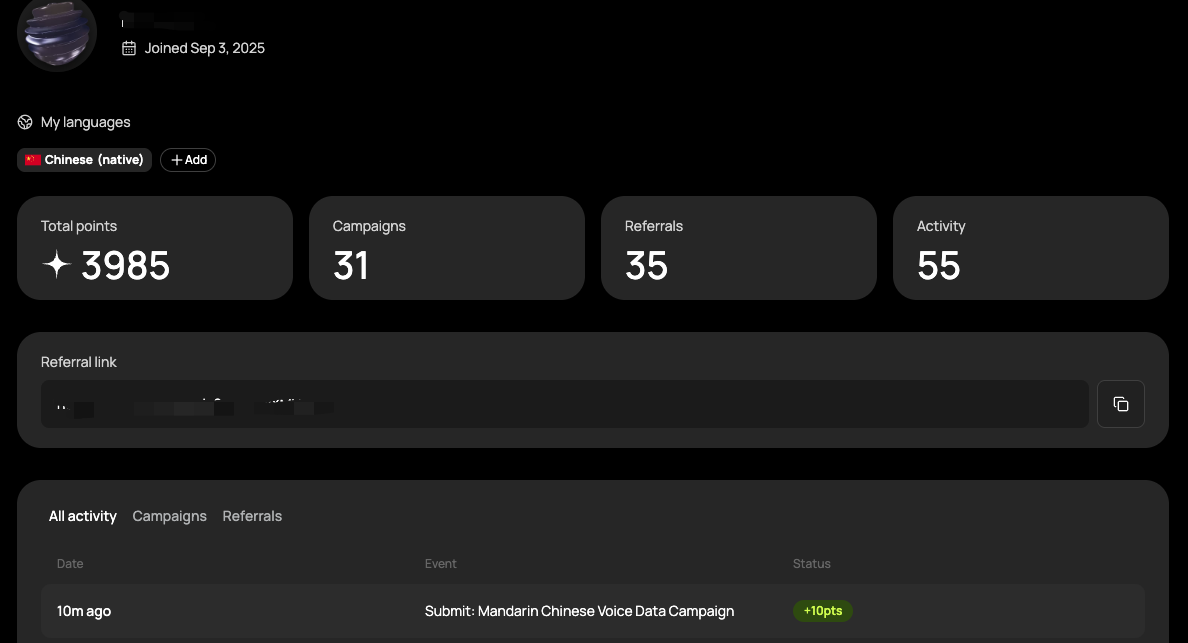
The “Leaderboard” section in the left sidebar displays the ranking of top point earners. Currently, participation remains relatively low. The author earned 3,985 points over two days, ranking 435th. As more users join, competition may intensify.

Airdrop Expectations
Although Poseidon has not yet announced a token launch date, its website states that accumulated points from user interactions will be converted into rewards or token airdrops once the tokenomics are finalized.

With the rapid development of AI in recent years, numerous related crypto projects have emerged. However, the foundational data required for AI advancement is being rapidly depleted. There is an urgent need for high-quality, real-world voice data—this demand gave rise to Poseidon.
From a user perspective, this could be a low-risk, high-potential early opportunity. By simply investing time and voice input now, users may gain eligibility for future airdrops.
Join TechFlow official community to stay tuned
Telegram:https://t.me/TechFlowDaily
X (Twitter):https://x.com/TechFlowPost
X (Twitter) EN:https://x.com/BlockFlow_News
 深潮TechFlow