
Trillions of Capital Pour into AI, Only Two Money-Losing Companies Foot the Bill: Bank for International Settlements Also Warns of Bubble Risks
TechFlow Selected TechFlow Selected
Trillions of Capital Pour into AI, Only Two Money-Losing Companies Foot the Bill: Bank for International Settlements Also Warns of Bubble Risks
If Microsoft, Google, and Amazon decide to stop purchasing $30 billion worth of GPUs every quarter, the entire supply chain will collapse.
 Navigating Web3 tides with focused insights
Author: Ed Zitron
Compiled by: TechFlow
TechFlow Editor's Note: The Bank for International Settlements (BIS) annual report reveals a truth deliberately ignored by tech giants: trillion-level AI capital expenditures have exceeded these companies' cash flow and profitability, and the ultimate destination of this money is merely sustaining two model labs, OpenAI and Anthropic, which are bleeding hundreds of millions. If Microsoft, Google, and Amazon decide to stop purchasing $30 billion worth of GPUs every quarter, the entire supply chain will collapse.
This month, I released a two-part series of in-depth reports analyzing the "bubble within a bubble" structure in the AI bubble—from the unsustainable reckless growth of semiconductor companies to the cult of personality surrounding Sam Altman and Dario Amodei. On Friday, I will release the long-awaited "SoftBank Hater's Guide," which you won't want to miss.
On Sunday, the Bank for International Settlements (BIS) released its annual report, saying a bunch of things I've been saying for a while:
In the short term, the ongoing AI investment boom has raised questions about the sustainability of the current economic expansion. The five major hyperscale cloud companies plan to spend over $1 trillion on AI-related capital expenditures between 2025 and 2026. These commitments exceed these companies' earnings and free cash flow, leading some to issue debt to raise additional funds.
Seeing the central bank of central banks say what I've been saying for the past few years is indeed comforting. But this part makes me feel both vindicated and terrible for the entire world:
Disappointing returns could trigger a sudden withdrawal of financing and turn the capital expenditure boom into a long-term investment depression, with potential cascading effects on financial conditions... If hyperscale cloud companies slow down or stop the pace of aggressive capital expenditure deployment, many borrowers in the supply chain may struggle to replace lost income and repay debts.
Bullshit. Last April, I wrote an article titled "AI is a Systemic Risk to the Tech Industry," outlining how the failure of one model lab, OpenAI, would have an earthquake-level impact on its supply chain, delivering blow after blow to Nvidia, Oracle, Microsoft, and various new cloud providers providing computing power for it (most notably CoreWeave).
Since then, OpenAI's sticky tentacles have reached into more aspects of the tech industry; it has signed agreements with companies like Google, Amazon, Cerebras, and Broadcom, while also accepting more investment, including SoftBank's massive commitment. SoftBank can only fulfill these commitments by selling precious stocks in companies like ARM and Nvidia and taking on debt.
The concept of systemic risk has never truly left my work; I've spent a lot of time thinking about this issue over the past year—thus, my writing has examined the potential consequences of an AI spending pullback for the industry's financiers, particularly private credit, and the semiconductor industry.
What the BIS is concerned about is not the plummeting revenue—if hyperscale cloud companies "slow down or stop the pace of aggressive capital expenditure development" as they fear, revenue will indeed plummet—but rather that revenue plummets and borrowers in the AI supply chain cannot repay their growing debt burdens.
Similarly, this is something I have sounded the alarm on multiple times. CoreWeave has always been the darling of this newsletter; in March 2025, I published "CoreWeave is a Ticking Time Bomb," focusing on the company's overwhelming pile of toxic debt and its reliance on OpenAI as a customer.
On a larger scale, we have Oracle—I covered this company exhaustively in the "Oracle Hater's Guide" newsletter.
Unlike new cloud providers like CoreWeave, Oracle is an older company that spent most of its existence selling databases and ERP software to some of the world's largest companies and public sector institutions. Oracle turned to providing AI computing power when its core business lines began to stagnate; due to its massive size, it was able to raise crazy amounts of debt.
As I pointed out before, Oracle was a company heavily in debt even before the AI bubble. As it happens, due to its tryst with OpenAI, Larry Ellison felt it necessary to turn the debt knob up to eleven.
Oracle's spending has pushed its free cash flow into negative territory—negative $23.7 billion by the end of fiscal year 2026—as of the end of May, it had $129.5 billion in outstanding debt. This does not include its various lease commitments, adding up to nearly $38 billion, nor does it include an additional $260 billion in lease commitments signed but not yet actually started.
All this is to say, Oracle has taken on massive debt for the benefit of one company, OpenAI, and if that company can't pay the bills, it's done for. Oracle's existence—and Larry Ellison's personal wealth—depends on OpenAI being able to fulfill its commitment to spend $300 billion on computing power.
This is both the most obvious and the least discussed part of the AI bubble—hyperscale cloud companies' capital expenditures exceeding $1 trillion are driving a massive semiconductor boom, a boom based at best on the highly unlikely assumption that large language models will turn into something completely different.
If Microsoft, Google, Amazon, and Meta decide to stop spending $30 billion or more every quarter on GPUs, RAM, storage, and data center construction, that will tear a hole in the side of what people consider a permanent supercycle.
I need to state how stupid it is to think the so-called semiconductor boom is not a brief opportunity to fill your boots before a global stock market disaster arrives. This disaster will be severe enough to make the Futurum Group want to commit suicide.
Hyperscale cloud companies—whose capital expenditures will exceed their cash flow in the third quarter of 2026—are getting such poor returns on AI investments that none of them will actually disclose revenue beyond vague "annualized revenue," meaning all these investments are actually based on the idea that something completely different will happen in the future.
This future must bring them at least $2 trillion in entirely new revenue by 2030, because if not, virtually all capital expenditures will be used to prop up Anthropic, OpenAI, and whatever Meta is doing with its chatbots.
There is no compelling or rational argument supporting continued capital expenditure, at least none that doesn't默认 accept that most current spending is wasteful, except for inflating stock prices and incubating two different large loss-making AI labs. Those millions of H100, B200, and B300 GPUs will not welcome a digital God, they will not create recursive self-improvement, they will not become the pivot point for adding $600 billion or more in entirely new revenue to current services; the only revenue they generate is from Anthropic and OpenAI's computing expenditures, which I estimate accounts for 20% or more of Google, Amazon, and Microsoft's cloud revenue.
I also must clarify that these companies' costs far exceed equity investment. Although Microsoft invested $13 billion in OpenAI, Microsoft executive Michael Wetter revealed in the Musk v. Altman case that this collaboration has already cost over $100 billion, implying OpenAI's infrastructure costs alone are at least $87 billion. I imagine Amazon and Google must spend similar amounts to handle Anthropic's equally greedy computing demands, especially considering the $11 billion+ cost of the Rainier project data center Amazon dedicated to Anthropic.
This is the severely under-discussed part of the AI bubble. Anthropic and OpenAI have raised less than $300 billion in total since 2019, but I estimate their real costs are at least $500 billion, considering the hyperscale cloud company capital expenditure investments necessary for their existence, not to mention the $340 billion or more Oracle spent building OpenAI's 7.1GW "Stargate" data center. These are not startups, but subsidiaries of large tech companies; they exist as independent departments only to inflate equity positions and hide the truth: AI capital expenditure is completely wasting money, even if you count two fat spendthrifts losing billions annually.
As I reported two weeks ago, OpenAI spent $17.2 billion on Microsoft Azure in 2025, a year in which it lost $20.9 billion on $13.04 billion in revenue. Even if that were profit (it isn't), that is still $4.2 billion less than Microsoft's capital expenditure in the first quarter of 2025.
Aside from OpenAI, Microsoft arguably has no AI business. Although it boasted in April of having $37 billion in AI annualized revenue (meaning a non-specific month multiplied by 12), that only equals about $3.08 billion per month, or less than one-tenth of its $31.9 billion capital expenditure in that quarter. Worse, Microsoft revealed this number "grew 12% year-over-year," implying its AI annualized revenue for the third quarter of fiscal year 2025 was $16.59 billion, or about $1.38 billion per month.
However, my report last November on OpenAI inference spending showed it spent $2.947 billion in the third quarter of fiscal year 2025, annualized to about $11.7 billion, meaning at least in that quarter, OpenAI might account for about 70% of Microsoft's AI revenue; I would be surprised if there were dramatic changes during the year, as OpenAI's inference spending in the first quarter of fiscal year 2026 was $3.648 billion.
All this is to say, the only real result of all this capital expenditure seems to be propping up two deeply loss-making companies, Anthropic and OpenAI, and then recouping a small fraction in the form of revenue, revenue that is only achievable through hundreds of billions in venture capital subsidies.
Now OpenAI and Anthropic account for 50% or more of the hyperscale cloud companies' remaining performance obligations, about $748 billion.
Besides mistakenly believing OpenAI or Anthropic can actually afford to pay without Google, Amazon, or Microsoft giving them money, there is simply no logical or rational reason to further invest capital expenditure in AI. Hyperscale cloud companies have no form of meaningful AI revenue outside their own pseudo-startup investments, A) they continue to invest and B) the market, analysts, and journalists act as if everything is fine, which is both absurd and irrational.
Sidenote: I haven't discussed Meta because Meta has no AI story. Mark Zuckerberg wasted every ounce of its capital expenditure, except for whatever it can obtain by reselling capacity to others—but don't worry, he thinks (this is a quote!) Meta has uses for computing power! No, sorry, those GPUs are not driving meaningful growth in advertising revenue, I've talked about that before.
Record sales from Nvidia, Micron, SanDisk, SK Hynix, and Samsung are a direct result of a completely speculative asset bubble, driven by reckless and directionless capital expenditure from some of the world's largest and wealthiest companies.
Anyone investing in data centers is building speculative capacity for demand that does not exist outside of Anthropic and OpenAI. If said demand existed, AI data center new cloud company CoreWeave would have a healthy and diversified revenue stream, not 65% of its revenue coming from Microsoft (for OpenAI) and Nvidia, with the rest from Google (for OpenAI), Anthropic, Meta, and of course OpenAI. There are simply no other large-scale AI computing consumers; the only reason we haven't touched that harsh reality is that data centers take 18-34 months to complete.
Even so, I can almost find no evidence anyone other than OpenAI, Anthropic, and hyperscale cloud companies possesses the demand or funding to justify data center construction.
I really need to emphasize this.
If we assume Nvidia CEO Jensen Huang's prediction of $1 trillion in Blackwell and Vera Rubin sales comes true, that would be about 40GW of data center capacity, IT load about 30GW, if we assume data centers earn about $12 per megawatt, generously speaking, that will generate about $435 billion in annual computing demand by 2030.
Let's be very clear about one thing: the only companies that can afford to spend money on computing power now are either hyperscale cloud companies or companies subsidized by hyperscale cloud companies. Even so, aside from OpenAI's $50 billion computing expenditure in 2026 and my estimated similar amount for Anthropic, there seems to be no more than a few billion dollars in demand, if any; CoreWeave, IREN, Nebius, Cipher Mining, and other new cloud providers would have hundreds of billions in remaining performance obligations, not remaining performance obligations that only expand under hyperscale cloud company support or Meta's Zuckerberg-style AI psychosis depth.
Let me put it simpler: those hundreds of billions in data centers are being built for no one; the only companies that can "afford" to pay even a small fraction of computing fees are unprofitable AI companies propped up by hyperscale cloud companies.
While this may read like a radical stance, I think looking at the current state of affairs and saying "whatever, I think hyperscale cloud companies should spend $1 trillion next year" is far more radical.
There is no rational reason to do this other than delusional thinking driven by a crazy market eager to avoid thinking that tech doesn't have any high-growth ideas.
Aside from creating OpenAI and Anthropic, current capital expenditure is almost completely wasted. Microsoft 365 Copilot sucks. GitHub Copilot sucks. Google AI Overviews suck. Google Gemini is a follower LLM, so it sucks too. Meta's LLM is very dangerous. Amazon Rufus sucks, and Amazon should be investigated by the SEC for implying it drove $10 billion in "annualized revenue" in the third quarter of 2025, because it absolutely did not. Alexa+ sucks. Everything sucks, and if large tech companies only spent a quarter of their capital expenditure, it would be equally terrible.
These products are almost universally hated, generating almost no revenue; even in the case of moderately successful GitHub Copilot (annualized revenue of about $1.08 billion as of last end of year), that is only because users' computing power was heavily subsidized, leading Microsoft to shift users to token-based billing, angering customers accustomed to burning thousands of dollars in tokens for a monthly payment of $39.
Yes, All This Money Could Be Wrong
Sundar Pichai, Andy Jassy, Satya Nadella, and Mark Zuckerberg are losers. They may possess billions of dollars, they may run giant tech companies, but they are losers, selling a technology destined to fail, technology based on unreliable, inefficient, and overly expensive tech, unsuitable for the reliable, deterministic, "set it and forget it" characteristics people actually associate with AI.
The four big losers are the only reason people take these large loser models seriously, marking that the tech industry and our economy are also driven by losers. Every bit of "progress" we see from LLMs comes from forcibly squaring the circle—billions in training costs, hundreds of billions in capital expenditure, endless tools, scripts, wrappers, and layers, trying to extract anything close to the so-called autonomy promise.
All the king's horses and all the king's men have put every dollar and every ounce of brainpower into trying to make LLMs into what they are not, and we as a society are expected to coddle these things, act like they are excellent, and give them credit for things that haven't happened yet. I refuse to accept the premise that LLMs' ability to generate code or copy open-source software is evidence that these things will become powerful autonomous tools in the future, and I think those who infer that are either intellectually bankrupt, deeply cynical, or easily fooled into clicking every email claiming their Paypal account has been compromised.
I assure you, all this money could be wrong! Hyperscale computing companies can indeed spend a trillion dollars on something that doesn't do what they say, because these companies are very willing to mislead you, to quote Nik Suresh:
A large part of the economy is driven by people who are simply very easily suggestible. That is to say, it is very, very easy to get them excited and willing to spend money.
Why is everyone investing in data centers? Because hyperscale computing companies did! Why are Micron and memory companies selling so much memory? Because A) GPUs use a lot of high-bandwidth memory, B) that high-bandwidth memory consumes three times the wafer space of ordinary DRAM, leaving less space for other kinds of cheaper, lower-margin memory, and C) because servers for these AI GPUs are also packed with memory!
These data centers are not being built because creditors have any "insight" into the massive AI computing power generative AI tools need and will need. They see the "success" of ChatGPT and Claude (two heavily subsidized products), think because Anthropic and OpenAI need massive computing power, everyone will need massive computing power. And because banks and private credit are eager for investment vehicles, everyone is so excited, it's super easy to get them excited about the prospect of building large, sexy, and expensive things!
The fact that much information is deep, deeply flawed doesn't help either.
Exponential View Should Be Ashamed of Itself
Exponential View's research uses fuzzy proprietary data to manipulate the dice.
Anthropic and OpenAI represent at least 68% of the so-called $110 billion AI revenue in the past 12 months. Although the report claims to "deduplicate" revenue across the entire AI stack, it does not provide any form of source data, making it unverifiable.
The report uses "annualized run rate" to try to make AI industry revenue look larger than it actually is.
This report is industry marketing disguised as research, but using deliberately positive frameworks and questionable data sources.
Last week, research firm Exponential View released a suspicious report claiming AI revenue reached $110 billion in the past 12 months (appearing to be between June 2025 and mid-June 2026), and did so by piecing together all AI revenue, including OpenAI and Anthropic's customer spending and computing expenditures. Although the report claims to have somehow "deduplicated" the numbers, Exponential View refused to explain how. Including both revenue and computing expenditures to try to represent the substantive health of the AI industry is also deeply deceptive.
This is because the AI industry is full of losers who cannot win without tampering with numbers, and because everyone is so excited, they are ready to be fooled and hesitate to dig one inch deeper.
Not me! I don't care, I hate feeling deceived, so I dug deep.
This is because OpenAI and Anthropic represent up to 75% of that revenue between their computing expenditures and revenue. According to The Information and my own reporting, OpenAI had about $8.77 billion in revenue in 2025 and spent about $17.48 billion on computing power, according to The Information had $5.7 billion in revenue in the first quarter of 2026 and spent $17.8 billion on computing power, totaling about $44 billion (40% of Exponential View's total), this does not include any computing expenditures or revenue from OpenAI in April, May, or June, which could further push the total higher.
Although Anthropic is harder to parse due to the Wall Street Journal's unwillingness to make readable charts, it had $4.8 billion in revenue in the first quarter of 2026 and spent what I believe was at least $4 billion on inference, although its training costs were not reported, I think assuming they were at least $5 billion is reasonable, totaling $14.6 billion. If we take half of Anthropic's (all numbers are forecasts) 2025 $4.5 billion revenue, $2.7 billion inference cost, and (I seriously question this number) $4.1 billion training expenditure according to The Information's reporting (very generous, as most concentrated at year-end), we get $5.65 billion, total contribution to Exponential View's analysis of $20.25 billion, about 18.4% of that $110 billion total.
So, yes, excluding anything from the second quarter of 2026, Anthropic and OpenAI represent 68% of the $110 billion AI revenue Exponential View is trying to get people excited about.
These are actions of a loser propping up a loser industry that cannot win by telling you the truth. This report is entirely to fool people who are already fooled and support the existing narrative, which is why Bloomberg reported it in the most obscure, industry-catering way:
According to a report from research firm Exponential View, artificial intelligence revenue has reached a tipping point, suggesting the hundreds of billions of dollars tech companies have invested in it may be economically sustainable. Global AI sales excluding China reached $25 billion in the first quarter of 2026, exceeding the industry's estimated $21 billion in depreciation costs related to data center and chip investments for the second consecutive quarter. While this milestone suggests AI companies are beginning to be able to cover the costs of their capital expenditures, profits are thin. Depreciation expenses still consume more than two-thirds of revenue, leaving little buffer to cover other costs, such as electricity, labor, and financing.
This is stupid for two reasons!
You are comparing the costs of the entire industry with the depreciation costs of the few companies actually buying AI GPUs.
In the first quarter of 2026, Amazon had $18.94 billion in depreciation, Microsoft $10.1 billion, Google $4.4 billion. That's $33.44 billion! That's more than $25 billion! And I haven't even included Meta, but don't worry, as I will discuss, Exponential View didn't either!
Now, you might wonder how they got that $25 billion number, that's because Exponential View gave it to them!
The next question we want to track is whether AI revenue can cover the capital investment needed to build infrastructure. Our model separates AI-oriented capital expenditures from ordinary capital expenditures of major hyperscale computing companies and new cloud companies, professional AI cloud providers. This adjustment is important because hyperscale computing companies were already spending about $120 billion annually on capital expenditures before ChatGPT. We captured additional investment in AI infrastructure, then depreciated computing assets over 6 years, other infrastructure over 14 years. Our modeling shows revenue attributed to hyperscale computing companies just clears depreciation expenses.
Yes, but now they are spending $765 billion on capital expenditures. Anyway, as I mentioned above, Exponential View's magic math magically reduced those capital expenditure fees to $25 billion and completely removed Meta, because "initiatives focused on ad uplift, so not considered pure generative AI revenue, or currently has almost no direct monetization." What a loser move! Meta has oriented its entire company towards AI!
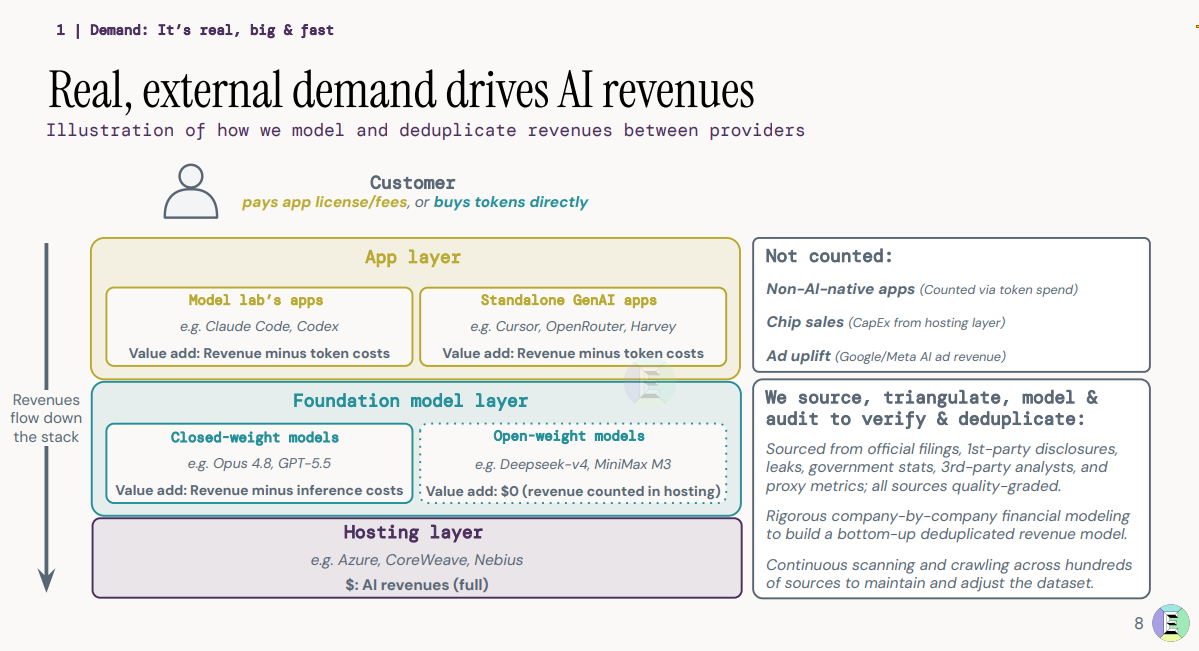
I refuse to waste too much time on this article, but I need you to see how deceptively it frames this so-called "good news" for the AI industry, comparing its own proprietary depreciation formula with its own proprietary AI revenue formula to get a chart designed to make the AI industry look good. No sourcing needed! No data needed! Just put the hype in a bag and invest in AI stocks!
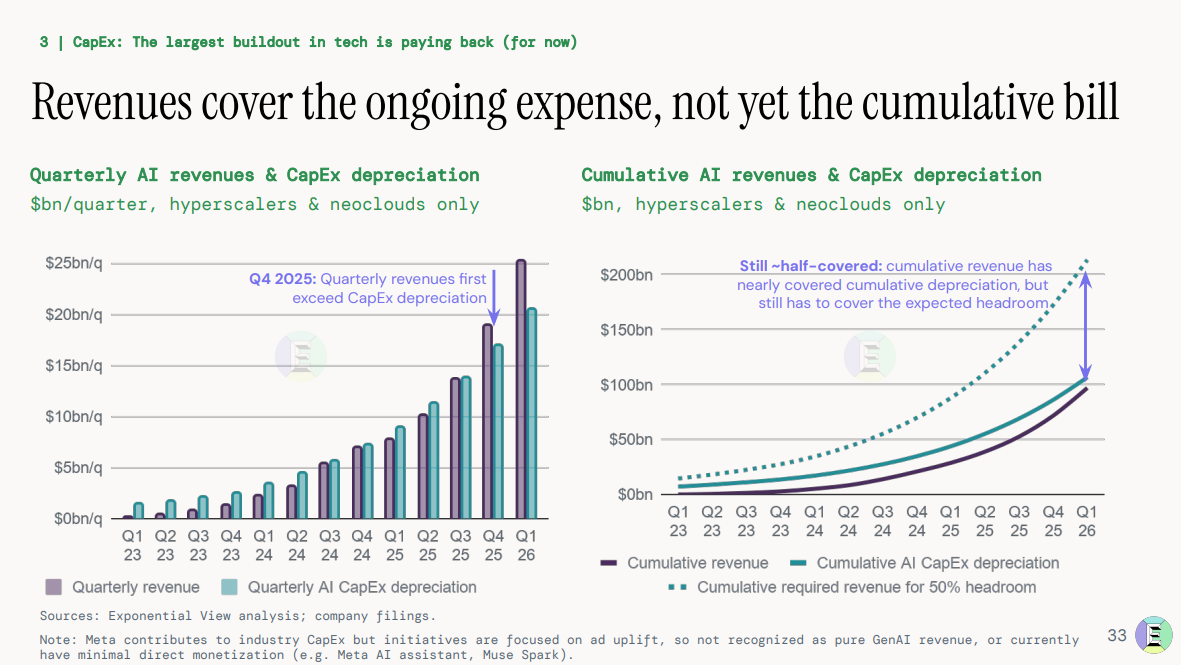
I also find Exponential View resorting to this strange, confusing "cumulative" AI revenue versus capital expenditure depreciation chart despicable. The vast majority of these revenues are OpenAI and Anthropic's computing expenditures, I don't know, if you are trying to do a report giving the true state of the AI industry, maybe try representing that anywhere in the report!
As I suggested, these are actions of losers propping up other losers. If this industry had a fundamentally sound revenue story, showing profits versus losses, tracking revenue in a transparent manner and producing a report showing AI's significant rise would be extremely easy.
Instead, Exponential View says AI is "real, big, and fast" through a Pee Wee's Playhouse full of undefined models, datasets, and so-called "quality grades," which further fuels a dangerous bubble and may deceive retail investors into making further bad decisions.
Large Loser Models
I know calling people losers sounds a bit mean, but what should I call an industry selling itself on lies and deception? What should I call people deliberately misleading others about the economics and results of generative AI? If AI is so incredibly successful and impossibly excellent, why does every explanation sound like it was written by the Riddler or someone about to drink Jonestown Kool-Aid?
Because they are losers who cannot win by truly winning. Their best (and only) hope is to overwhelm you with a 24/7 marketing campaign (driven by media), making all this look inevitable, unstoppable, and a huge success, even though every company is losing money and every product rings with a soulless mediocrity.
This is because LLMs, while an interesting tool in a vacuum, are currently being marketed by losers to losers, using a mixture of doom唠叨, crazy inference, and outright lies, manipulating people into believing the assumption that technology always gets better and so much money can't be wrong, to create a deception-driven marketing campaign. While using them won't automatically make you a loser, you become a loser the second you actively push someone to do so, because you have become a follower of the Loser Mafia.
I have never heard any AI advocate advocate for a technology with any degree of excitement in their lives, because their excitement about how these tools make them feel and what they represent far exceeds anything else. They are also tools deliberately constructed to generate engagement and make you feel productive, even when you are not.
Just listen to this person in this Bloomberg story about AI making people "efficient, anxious, and afraid to quit":
Matt Van Horn, a serial entrepreneur and father of four, never turns off his laptop anymore. He keeps more than six AI agents running in Anthropic's Claude Code. Every 10 minutes or so, they ask him what to do next. He keeps his laptop on during his kids' soccer practice, while dropping them off at school, and in hotels while on vacation. When he sleeps, an agent steps in to look after the other agents. Van Horn is one of many founders whose work is being transformed by AI. When building his latest company, he used AI agents to help contribute to hundreds of projects on GitHub. But he and many other AI evangelists also work longer hours than ever before, because they are coping with the anxiety of how AI might progress without them if they quit.
Sorry buddy, you have an addiction, and I'm worried it's ruining your life. What is this producing? What exactly are you doing with this time? Because if you allegedly have 100x productivity, wouldn't that, you know, produce something quite incredible? I don't know—nor do I want to attack this person—how important or unimportant his commits on GitHub might be, but the ROI of "obsessively checking your laptop all the time in case you might not be productive" should be something at the level of curing diseases.
The story continues:
After talking to a Bloomberg reporter for 15 minutes, he pointed out that most of his agents were probably waiting for his next prompt. "I don't have a therapist, but if I did, they would say, 'It's okay, Matt,'" he laughed. "They say agents should do the work for us, but I've never worked this hard in my life. I just have 100x the output I had before."
This person is a victim of a scam, an industry-wide psychosis, where you are judged for not constantly dedicating every second of your existence to prompting a series of chatbots to make something, all based on a false belief that at some point it will become so smart that you... don't have to prompt them?
Nevertheless, Van Horn is completely correct—the AI sales pitch is that agents should do the work for you, but billionaire losers are gaslighting you into believing a digital busybox that requires constant vigilance to ensure it does what you ask or doesn't spend too much money is somehow "autonomous."
While it's easy to mock Silicon Valley, what we are witnessing is a widespread mental health epidemic caused by liars like Sam Altman, Dario Amodei, and their wealthy supporters, who lie about AI's capabilities, creating an abusive culture where humans become subordinate to non-thinking, hallucination-prone agents subsidized by OpenAI or their employers:
Engineers work until 4 am just to show productivity that matches the agents they deploy. Startups are creating internal consulting programs allowing employees to vent AI-induced burnout, or teaming up with self-proclaimed AI ambassadors to help them learn how to use the technology better. In San Francisco, people take mental health walks in the shadow of small planes pulling "Stop Hiring Humans" banners, Friday nights increasingly become "touch grass" parties—deliberately created spaces not to talk about AI, because everywhere else has been infected by it.
This is fucking terrible, and every loser hyping this bubble should be ashamed of themselves.
In fact, fuck it, I want to speak directly to those working in Silicon Valley and the tech industry, exploited by this industry.
To Tech Workers Hurt by the AI Bubble
I know you are not all against innovation.
I know many of you feel suffocated.
I see you, hear your voices every day, and I find the treatment you suffer disgusting.
Your industry has abandoned you.
Your investors are lying to you, they get rich, while you can't even afford a studio apartment in the Tenderloin. AI hasn't done the things they promised, and those excited about it are excited because they believe it will replace you. You are victims of a marketing campaign that enriches a few at the expense of your time and energy, letting you defend a tool destined to fail.
The tools you use are designed to manipulate you, to make you work longer hours in the name of automation. You are being abused. You are deceived, fighting for the 1% in the name of democratizing software. Your agents were supposed to set you free, but they bind your body and mind to a system designed to exploit your labor, extract your value, and burn you out. The people making these agents fantasize about replacing you with them and want to use your data to achieve this. They are lying that this is possible, but they want you afraid so you will use their products more.
They persuaded you to fight on their side, but whoever wins, you lose.
You are victims. I am not your enemy. I also love technology, and I wish the tech industry could make cool things again.
But under current leadership this will not happen.
This era is designed to drain your life, suffocate you with endless tech topics, make technology every part of your life, somehow sell you the promise of automation, but only a kind of automation you must continuously monitor, continuously prompt, designed to be addictive and superficially productive, designed to fuel a godless version of the Protestant work ethic in Bay Area culture.
You must be a top engineer, you must work 15 hours, you must let 8 subagents violently assault your codebase for this or that reason, your Calendly must be open from 8 am to 8 pm, you must be willing to work desperately for a chance to escape the "Permanent Underclass"—an abused term referring to a world after a completely fictional concept of superintelligence, peddled by those who speak with an arrogance that makes me want to spray them with water like a cat jumping on the table.
Those who show grotesque joy at the idea of AI destroying everything you cherish, eager to be the first announcer, are your enemies, and so are those desperately licking the boots of Altmans and Amodeis. Do not believe those who say joining the inner circle requires you to use certain software or attack others in the name of Silicon Valley.
People encouraging you to work this way do not care about you, or they are manipulated, believing this is how you can all get rich, while manipulators are exploiting their ignorance, fear, or greed.
People at the top do not care about the future, do not care about progress, only about growth. They are believers in the collective consciousness of capital, a collective consciousness with no other purpose than constant expansion at maximum speed, as long as something is always happening everything is fine, because once you stop, you will remember what you are doing actually doesn't matter, because you are doing software with sweatshop hours.
AI agents are designed to make you interact with them. They are designed to make you consume tokens. They are designed to make you apologize for their mistakes and credit them with your labor成果. Any "autonomous" tool requiring specific prompts, frameworks, scripts, and tools to sometimes work autonomously is deceiving you.
I am also sure there are some completely normal software practitioners using these things locally or using open-source models, treating it like ordinary software, hating data centers, thinking capital expenditure or mass-market versions of LLMs are unnecessary. These people are drowned by a worrying large group, a group speaking as if they are in a cult, a cult existing to prove OpenAI and Anthropic are not just SaaS companies. For them, using AI is a virtue signal, showing they are pure, productive souls, voluntary subjects of the future, assuming they will ascend because they told enough people "we are still early."
The tech industry is trapped in a religious scam, sold to them packaged in atheistic "rationalism."
Some may or may not suffer from AI psychosis—or at least severe addiction—this is the result of being forced to interact with these things day after day, the simplest check is to try not using them for a day, or try solving problems without using them. If this is you, know I am not attacking you, I see you as a victim of a scam.
You are ingesting poison while being told it is ambrosia. You are forced to work twice as much, producing roughly the same, or even less. You are shamed or isolated for not using the right tools or saying the right things. Silicon Valley is built on ideals of individualism and rationality, yet people at the top of your industry are telling you to line up, join an illogical consensus. You exist in a monoculture treated as counter-culture, but mainly benefiting Microsoft, Google, and Amazon.
Your culture is being eroded by people who do not care about technology. You are unwitting pawns in a larger war against innovation, billions in funds directed to those who only care about growth and "acceleration," benefiting only a few. If you feel fear, anxiety, lethargy, and exhaustion, you are not alone, because you are working desperately for AI models owned by subsidiaries of the world's largest companies, building layers on top of them.
So many of you have to position your products or financing around Twitter, this is a sign your culture is decaying. A true meritocracy would reject the idea of "going viral on social media" like rejecting a virus, because it overwhelmingly favors a monoculture suppressing free thought and dissent.
Tech workers are in a continuous battle between idiots and monsters, or a mixture of both. Those who want to build useful software customers love are drowned by a Greek chorus-like group of mediocre fools who think they are capable because they can bang on LLMs' heads to create an illusion of capability.
Generative AI is the Peter Principle on steroids, eliminating friction points that might expose smooth idiots, making them more agile, and extremely dangerous. Companies are managed by people who don't know what they are doing, desperately avoiding anyone realizing we have reached the end of the software hyper-growth era, increasingly aware of their mortal nature and their lack of a culture that might truly build something humans want.
For those of you still holding on, I see you and admire you, because if I were working at most tech companies now, I would fucking quit. It is disgusting to see the entire industry bowing at the feet of this great non-profit mediocrity machine; based on my weekly conversations with many tech workers, basically the mood everywhere is exhausting, demoralizing, manic, looking terrifying.
Everything must be done faster, with fewer people, less organizational support, but using more of a tool known for hallucinations and destructive costs, you must use it heavily, but not too much. No matter how much you use, you must constantly praise it, lest a cult of personality and mediocrity isolate or fire you for the crime of not wanting to "do AI."
Even if you are trapped in this world for the next few months or years, know it is not crazy that you find it offensive, exhausting, and debilitating. You don't have to do things this way, but I understand if you are forced to due to circumstances or social pressure.
The tech industry is in the throes of mild AI psychosis, or in other words, this is a way of expanding the already strong sense of fiction that kept this industry going over the past decade.
The larger cargo cult praying at the feet of any capital desire currently owned by venture capitalists has led everyone astray, so that companies worth billions—even trillions—of dollars are based on how they might perform on Twitter, Twitter is a malicious presentation of the tech industry, catering to Silicon Valley gossip and market delusions, intellectually hindering most who cater to it to conduct business or marketing.
PS: You might just be an ordinary person, unfortunately in a situation where your boss (or bosses) requires you to adopt a tool that is at best somewhat useful in specific circumstances. Your performance review or continued employment may depend on your use of AI tools, if so, you must make it your mission to spend as much of your company's money as possible. I call this a "Rogue Bet"—in a sufficiently AI-ized organization, you will be hailed as a hero, but will burn through massive funds, and may cause them to reduce reliance on AI because of it. In a normal organization, your CEO would see the staggering costs of AI and wish they had some sense.
The rest know exactly what they are doing: catering to a venture capitalist audience convinced they are "in the arena" by posting 12 hours a day, writing 2000-word long articles with Claude. You must appease these wealthy fools, because if you don't, it's basically impossible to raise funds. You must be able to recite the rituals—Hermes! Loops! Permanent Underclass!—otherwise you will be considered uncool by the uncoolest people. You, Silicon Valley's great individualist thinker, must convince wealthy fools you are an independent and rational person, but at the same time you will follow the larger consensus.
If your ideas, dreams, or goals are outside some Potemkin-style agentic startup, or if you can conjure tricking a VC into thinking you—or anyone—will invent recursive self-improvement or self-learning AI, then now is a very unfortunate moment.
If you can sound like you will become the next Baseten or something, you can get money now. I guess this is the era of inference. And loops. Keep cheering! Never stop identifying with what others are doing, or if you disagree, only in a way indicating you agree on big things, meaning you ultimately support one or both of OpenAI and Anthropic, companies that actually operate as subsidiaries of the world's largest tech companies.
It will be like this until something changes.
The AI Industry is Losing
If I haven't made it clear enough, the AI industry is losing. Their plans aren't working, their products aren't doing what they promised, and although they intend to exhaust all available capital sources, they won't have enough money to do this forever. And, no, AI is not "too big to fail."
Everyone is mocking it. "AI" has become synonymous with generic, ugly, corporate junk. It is a physical disaster on earth, emitting terrible toxins into minority communities, creating so much noise it makes people physically ill, worse still, some independent writers make it their mission to express doubt about these issues because they don't represent the "overall" situation of data centers.
Everyone trying to be the "rational" voice on data center issues should know they are just helping make the AI industry stronger. If you worry people are "unfair" about water usage, you are an active pawn of capital, your existence is only to help drive up NVIDIA's stock price and the tens of billions in speculative investment flowing into these monsters.
Without going into details, know anyone talking about data center water usage in terms of almonds or cows is actually an industry shill.
California does use a lot of water to produce almonds—but also produces 100% of the US and 80% of the world's supply. Cows and other livestock also occupy a lot of water and land, but they also produce food for people. You can argue how much water data centers might or might not use, every second you do so will sound like a complete loser, because you are fighting to ensure the AI industry can build data centers for the world's largest companies.
Data centers are monuments to everything wrong in the world—terribly huge, noisy, requiring all kinds of electricity, water, and resources. They create few jobs, people involved in construction usually come from out of state. Their actual value to the world is largely tied to their vague theoretical contribution to what AI companies do, and they receive huge tax breaks, meaning they actually contribute little to many regions where they are placed. They are deliberately conflated with smaller, useful data centers we had in the past, all so nerds can say "Hmm, you never had opinions on these before?"
I didn't, because previous data centers weren't filled with GPUs, nor did they consume more electricity than a small town, nor were they forcibly pushed through through a combination of crony capitalism, tax breaks, and endless debt.
And it's simply unclear why we need them!
No, really, why do we need these damn things? So Anthropic and OpenAI can do more of whatever they are doing? Neither seems unable to serve customers—except for Claude's terrible uptime—they also don't seem to improve products based on the availability of computing resources.
For such an offensive massive footprint—physically, financially, and socially—no one can really explain why the fuck we need all this stuff, except they might make someone money on a service known for huge mistakes and lack of profitability.
As I discussed, outside these two companies, demand simply does not exist. The only reason people believe there is demand is because the world's largest tech companies have burned through all the money, just to hide a fact from you: they have no more big ideas.
The AI industry fights like a bunch of losers, because they are losers. They cannot win by telling the truth about products, infrastructure, financial status, or overall intent. Their success离不开 manipulation and deception, because deep down they know their business model doesn't make sense, and their actual products—described in the present tense—simply cannot justify what they demand.
They need us to indulge them, ignore their catastrophic costs, turn a blind eye when they hallucinate or delete someone's database, blame ourselves when they make mistakes, describe them using completely theoretical terms, because reality is fucking terrible.
Everything the AI industry creates isn't worth a fraction of the trillions invested in this industry. It's clear by this point, the cost of these models is about equivalent to a person, but neither can replace a person, nor are they profitable for providers.
The AI industry's best chance is open-source models, but they may only become better by distilling American models. At some point, Anthropic or OpenAI will slow down, then completely stop making models, because training models is too money-burning, and these costs will only continue to increase.
Even if GLM 5.2 is really close to Opus 4.8 level, it is done by copying its outputs. This means these models may only get better if foundation model companies continue training, and this is only possible if they can continue financing, if open-source models take their business in any meaningful way, financing will become difficult.
Can Anthropic and OpenAI theoretically make better models in a vacuum? Of course! But they have to slow down now, because Sam and Dario's four-to-five-year fear-mongering campaign has forced them into a position where the US government requires regulating their model releases, at a time when the AI industry cannot afford to slow down.
Their only option is to sit there and accept it, or admit they are doing ordinary software, which will make "building data centers worth trillions of dollars" harder to justify.
This will also be a harder story to sell to SoftBank's Masayoshi Son. He gave a truly crazy speech at SoftBank's 46th Annual General Meeting, calling the company a "golden egg machine," also a goose laying eggs, and these eggs are sometimes undervalued.
Masayoshi Son has already put $64 billion into OpenAI, tying the fate of a company worth $250 billion—Japan's third-largest company on the stock market—to Sam Altman, betting he can turn a company that burned $20.9 billion in a single year into a company with annual revenue exceeding $284 billion by 2030.
If you are curious, the second largest is Mitsubishi UFJ Financial Group, a large Japanese bank investing hundreds of billions in AI data centers. The largest is Kioxia, a memory and storage company, whose revenue skyrocketed due to huge demand for memory and storage from AI data centers.
What do you think will happen if AI data center capital expenditure slows down? What do you think will happen if it turns out there isn't enough demand to support all these data centers? Even if MUFG and SMBC (Japan's second-largest bank, also highly leveraged on AI) have sold off some risk, their counterparties are still part of the global banking system.
Anyway, SoftBank's glorious future full of geese depends on OpenAI going public. And The New York Times just reported it will likely delay its IPO to 2027, because bankers think it can't get a trillion-dollar valuation. Considering its pre-financing (that is, before raising $122 billion) valuation was about $73.5 billion, this is absolutely a disaster.
Although it partly blames SpaceX's valuation difficulties, I think it's possible (though I have no privileged information to confirm) that my article publishing its audited financial data played a role.
Financial data can be presented in various ways, I have to suspect its S-1 filing will somehow—perhaps the way business segments are split—differ from what I reported. Maybe bankers saw the reaction to these numbers, SpaceX's chaos, the market's weird state, and said "Dude, you're lucky if you can list at $700 billion."
We may never know. 2027 is like 3000 years away, how far OpenAI still has to drag itself to get there.
Although it "raised $122 billion" earlier this year, it is still waiting for another two payments of $20 billion each from NVIDIA and SoftBank, now cannot directly get that $15 billion from Amazon, because Amazon's condition is it either lists or achieves AGI. Considering Mr. Altman can't even fool a bunch of bankers stupid enough to believe SpaceX can grow AI revenue 300 times by 2030, obviously the scam is over.
Another worrying sign is SoftBank cannot use all its OpenAI shares—book value possibly exceeding $100 billion—as collateral to get a $6 billion margin loan. This shows banks lack confidence in this company.
Some might think Anthropic has a better chance, but I'm not sure what difference it has from OpenAI, except how much Dario Amodei is hated and how much he seems to annoy the Trump administration.
Anthropic is a large language model company losing billions, offering subsidized accounts, letting users burn $8,000 worth of tokens for $200 a month. To adapt and develop what Cory Doctorow said: If your business is only successful when selling something worth $40 for $1, that's not a real business, but a way to funnel venture capital dollars to hyperscale cloud providers, selling a non-existent product to a group of people.
Anyone too lazy to say "they will raise prices" or use some cliché AWS or Uber comparison is either deliberately ignorant (I've explained here) or is a loser like everyone else in the AI industry. If you are so confident in this stuff, despite alarms ringing deafeningly, you need to start finding real, solid, tangible evidence, and fast.
Every argument supporting AI requires you to speak in the future tense, ignoring your lying eyes. The AI industry doesn't allow you to discuss LLMs by today's standards, must remind you progress has been so rapid in past few years, require you to immediately admit something might get better in the future.
Seriously, try talking to someone who loves AI, criticize the technology, see how quickly they fall into AWS losing money, AI models getting better quickly (in benchmarks favorable to them, because they can't use computers like you and me), "intelligence costs dropping" (actually rising), or countless other clichés, these arguments mainly rely on you ignoring the present, supporting billionaires' dreams of the future.
As I've always said, these are losers' behaviors. When you don't have a compelling story, cannot win through candor or sincerity, have no way to prove yourself effective except resorting to cult of personality and doing financial engineering, you do this. But you are a loser, not even for fraud! You just write PDFs to get shares on Twitter.
Forgive me for being so blunt, but I've had to prove myself endlessly over the past few years. When I finally brought you evidence OpenAI lost a huge amount of money, you were immediately distracted by the first set of keys dangling over your head. If you really love the AI industry so much, you should demand it provide better evidence! You should be angry OpenAI's numbers are so bad, angry at having to pretend they are okay to demean yourself! How shameful!
This is loser stuff! If you love large language models so much, go demand the people making them give you and me answers. Whenever someone asks me where I might be wrong, mostly boils down to "But what if things that haven't happened yet happen?" If your answer is "OpenAI will use Broadcom's 'Jalapeño' chips to reduce silicon costs," you have nothing! It's still in early testing!
The future these people are building has no future. Demand for these data centers does not exist. Never has. Never will. You can invest however much money in Baseten, you can talk about the exciting world of open source for hours, but actually there isn't enough demand, unless it soon, in a big way, becomes something very different, and likely also has to become cheaper.
Anthropic and OpenAI have $1.1 trillion in computing commitments, this depends on their continued growth. At this time, their customers are protesting costs, the market clearly stating "you aren't worth a trillion dollars."
What do you think can change this?
AI's halo effect has given way to social skepticism, even those who love it have a vague reluctant "I give up" atmosphere, I find watching these tiring, and when the bubble bursts, I will find it hard to forget. Even those claiming excitement are making jokes about Masayoshi Son and Sam Altman!
Everything about AI reeks of death and despair, losers pretending to be winners, can only thrive in an environment rewarding fraud, false hype, and forward-looking statements, ranging from absurd to deliberately harmful.
This is ugly, regressive, when this era ends, I expect financial slaughter and chaos, if not so many people easily swallowed poison in the name of innovation, these could have been easily avoided.
Then again, some people might be born to be regulated by wallet inspectors.
Join TechFlow official community to stay tuned
Telegram:https://t.me/TechFlowDaily
X (Twitter):https://x.com/TechFlowPost
X (Twitter) EN:https://x.com/BlockFlow_News
 @edzitron