Divergence in the U.S. RWA Path: Multi-party Competition Among Synthetic, Derivative, and Real-Share Custody Approaches
TechFlow Selected TechFlow Selected
Divergence in the U.S. RWA Path: Multi-party Competition Among Synthetic, Derivative, and Real-Share Custody Approaches
From synthetic assets to CFDs, and on to real stock custody, how do compliance, liquidity, and user experience compete?
 Navigating Web3 tides with focused insights
Imagine clicking "Buy" for TESLA tokens in your Web3 wallet, while off-chain partner brokers simultaneously place orders to purchase the corresponding amount of Tesla stocks; the reverse works just as well.
Could this truly be considered bringing Wall Street's investment logic on-chain?
Looking back at the evolution of tokenized U.S. equities, new players keep emerging with diverse models: from early synthetic asset approaches via Mirror and Synthetix, to derivative trading through Contracts for Difference (CFDs), and now platforms like Robinhood and MyStonks experimenting with real stock custody—tokenized U.S. equities have continuously explored various paths.
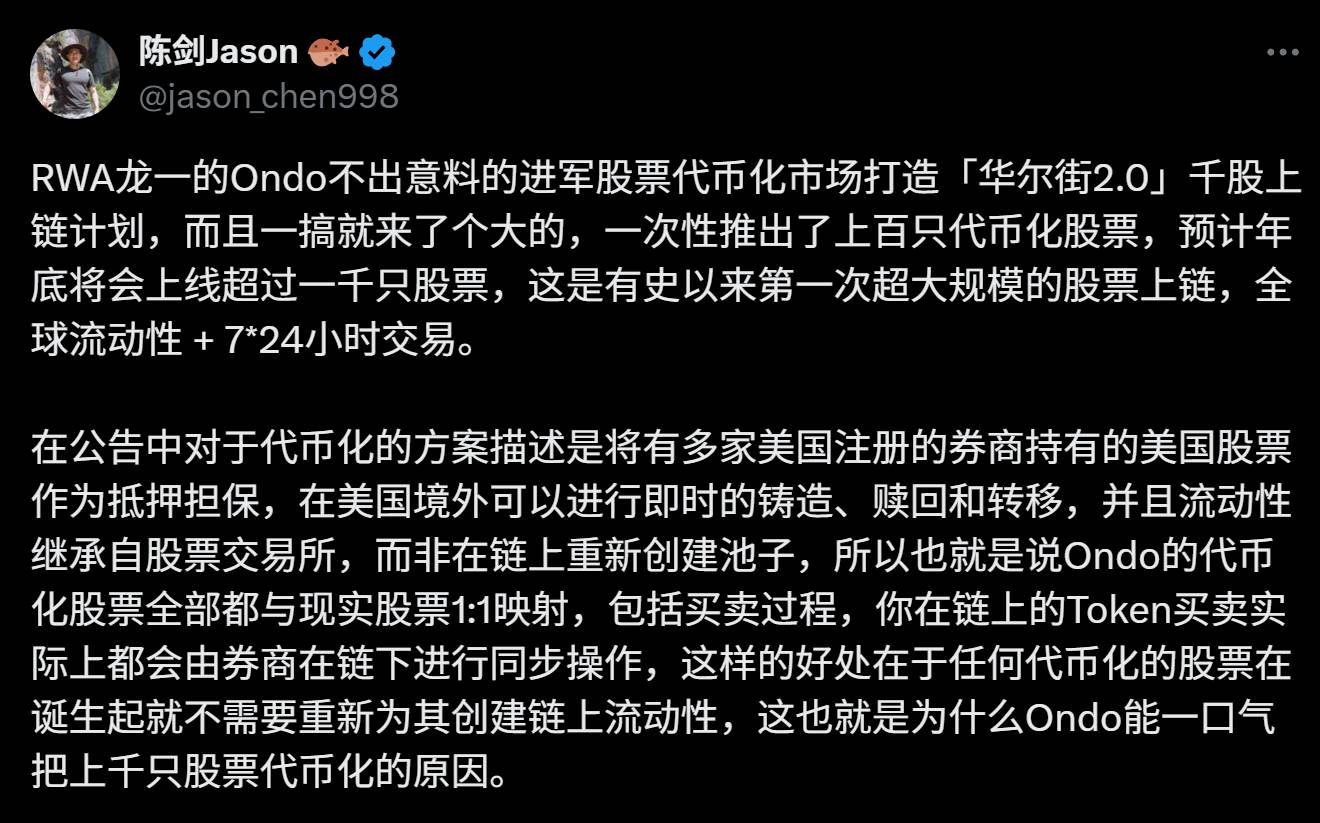
The latest radical exploration comes from Ondo Finance, adopting a more direct "on-chain instruction, off-chain real stock synchronized trading" model—every on-chain trade executed by investors is mirrored in real-time off-chain transactions by cooperating brokers. This means tokenized stocks no longer rely on additional on-chain liquidity pools, naturally enabling large-scale scalability.
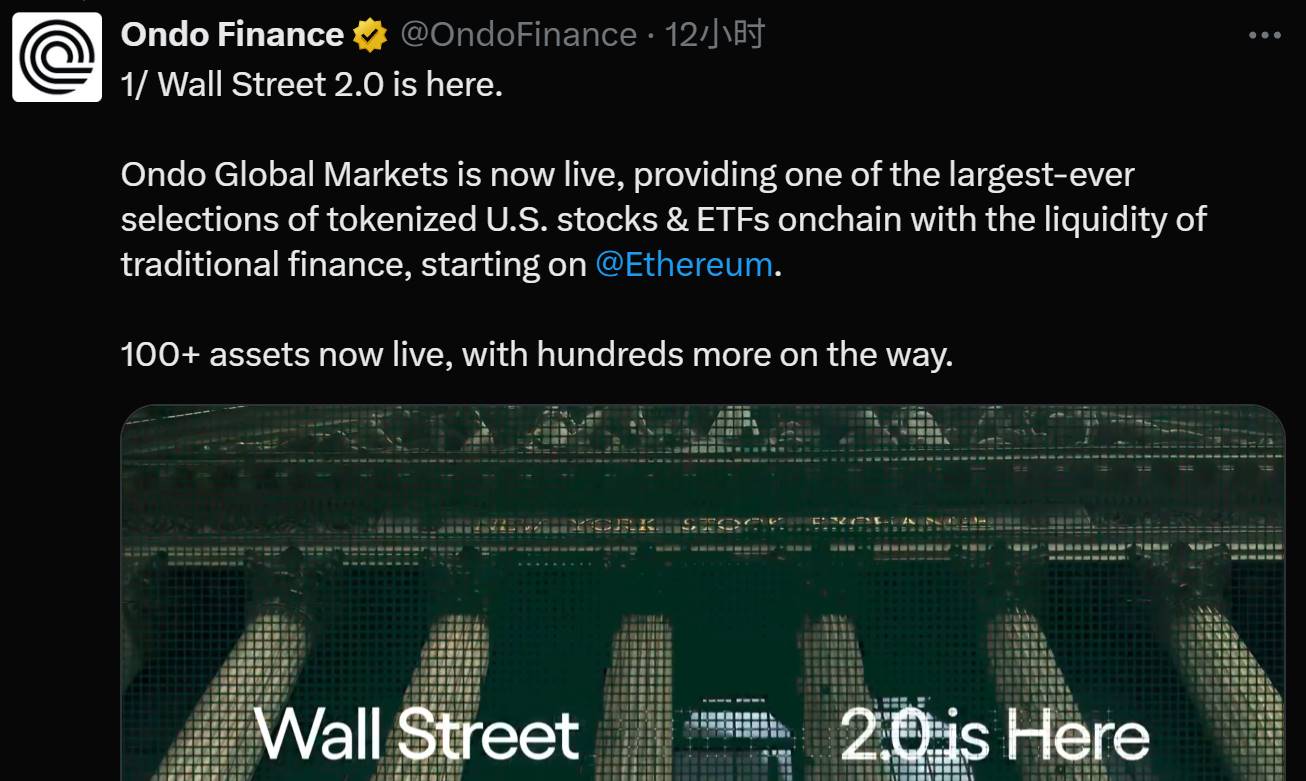
As of this writing, Bitget and Bitget Wallet have率先 completed integration with Ondo, allowing users to directly trade hundreds of tokenized U.S. stocks and ETFs through Bitget Wallet’s on-chain gateway, significantly lowering investment accessibility and positioning itself clearly as a disruptor.
Synthetic assets, CFDs, real stock custody, instant on-chain/off-chain linkage—the tokenized U.S. equity赛道 has reached a new watershed moment.
1. Wall Street On-Chain: The 21st Century "American Dream"
In the 19th century, the American Dream was the California gold rush, the freedom of the New World.
In the 20th century, it was transoceanic immigration, "all men are created equal," and striving for a better life.
In a sense, tokenized U.S. equities represent the 21st-century "American Dream." It reflects global investors' aspirations for financial freedom and extends the influence of U.S. capital markets—bringing the pulse of Nasdaq to every connected corner of the globe, reinforcing dollar settlement dominance, expanding capital attraction radius, and allowing Wall Street to maintain control over rules within the borderless digital world.
Looking back, from MakerDAO and Centrifuge pioneering the RWA concept and practice, to Polymath and others attempting to bring Wall Street regulations on-chain through STOs, tokenized U.S. equities have long been seen as the RWA form closest to mainstream investment habits and easiest to implement. However, due to regulatory uncertainty, insufficient liquidity, and weak technology, the STO boom quickly faded.
The turning point came in 2020, when DeFi Summer proved the feasibility of on-chain liquidity, and stablecoin adoption provided solid anchors for cross-border settlements and asset pricing.
-
Mirror Protocol and Synthetix launched synthetic U.S. equity assets on-chain
-
FTX and Binance partnered with licensed brokers to offer tokenized U.S. equity trading pegged to real stock prices
However, following FTX's collapse and tightening global regulations, on-chain liquidity gradually dried up, forcing most tokenized stock offerings on CEXs and DeFi platforms offline.
In 2023, the Federal Reserve initiated its most aggressive interest rate hike cycle in 40 years, causing Treasury yields to surge and capital to return to high-yield, low-risk assets. MakerDAO shifted toward an RWA model backed by U.S. Treasuries, regulatory frameworks were established in places like Hong Kong, and traditional financial institutions began piloting compliant tokenized securities.
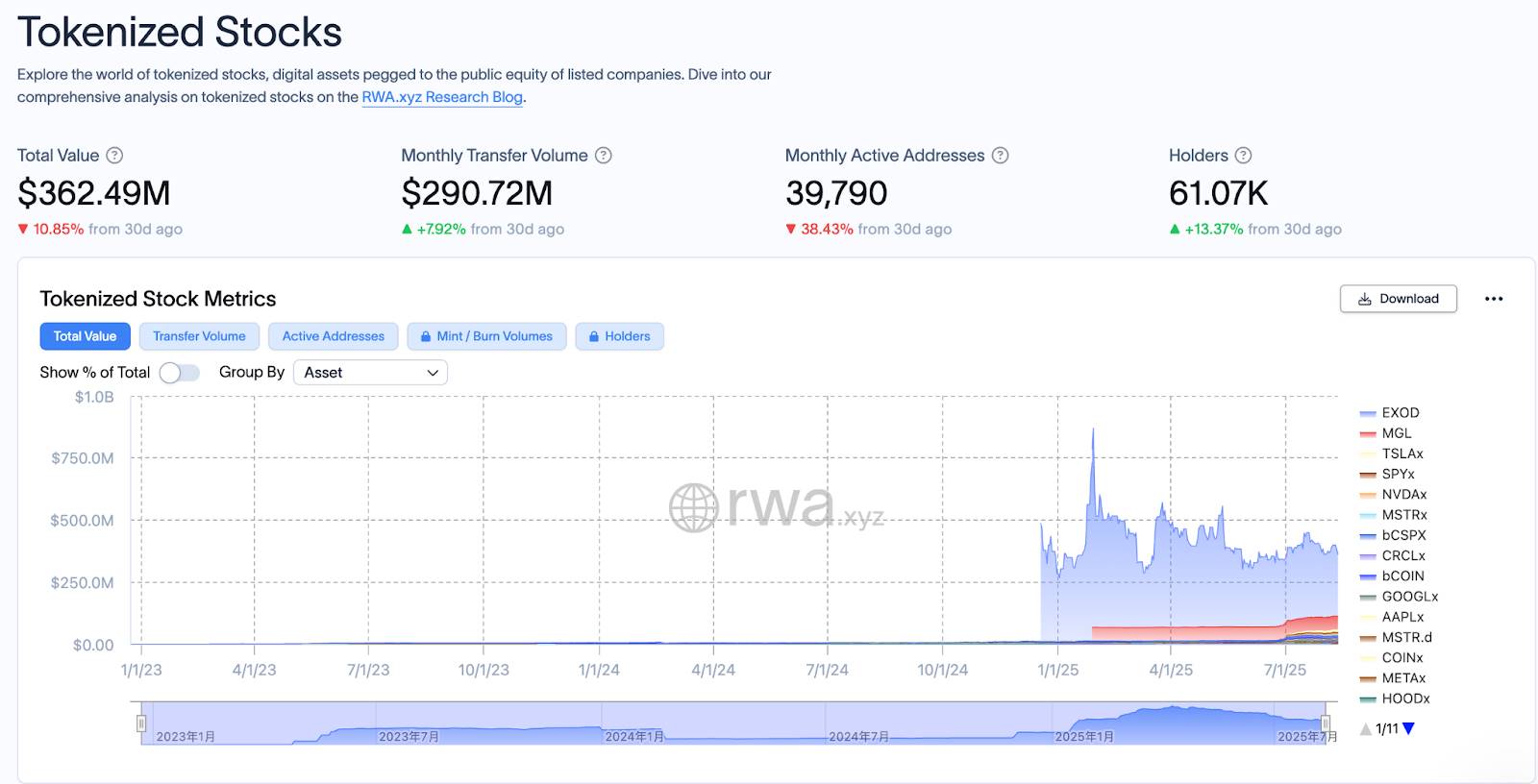
Today, RWA has achieved breakthroughs across regulation, technology, and product development, and tokenized U.S. equities are re-entering a growth phase. According to RWA.xyz, as of August 13, the total value of tokenized stocks stands at approximately $362 million, covering 167 asset types, with monthly trading volume around $290 million and over 60,000 holders.
This number may not yet seem large, but it signals a trend—the liquidity frontier of U.S. equities is being quietly rewritten by the on-chain world.
2. Who Is Tokenizing U.S. Equities?
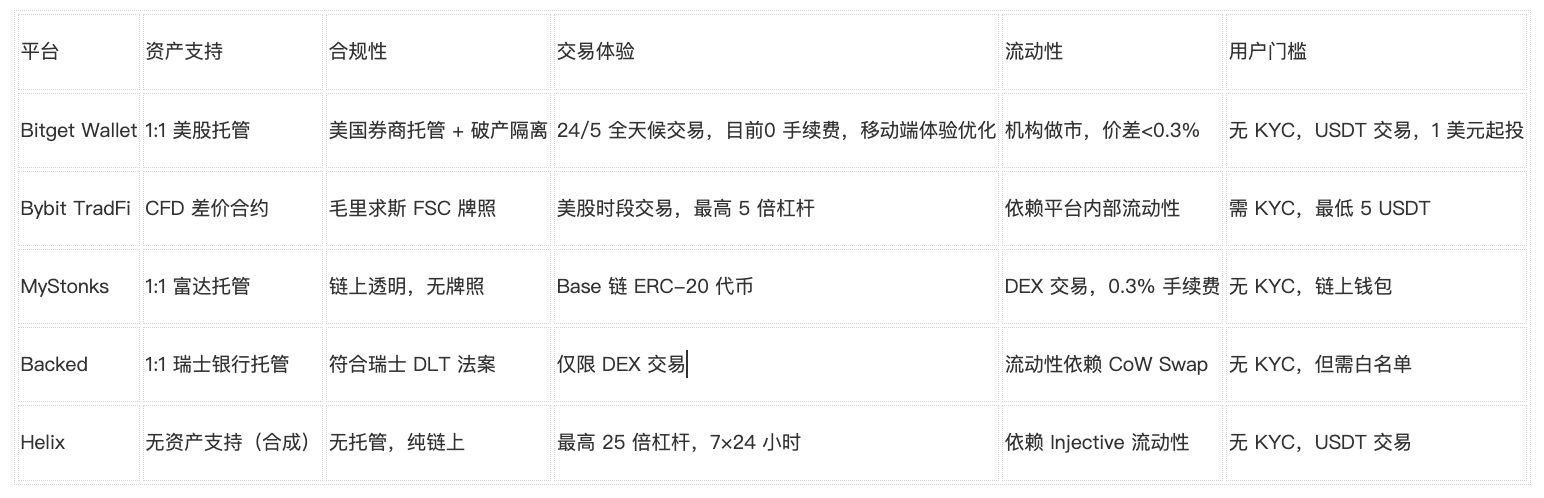
After years of experimentation and consolidation, participants in the tokenized U.S. equities space are taking shape, forming differentiated landscapes across compliance pathways, technical architectures, and liquidity strategies. Currently, four major representative platforms dominate:
Bybit TradFi
Bybit MT5 Gold & FX platform now supports Contracts for Difference (CFD) on U.S. equities, initially offering 78 U.S.-listed company symbols with up to 5x leverage. A CFD is a derivative contract allowing investors to profit from price differences without owning the underlying asset, generally carrying higher risk and volatility.
For crypto users, registering on Bybit and completing KYC Level 2 verification grants access. However, Bybit MT5 only holds a license from the Mauritius Financial Services Commission and currently cannot serve major markets such as the EU, UK, or U.S.
https://www.bybit.com/future-activity/en/mt5
MyStonks
MyStonks is a decentralized RWA trading platform that officially launched its on-chain U.S. stock token market on May 10, fully backed by custody services from Fidelity. After depositing USDT/USDC into MyStonks, the platform converts them into USD to purchase corresponding stocks, then mints ERC-20 tokens on Base at a 1:1 ratio. MyStonks supports direct login via Web3 wallets. Recently, MyStonks completed U.S. STO compliance registration, enabling issuance of compliant security tokens.
Backed Finance (Swiss Compliance License + DeFi Access)
Backed Finance is a Zurich-based tokenized asset issuer holding a Swiss compliance license. Its issued tokens are 1:1 backed by real assets, custodied by Swiss banks. Backed has launched xStocks, a tokenized stock product tradable on CEXs like Bitget and Kraken, as well as Solana DeFi. xStocks tokens are cross-chain compatible, available on ETH, Base, Gnosis, Arbitrum, Avalanche, Optimism, BSC, Sonic, and Polygon. Backed does not require user KYC and currently operates under whitelist access.
Helix
Helix is a DEX in the Injective ecosystem that has launched iAssets synthetic assets and recently introduced trading markets for 13 U.S. equity synthetic assets. iAssets are essentially on-chain derivatives, not backed by physical stocks, tracking U.S. equity prices via smart contracts and oracles. Users must use USDT stablecoins as margin, with up to 25x leverage offered.
Different from the above platforms, Bitget Wallet is the first Web3 wallet to enter the tokenized U.S. equities space. Combining trading gateway and asset management functions, it simplifies onboarding for Web2 users while aggregating multi-chain DeFi, enabling users to trade U.S. equity tokens directly using their on-chain identity without complex KYC processes.
More importantly, Bitget Wallet partners directly with Ondo to introduce a real asset custody pathway and collaborates with professional market makers to deliver liquidity depth comparable to traditional brokers.
3. Diverging Paths in Tokenized U.S. Equities
Overall, competition among current tokenized U.S. equity platforms manifests primarily across three dimensions: asset backing and compliance, liquidity, and user accessibility.
1. Real Assets and Compliant Custody
The first approach is the synthetic asset model pioneered by Synthetix and Mirror. Flexible but lacking real asset backing, users bear counterparty risk themselves. Ultimately, price pegging ≠ asset ownership—U.S. equity tokens minted and traded under synthetic models do not confer actual ownership of the underlying stocks in reality.
If oracles fail or collateral collapses (Mirror fell victim to the UST crash), the entire system risks liquidation imbalances, price de-pegging, and loss of user confidence.
Meanwhile, CFD models like Bybit lean toward high-leverage derivative trading, resembling traditional forex trading, with limited licensing coverage and existing in a gray regulatory area.
Bitget Wallet's model holds greater advantages—through Ondo's partnership with U.S.-registered brokers, tokens are 1:1 linked to real U.S. stocks, audited daily, avoiding the "paper tokens" risk present on some platforms, making it more resilient under evolving regulations.
2. Liquidity Optimization Capability
Liquidity directly impacts user experience. Platforms like Backed and MyStonks rely more on on-chain DEX spot pools, often constrained by single-pair size and slippage, leading to unstable trading.
Helix's iAssets cater to leveraged derivatives markets, attracting short-term trading activity, but questions remain about long-term stability given their high volatility and leverage.
Notably, Bitget Wallet adopts a hybrid TradFi approach. Building on Ondo's "on-chain instruction, off-chain real stock synchronized trading" model mentioned earlier, it enables instant minting, redemption, and transfer outside the U.S., as researcher Chen Jian noted: "The benefit is that any tokenized stock doesn't need to recreate on-chain liquidity from scratch—that's why Ondo can tokenize thousands of stocks at once."
Additionally, by leveraging institutional market makers like Jump Crypto, it provides on-chain depth and spreads close to traditional brokers (<0.3%), creating a two-layer mechanism of "off-chain real stock synchronization + on-chain institutional liquidity." This allows users to enjoy lower trading friction while avoiding common DeFi issues like insufficient liquidity and slippage.
3. User Accessibility and Global Reach
For emerging market investors, synthetic asset models naturally offer the lowest barriers and highest global accessibility: requiring only an on-chain wallet, no identity verification. But this convenience comes at the cost of lacking real asset backing, placing full risk on users.
Bitget Wallet follows closely, offering an entry point with "no KYC + tradeable with USDT + $1 minimum investment," significantly lowering barriers while ensuring asset security through Ondo's real stock custody.
In contrast, Bybit, despite certain liquidity advantages, faces limited reach due to CFD nature and mandatory KYC; Backed, though multi-chain compatible, still requires whitelist applications, limiting openness.
In short, at this stage, Bitget Wallet has carved a unique path distinct from synthetic asset DEXs, CFD platforms, and traditional RWA protocols. This model aligns with regulatory trends demanding asset safety while accommodating global user participation to a significant extent.
Nevertheless, even with Ondo's advanced real stock custody model combined with Bitget Wallet's traffic gateway achieving a balanced mix of asset security, liquidity, and accessibility—and gaining certain differentiation advantages—the entire sector still faces three major challenges:
-
Cross-border regulatory uncertainty: Even with U.S. broker custody, selling tokenized securities across borders may trigger compliance requirements in different jurisdictions.
-
Market education and liquidity guidance: Convincing more traditional investors to adopt on-chain U.S. equity products and maintaining stable liquidity depth remains a long-term operational challenge.
-
Taxation rule gray areas: Taxation is an invisible yet critical factor. Capital gains and dividend tax treatment for on-chain U.S. equities varies across countries and lacks standardization. Whether and how the IRS tracks on-chain transactions remains uncertain. This means platforms must not only provide compliant trading services but also clear tax guidance to truly lower participation barriers.
Overall, the tokenized U.S. equities赛道 is transitioning from "experimental phase" to "model divergence." Those who can simultaneously solve compliance, liquidity, and accessibility will be best positioned to break through.
Join TechFlow official community to stay tuned
Telegram:https://t.me/TechFlowDaily
X (Twitter):https://x.com/TechFlowPost
X (Twitter) EN:https://x.com/BlockFlow_News
 @Farm_Web3