Building Full-Stack Decentralized AI: GAIA Token Launches, AI Phone Ushers in a New Era of User Sovereignty
TechFlow Selected TechFlow Selected
Building Full-Stack Decentralized AI: GAIA Token Launches, AI Phone Ushers in a New Era of User Sovereignty
GAIA is fully integrating the decentralized AI full-stack ecosystem through a three-step strategy: "building protocols, issuing tokens, and launching hardware."
 Navigating Web3 tides with focused insights
By: Alex Liu, Foresight News
In 2025, GAIA is progressively realizing its ambitious vision—building a complete decentralized AI stack extending from the protocol layer to hardware endpoints, truly returning control of data, intelligence, and value back to ordinary users.
Recently, with the implementation of two key developments, this vision has not only been further solidified but also opened new possibilities for deep integration between Web3 and AI: the native token GAIA has officially launched, while the limited-edition AI phone, Gaia AI Phone, is即将 unveiled, marking the true beginning of a privacy-first, on-device AI terminal era.
GAIA Token Launch
As the economic and governance core of the decentralized AI system, the launch of the GAIA token is undoubtedly a milestone. On July 30, GAIA debuted on Binance Alpha and simultaneously initiated an airdrop campaign for community users.

On the same day, Bitget exchange also listed relevant trading pairs and distributed over 4.7 million GAIA tokens as rewards through marketing campaigns such as Launchpool and CandyBomb, effectively boosting the token's initial liquidity and global accessibility.
The airdrop program is equally notable: Season One distributes a total of 30 million GAIA tokens, representing 3% of the total supply, with the overall airdrop pool accounting for 5%. From August 6 to November 19, early ecosystem participants—including node operators, domain holders, and XP contributors—can gradually claim their allocations.
GAIA is more than just a medium of exchange; it is designed as the lifeline of the entire GAIA network, serving critical functions such as governance voting, node incentives, agent deployment, and domain registration, enabling transparent on-chain governance and community co-management.

The GAIA token design balances the diverse needs of network operations, ecosystem expansion, and community participation. Of the total token supply, 32% supports network operations, including rewards for node operators and validators, ensuring network security and long-term stability. 20% is allocated to early supporters, with strict vesting and unlocking schedules to ensure long-term commitment rather than short-term profit-taking. 16% is held in the foundation treasury for strategic reserves and future development. 15% is assigned to the team and core contributors, subject to multi-year linear unlocking to incentivize sustained contributions.
In addition, 8% is dedicated to ecosystem growth, rewarding developers, partners, and infrastructure providers to drive real-world application deployment. 5% is reserved for community engagement, covering XP, domain, and node contributors, encouraging active participation in network governance and ecosystem building. Finally, 4% serves as liquidity pool reserves to ensure market availability and smooth trading of $GAIA. The overall design emphasizes long-term sustainability, with strict lock-up and release mechanisms for team and investor holdings, while allocations to communities and contributors directly promote protocol activity and continuous ecosystem expansion.
AI Phone Release
Meanwhile, the launch of the Gaia AI Phone marks GAIA’s strategic leap from protocol layer to hardware endpoint. This AI-native smartphone, deeply customized from the Galaxy S25 Edge, can perform cross-chain AI inference tasks locally on the device without relying on cloud servers, significantly enhancing response speed and offline capabilities while protecting user privacy.
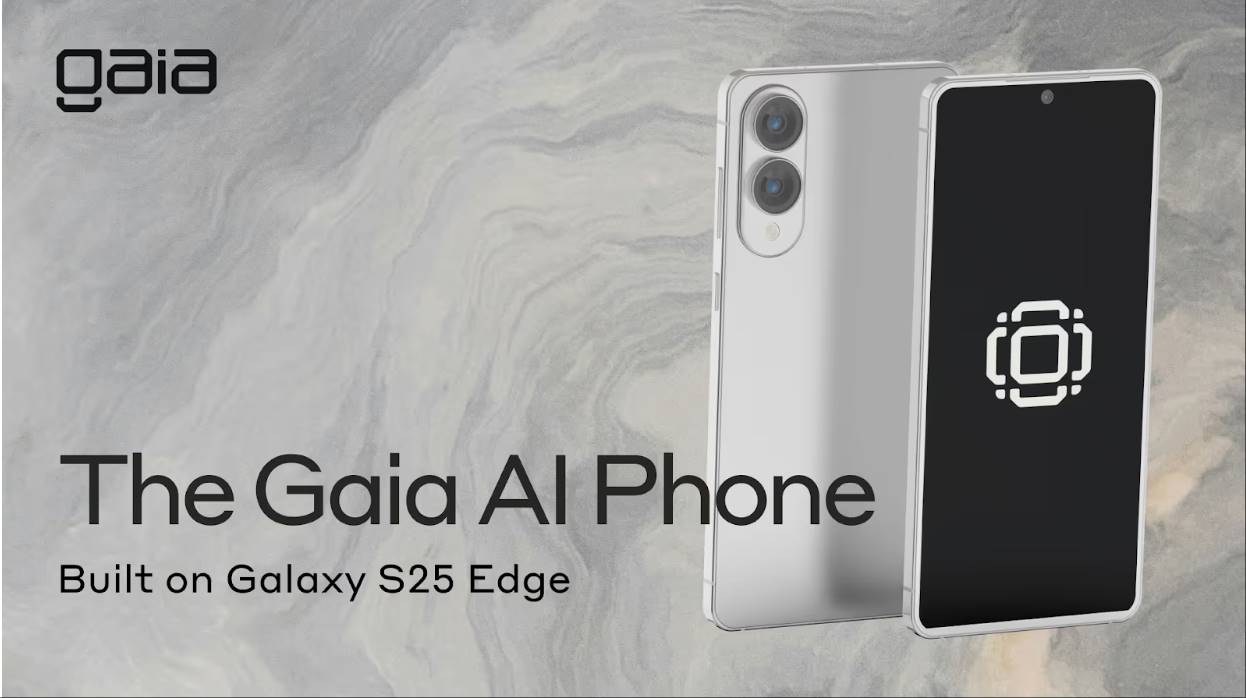
Only 7,000 units will be released globally. Each device comes pre-installed with a Gaia Domain System worth approximately $199 and includes ongoing ecosystem rewards. The first 3,000 pre-order customers will also receive entrance tickets to Korea Blockchain Week (KBW), further boosting market excitement and community cohesion.
From a broader perspective, the Gaia AI Phone is not merely a hardware product but represents the realization of the "AI sovereignty" concept. As GAIA COO Shashank Sripada emphasized, it enables users to truly own their data and agents, freeing them from dependence on centralized cloud services and intermediary platforms. The device integrates low-barrier node participation mechanisms, decentralized identity and agent architecture, and comprehensive on-chain governance modules, technically ensuring censorship resistance and decentralization at the foundational level.
Funding and Data
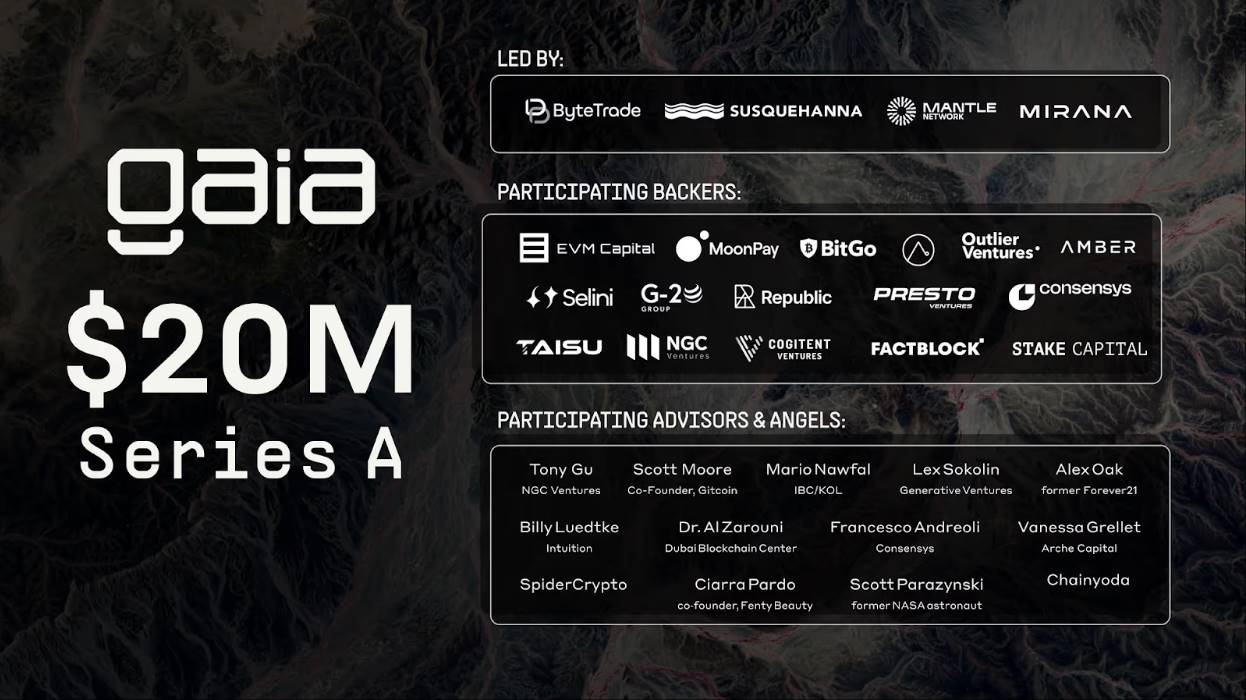
The rapid rise of the GAIA ecosystem is supported by strong funding and robust technical infrastructure. In July 2025, GAIA Labs successfully closed its seed and Series A rounds totaling $20 million, with investments from prominent institutions including ByteTrade, SIG, Mirana, and Mantle Eco Fund. These funds will primarily support mobile AI hardware R&D, infrastructure expansion, open-source AI toolkits, and cross-chain capability development.
Currently, the GAIA network operates over 700,000 active nodes stably, having completed more than 17 trillion inference calls, demonstrating exceptional scalability and practical efficiency. Additionally, Coral Protocol led significantly with a 34% score in the GAIA Benchmark, outperforming Microsoft-backed models and validating the technical feasibility of decentralized mini-model architectures.

Future Outlook
From an industry standpoint, GAIA has achieved a crucial transition from decentralized AI protocol to end-user devices through its dual-track "protocol + hardware" strategy. Its privacy-first AI interaction model has the potential to reshape the relationship between individuals and intelligent devices. With triple safeguards in funding, governance, and technology—combined with multi-dimensional initiatives including token listing, airdrops, hardware launches, and developer tool releases—GAIA has built powerful ecosystem appeal. Of course, challenges remain, including intense competition in the hardware market, costs associated with educating user behavior, and regulatory uncertainty in the AI-crypto convergence space.
In summary, GAIA is fully integrating the full-stack decentralized AI ecosystem through a three-step strategy: building protocols, issuing tokens, and launching hardware. This is not only a restructuring of technical architecture but also a profound awakening regarding user sovereignty. Whether for users, developers, or investors, GAIA is undoubtedly one of the most值得关注 projects in the current Web3 and AI convergence landscape.
Join TechFlow official community to stay tuned
Telegram:https://t.me/TechFlowDaily
X (Twitter):https://x.com/TechFlowPost
X (Twitter) EN:https://x.com/BlockFlow_News
 Foresight News