








Huobi HTX "Partner 1+1": Practical Insights from Web3 Investment Experts on Earning Their First Fortune and Seizing New Opportunities
TechFlow Selected TechFlow Selected
Huobi HTX "Partner 1+1": Practical Insights from Web3 Investment Experts on Earning Their First Fortune and Seizing New Opportunities
Invited crypto KOLs such as Solana, Crypto Xiao Wu, and Crazyox to share their practical experiences and insights, ranging from their entry into the industry and earning their first fortune to the latest investment opportunities.
 Navigating Web3 tides with focused insights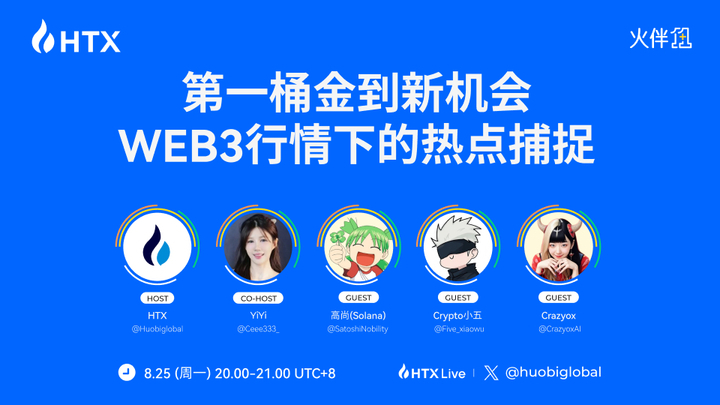
On August 25, Huobi HTX's latest episode of "Huoban 1+1" focused on the theme "From First Gains to New Opportunities: Capturing Trends in the Web3 Market," inviting crypto KOLs such as Gao Shang (Solana), Crypto Xiao Wu, and Crazyox to share their practical experiences and insights ranging from their entry into the industry and first profits to the latest investment opportunities.
Huoban 1+1: Entering Web3 – The Journey Behind the First Profit
Crypto Xiao Wu: Entered the blockchain industry in 2020, with six years of Web3 experience. Having weathered market ups and downs, I gradually found my own path. In 2021, I caught the "Zoo" meme coin wave and earned my first substantial profit.
When I first entered the space, I easily trusted others and blindly followed trades, leading to losses. Later, through self-study—analyzing trends, K-lines, and market patterns—and by managing position sizes and emotions while strictly enforcing take-profit and stop-loss strategies, I slowly achieved capital growth.
Gao Shang (Solana): Joined the space back in high school in 2018 and now works as a market maker handling exchange and on-chain orders. My beginnings were humble—I made my first money through community work on the "Panta" project, earning about 100,000 RMB. At that time, I had no capital; it was all human effort.
After earning my first gains, I participated in many early-stage projects, including the "Zoo" meme coin boom, realizing the huge potential of underpriced assets. But I also came to understand that merely making profits isn't enough—if you don’t cash out, you might end up with nothing.
Crazyox: Entered the space early, initially participating in ICO projects and experiencing some failed launches. EOS’s public chain ecosystem was where I made my first major gain, thanks to its high transaction efficiency and vibrant ecosystem. I earned a 10x return but failed to exit in time. Paper wealth means nothing; only timely profit-taking secures real results. Now I deeply believe in aligning knowledge with action—turning knowledge into true understanding through practice, such as dollar-cost averaging BTC.
Huoban 1+1: Which Sectors or Narratives Are You Focusing on in Web3? What Are Your Views on Future Trends?
Crypto Xiao Wu: I mainly focus on airdrop farming and primary market launches, such as Solana IDO launchpads. I’m bullish on RWA, stablecoins, AI, and meme coins. AI is a long-term trend, while meme coins offer high risk and high returns—I’ll continue participating as an experienced player.
Gao Shang (Solana): I mainly focus on presales and alpha projects, leveraging information asymmetry for profit, especially within the Solana ecosystem. Solana has strong liquidity—for example, Kanye’s token chose Solana for issuance, and celebrity tokens may increasingly favor it. I believe new ecosystems always bring speculative capital and opportunities, and any asset not yet fairly priced deserves research.
Crazyox: I’m watching AI, RWA, and emerging ecosystems. Web3 evolves quickly with short cycles—new ecosystems attract hot money and offer high return potential. For instance, traditional finance is highly optimistic about RWA, and AI is rapidly rising. My principle is “play new, not old,” because established ecosystems often lose users to new projects. An average person going through two bull-bear cycles can achieve returns far surpassing traditional industries by catching just one or two new ecosystem waves. I’ll keep monitoring Twitter for signals on new ecosystems, deploy capital early at low points, and aim for steady gains.
Huoban 1+1: How to Efficiently Capture the Latest Web3 Trends?
Crypto Xiao Wu: I rely on three main methods to spot trends: 1. On-chain data—monitoring new projects and fund flows for early signals; 2. Community sentiment—if a new coin suddenly becomes popular in groups, it’s often an opportunity; 3. Trading data—analyzing K-lines, order book depth, and slippage to assess project viability.
My strategy follows a “three-step approach”: First, test with a small position; then add more after confirming the trend and news flow; finally, go big while setting clear take-profit and stop-loss levels, strictly following the plan to avoid emotional decisions. This method works well for farming and speculative projects, helping me capture short-term opportunities.
Gao Shang (Solana): I use three main channels to find trends: 1. On-chain data—tracking new projects and capital movements to uncover hidden opportunities; 2. News alerts—staying updated on market developments and new asset listings; 3. Community discussions—I’m in many groups, and when a previously ignored coin starts trending, it often signals a major opportunity.
I think meme or speculative coin booms will reoccur—emotion-driven rallies can lead to explosive growth. When evaluating projects, I consider timing. For example, Trump coin rose steadily for three days before listing on Binance, indicating real capital inflow rather than pure hype. Such opportunities are worth heavy bets. Otherwise, I join smaller positions based on market intuition.
Crazyox: I have three key information sources: Overseas macro analysts—whose deep content helps me see broader trends; Ecosystem research bloggers—who provide solid analysis on specific projects, which I read carefully and share on Twitter; and Twitter influencers—following KOLs focused on macro insights for timely updates.
In addition, I exchange views with close friends who have unique insights across different fields. Combining Twitter intelligence, I strategically deploy capital early in promising ecosystem plays—such as Uni and OKB—achieving 70% returns. This approach suits ordinary users—low effort, high efficiency.
Huoban 1+1: How Do You Manage Position Sizing and Risk Amid Market Volatility?
Crypto Xiao Wu: 20% DCA in BTC/ETH: Core holdings—buy more on dips, sell small amounts on rallies, remain confident regardless of volatility. 20% in stablecoins: Maintain liquidity for emergencies. 40% in altcoins: Invest in platform tokens or structured products for steady returns. 20% in liquid funds: Used for on-chain farming or speculative plays chasing high-risk, high-reward opportunities.
This allocation ensures a solid base—so even if high-risk bets fail, the impact is manageable. I analyze the market calmly and stick to my strategy, avoiding emotional trading.
Gao Shang (Solana): Many of my biggest wins were due to luck, but looking back, my biggest regret is failing to cash out in time. I suggest withdrawing 30% of profits each time—either cashing out or DCA’ing into BTC—to secure part of the gains. This reduces risk while keeping capital ready for new opportunities. My position management is relatively simple, mostly based on experience, but I plan to adopt stricter discipline moving forward.
Crazyox: Off-chain income supports DCA: A stable external income gives me confidence to consistently DCA BTC/ETH, locking in beta returns. Allocate part of portfolio to new ecosystems: Bet on speculative coins or new projects for alpha gains, then recycle part of profits back into core holdings. Use small positions to experiment with new models: Try unproven areas, accept possible losses—because one win could cover all costs.
Web3 moves fast—sticking rigidly to old strategies may be safe but limits returns. I encourage experimenting with new things, but always backed by stable assets to ensure you’re not left behind.
Huoban 1+1: When Using CEXs, What Factors Matter Most to You? Any Suggestions for Huobi HTX?
Crypto Xiao Wu: I prioritize four factors when choosing a CEX. 1. Security: This goes beyond preventing theft—it includes compliance mechanisms and risk controls like compensation guarantees. Huobi HTX makes me feel secure in this regard, such as their deposit/withdrawal safety commitment and partial loss protection. 2. Liquidity: Deep order books reduce slippage, especially for large trades, giving me peace of mind. 3. Speed of new listings: Web3 cycles are short—trends fade fast, so exchanges must list new assets quickly. 4. Authenticity of events: Some platforms run flashy campaigns with unclear rewards, discouraging user participation. Huobi HTX’s event design stands out—reward structures are transparent and engagement is high. I’m very satisfied with my overall experience on Huobi HTX, especially its security.
I suggest Huobi HTX continue developing differentiated features: Innovations like the C2C Select Station concept are great for boosting user stickiness. Improve user experience: Make the trading interface and speed even smoother to enhance satisfaction. I look forward to seeing more unique offerings under Sun’s leadership—perhaps novel security mechanisms or trend-focused campaigns—that help Huobi HTX reclaim its peak status.
Gao Shang (Solana): I care most about three things: Security: Asset safety comes first—an exchange must have strong risk controls. Trading experience: Smooth operations, no lag, low fees. Liquidity: Deep markets minimize slippage, enabling efficient large trades. These factors let me trade confidently and reduce unnecessary losses.
So I hope Huobi HTX can improve further in these areas. Strengthen security: Maintain high standards for deposits and withdrawals to build trust. Enhance liquidity: Deeper books attract big traders and reduce slippage. Accelerate new listings: With Web3 trends fleeting, faster asset rollouts would make Huobi HTX more competitive. Huobi HTX is already doing well here, but can push further—perhaps by creating unique on-chain ecosystem玩法 to attract more Web3 users.
Crazyox: I value three aspects: 1. Security and liquidity: Safety is foundational, and liquidity ensures smooth trading—aligning with Gao Shang’s view. 2. Unique features: Each CEX should have its own “DNA.” For example, OKX fits well for playing speculative coins, while Ton’s ecosystem suits micro-gifting. If Huobi HTX develops distinctive玩法, it can attract loyal users. 3. User stickiness: A good CEX needs community vibes—making trading feel fun and rewarding. Huobi HTX has potential here; I hope they further highlight their uniqueness.
My suggestions for Huobi HTX: Build a unique identity: Find a niche no one else can replicate and dominate it. For instance, TRON attracted users via low fees and fast transfers—Huobi HTX could become industry-leading in security or a novel gameplay mechanic. Build a loyal user base: Use distinctive events and features to gather users who enjoy playing together. For example, Huobi HTX’s campaigns could emphasize community spirit, making participation feel rewarding and enjoyable. Keep innovating: Brother Sun has always been good at riding trends—I hope he continues delivering surprises, such as cooler ecosystem projects or trading systems. I truly believe Huobi HTX has the potential to become users’ top choice!
About Huobi HTX
Founded in 2013, Huobi HTX has evolved over 12 years from a cryptocurrency exchange into a comprehensive blockchain business ecosystem, covering digital asset trading, financial derivatives, research, investment, incubation, and more.
As a global leader in Web3, Huobi HTX adheres to a development strategy centered on global expansion, ecosystem prosperity, wealth effects, and security compliance, offering crypto enthusiasts worldwide comprehensive, secure, and reliable value and services.
To learn more about Huobi HTX, visit https://www.htx.com/ or HTX Square, and follow us on X, Telegram, and Discord. For inquiries, contact [email protected].
Join TechFlow official community to stay tuned
Telegram:https://t.me/TechFlowDaily
X (Twitter):https://x.com/TechFlowPost
X (Twitter) EN:https://x.com/BlockFlow_News






