2025 New Regulations on the Crime of Assisting Information Network Criminal Activities: How Will They Impact Web3 Practitioners?
TechFlow Selected TechFlow Selected
2025 New Regulations on the Crime of Assisting Information Network Criminal Activities: How Will They Impact Web3 Practitioners?
Web3's spring can only come with "legal tailwinds."
 Navigating Web3 tides with focused insights
By Attorney Pang Meimei
In 2015, China's Criminal Law introduced the crime of "aiding information network criminal activities" (hereinafter referred to as "the aiding crime"). With the continuous deepening of the "Card-Cutting" campaign, the number of prosecutions under this charge has surged rapidly. Public data shows that the aiding crime now ranks third among all criminal cases. In practice, there is mixed sentiment toward this charge: on one hand, it attracts attention due to lighter liability compared to accomplice liability; on the other hand, its use as a catch-all provision makes it difficult to escape legal consequences. In practice, sentencing standards for the aiding crime vary significantly across different regions, leading to frequent occurrences of "similar cases receiving different judgments." On July 28, 2025, the "Two Highs and One Ministry" jointly issued the "Opinions on Handling Certain Issues in Criminal Cases Involving Aiding Information Network Criminal Activities" (hereinafter referred to as the "Opinions"), which serves as a comprehensive reinforcement guide for judicial practice regarding the aiding crime and has been widely called the "new rules for the aiding crime."
1. What Changes Does the New Aiding Crime Regulation Bring?
The Opinions make significant adjustments to the criteria for identifying the aiding crime and sentencing guidelines, mainly reflected in the following aspects
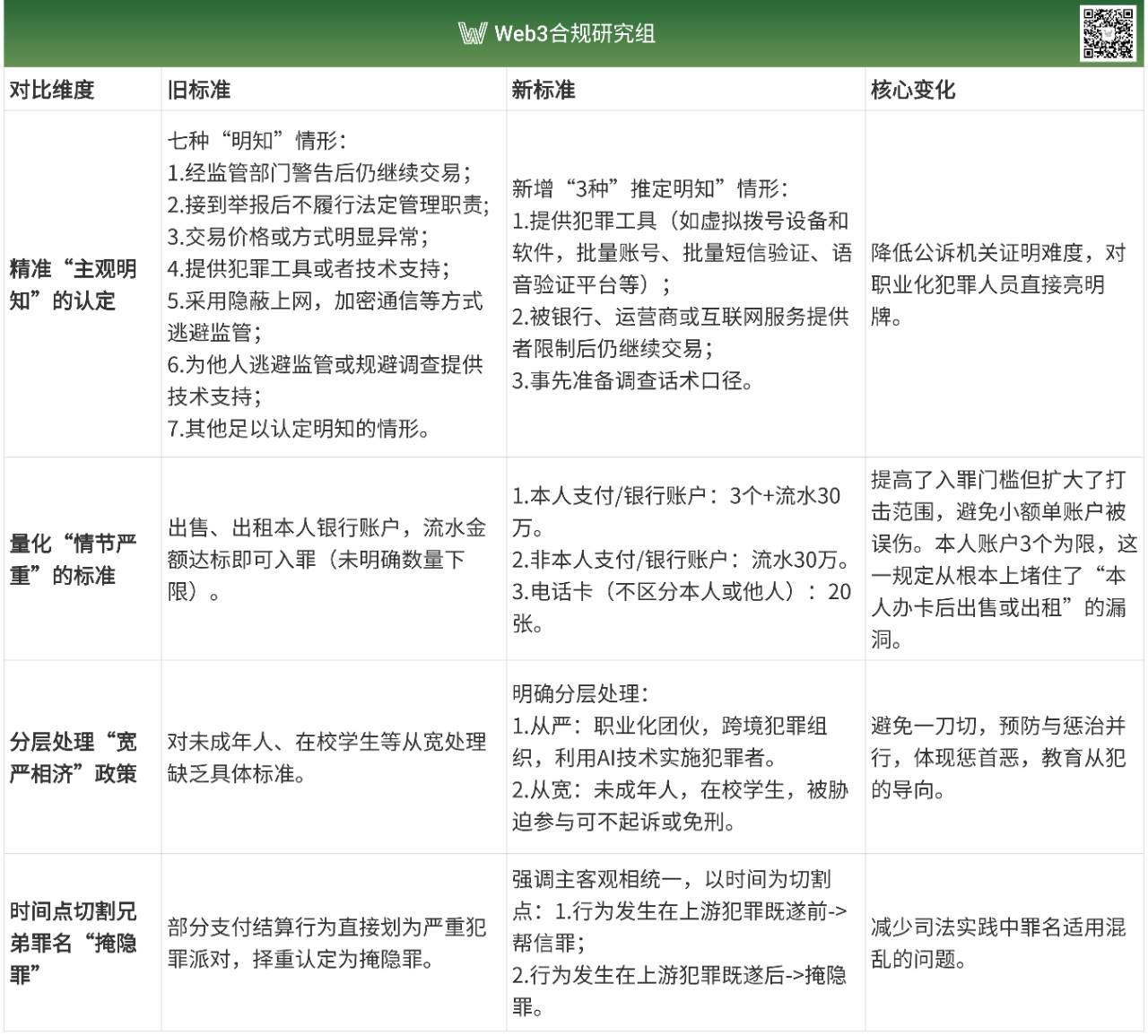
2. What Is the Judicial Significance of the Seven Typical Cases?
Simultaneously with the release of the Opinions, seven typical cases were published. These cases cover key roles in cyber-related gray-market industries such as "U dealers," "account dealers," and "professional appeal handlers." Notably, Case 4 focuses on the field of virtual currency crimes. Through analyzing the Opinions and these published cases, I find that while they do not differ much from ordinary criminal cases we handle daily, they demonstrate stricter measures and greater intensity in combating cybercrime and gray-market operations.
[Basic Case Details] In mid-July 2022, defendants Wang Mou, Zhang Mou, and Zhao Mouchou conspired to transfer illicit funds for others through bank transfers, cash withdrawals, and purchasing virtual currencies to gain illegal profits. They had clear divisions of labor: Wang provided capital, Zhao used it to purchase virtual currencies and deliver them to their superior as a deposit, while Wang and Zhang collected numerous bank cards from others and provided them to the superior for receiving illicit funds. Once illicit funds were deposited into the bank accounts provided by Wang and others, the superior would notify them, upon which Wang and others arranged for individuals to withdraw cash at multiple banks in Daqing City, Heilongjiang Province. After deducting a commission of 10%-15% of the received funds, the remaining amount was used to purchase virtual currencies and transferred to the superior. It was found that between August 5 and 14, 2022, over 400,000 yuan of fraudulently obtained funds from 15 victims including Lin Mouchou were transferred via Wang and others.
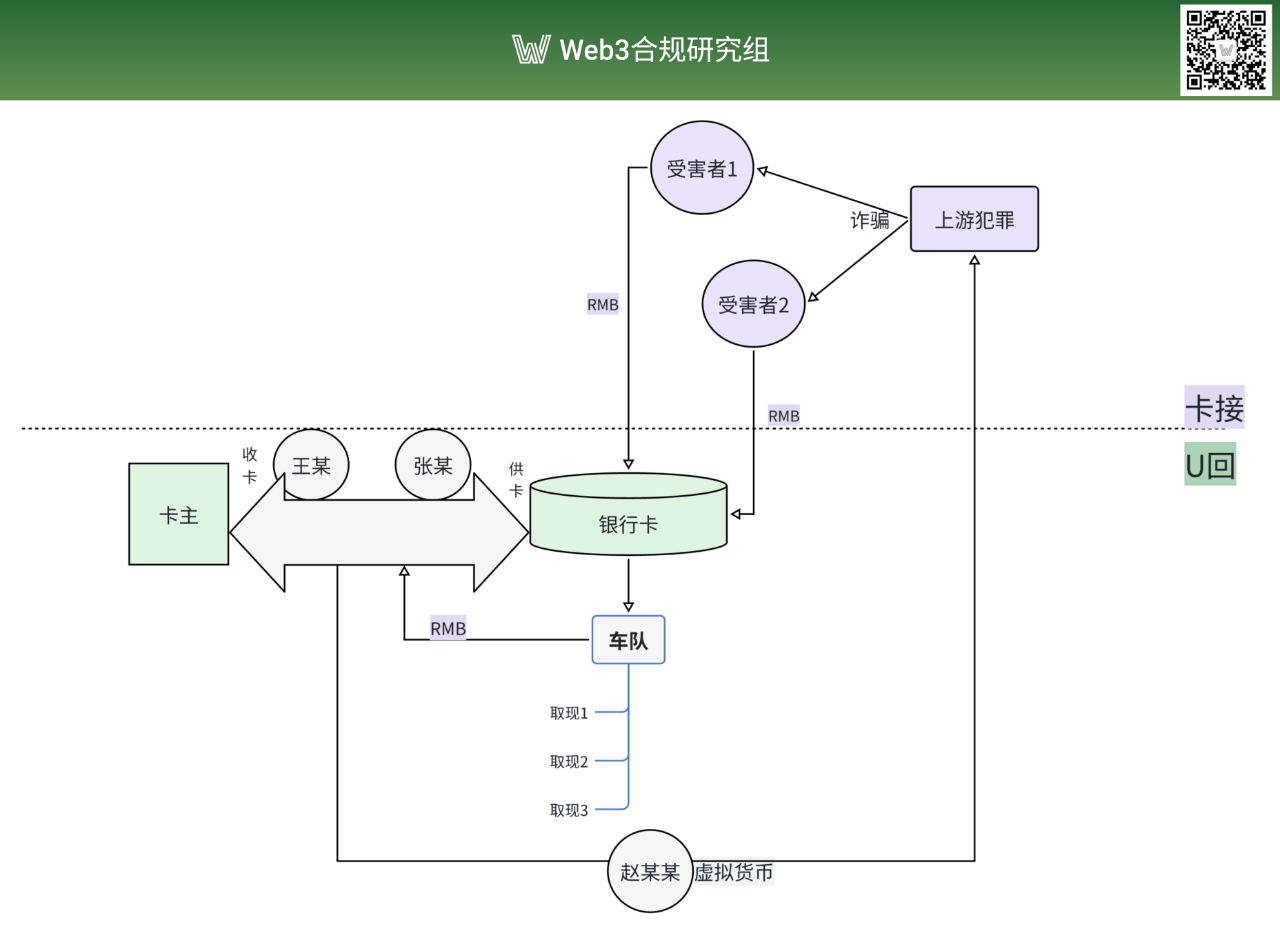
[Judgment Result] The Acheng District People's Court of Harbin City legally sentenced Wang and Zhang to three years and six months in prison each, along with a fine of 30,000 RMB; Zhao was sentenced to three years and three months in prison, along with a fine of 25,000 RMB. After the verdict, Wang, Zhang, and Zhao appealed, but the second-instance court upheld the original judgment.
[Warning] Wang, Zhang, and Zhao converted illicit funds received via bank cards into virtual currencies for fund transfer, representing a classic example of using the "card-to-U redemption" method in virtual currency transactions—a so-called "perfect closed-loop funding operation" self-proclaimed by many criminals. In practice, many upstream fraudsters hide overseas, skillfully leveraging the anonymity, high concealment, and transaction convenience of virtual currencies to increase investigative difficulties for law enforcement. Downstream offenders assist in laundering and transferring funds through complex operations, continuously supplying resources to the upstream, ultimately making victims' losses irrecoverable. This case not only concretizes the application rules of the Opinions but also provides clear behavioral guidance and adjudication benchmarks for similar cases—intermediaries who provide channels for illicit fund flows, even without direct involvement in upstream fraud, should be severely punished.
3. What Should Web3 Practitioners Pay Attention to After the New Rules?
The Spring for Web3 Can Only Be Enjoyed "Legally"
1. The new rules send a clear signal: ignorance is no longer an all-purpose shield. Web3 industry practitioners should strengthen their study and understanding of relevant laws and regulations, enhance vigilance, reinforce risk prevention measures, and establish sound compliance strategies to ensure the legality and compliance of business activities, avoiding becoming tools or accomplices of criminals unknowingly.
2. Under the policy of balanced leniency and severity, students or those coerced may receive lighter penalties, while technical experts face heavier ones. After the issuance of the Opinions, personnel involved in building and maintaining cryptocurrency trading platforms, developers of mixers and anonymous wallets must beware of risks. Even without direct participation in fraud or pyramid schemes, they may be deemed as providing "specialized technical support for illegal activities," directly constituting the aiding crime, because their development work effectively lowers the barrier to crime, shifting from "technological neutrality" to "technical assistance."
3. OTC traders are undoubtedly "licking blood off a blade," facing significantly increased criminal risks. If OTC traders continue transactions after their accounts are frozen, they are likely to be considered as "continuing behavior despite restrictions," directly constituting the aiding crime. Providing USDT matching services for underground banks could lead to cumulative charges.
4. Compliance is imperative for Web3 entrepreneurs. Web3 entrepreneurs should proactively build industry-wide compliance systems externally and strengthen internal training, regularly organizing legal training for all staff.
4. How Do Lawyers View the Key Impacts and Challenges of the Opinions?
Organized and professional assisting behaviors are explicitly listed in the Opinions as circumstances warranting strict punishment. After the release of the Opinions, on one hand, the cost of upstream crimes increases; on the other hand, habitual card openers and professional card maintainers can be effectively punished. Although the Opinions refine the standards for conviction and sentencing, providing lawyers with clearer and more specific legal grounds and guidance in handling aiding crime cases, the determination of "knowledge" may still leave room for ambiguity due to case complexity. Factors such as the degree of subjective awareness, behavioral motives, and whether there was actual profit motivation require deep exploration during defense work. In conclusion, the issuance of the "Opinions on Handling Certain Issues in Criminal Cases Involving Aiding Information Network Criminal Activities" marks the judiciary's entry into a phase of "penetrative" crackdown on the virtual currency industry. Practitioners must deeply recognize that only by constructing a full-process compliance system covering "pre-event review → in-process monitoring → post-event traceability" can business operations proceed within a compliant framework.
Attorney Meimei advises virtual currency industry practitioners: help others, offer assistance, but don't commit the aiding crime. If under investigation, contact a lawyer immediately to avoid having "knowledge" inferred due to incorrect statements.
Join TechFlow official community to stay tuned
Telegram:https://t.me/TechFlowDaily
X (Twitter):https://x.com/TechFlowPost
X (Twitter) EN:https://x.com/BlockFlow_News