








Crypto Investment: Betting on Fundamentals or Cash Flow?
TechFlow Selected TechFlow Selected
Crypto Investment: Betting on Fundamentals or Cash Flow?
The best risk-adjusted returns on investment are often precisely the product of combining both.
 Navigating Web3 tides with focused insights
Author: Jon Charbonneau
Translation: Chopper, Foresight News
The latest popular narratives in crypto revolve around "yield" and "DAT (decentralized treasury)," highlighting two fundamentally different investment approaches:
-
Fundamental investing: buying an asset because you expect measurable economic returns (such as cash flows) under a set of clear assumptions. These returns create intrinsic value for the asset.
-
Greater fool theory investing: buying an asset simply because you believe someone else will buy it from you at a higher price in the future (even if the market price already exceeds intrinsic value).
In other words, are you primarily betting on fundamentals or capital flows? This short article provides a simple framework to help you understand the value of both.
Fundamentals vs. Capital Flows
It's All About the Future
Compared to purely betting on capital flows, fundamental investing is generally considered less risky and less volatile:
-
Lower downside risk: Fundamental investors often avoid large losses. Since assets have intrinsic value, you gain some downside protection—either reflected in market prices or the asset’s ability to generate cash flow.
-
Lower upside potential: Fundamental investors often miss the biggest winners. You may completely overlook purely speculative investments (like a meme coin that 1000x), or sell positions too early (e.g., exiting before valuation peaks).
While these trade-offs are often marginal, both approaches ultimately depend on predictions about the future—and your predictions may be right or wrong. You’re either betting on future fundamentals (e.g., Protocol X will generate $Y in revenue next year) or future capital flows (e.g., Token X will see $Y in net buying volume next year).
Therefore, the core of both approaches lies in how confident you are in your predictions. In practice, fundamental investing often allows for more confident forecasting. For example:
-
Fundamentals: You can observe companies like Tether or protocols like Hyperliquid consistently generating high revenues. Combined with an understanding of core operations, you can reasonably forecast future cash flows. A quality project won’t suddenly lose all customers or revenue, and ideally, will grow over time.
-
Capital flows: I see little edge in predicting how long DAT enthusiasm will last (aside from insider information). It could fade tomorrow or continue for another year—I genuinely don’t know.
Growth vs. Value
Fundamental investing isn't synonymous with dull or low returns. Purely fundamental bets can still capture massive winners. In such cases, you're usually emphasizing future improvement in fundamentals (i.e., growth investing), rather than maintaining current fundamentals (i.e., value investing). Betting on high growth typically implies higher risk, so you expect higher returns as compensation.
This is also a spectrum—growth and value investing aren’t mutually exclusive. Given that crypto is largely early-stage investing, most fundamental investing here leans more toward growth than value.
An asset that’s currently unprofitable but has high growth potential may be more suitable for fundamental investing than a profitable one with low growth potential (or even declining profitability). Would you rather hold OpenAI or Ethereum? This confuses many participants—high P/E ratio investments can still be fundamentally driven. The key difference is:
-
Fundamental investing: You believe the protocol has potential for extremely high future growth, which will translate into substantial future earnings.
-
Greater fool theory investing: You don’t expect growth or earnings—you just hope someone will buy it from you at a higher valuation.
Fundamental-Driven vs. DAT-Driven
Based on all of the above, I still prefer holding fundamentally sound base-layer assets. This includes mature projects with strong current fundamentals that I expect to persist, as well as early-stage projects with high potential for future fundamental growth.
In contrast, we haven’t participated in any DATs so far (though I remain open to their value proposition in specific cases). I’m similarly cautious about base-layer assets whose investment thesis relies almost entirely on DAT-driven capital flows rather than strong fundamentals. Once DAT enthusiasm fades, the price support for these assets could collapse rapidly. I view this primarily as a capital-flow-driven speculative trend, and personally see little room for generating excess returns. It’s better to invest where you have an edge—and DATs can also buy assets with strong fundamentals.
Reducing Dependence on Human Psychology
Buffett and Bitcoin
Confidence in predictions is often inversely related to how much the outcome depends on unpredictable human psychology and behavior.
The essence of fundamental investing is: you don’t need others to agree with you. A simple test is: “Would you still hold this asset even if you could never sell it?” Warren Buffett doesn’t need the market to validate his views. The stocks he buys generate enough cash flow to recoup his investment and deliver a return.
-
Bitcoin: Buffett has said he wouldn’t buy all the Bitcoin in the world even for $25, because it generates no income for holders—it only has value if someone else buys it.
-
Apple stock: Conversely, anyone would happily pay $25 for all Apple shares, even if they could never sell them, because Apple generates $25 in revenue instantly.
Clearly, fundamental investors can usually sell their assets, but at least they enter knowing that market value may deviate from intrinsic value for extended periods—and they’re willing to endure that. In extreme cases, they say: “If you aren’t willing to hold a stock for ten years, don’t consider holding it for ten minutes.”
Fundamental investors still consider human behavior, since it affects forecasts of future earnings (e.g., will people keep paying for the protocol’s product?). But they don’t need to take the harder additional step: believing others will share their logic and buy the asset. Even when an asset clearly creates value through product sales, predicting market reactions is often difficult (markets can stay irrational and undervalue strong fundamentals for long); when an asset clearly cannot create value through sales (e.g., meme coins), predicting market reactions becomes even harder.
Even when investing based on capital flows, you can strengthen prediction confidence by reducing dependence on human psychology. For instance, instead of relying purely on narrative-driven sentiment, you can quantify token issuance schedules, investor unlock timelines, and unrealized profits held by investors to forecast selling pressure.
Additionally, identifying certain long-term behavioral patterns reduces uncertainty. For example, humans have used gold as a store of value for thousands of years. Theoretically, everyone might suddenly decide gold is only worth its industrial use—but this is nearly impossible. If you own gold, that’s usually not your biggest risk.
Bitcoin, Ethereum, and Meme Coins
Likewise, Bitcoin’s rise over the past 16 years has made it increasingly clear when and why people buy Bitcoin. This helps reduce reliance on human psychology in investment decisions (e.g., will people buy Bitcoin when global liquidity increases?), shifting focus toward the underlying macro drivers we actually want to bet on (e.g., will global liquidity continue to expand?). Thus, even though Bitcoin is largely a capital-flow-driven investment, it may still be the most confident bet for most crypto investors.
This also helps explain why Ethereum’s investment thesis is inherently more complex. It requires more uncertain assumptions about human behavior and market psychology. Most investors broadly agree that Ethereum’s cash flows alone are insufficient to justify its valuation. Its sustained success likely hinges on becoming a lasting store of value (more like Bitcoin), requiring some or all of the following predictions:
-
Multiple crypto stores of value: You might predict people will start assigning relatively higher store-of-value premiums to assets beyond Bitcoin (like Ethereum), making Bitcoin no longer unique. But we don’t see this today, and historically people tend to converge on one asset for such roles (e.g., gold is priced mostly for monetary value, silver mostly for industrial use).
-
Replacing Bitcoin as store of value: You might predict Bitcoin will eventually fail (e.g., due to security budget issues or quantum computing), and Ethereum will naturally become the successor “digital gold.” But once confidence collapses, all crypto assets may fall together.
-
Store of value tied to specific utility: Ethereum’s case is often linked to its additional utility relative to Bitcoin, measurable via metrics like “value secured,” EVM activity, “Layer 2” activity, or DeFi usage. But unlike Ethereum’s cash flows (i.e., revenue), these metrics don’t provide intrinsic value—they’re just part of the store-of-value narrative. Therefore, Ethereum is far from a pure expression of the underlying belief that “network-level metrics will grow”; while betting on these trends, you’re also betting on how the market will price Ethereum as a result.
To be clear, there’s nothing wrong with making these bets. Buying Bitcoin in 2009 required similarly uncertain assumptions about human behavior—and it worked out well. Investors just need to understand exactly what they’re betting on and how their view differs from market consensus. To achieve sustainable excess returns, you must see where the market is wrong.
Taking it further, there are pure meme coins. They’re destined to lack lasting monetary premium—you’re fully betting on human psychology and the market’s short-term reaction to new narratives. Is this meme exciting enough? Interesting enough? Or too boring? It’s like a game of “chicken.”
Conclusion
Neither of the two investment approaches discussed is inherently right or wrong. For investors, the key is whether you can systematically make confident predictions using them. More confident predictions reduce volatility and downside risk; predictions more confident than market consensus can generate excess returns.
Most of the time, especially for long-term investing, I find I can better replicate alpha using strategies more reliant on fundamentals. But as noted, this isn’t absolute. An investment like Bitcoin may sit between “fundamental investing” and “greater fool theory,” depending on how you quantify monetary utility. You might have high confidence in betting on Bitcoin (mainly based on capital flows) but low confidence in a DeFi project (mainly based on fundamentals).
Finally, the two approaches aren’t mutually exclusive. You can invest based on both fundamentals and capital flows. In fact, the best risk-adjusted returns often come from combining both.
Historically, being primarily capital-flow-driven has paid off for crypto investors. This makes sense: tokens mysteriously surged every four years, interest rates were zero, investors raised excessive capital, and few projects generated cash flows sufficient to justify high valuations. Looking ahead, however, as the industry matures, focusing on fundamentals may ultimately yield more excess returns.
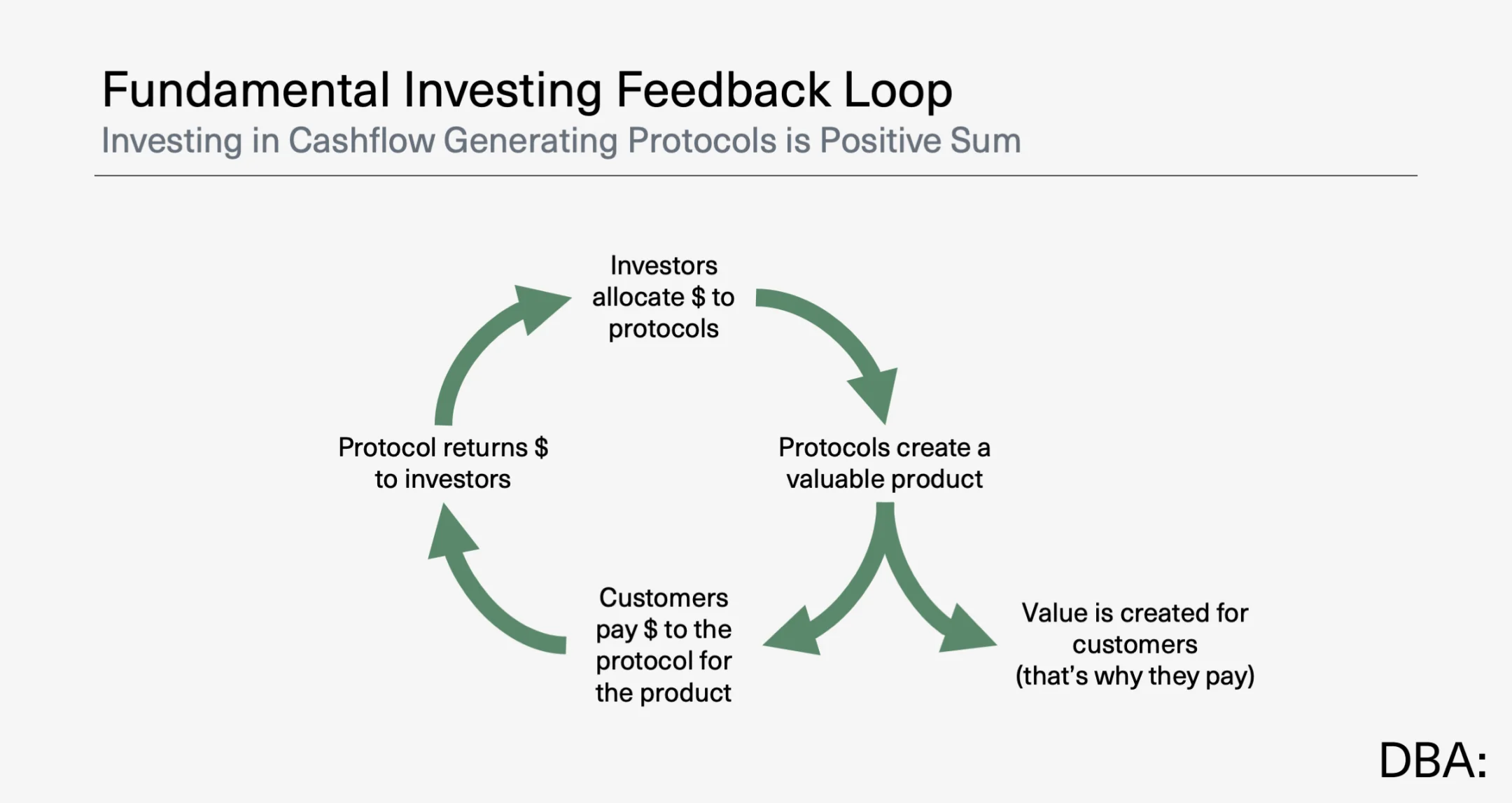
I also hope fundamentals become more important, as it’s crucial for the industry’s long-term health. I have no issue with meme coins (most are just fun gambling), but narrative trading around valueless assets is essentially a zero-sum game. In contrast, allocating capital to projects that generate cash flows could be positive-sum. Building revenue-generating projects requires creating products customers are willing to pay for; issuing tokens purely for narrative purposes has no such requirement—the token itself becomes the product.
Crypto needs the feedback loop created by fundamental investing:
The overall trend in crypto is encouraging:
-
Crypto investing is becoming increasingly fundamentals-driven. We finally have more tokens generating meaningful cash flows, token transparency frameworks are widespread, and valuation models are easier to understand. As a result, dispersion in token returns is growing.
-
Traditional finance investing is becoming increasingly flow-driven. The world is getting weirder and more absurd—meme stocks and insane IPO day-one pops are becoming common. Understanding the next hot narrative matters.
Someday, the two will converge, and we’ll just talk about “investing.” But one thing won’t change: fundamentals and capital flows will both remain important.
Join TechFlow official community to stay tuned
Telegram:https://t.me/TechFlowDaily
X (Twitter):https://x.com/TechFlowPost
X (Twitter) EN:https://x.com/BlockFlow_News
 @dba_crypto






