CFTC launches "Crypto Sprint" to open compliance pathway for spot crypto assets
TechFlow Selected TechFlow Selected
CFTC launches "Crypto Sprint" to open compliance pathway for spot crypto assets
From gray areas to regulatory compliance, the U.S. crypto market迎来a systemic turning point.
 Navigating Web3 tides with focused insights
By kkk
Under strong push from the Trump administration, the U.S. is accelerating the integration of digital assets into the mainstream financial system. On August 1, the Commodity Futures Trading Commission (CFTC) officially launched a regulatory initiative called "Crypto Sprint," followed by a proposal on August 5 to allow spot crypto assets to be traded compliantly on CFTC-registered futures exchanges (DCMs). This move not only ends the long-standing regulatory gray area for spot markets but also signals a clear and feasible compliance path ahead for the Web3 industry.
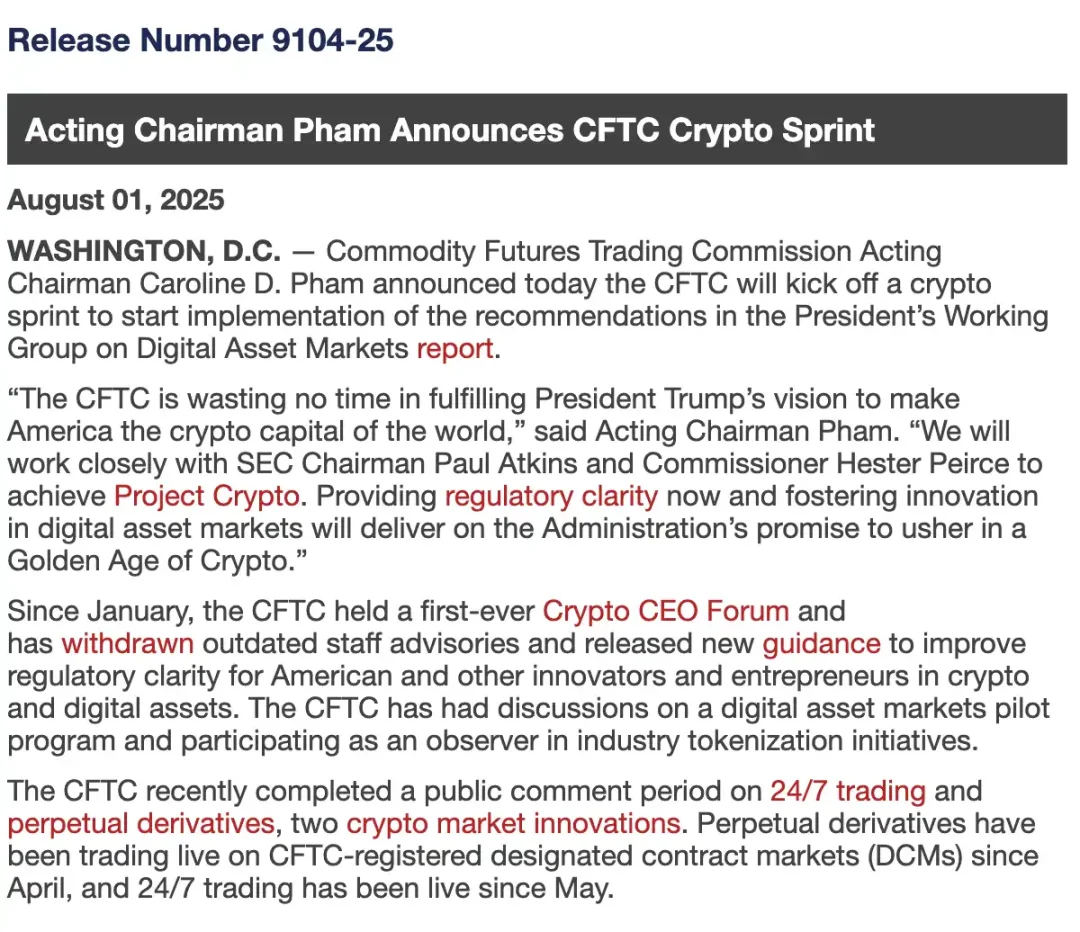
CFTC Acting Chair Caroline Pham publicly stated: "Under President Trump's strong leadership, the CFTC is fully advancing federal-level spot digital asset trading and coordinating closely with the SEC's 'Project Crypto.'" This statement sends a powerful signal: U.S. regulators are shifting from "defensive suppression" to "institutional acceptance," creating unprecedented compliance opportunities for Web3 infrastructure such as DeFi, stablecoins, and on-chain derivatives.
Spot Contracts Legalized: The Institutional Starting Point for Crypto Markets
For years, the U.S. regulatory framework has lacked unified oversight over crypto spot trading. Trading of assets like BTC and ETH has largely occurred on overseas platforms or unlicensed domestic exchanges. Regulatory gaps have not only made investor protection difficult but also kept institutional capital sidelined.
The CFTC's "Crypto Sprint" aims directly at this pain point. One of its core components is enabling spot contracts for non-security crypto assets to be legally listed on CFTC-registered Designated Contract Markets (DCMs). By authorizing these platforms to host spot crypto trading, the CFTC offers a compliant alternative to the unlicensed or offshore platforms that have gradually lost institutional trust following the FTX collapse (2021) and Binance's ongoing regulatory issues. For institutional investors, this policy means a more legal, transparent, and fair entry path into crypto assets—removing barriers to large-scale digital asset allocation.
According to the CFTC, Section 2(c)(2)(D) of the Commodity Exchange Act already mandates that any commodity transaction involving leverage, margin, or financing must occur on a registered DCM. This provision provides a solid legal foundation for the listing of spot crypto contracts and brings much-needed regulatory certainty. Under this framework, we may soon see centralized platforms akin to Coinbase—or on-chain derivatives protocols like dYdX—obtain合规 operating licenses by registering as DCMs.
At the same time, the policy opens a compliant gateway for traditional financial institutions to access crypto assets. As a representative DCM, the Chicago Mercantile Exchange (CME) already has full infrastructure for BTC and ETH futures markets. Once spot contracts are approved, it could offer institutional investors a one-stop gateway from futures to spot trading, accelerating traditional capital inflows into crypto.

SEC and CFTC Join Forces: Regulatory Coordination Brings Certainty
In recent years, one of the biggest regulatory challenges in the U.S. crypto market has been the overlapping jurisdictions and ambiguous boundaries between the Securities and Exchange Commission (SEC) and the Commodity Futures Trading Commission (CFTC). Projects often faced simultaneous pressure from both agencies—subjected to securities regulations by the SEC while navigating commodities rules under the CFTC—leading to a "sandwich regulation" or "double enforcement" dilemma that drained resources and increased uncertainty.
The current "Crypto Sprint" marks the first clear signal that the CFTC and SEC will establish close cooperation to jointly clarify the legal classification of digital assets (security vs. commodity), custody standards, and trading compliance requirements—offering market participants a unified and predictable compliance pathway.
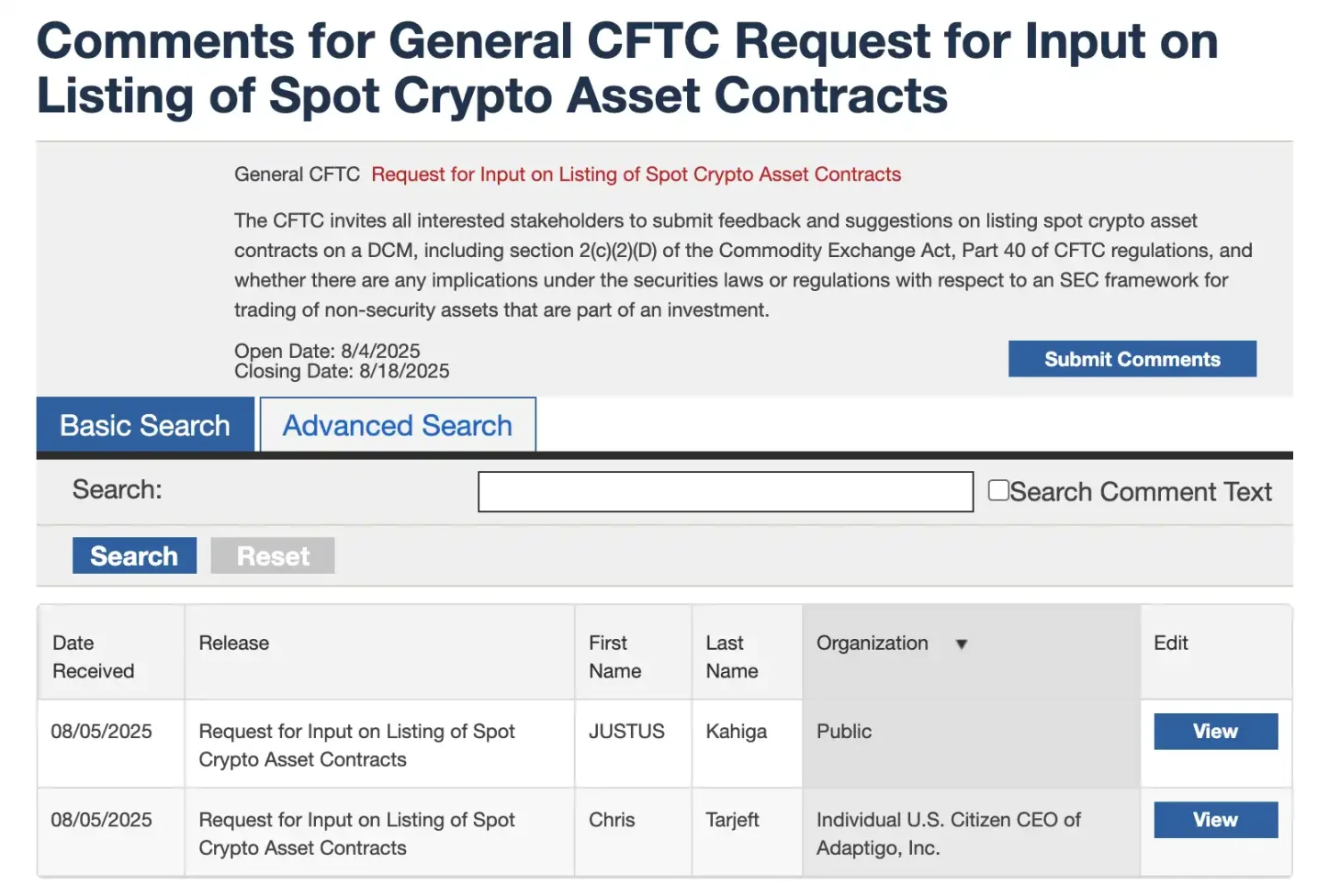
The term "sprint" signifies not just faster regulatory pace, but a fundamental shift in mindset—from passive defense to active collaboration. For Web3 projects, this is no longer merely a "regulatory observation period," but an unprecedented window for co-building institutional frameworks. The CFTC has opened public consultation on its proposal to list spot crypto asset contracts on registered DCMs, with feedback due by August 18. Participants who submit timely input may not only avoid future regulatory blind spots but also influence the final shape of the rules.
Meanwhile, the SEC’s "Project Crypto" is aligning closely with the "Crypto Sprint" to build a unified federal regulatory framework, clearly defining the boundary between security-type and commodity-type crypto assets, and promoting the development of a "Super App" structure capable of trading multiple asset classes. If realized, future platforms could legally offer a full suite of financial services—including stocks, Bitcoin, stablecoins, and staking—under a single license.
SEC Chair Paul Atkins and Commissioner Hester Peirce have publicly voiced support, calling it a "historic turning point toward on-chain financial systems," and pledged to accelerate rulemaking in key areas such as stablecoin regulation, crypto custody, and compliant token issuance.
This dual-track regulatory advancement could finally end the long-standing U.S. confusion over whether crypto assets are "securities" or "commodities," setting a clear, replicable compliance model for the world.
More importantly, it means Web3 projects no longer have to operate under constant threat of accidental violations. Instead, through clear registration processes, compliant custody, and audit mechanisms, they can truly integrate into the mainstream financial system—bridging on-chain assets with real-world finance.
Conclusion
In just one week, the U.S. government has sent unprecedented signals in the digital asset space: the White House released the official *Digital Asset Strategy Report*, the SEC launched "Project Crypto," the CFTC initiated "Crypto Sprint" and opened public consultation on spot contract listings—and remarkably, the White House even declared that banks must not discriminate against crypto firms. This is not just a slight relaxation—it’s a complete policy reversal.
Once the greatest regulatory shadow over crypto projects, the SEC is now working hand-in-hand with the CFTC to build a unified Web3 regulatory framework. What we’re witnessing is a visible, structural transformation: from ambiguity to clarity, from suppression to support, from gray zones to federal legislation.
This time, it’s not just regulators sprinting—it’s every Crypto Builder.
Join TechFlow official community to stay tuned
Telegram:https://t.me/TechFlowDaily
X (Twitter):https://x.com/TechFlowPost
X (Twitter) EN:https://x.com/BlockFlow_News
 BlockBeats