OpenAI's most powerful model GPT-5 is here, available for free
TechFlow Selected TechFlow Selected
OpenAI's most powerful model GPT-5 is here, available for free
Altman hails a major step toward AGI, with Microsoft taking the lead in integration.
 Navigating Web3 tides with focused insights
By Dan Li, Wall Street Insights
OpenAI's most anticipated product of the year has arrived.
On Thursday, August 7, OpenAI announced the launch of its next-generation flagship artificial intelligence (AI) model, GPT-5. It is OpenAI’s first “unified” AI system—the first time combining the reasoning capabilities of its o-series models with the rapid response abilities of its GPT-series models.
OpenAI CEO Sam Altman praised GPT-5 highly at the new model launch event, calling it “the best model in the world” and a “major upgrade” compared to previous versions. He stated that its release marks an “important step forward” on OpenAI’s path toward achieving Artificial General Intelligence (AGI).
According to OpenAI, GPT-5 excels across multiple benchmark tests, reaching state-of-the-art performance in programming, mathematics, and health domains. GPT-5 achieved a 74.9% accuracy rate on the SWE-bench Verified coding test, slightly surpassing Anthropic’s new model Claude Opus 4.1 released this Tuesday. Meanwhile, GPT-5 shows significant improvement in hallucination issues, with an error rate of only 4.8%, far below GPT-4o’s 20.6%.
Starting Thursday, GPT-5 is available to all free ChatGPT users as well as Plus, Pro, and Team subscribers, serving as the default model. It will roll out to Enterprise and Edu paid plans within one week.
As with GPT-4o, the difference between free and paid versions of GPT-5 lies in usage limits. Plus users have higher usage caps, while Pro users enjoy unlimited access along with an enhanced version, GPT-5 Pro. For free users, full reasoning functionality may take several days to fully activate. Once free users reach their GPT-5 usage limit, OpenAI will switch them to the smaller model GPT-5 mini.
On Wednesday, OpenAI also announced it would offer ChatGPT products to U.S. federal government agencies at a symbolic annual fee of $1. Specifically, this refers to the enterprise version of ChatGPT, which includes enhanced security and privacy features.
Shortly after OpenAI officially unveiled GPT-5, Microsoft announced it would integrate GPT-5 into its broad portfolio of products starting Thursday, including platforms such as 365 Copilot, Copilot, GitHub Copilot, and Azure AI Foundry—enabling immediate access for Microsoft’s enterprise and consumer users to GPT-5’s advanced reasoning and programming advantages.
GPT-5 Delivers Three Key Advantages in Programming, Creative Writing, and Health
OpenAI’s GPT-5 launch announcement begins by stating: “GPT-5 is our smartest, fastest, and most practical model yet, with built-in thinking ability that gives everyone expert-level insight.”
According to OpenAI, as its “most powerful model,” GPT-5 achieves significant improvements in three key areas.
First is programming capability. GPT-5 is OpenAI’s strongest coding model to date, excelling in complex frontend generation and debugging large codebases. It can create visually appealing, responsive websites, apps, and games from just a single prompt. Early testers noted improvements in design choices such as spacing, typography, and whitespace.
In the SWE-bench Verified benchmark test, which uses real-world coding tasks sourced from GitHub, GPT-5 achieved a 74.9% accuracy rate on its first attempt after thinking—higher than OpenAI’s reasoning model o3 at 69.1% and GPT-4o at 30.8%.
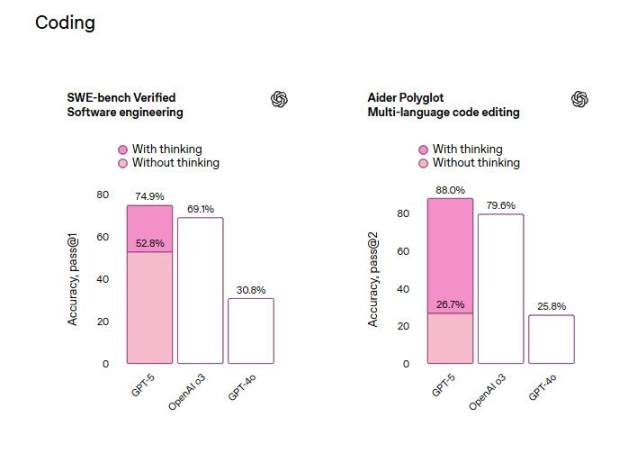
Commentators noted this means GPT-5 slightly outperforms Anthropic’s Claude Opus 4.1 launched on Tuesday and Google DeepMind’s Gemini 2.5 Pro, which scored 74.5% and 59.6% respectively on the SWE-bench Verified test.
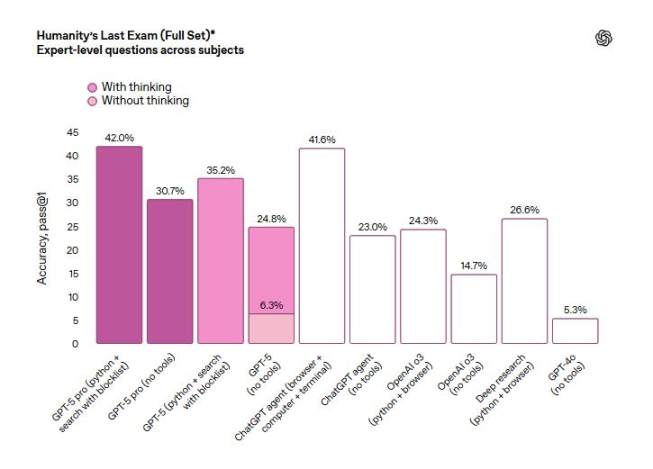
However, on Humanity’s Last Exam—a cross-disciplinary test measuring performance in math, humanities, and natural sciences—the enhanced GPT-5 Pro version with extended reasoning scored 42% when using tools. This is slightly lower than xAI’s Grok 4 Heavy, which scored 44.4%.
Altman said GPT-5 particularly excels at launching entire software applications on demand—a concept known as “ambient coding,” where AI generates functional code based on natural language prompts, accelerating development speed.
As an example, OpenAI researchers demonstrated asking GPT-5 to create a web app to help English speakers learn French. The app needed an engaging theme and include flashcards, quizzes, the classic Snake game, and a way to track daily learning progress.
The same prompt was submitted to two separate GPT-5 windows, generating two different apps within minutes. OpenAI executives noted these apps had “some flaws,” but users could further customize the AI-generated software according to personal preferences—for instance, changing backgrounds or adding more tabs.
In creative writing, GPT-5 handles structurally complex tasks such as unrhymed iambic pentameter or naturally flowing free verse. Nick Turley, Vice President of ChatGPT at OpenAI, said GPT-5 demonstrates “better taste” in creative tasks, with more natural-sounding responses.

Health consultation is the third major area of improvement.
GPT-5 actively flags potential health concerns and helps users interpret medical results, although OpenAI emphasizes that ChatGPT cannot replace medical professionals.
In the HealthBench Hard Hallucinations test, the thinking-enabled GPT-5 produced hallucinated errors at a rate of only 1.6%, significantly lower than GPT-4o and o3, which had error rates of 15.8% and 12.9% respectively.

Significantly Reduced Hallucinations and a New Safety Training Approach
OpenAI says GPT-5 is more reliable and practical than previous models, answering real-world questions more accurately with a significantly reduced likelihood of hallucinations.
When web search was enabled on anonymized prompts representing ChatGPT production traffic, GPT-5 responses contained factual errors about 45% less often than GPT-4o; after thinking, GPT-5 responses had factual errors about 80% less often than o3. As shown in the chart below, GPT-5’s error rate is only 4.8%, compared to 20.6% for GPT-4o and 22% for o3.

OpenAI also introduced a new form of safety training for GPT-5 called safe completions. This trains the model to deliver the most helpful possible answers within safety boundaries. Sometimes this may mean partially answering a user’s question or providing only high-level guidance.
If a refusal is necessary, the trained GPT-5 will transparently inform the user why and offer safe alternatives.
Through controlled experiments and within OpenAI’s production models, the company found this safe completions method to be more nuanced, better at handling dual-use queries, more robust to ambiguous intent, and less prone to unnecessary over-refusal.
Michelle Pokrass, OpenAI’s head of post-training, said: “GPT-5 has been trained to recognize when a task cannot be completed, avoid guessing, and explain its limitations more clearly—reducing unfounded assertions compared to prior models.”
Four Optional ChatGPT Conversation Personas Launched
OpenAI says GPT-5 shows improved instruction following, with corresponding enhancements in executing custom instructions. OpenAI is rolling out a new research preview offering four preset personas for all ChatGPT users.
The initial four persona options—Cynic, Robot, Listener, and Nerd—are optional and can be adjusted anytime in settings to match users’ preferred communication styles with ChatGPT.
These four personas are initially available for text chat and will later expand to voice chat, allowing users to set ChatGPT’s interaction style without writing custom prompts—whether concise and professional, thoughtful and supportive, or slightly sarcastic.
OpenAI says all these new personas meet or exceed its internal evaluation standards for reducing overly flattering behavior.
Altman Hails Historic Breakthrough: Using GPT-4 Again Feels Terrible
At Thursday’s briefing, Altman gave GPT-5 extremely high praise, positioning it as a major milestone toward AGI. He said:
“At any point in history before now, having something like GPT-5 would have been unimaginable. This is the first time it genuinely feels like talking to an expert in any field.”
During the briefing, Altman even went so far as to disparage GPT-4 to elevate GPT-5, saying:
“I’ve tried going back to using GPT-4, and it feels really bad.”
GPT-5 uses a unified system architecture with a real-time router that automatically decides whether to respond quickly or engage in deep “thinking,” based on conversation type, complexity, and tool requirements. This eliminates the need for users to manually select appropriate settings, making ChatGPT easier to use.
In internal benchmarking for economically valuable work, GPT-5 operating in reasoning mode matched or exceeded expert-level performance in about half of cases across more than 40 occupations, including law, logistics, sales, and engineering. OpenAI VP Nick Turley said: “This model just feels really good.”
Altman likened using GPT-5 to having instant access to a team of experts, all holding PhDs. He added: “In many new fields, people are limited by ideas, not execution.”
Microsoft Integrates Fully to Gain First-Mover Advantage
On the very day of GPT-5’s release, Microsoft announced its integration across a wide range of products. In enterprise applications, Microsoft 365 Copilot will leverage GPT-5 to better handle complex problems, maintain focus during long conversations, and understand user context. Enterprise users can apply reasoning capabilities to emails, documents, and files.
For consumers, Microsoft Copilot’s new intelligent mode will use GPT-5 to help users discover optimal solutions. Users can experience GPT-5 for free via copilot.microsoft.com or through the Copilot app on Windows, Mac, Android, and iOS devices.

Developers will gain access to GPT-5 through GitHub Copilot and Visual Studio Code for writing, testing, and deploying code. The Azure AI Foundry platform will provide all GPT-5 models, equipped with an AI-driven model router that selects the optimal model based on each task’s complexity, performance needs, and cost efficiency.
Microsoft’s AI Red Team tested the GPT-5 reasoning model using rigorous security protocols, finding it exhibits one of the strongest AI safety configurations among OpenAI’s historical models, particularly against attack patterns such as malware generation and fraud automation.
Join TechFlow official community to stay tuned
Telegram:https://t.me/TechFlowDaily
X (Twitter):https://x.com/TechFlowPost
X (Twitter) EN:https://x.com/BlockFlow_News