









Will rates be cut or will it rain tomorrow? The crucial week setting the tone for August's market performance
TechFlow Selected TechFlow Selected
Will rates be cut or will it rain tomorrow? The crucial week setting the tone for August's market performance
The Federal Reserve's interest rate decision, tech giants' earnings reports, and the White House's digital assets report—all arriving simultaneously, just before the season when the crypto market historically tends to weaken the most.
 Navigating Web3 tides with focused insights
By: BlockBeats
Most people haven't realized it yet, but what's happening this week is setting the tone for August—and could determine the entire summer’s market direction.
Three major variables—the Fed rate decision, big tech earnings, and the White House digital assets report—are all converging just before the historically weakest season for crypto markets.
Traders are at an awkward crossroads: should they position early for a rebound, or prepare for a liquidity pullback?
As 10xResearch wrote in its latest report: "We're approaching a pivotal moment. The most important calendar events—corporate earnings, the White House digital assets report, and the FOMC meeting—are about to settle before summer fully arrives. Given that crypto has traditionally underperformed in August and September, traders face a dilemma." Their real-time indicators also suggest today’s price action may set the rhythm for the entire summer.
What makes it more complex is that the market isn’t just waiting for an answer on rate cuts—it’s waiting for directional clarity. Will the Fed pivot toward easing, pushing Bitcoin and Ethereum higher? Or will it stay on hold, dousing the market with cold water?
Below, BlockBeats compiles macro insights on interest rates and tariffs, along with trader sentiment and outlooks on major cryptocurrencies, to help guide your trading this week.
Triple Macro Data Hits This Week
From Wednesday to Friday, the U.S. will release three core economic reports—GDP, core PCE, and nonfarm payrolls—that together form the key benchmarks for determining when rate cuts might begin. Their impact on market sentiment could rival even the Fed’s own policy meeting this week.
July 30 (Wednesday): Q2 GDP preliminary reading is expected at +1.9%, a clear improvement from Q1’s -0.5%. A stronger-than-expected print may be interpreted as evidence of a “soft landing,” potentially dampening hopes for earlier rate cuts.
July 31 (Thursday): June core PCE inflation data, the Fed’s preferred gauge, is forecasted at +2.7% YoY. A slight miss could boost bets on rate cuts later this year; any surprise uptick might trigger short-term risk-off behavior.
August 1 (Friday): July nonfarm payrolls, expected at +115K jobs with unemployment edging up to 4.2%. This will directly influence the Fed’s view on whether the labor market has cooled significantly—a crucial piece in shaping policy direction.
Rate Cut Unlikely Tomorrow
The Federal Reserve will hold its FOMC monetary policy meeting on July 30–31. Markets widely expect the benchmark rate to remain unchanged in the 4.25%–4.50% range. According to Polymarket, as of July 29, the probability of no rate change stands at 97%, while a 25-basis-point cut has only a 3% chance.
In other words, no actual cut is expected—but the market is watching closely for signals of one.
Nick Timiraos, known as the “Fed whisperer” at The Wall Street Journal, wrote: “Fed officials do believe rate cuts will eventually be needed, but they’re not ready to act this week.” He added: “Whether Powell hints at a September cut during the press conference will become the focal point for markets.”
Multiple institutions argue that current U.S. policy conditions are already extremely loose. An early rate cut could inflate asset bubbles and reduce the Fed’s ability to respond to future crises. Meanwhile, ongoing political pressure from Trump on Powell risks undermining the Fed’s independence, making policy statements more politically sensitive.
According to AP News and MarketWatch, internal divisions within the Fed have emerged into three camps:
1. Hawks (e.g., Michelle Bowman): Believe a rate cut now would be “premature” as inflation remains unanchored.
2. Doves (e.g., Christopher Waller): Advocate for early easing signals and supported a “July cut.”
3. The majority观望派: Emphasize “waiting for more data,” maintaining a data-dependent stance, favoring a cut at some point later this year.
This divergence could surface publicly this week, fueling market volatility. Whether Powell signals a “rate cut path” will be his biggest test.
It also means that even if policy stays unchanged, any dovish hint in the statement or press conference could be rapidly interpreted by markets as a signal to front-run rate cuts.
Market Reacts Indifferently to Tariff Developments
Last weekend, the Trump administration reached a new trade deal with the EU, averting a full-scale tariff war originally scheduled for August 1.
Yet markets didn’t celebrate. U.S. and European equities reacted flatly: S&P 500 edged slightly higher, while STOXX 600 actually declined. Both indices briefly rallied intra-day but gave up gains by close.
Some economists argue: “Markets are no longer excited by U.S.-EU trade deals—they urgently need a new catalyst.”
For Europe, the agreement isn’t seen as truly reciprocal. German Chancellor Friedrich Merz and French Minister for European Affairs Benjamin Haddad both publicly expressed hopes for greater openness in future trade. Meanwhile, Trump reiterated Monday: “We’ll likely impose uniform 15% to 20% tariffs on countries without trade deals with the U.S.”
This removes the previously feared “30% cliff.” While 15% is still high, the mere predictability of tariff policy has become a positive in itself.
Trader The Investors Side (@InvestorsSide) commented: “This isn’t a clean handshake moment—but markets don’t need peace, they need predictability. And that’s exactly what this deal delivers in the short term.”
In his view, while 15% tariffs remain elevated compared to pre-2024 levels, they eliminate the most explosive scenario—an abrupt 30% tariff cliff in August—marking a win for risk sentiment.
He also noted that the U.S. and China extended their tariff suspension for another 90 days, confirming that both economies are moving gradually toward a broader agreement, allowing markets to fully recover from the April event that triggered over -20% equity sell-offs.
At least on tariffs, traders can finally stop worrying about black swans and refocus on earnings, interest rates, and crypto prices themselves.
$9 Billion Moved, BTC Still Strong
This month, Bitcoin has held near all-time highs without showing typical bubble signs. Implied volatility and funding rates—usually indicators of excessive speculation—have remained low, suggesting investors see this rally as fundamentally sound.
Critically, several technical indicators once considered “bubble warnings” are silent: implied volatility (IV) remains subdued; funding rates are mild; leverage usage has notably decreased.
Multiple analysts note that since the launch of spot Bitcoin ETFs early this year, market structure has quietly transformed: “More traditional capital is allocating to Bitcoin via ETFs, avoiding contracts and leverage, and moving away from retail-style momentum chasing.” This has stabilized the market, turning pullbacks into “buy-the-dip” rather than “miss-the-rally” opportunities.
Nick Forster, founder of on-chain options platform Derive, agrees with this shift: “Michael Novogratz’s $150K prediction no longer sounds crazy.” He adds: “The options market now assigns a 52% probability that Bitcoin will hit $150K by year-end.”
This week, Bitcoin experienced a remarkable “large-scale transfer”: 80,000 BTC—worth about $9 billion—was awakened from a Satoshi-era cold wallet, sold, and circulated. The transaction was orchestrated by Galaxy Digital and marks the largest known estate-related sale in crypto history.
As analyzed by @TheInvestorsSide, the market had intensely watched this event, yet actual volatility was far lower than expected: “Despite the massive size, BTC briefly dipped below $115K and recovered to $119K within days.”
What does this mean? He argues: “Bitcoin barely flinched under $9B in selling pressure—that tells us everything we need to know. The natural trajectory remains upward. If BTC can overcome next week’s macro headwinds, my next short-term target is $130K.”
Renowned on-chain analyst and Checkonchain co-founder James Check (@Checkmatey) provided deeper context: “This was a very conventional, orderly sale. Galaxy facilitated a client transfer and used OP_RETURN to publish a news message on-chain.”
More intriguingly, he pointed out that Galaxy “casually” sent back a transaction output of 1 satoshi to the original address—widely interpreted as a middle finger to anyone attempting to legally claim those BTC.
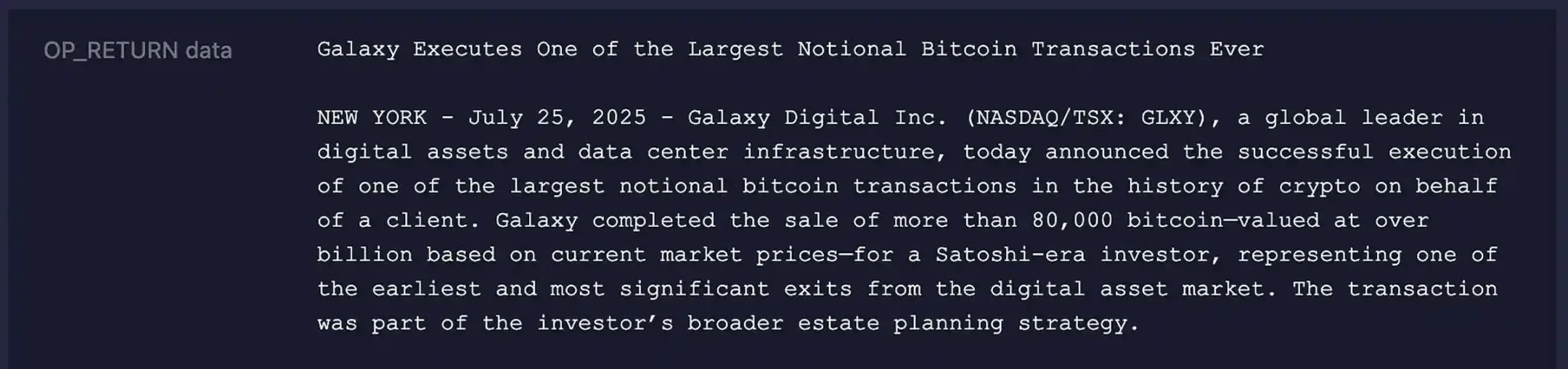
But from an on-chain perspective, Check focused on structural capital flows: “This wasn’t just a wallet migration—it was a real ownership transfer. Whether sold OTC or on exchanges, on-chain transactions had to occur, and capital was repriced.”
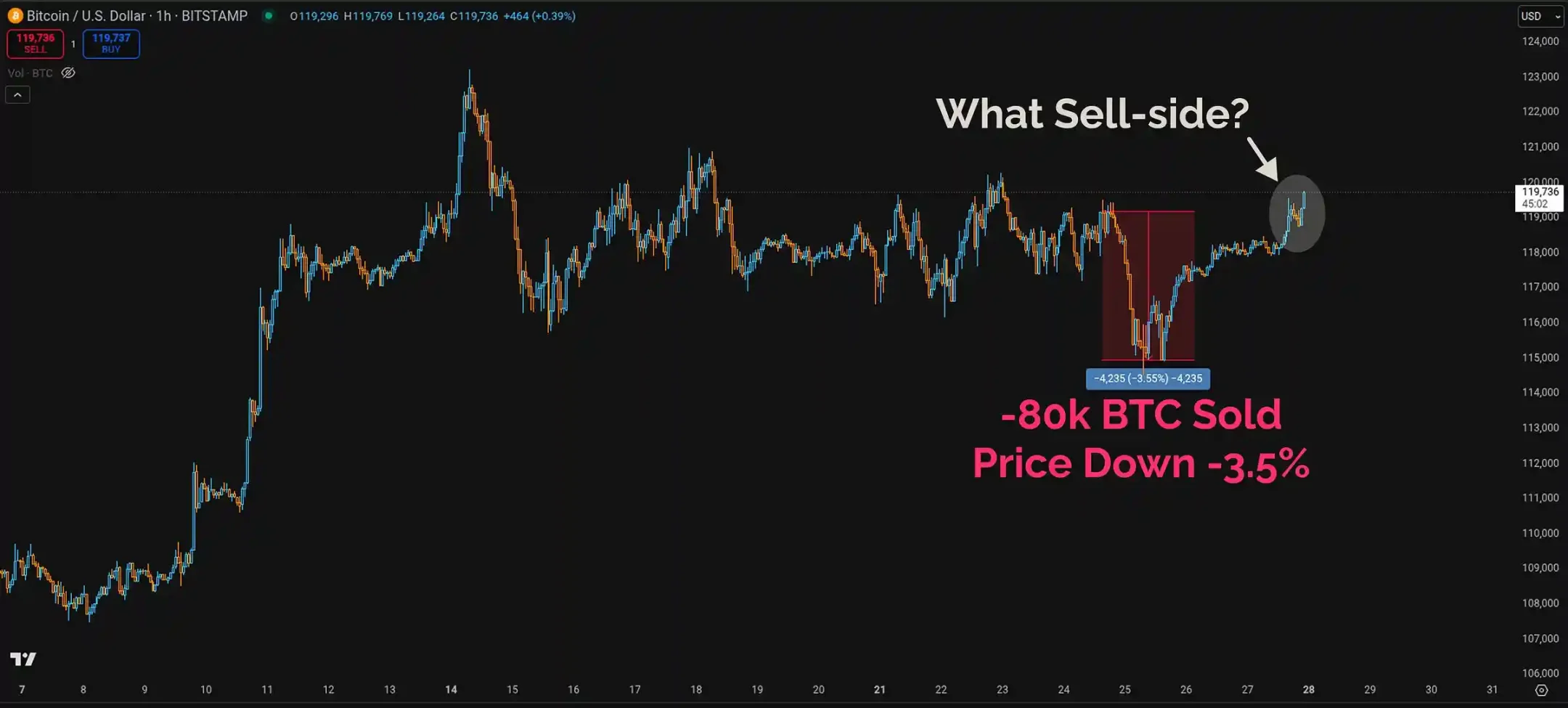
He emphasized that multiple metrics—realized market cap, active addresses, capital movements—accurately reflected the event; price corrected only 3.5% and quickly rebounded.
Check described this as a classic mid-bull market pullback-recovery pattern, dubbed the “Dali Llama recovery”: “Even over the weekend, on-chain data and market reaction remained surprisingly resilient. Bitcoin is heading higher.”
ETH Approaching $4,000
According to the latest options data: Bitcoin’s December implied volatility is just 30%, indicating stable expectations for its price path; Ethereum’s December IV, however, is as high as 60%—nearly double that of Bitcoin.
This suggests Bitcoin is advancing steadily in a primary trend, while Ethereum may be poised for a more volatile, non-linear breakout.
ETH’s price action confirms this: over the past two weeks, ETH surged from $2,600 to nearly $3,800. After BTC repeatedly broke new highs, ETHBTC remained weak until BTC hit $123K—then it was ETH’s turn. It rose from $3,000 to $3,800 in five days, gaining 27% with minimal drawdown.
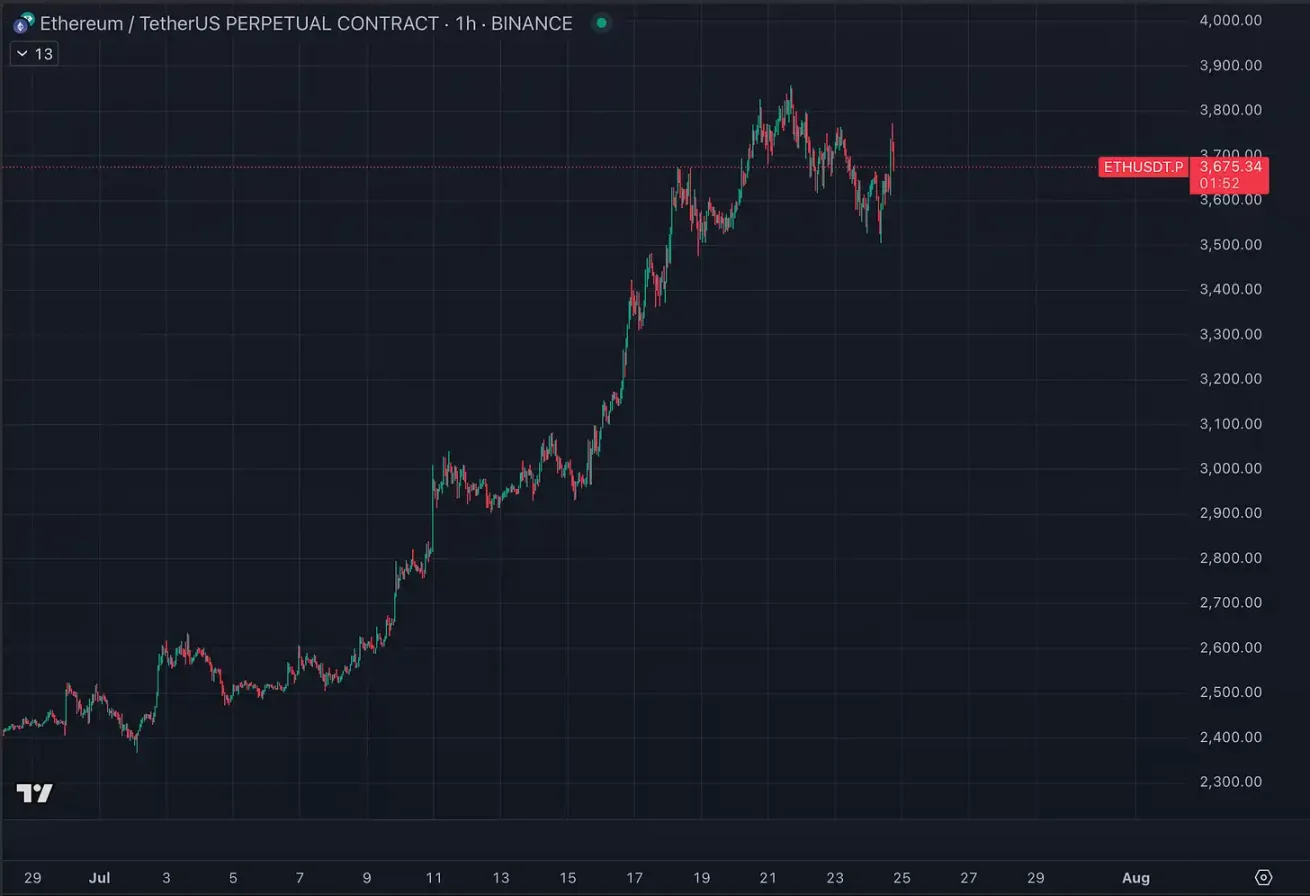
As @TheInvestorsSide noted: “Ethereum ETFs have recorded daily inflows exceeding Bitcoin ETFs for six consecutive days, setting a new historic record of 16 straight days of net inflows.”
He stated bluntly: “After months of neglect, Wall Street is re-embracing ETH. I believe we’ll see ETH break $5,000 in the medium to short term.”
Nick Forster, founder of Derive, offered a bolder forecast: “The probability of Ethereum reaching $6,000 by year-end has surged from under 7% in early July to over 30%.” He sees this as a “massive repricing of tail risk.”
This aligns with Capriole Fund founder Charles Edwards’ view: he expects ETH to make new all-time highs within the next “6 to 12 months.”
Analyst Viktor revealed another layer of capital dynamics—the accelerating reflexive loop among ETH-focused funds:
The clearest examples are Sharplink Gaming and Bitmine led by Tom Lee. Sharplink Gaming’s stock surged nearly 5x in two weeks in early July. The team capitalized by issuing new shares and using proceeds to buy ETH, purchasing up to $400M in a single week. Its mNAV now stands at 2.3; if valuations remain high, this “sell stock, buy coin” behavior is expected to continue. Bitmine raised $250M in private funding in just 10 days and publicly announced its ETH holdings surpassed $1B. It continues to raise capital via ATM (at-the-market offerings) to acquire more ETH.
“These altcoin funds are creating a self-reinforcing capital loop through stock appreciation, fundraising, and coin buying,” Viktor added. ETH strength has naturally lifted certain “ETH proxy tokens,” especially in DeFi—$CRV, $FXS, and $CVX all doubled. $ENA surged 125% from lows, though late-stage gains were likely driven by early announcements of an $ENA fund company named StablecoinX, trading as $USDE. Caution is advised when investing in such altcoin fund stocks.
In Tom Lee’s latest internal report, “The Alchemy of 5%,” the Bitmine chairman and Fundstrat co-founder declared: “Wall Street broadly believes Ethereum will be one of the most important macro trades of the next decade.”
His BTC forecast: $250,000 by end of 2025. His ETH target: $60,000, justified by ETH’s role as the main platform for Web3, DeFi, stablecoin issuance, and staking; the arrival of spot ETFs; structural buying from funds; and macro tailwinds from inflation and the economic cycle boosting crypto premiums.
In his view, this bull run isn’t a traditional speculative frenzy, but an institutional-grade primary wave shaped by ETFs, investment vehicles, and on-chain liquidity.
Traders Eyeing SUI
The token has a daily trading volume of $4.7B and a market cap of $9.98B, showing upward momentum with further upside potential. As SUI recovers from prolonged market pressure typical of consolidation phases, traders are reassessing its prospects.
Prominent crypto analyst Ali Martinez noted that SUI’s price broke out of a symmetrical triangle pattern on the daily chart—a classic technical formation often followed by sharp price moves. Such breakouts typically signal a shift from market uncertainty to clear directional momentum, in this case, upward.
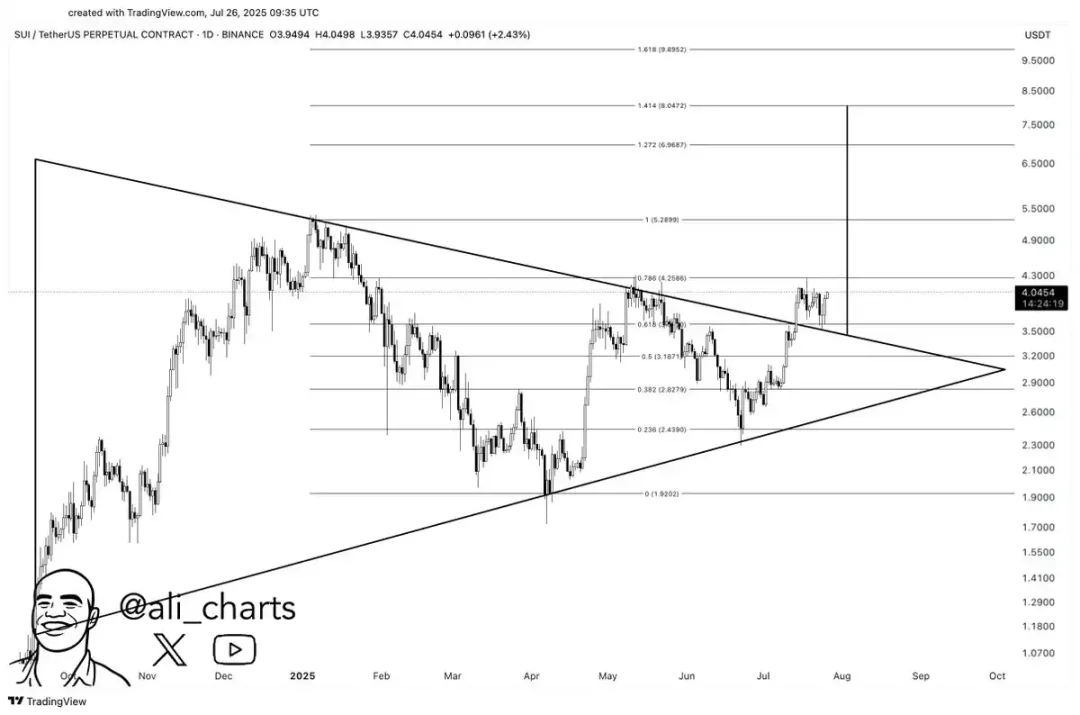
Ali Martinez said that as long as capital inflows continue, a confirmed breakout above the $4.50 resistance could push prices toward $8. He explained that the triangle formation marks the end of consolidation and the beginning of a trend reversal.
According to Reuters, institutional firm Canary Capital has filed with the U.S. SEC for the first spot SUI ETF. If approved, SUI would become one of the first mainstream Layer-1 tokens to gain access to traditional ETF channels. This move is seen as a key precursor to unlocking institutional capital into SUI.
Join TechFlow official community to stay tuned
Telegram:https://t.me/TechFlowDaily
X (Twitter):https://x.com/TechFlowPost
X (Twitter) EN:https://x.com/BlockFlow_News
 BlockBeats






