$4 Trillion Market Cap: Unpacking the Capital Flows in the Cryptocurrency Market
TechFlow Selected TechFlow Selected
$4 Trillion Market Cap: Unpacking the Capital Flows in the Cryptocurrency Market
Where is the money coming from? Can the upward trend continue?
 Navigating Web3 tides with focused insights
By: Tanay Ved
Translated by: Saoirse, Foresight News
Key Takeaways:
-
Bitcoin's realized market cap has surpassed $1 trillion, reflecting increased long-term investor commitment and stronger conviction as the crypto market nears a $4 trillion valuation.
-
Ongoing inflows into spot ETFs, combined with growing corporate treasury accumulation, have driven demand for BTC and ETH beyond new issuance rates.
-
Market leadership is gradually broadening, with ETH showing relative strength and altcoins like SOL and XRP increasing participation through rising spot trading volumes.
-
The GENIUS Act established the first federal regulatory framework in the U.S. for fiat-backed stablecoins, bringing clarity to the over $250 billion stablecoin market and laying the foundation for greater industry participation and competitiveness.
Introduction
Digital asset markets are approaching the $4 trillion mark for the first time—an important milestone in the industry’s development. This latest price surge stems from a combination of structural and cyclical factors, including sustained inflows into Bitcoin and Ethereum spot ETFs, accelerating accumulation by digital asset fund managers, and significant regulatory breakthroughs such as the passage of the GENIUS Act. The momentum behind cryptocurrencies appears to be strengthening.
In this article, we analyze the key market forces and on-chain capital flows driving this expansion phase.
Bitcoin Realized Market Cap Hits $1 Trillion, Market Participation Broadens
Bitcoin reached a record high of $123,000, pushing its market cap to $2.38 trillion, while its "realized market cap" surpassed $1 trillion. This indicates deeper capital commitment at elevated prices and highlights growing recognition of Bitcoin’s status as a global asset amid strong ETF demand and rising institutional interest.
(Note: Realized market cap calculates total value based on the price at which each coin last moved on-chain. This metric more accurately reflects actual capital invested and wealth held long-term, offering a truer picture of long-term holder confidence and fundamental valuation compared to traditional market cap, which is based on current prices.)
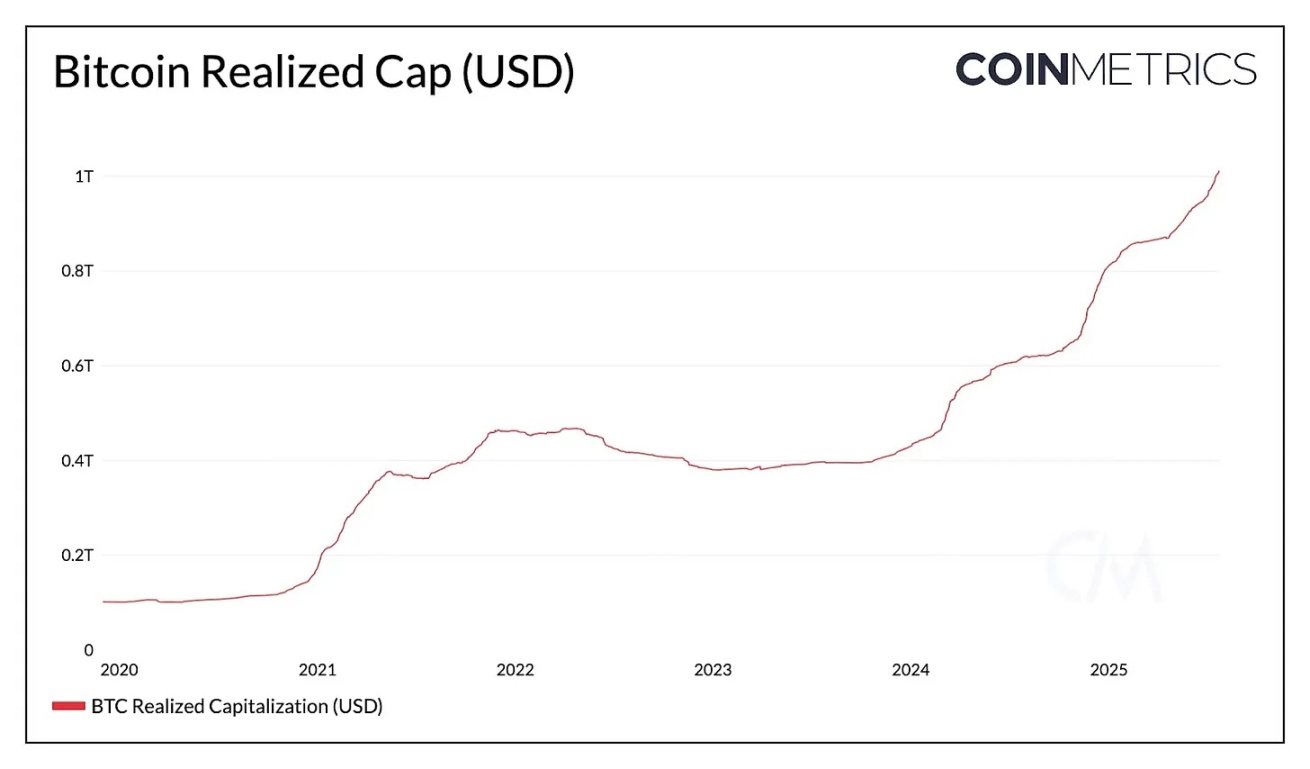
Source:Coin Metrics Network Data Pro
Recent market dynamics suggest we may be in the early stages of a broadening leadership trend. Ethereum has begun to show relative strength, with the ETH/BTC exchange rate rebounding 73% since May and ETH surpassing $3,900. This momentum is fueled by record ETF inflows, rising corporate treasury adoption, and Ethereum’s continued dominance in the stablecoin space—making it a key beneficiary of the GENIUS Act.
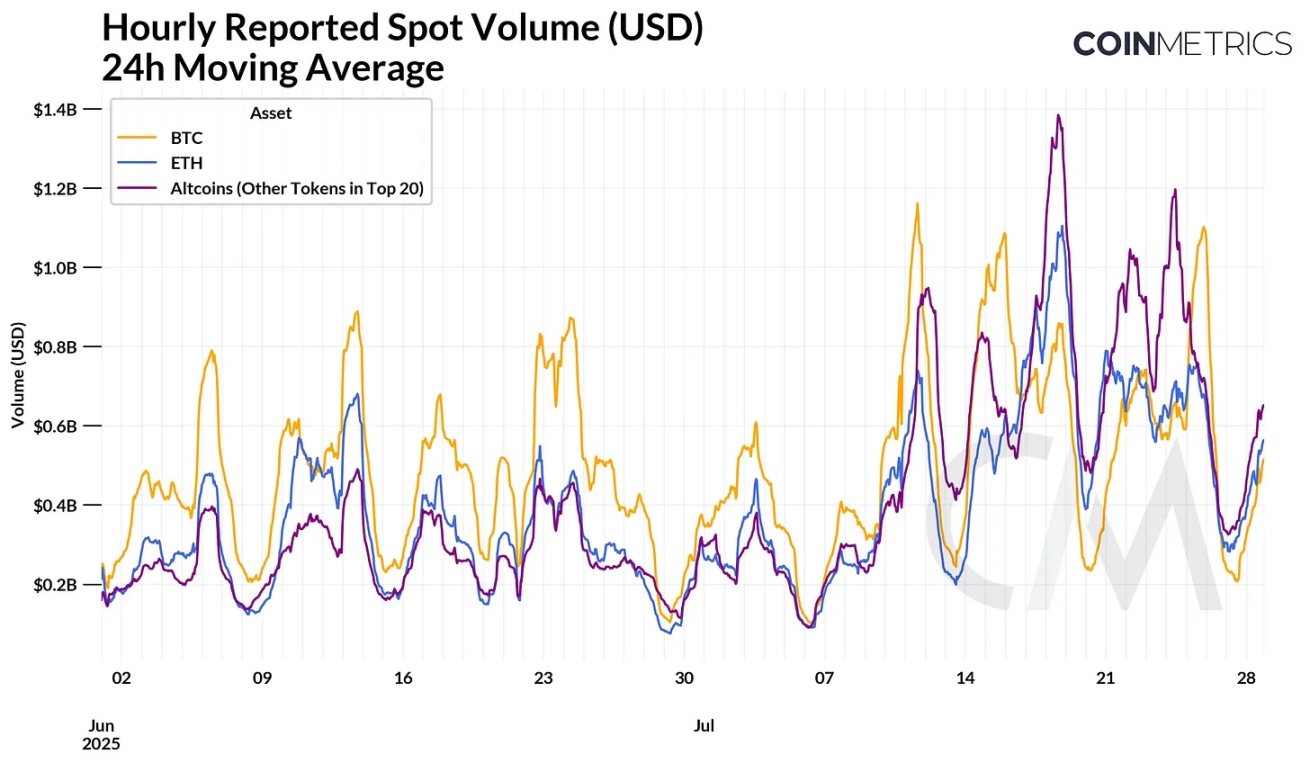
Source: Coin Metrics Market Data Pro
This broadening trend is also evident in spot trading volume, with renewed activity in ETH and large-cap altcoins such as SOL and XRP. While Bitcoin trading remains robust, ETH and altcoin volumes have seen notable growth in recent weeks. As altcoin market cap approaches $1.6 trillion, Bitcoin’s market dominance has declined to 59%. Although early signs of diversification are visible, it remains to be seen whether this marks a sustained shift in market structure.
The table below summarizes market data for the top 20 tokens by market cap (excluding stablecoins and other on-chain derivatives):
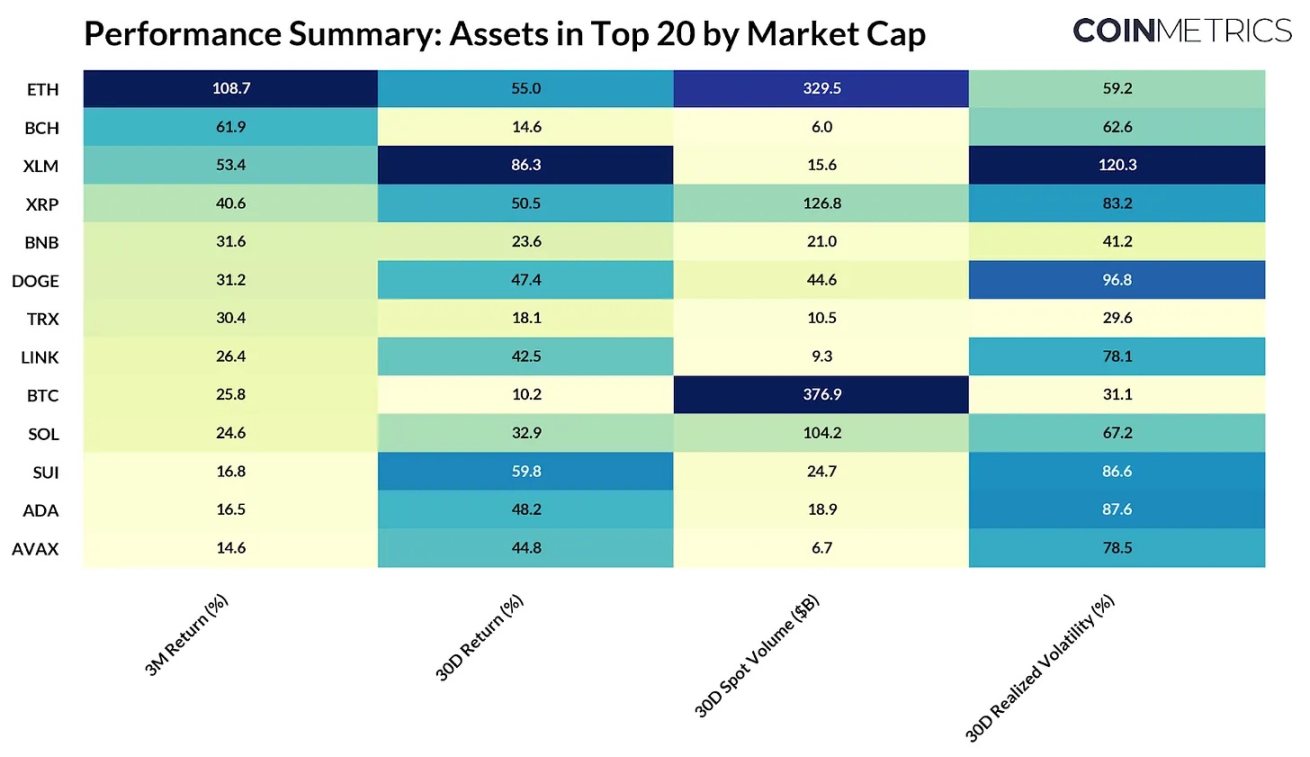
Source: Coin Metrics Reference Rates& Market Data Pro
ETFs and Corporate Treasuries Drive Accelerating Demand
A major source of demand for Bitcoin and Ethereum comes from spot ETFs. After slowing in March and April, Bitcoin ETF inflows regained momentum in May, pushing total holdings in U.S. spot ETFs above 1.27 million BTC (6.4% of total supply). BlackRock’s iShares Bitcoin Trust (IBIT) remains the largest issuer, holding 735,000 BTC (worth $87 billion).
Source:Coin Metrics Network Data Pro, excluding Fidelity Wise Origin Bitcoin Fund (FBTC)
Ethereum is now experiencing similar demand growth. Over recent weeks, Ethereum spot ETFs have recorded consecutive net inflows, sometimes exceeding those of Bitcoin ETFs. Despite launching over a year ago, Ethereum ETFs have seen significant growth in recent months, now holding 5.8 million ETH (4.8% of total supply).
Increasing corporate treasury adoption focused on Ethereum further supports demand growth, resulting in ETH accumulation outpacing new issuance. Unlike Bitcoin treasuries that primarily hold BTC as a passive asset, ETH treasuries actively generate native yield through staking and DeFi—a model now extending to other large-cap token ecosystems such as Solana (SOL), TRON (TRX), and Ethena (ENA).
On-Chain Holdings by Address Balance
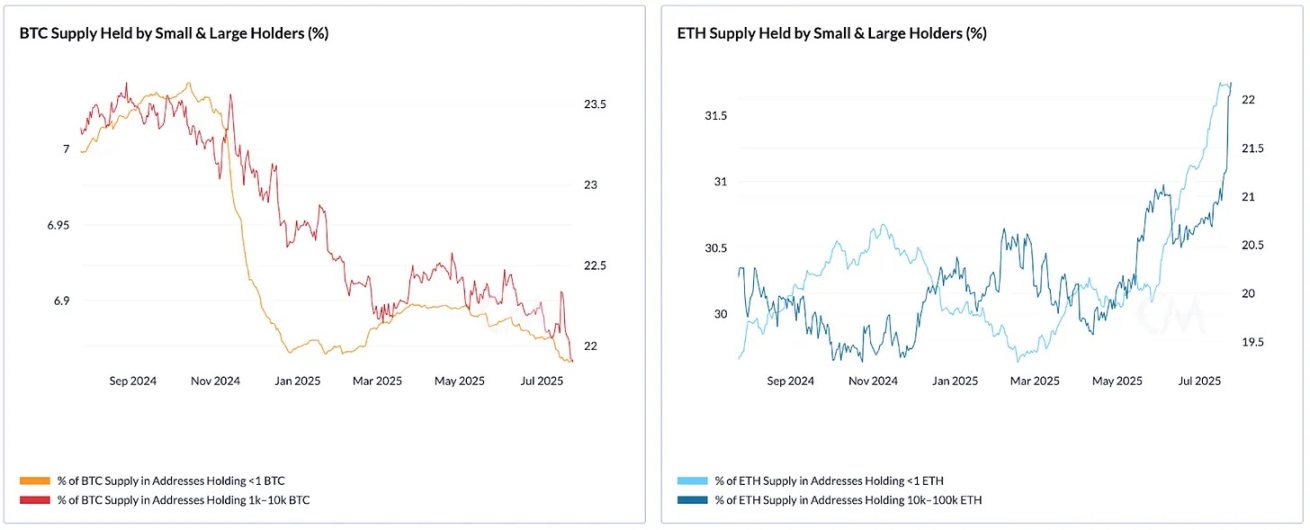
Source:Coin Metrics Network Data Pro(BTC and ETH Supply by Address Balance)
As shown in the chart above, small (<1 BTC) and large (1k–10k BTC) Bitcoin holders have gradually reduced their positions over the past year, suggesting a period of distribution at higher prices. In contrast, Ethereum shows fresh accumulation, especially among large holders (10k–100k ETH), whose share recently rose above 22%. Small ETH holders (<1 ETH) have also increased their holdings, continuing a steady upward trend since 2021.
The GENIUS Act and a New Era for Stablecoins
On July 18, the GENIUS Act was signed into law, establishing the first federal framework in the U.S. for fiat-backed stablecoins. The framework creates a level playing field for issuers, requiring full reserves backed by low-risk, short-term U.S. Treasuries and cash, regular audits, and licensing for issuance. Similar to the approval of Bitcoin spot ETFs, the GENIUS Act brings clarity and legitimacy to the dollar-pegged stablecoin sector.
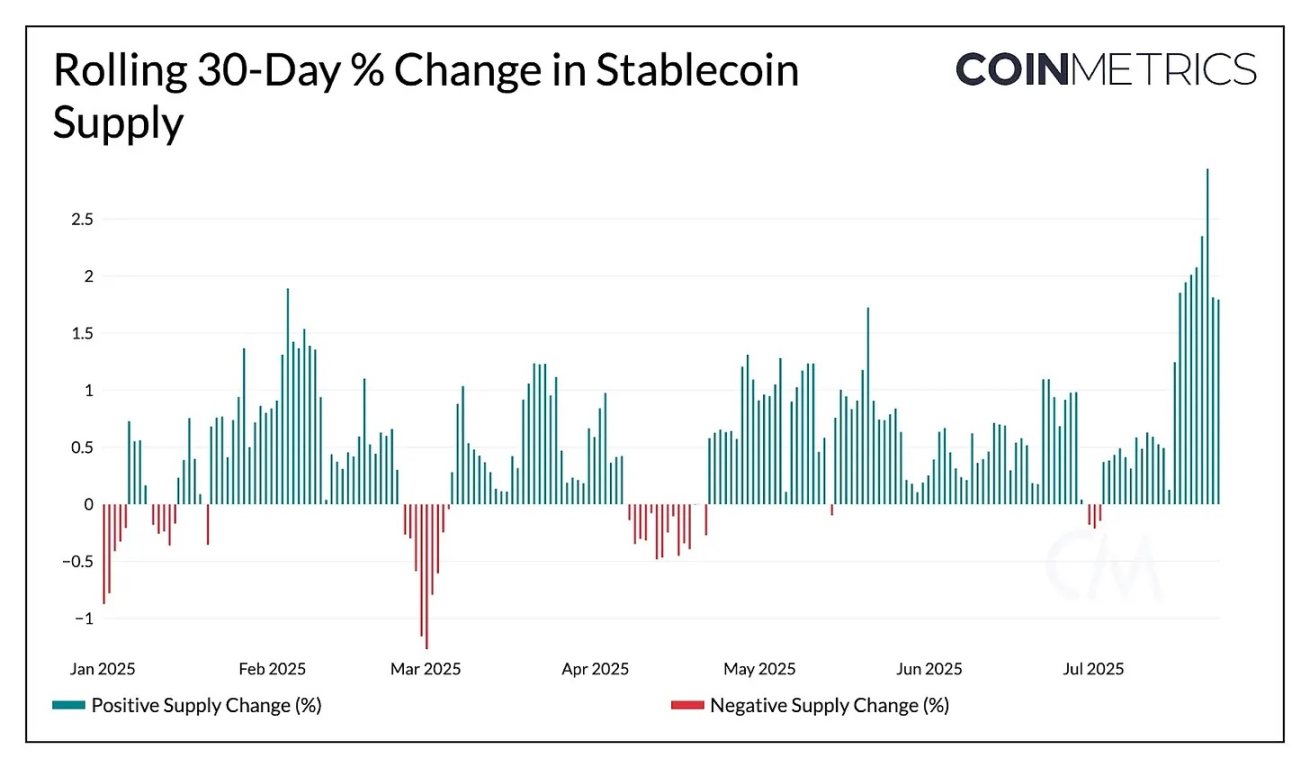
Looking at 30-day rolling supply changes, stablecoin supply growth has accelerated in recent weeks, with total supply now exceeding $255 billion.
Source:Coin Metrics Network Data Pro
This framework is expected to strengthen trust in fiat-backed stablecoins, lower barriers for new entrants, and foster greater competition in payments. From existing issuers like Tether and Circle to potential participants such as regulated banks and fintech firms, increased competition could reduce costs for consumers and businesses while reinforcing dollar demand.
Source:Coin Metrics Network Data Pro
Among current issuers, Circle and Paxos appear well-positioned to meet GENIUS Act requirements, with USDC and PayPal USD (PYUSD) already backed by full reserves and undergoing regular attestation. Circle is actively applying to the Office of the Comptroller of the Currency (OCC) for a federal trust bank charter to fully comply with the GENIUS Act and offer custody services to institutional clients. Other major issuers are adjusting their structures to align with the new regulations. Federally chartered crypto bank Anchorage Digital partnered with Ethena Labs to launch USDtb via its stablecoin issuance platform, making Ethena’s USDtb one of the first stablecoins fully compliant with the GENIUS Act, with Anchorage handling federal oversight and reserve management. This model offers a “one-stop” solution for other projects aiming to operate in the U.S. market.
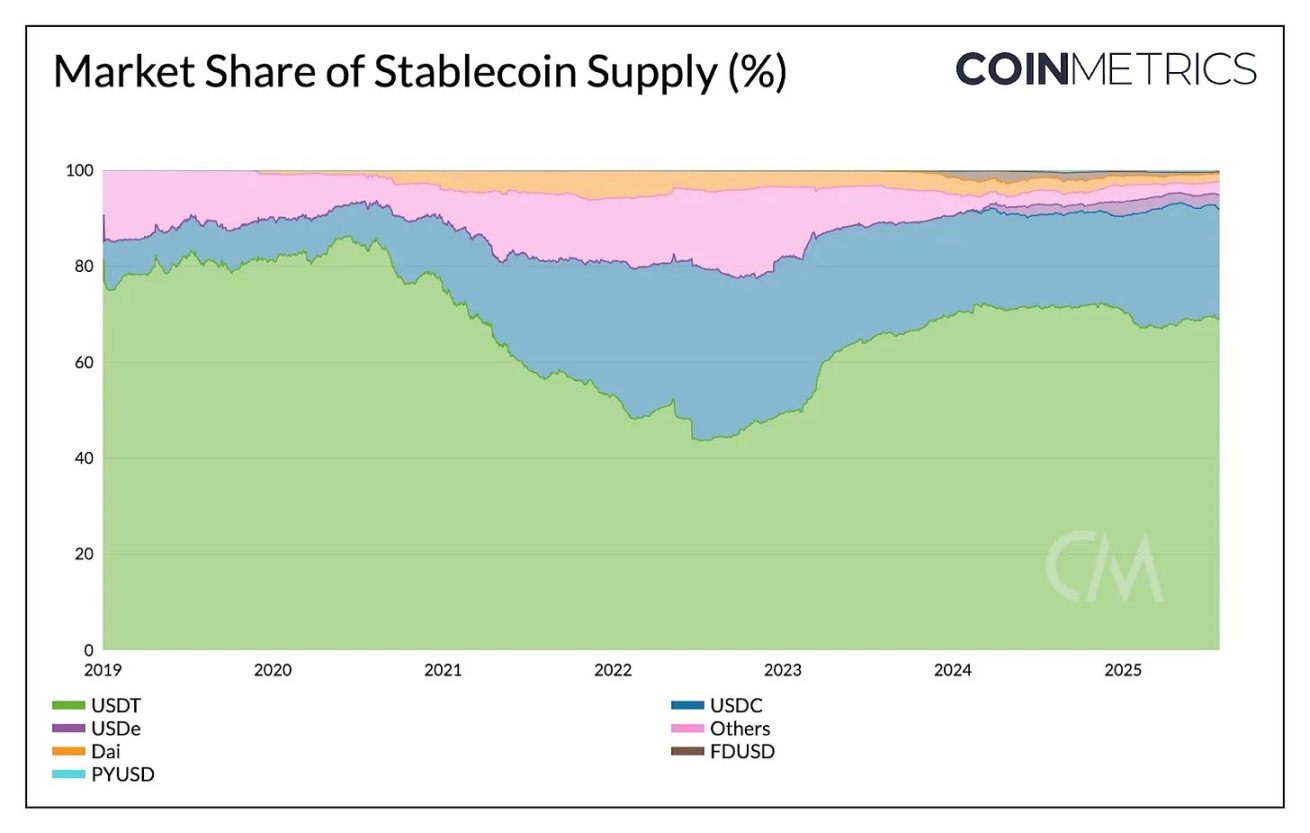
Tether (USDT), which accounts for about 68% of stablecoin supply, faces a more complex compliance path. Historically operating outside direct U.S. regulation, USDT’s reserves include non-compliant assets such as Bitcoin and precious metals. In response, Tether plans to launch a separate, U.S.-compliant stablecoin focused on institutional payments and interbank settlements. This new product will adhere to GENIUS Act standards, while the existing $162 billion USDT will continue operating in offshore markets, primarily serving emerging economies.
Stablecoin issuers have three years to comply with the GENIUS Act. After this period, only compliant stablecoins will be supported by exchanges and custodians, allowing time for issuers to adapt to the new framework.
Conclusion
The recent push toward a $4 trillion market cap reflects growing investor confidence in these assets. Demand from ETFs and corporate treasuries continues to exceed new issuance, creating favorable supply dynamics for Bitcoin and Ethereum. Valuation metrics such as Bitcoin’s Market Value to Realized Value (MVRV) ratio indicate the market has not yet entered overheated territory. While Bitcoin maintains its central position due to strong ETF inflows and long-term holder support, signs of broadening market leadership are emerging.
Furthermore, the passage of the GENIUS Act marks a pivotal moment in U.S. crypto regulation, bringing clarity to the stablecoin sector and paving the way for greater competitiveness and deeper integration with traditional finance. Despite potential short-term volatility, strong structural demand, an improving regulatory environment, and expanding participation suggest the market is well-positioned for continued strength.
Join TechFlow official community to stay tuned
Telegram:https://t.me/TechFlowDaily
X (Twitter):https://x.com/TechFlowPost
X (Twitter) EN:https://x.com/BlockFlow_News
 @coinmetrics