Gemini again choked by JPMorgan, founder denounces bank for launching "financial persecution 2.0"
TechFlow Selected TechFlow Selected
Gemini again choked by JPMorgan, founder denounces bank for launching "financial persecution 2.0"
Banking sector sounds the attack on the cryptocurrency industry?
 Navigating Web3 tides with focused insights
Written by: Wenser, Odaily Planet Daily
The clash between traditional financial giants and crypto platforms is unfolding once again, with two major U.S. industry titans taking center stage—one being JPMorgan Chase, known as the "leader among investment banks," and the other being the established cryptocurrency exchange Gemini. At around 2 a.m. Beijing time on July 26, Tyler Winklevoss, co-founder of Gemini, took to social media to condemn JPMorgan for refusing to provide data services to Gemini due to his prior statements, accusing the bank of engaging in unfair competition and attempting to stifle fintech firms and crypto platforms. The news quickly reminded many in the crypto industry of the past打击 inflicted by the so-called "Operation ChokePoint 2.0." This article from Odaily Planet Daily offers a brief overview of what has been dubbed "Financial Persecution 2.0" against Gemini for readers’ reference.
Gemini Under Siege Again: When Bank Data Becomes a Competitive Weapon
In the intersection between traditional finance and cryptocurrency industries, user data remains a critical asset for both legacy banks and crypto platforms. After all, the more comprehensive KYC information is, the better platforms can assess user risk profiles, asset sizes, security levels, build clearer user personas, and operate their businesses efficiently.
The current dispute between Gemini and JPMorgan centers precisely on banking data.
Just as Musk monetized Twitter's API access after acquiring the platform, or Reddit charges third-party clients and apps for accessing its data, "data business" has long been an ambiguous yet integral part of platform economies. After Tyler Winklevoss, co-founder of Gemini, criticized JPMorgan on July 20 for stripping Gemini of free access via Plaid—a third-party platform—to bank data, and instead charging fintech companies high fees for such access—JPMorgan, one of America’s top banks, responded bluntly by issuing what amounted to a death sentence: “Following the removal of Gemini’s customer eligibility under Operation ChokePoint 2.0, plans to reinstate Gemini as a client have been suspended.”
Undoubtedly, much like how U.S. banks previously refused banking services to certain crypto and tech startups during Operation ChokePoint 2.0, this move by JPMorgan represents another unilateral act of suppression by a traditional financial powerhouse against a crypto platform. To understand this, we must briefly revisit this infamous episode of industry persecution.
Back to 'Operation ChokePoint 2.0': The Banking Sector's 'Crypto Strangulation Campaign'
In 2023, several crypto-friendly banks—including Silicon Valley Bank, Silvergate, and Signature Bank—collapsed amid the crypto winter and internal mismanagement. Some industry insiders pointed out that these failures might have stemmed from pressure exerted by the Biden administration on banks to sever ties with cryptocurrency companies.
Afterward, Operation ChokePoint 2.0 gradually emerged from the shadows.
Marc Andreessen, founder of a16z, revealed on the Joe Rogan Experience podcast: “Operation ChokePoint 2.0 primarily targets political opponents of the current administration and disfavored tech startups. Over the past four years, more than 30 tech founders have had their bank accounts shut down. Clearly, this isn’t isolated.” Elon Musk later amplified this claim through a repost.
In December 2022, Sam Kazemian, founder of Frax Finance, reported after communicating with JPMorgan: “While no wrongdoing has been proven, participants in the crypto space face significant challenges securing reliable banking services.”
Specifically, banks often deny services without clear justification, but the consequences are severe—affected entities may be unable to open bank accounts, face restrictions on fund transfers, or even confront existential threats. In the face of an inescapable modern banking system, both individuals and corporations appear powerless against such financial dominance.
Notably, this campaign also laid the groundwork for Trump’s political comeback—according to Marc Andreessen of a16z: “That’s why we ultimately supported Trump. We cannot live in a world where fully legal companies are punished by the U.S. government through unjust regulatory procedures.”
On March 7 this year, Trump publicly declared at the White House Crypto Summit that he would end Operation ChokePoint 2.0’s assault on the crypto industry, effectively marking a temporary end to the “financial persecution” of the Biden era.
JPMorgan’s Off-Field Move: Using Data Monetization to Sidestep the U.S. Consumer Financial Protection Act
Another focal point in the current conflict between Gemini and JPMorgan lies in the U.S. Consumer Financial Protection Act, which Tyler Winklevoss referenced.
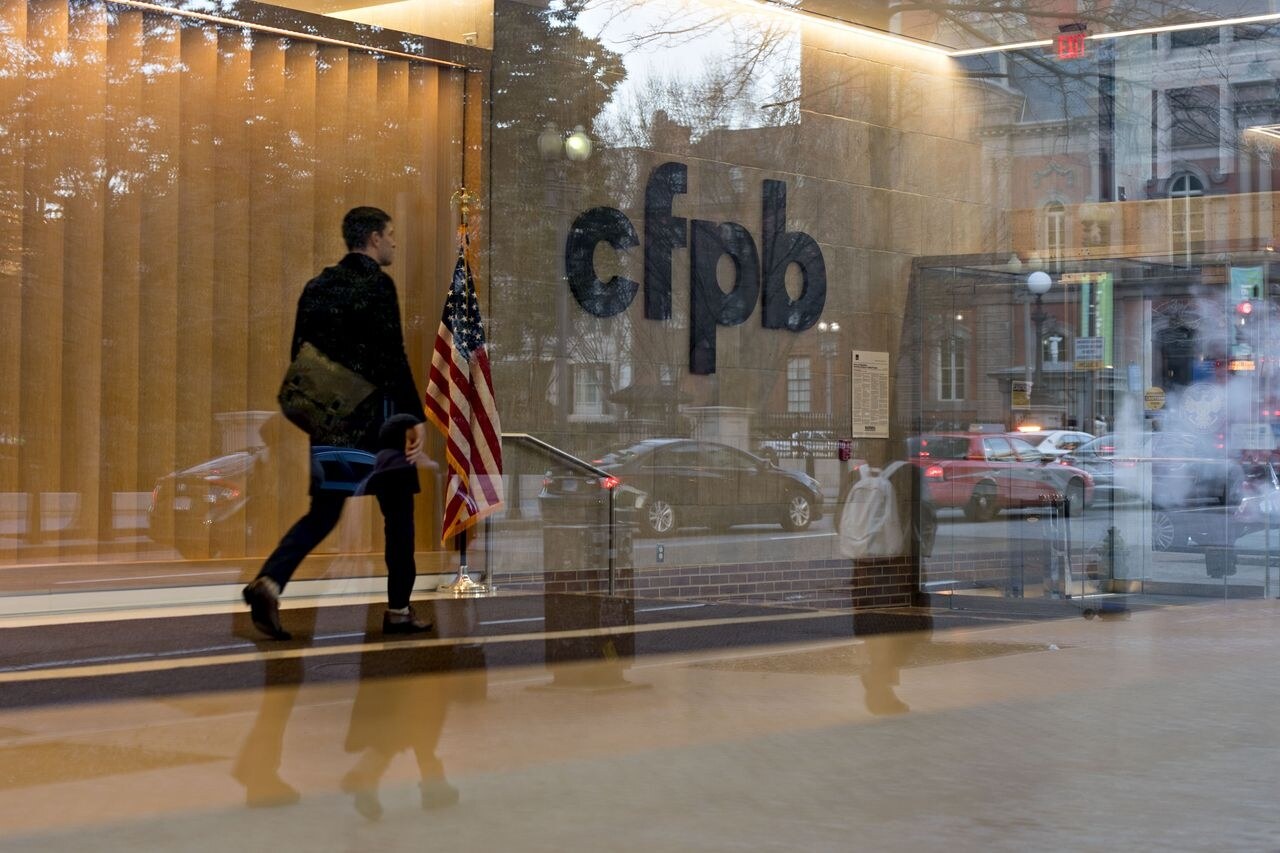
In 2024, leveraging dormant legal authority granted by Congress in 2010, the U.S. Consumer Financial Protection Bureau (CFPB) issued the Final Rule on Personal Financial Data Rights. This rule mandates that financial institutions, credit card issuers, and other financial providers unlock personal financial data upon consumer request and transfer it freely to another service provider. It ensures consumers can access and share data related to bank accounts, credit cards, mobile wallets, payment apps, and other financial products—including transaction history, account balances, payment initiation details, upcoming bills, and basic account verification. Crucially, the rule states: “Financial service providers must offer this information free of charge.”
The intention was to foster competition and consumer choice, reduce lending costs, and improve customer service across payments, credit, and banking markets. However, objectively, it enabled crypto exchanges and similar platforms to access users’ banking data at no cost. Now, JPMorgan’s response is simple: “Want user data? Fine—pay up!”
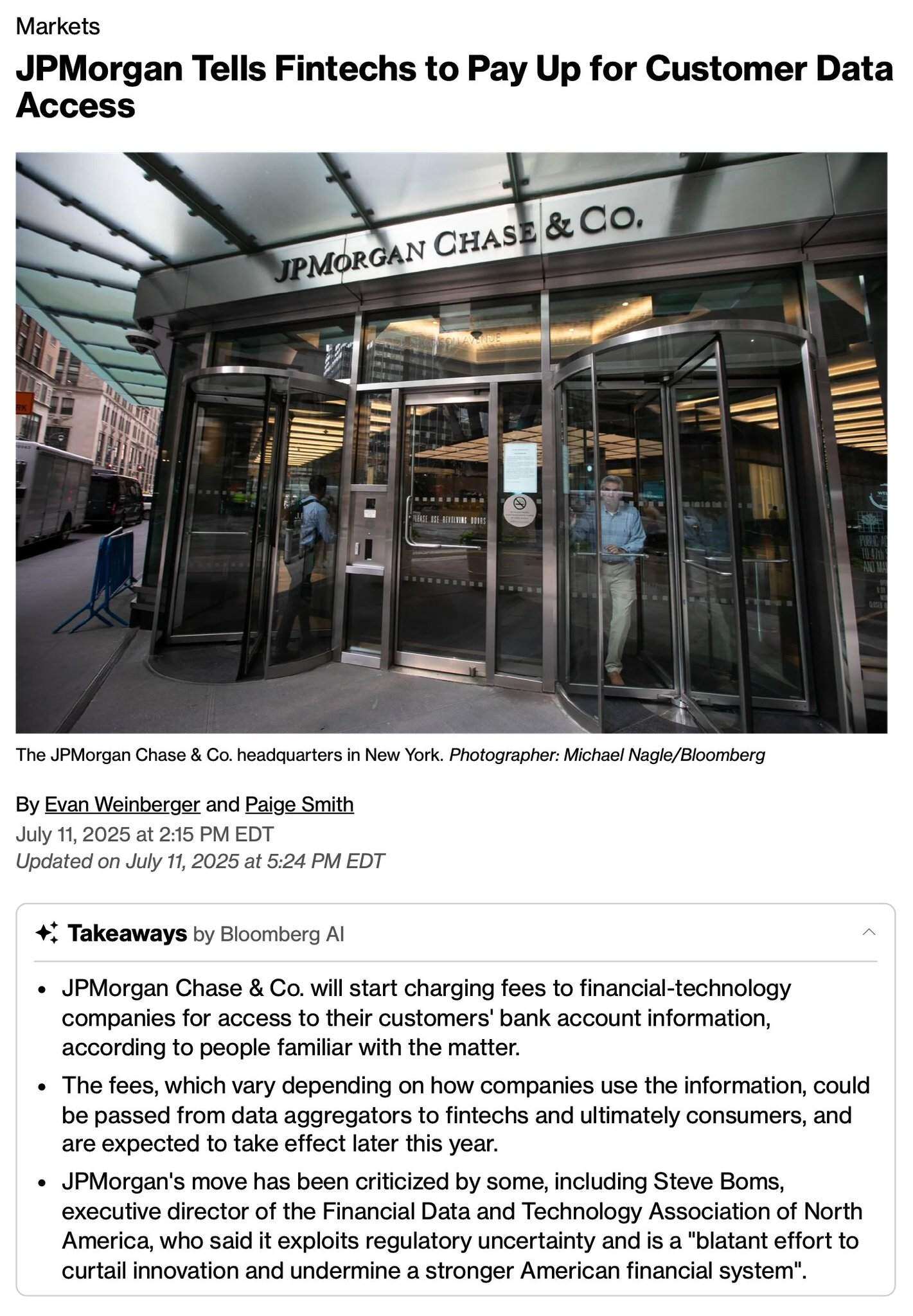
As previously reported by The Wall Street Journal
Meanwhile, as members of the entrenched interest group, bankers continue efforts to sue the CFPB, aiming to overturn the aforementioned “open banking rule,” thereby ending the open banking era and indirectly curbing the growth of crypto platforms.
This is clearly not the first time—and won’t be the last—that U.S. banks have shown hostility toward the cryptocurrency sector. Recently, the American Bankers Association and other banking and credit union trade groups jointly urged the Office of the Comptroller of the Currency (OCC) to halt reviews of bank license applications from crypto firms such as Circle, Ripple, and Fidelity Digital Assets, citing concerns over lack of transparency, failure to meet public scrutiny standards, and posing serious legal risks to the banking system.
Caitlin Long, founder of crypto bank Custodia Bank, noted that the question of whether trust charters could effectively serve as full bank charters (including lending rights and access to Federal Reserve master accounts) despite requiring only 10–15% of the capital needed for traditional banks, may soon enter legal litigation. Yet she added: “The banking industry’s fierce resistance is intriguing. If their feared scenario becomes reality, why don’t they simply convert into trust companies themselves, operating under far lower capital and regulatory burdens?”
Alexander Grieve, Head of Government Affairs at venture firm Paradigm, commented on the joint letter: “Banks and credit unions rarely agree on most issues. But they seem united on one thing: they’re finally facing real competition from the crypto industry.”
Conclusion: The War Between Banks and Crypto Platforms Has Begun
No matter how the “user data” dispute between Gemini and JPMorgan concludes, one thing is certain—the war between the banking sector and crypto platforms has moved from the shadows into the open. With recent passage of stablecoin legislation, the CLARITY Act, and anti-CBDC surveillance state bills, competition between the two sides in areas such as cross-border payments, daily transactions, and commercial acceptance will inevitably intensify. Whether banks will continue to dominate crypto platforms or crypto platforms will ultimately disrupt the banking establishment may depend on whether Trump delivers on his promised decisive action.
Join TechFlow official community to stay tuned
Telegram:https://t.me/TechFlowDaily
X (Twitter):https://x.com/TechFlowPost
X (Twitter) EN:https://x.com/BlockFlow_News
 Odaily