The cost of acquiring wealth in financial markets
TechFlow Selected TechFlow Selected
The cost of acquiring wealth in financial markets
To make money in trading, you only need to be willing to take the risks that make others uncomfortable.
 Navigating Web3 tides with focused insights
Written by: adam
Translated by: AididiaoJP, Foresight News
On social media, you often see this phenomenon: people chasing or even glorifying unique metrics, strategies, and charts, talking endlessly about "edges" and sharing "wealth codes."
Let me pour some cold water on that: while edge and alpha do exist, the things you constantly see on YouTube or Twitter are nowhere near them.
Most of the strategies displayed online aren’t alpha. They’re more fundamental—yet completely overlooked by most people, who don’t even understand why they work.
Most assume that to make money in trading, you need to be smarter than the market. In reality, you just need to be willing to take risks that make others uncomfortable.
That’s risk premium. Once you understand it, you not only grasp why you’re making money, but can also build strategies logically and stick with them long-term.
What Is Risk Premium
Before discussing trading, let me illustrate with a simpler example.
Insurance is a profitable business. You pay $300 annually to insure your $200,000 house against fire.
Insurers have actuarial tables showing your house has roughly a 1-in-5,000 chance of burning down.
This means their expected annual payout per policy is about $40.
So they collect $300, expect to pay $40, and pocket the $260 difference.
But here’s the key: you know these odds too. Insurers don’t have secret information about fire probabilities. Both sides understand the math. So why do you still pay?
Because you’re transferring risk. You’d rather pay $300 for certainty than face the tiny chance of losing $200,000.
To escape that uncertainty and discomfort, you’re willing to pay $260 annually.
The insurer takes on your unease—and gets paid for it.
That $260 is the risk premium.
It exists not due to information asymmetry or skill, but because bearing risk itself is unpleasant—and someone must be compensated for it.
Stocks Go Up
The simplest, perhaps most “primitive” risk premium is equity risk premium. Let’s talk stocks, as some still misunderstand this.
There’s a strange notion that stocks “should” return 7–10% annually, as if it were a law of physics—as though the market owes you an entry fee.
Not true.
The historical long-term upward trend of stocks is actually compensation.
If you buy SPY (S&P 500 ETF) and hold, you embark on a journey. Your portfolio may halve during crises, stagnate for a decade (like 2000–2010), and individual stocks may go bankrupt.
Recessions happen. Wars happen. Sometimes it feels terrible—you might cry under a cold shower after checking your account.
And that’s precisely why the premium exists.
If holding stocks felt safe, their returns would match short-term Treasuries.
If META stock had the same volatility and drawdowns as bonds, everyone would buy it.
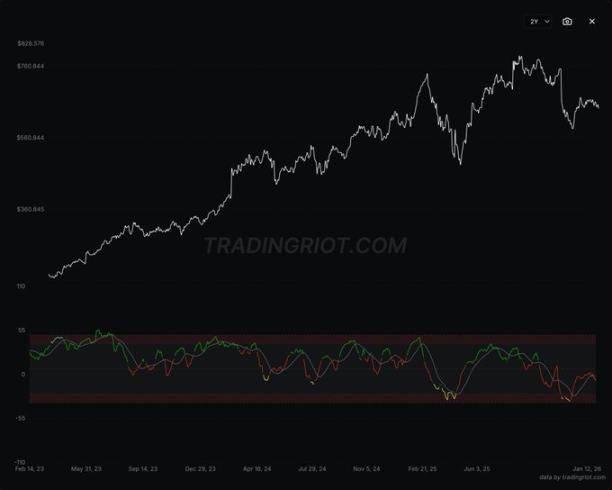
But it doesn’t. Despite massive gains since 2013, it dropped 40% last year and 80% in 2021.
So who would accept stock-like risk for bond-like returns?
No one.
Stock investors demand extra compensation for this uncertainty. Historically, that’s about 4–6% annually above the risk-free rate.
Interestingly, despite being widely known, the equity risk premium hasn’t disappeared.
Over a century, across dozens of countries, through world wars, depressions, and tech revolutions—the data proves it.
The premium persists because the underlying risk persists. Someone must hold stocks—and those holders want to be paid for the discomfort.

This differs fundamentally from trading edge: once an edge is discovered, it gets arbitraged away. But risk doesn’t vanish just because you understand it.
Bitcoin: Risk Premium or Something Else?
Which brings us to Bitcoin—an interesting case.
Since its inception, BTC’s price action has been exceptionally strong.
Far stronger than stocks. If you bought and held all along, despite brutal drawdowns, returns have been astonishing.
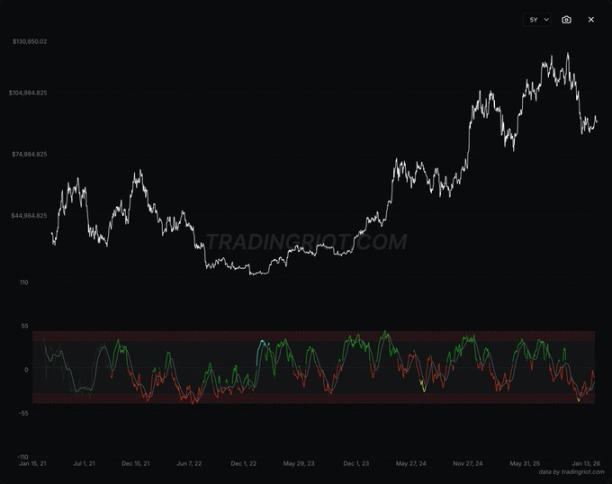
The honest question is: is this risk premium—or something entirely different?
I think there’s no definitive answer yet.
For stocks, we have over 100 years of data across multiple countries and economic systems.
That’s enough to be fairly confident the premium is structural.
For Bitcoin, we have about 15 years of data—single asset, specific tech and monetary environment. And since the pandemic, Bitcoin has changed dramatically: flows now come from ETFs, options markets are booming, etc.
The long-term upward price trend could be risk premium.
Holding something that crashes 80% repeatedly is deeply uncomfortable. If the asset keeps rising, part of that return likely compensates you for enduring such wild swings.
But it could also be early adopter effect, speculative momentum, or simply a bubble not yet fully burst. Probably some combination.
My point is: speculation in crypto markets exceeds traditional ones. Not necessarily bad—but it means you should have higher uncertainty about future returns.
Anyone claiming to know BTC will return X% annually is extrapolating from very limited data. Be honest about what you don’t know.
As for altcoins, I believe little needs to be said—they mostly perform poorly and are only suitable for short-term speculation.
Carry Premium: Traditional and Contemporary
Let me explain carry trades, as they’re classic examples of risk premium—present in both traditional finance and crypto.
Classic carry trades operate in forex markets.
You borrow a low-interest currency (e.g., JPY at 0.5%), invest in a high-interest one (e.g., AUD at 5%). You earn the 4.5% interest differential. This FX carry trade has historically been profitable.
Why does it work? Because you’re taking risk.
When global risk appetite collapses, high-yield currencies tend to crash, while safe-haven currencies like JPY or CHF appreciate.
In days of chaos, you can lose all accumulated carry profits. That steady income compensates you for occasional violent reversals.
In futures markets, the same concept appears via basis trades.
When futures prices exceed spot prices (contango), you can buy spot and short futures, locking in the spread as profit.
This is called cash-and-carry arbitrage.
For traditional futures like Treasuries or equity indices, the basis is usually arbitraged by professionals.
But in reality, these opportunities are compressed to near zero for retail in traditional markets.
Hedge funds use repo financing and 30–50x leverage on Treasury basis trades, capturing tiny spreads only worth it at scale.
Big players have cleaned up these markets.
Crypto is different—at least for now.
Perpetual contract funding rates are essentially the crypto version of carry trades.
When funding rates are positive (common, since most retail traders are long, exchanges charge longs), longs pay shorts every 8 hours.
So you can: go long spot BTC and short perpetual futures, earning funding fees while staying market-neutral (delta neutral).
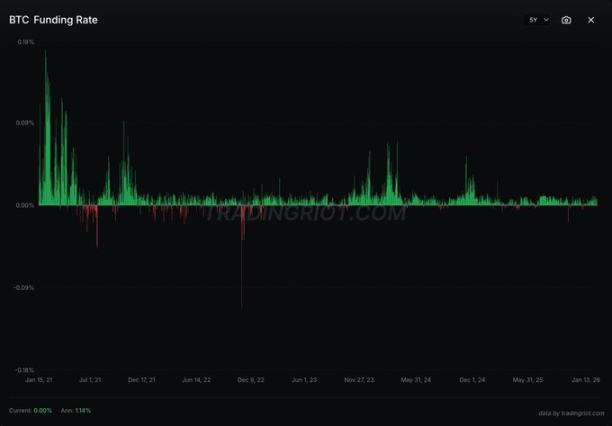
Why does positive funding persist? Because retail wants leveraged long exposure.
They’re willing to pay for it. Market makers and arbitrageurs stand on the other side, providing needed liquidity and getting paid via funding rates.
The risk profile mirrors FX carry.
During crashes, funding rates can swing sharply negative—precisely when your exposure is largest.
BIS research confirms this, showing severe drawdowns in crypto arbitrage strategies, with frequent liquidations on the futures leg during volatile periods.
You earn small, steady gains most of the time—then give back months of profits in one event. Same negatively skewed return structure as selling insurance.
Funding rate premiums still exist, though less obvious and profitable in large caps than years ago. Altcoins continue showing high funding rates, especially on platforms outside major centralized exchanges.
But this adds another layer of risk—counterparty risk. Smaller, often decentralized exchanges are far more likely to get hacked or collapse.
Volatility Risk Premium
If there’s one well-documented and tradable risk premium, it’s volatility risk premium.
On S&P 500 index options, and most ETFs, stocks, and futures, implied volatility exceeds subsequent realized volatility about 85% of the time.
This gap exists because investors systematically overpay for protection:
- Institutions need to hedge portfolios.
- Retail buys puts when fearful.
- All this demand pushes option prices above fair value.
Volatility risk premium is the compensation for selling that insurance.
That’s why selling options is generally smarter than buying.
Sell straddles, strangles, or run covered calls—these strategies harvest the same underlying premium.
The issue is return profile: stable profits most of the time, then huge losses during crashes.
Selling puts during March 2020 (pandemic) or 2008 crisis was devastating.
This is why I’m skeptical of "income strategies" that sell options across a basket of stocks—they often get crushed hardest during crashes.
But overall, this risk profile isn’t a flaw—it’s why the premium exists.
The chart below shows returns from selling 30-day straddles on SPY: consistent gains, frequently wiped out by sharp volatility events.
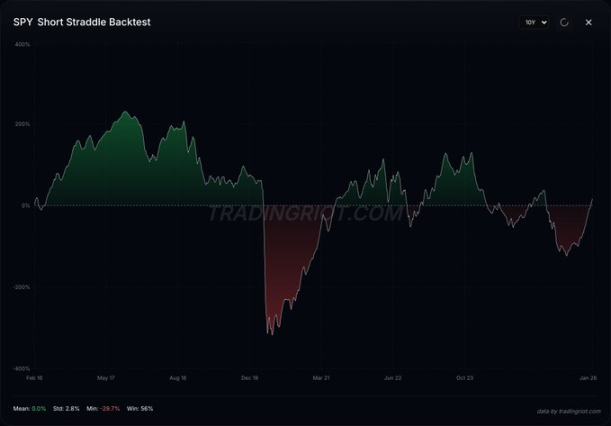
If it felt comfortable, everyone would do it—the premium would vanish.
You see similar dynamics in skew—a different form of harvesting risk premium.
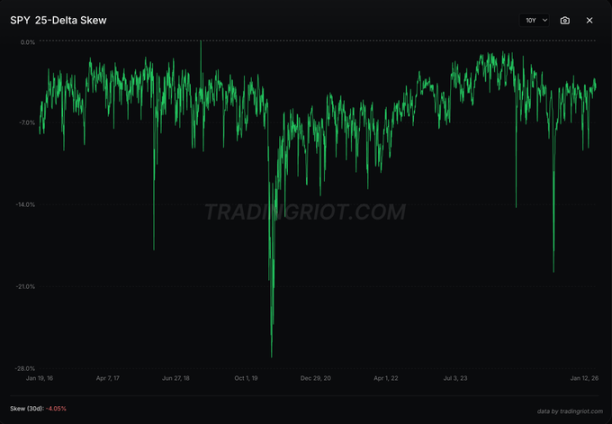
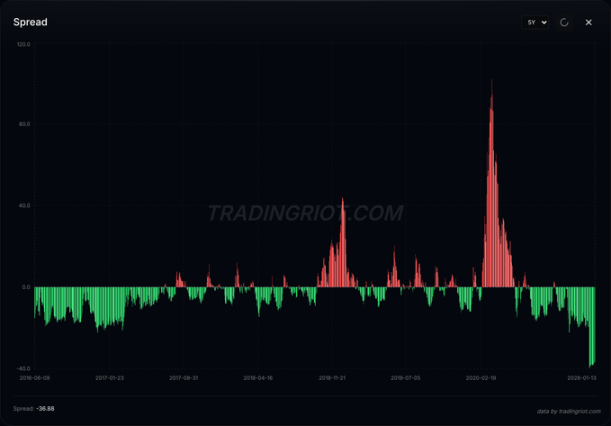
From the 25-Delta skew chart, in SPY it’s consistently below 0—meaning for 25-Delta options, put implied volatility is always higher than call.
Out-of-the-money puts are relatively "more expensive" than at-the-money or calls.
The volatility smile skews because everyone wants downside protection.
Selling put spreads or risk reversals captures this skew premium. Same return profile: steady gains, occasional large losses.
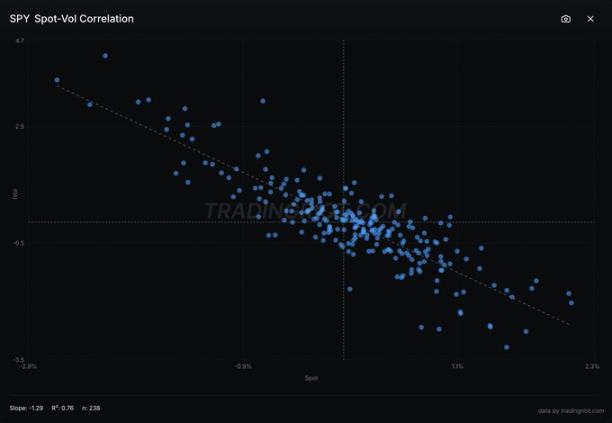
SPY spot-volatility correlation: when prices fall, implied volatility rises.
Due to the common "slow climb, fast drop" pattern—crashes are typically more violent than gradual rallies.
Momentum Premium: The One With Positive Skew
Most risk premiums are negatively skewed: small frequent gains, occasional large losses. Momentum is different.
Historically, assets that have been rising tend to keep rising; falling assets tend to keep falling.
This trend-following premium is documented across stocks, bonds, commodities, and currencies over long histories.
Explanations are largely behavioral:
Investors initially underreact to news, creating sustained trends; or herd effects attract more buyers, pushing prices further in the same direction.
What’s interesting about momentum is its return profile:
In choppy, trendless markets, you lose small amounts. Signals reverse, stop-losses trigger, transaction costs eat into gains.
But when big trends emerge, you make huge profits.
This is positive skew—the mirror image of short volatility strategies.
Thus, momentum strategies often perform well during crises. When markets crash, trend followers short and ride the decline. While volatility sellers get crushed, trend followers often survive unscathed.
The bad news: momentum has weakened over recent decades. More capital now chases these signals. When an edge becomes widely known, competition erodes returns.
The premium hasn’t vanished, but it’s smaller than historical backtests suggest.
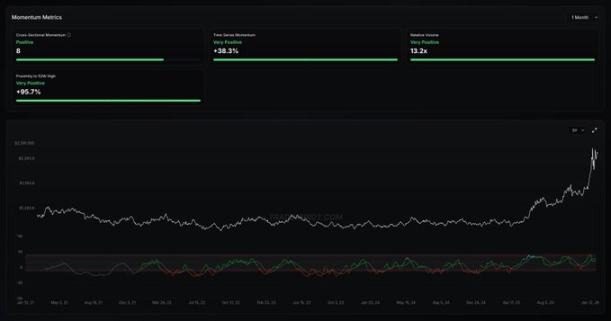
Recent commodity moves perfectly illustrate this strategy’s expected return: months or years of sideways action and small losses, finally compensated by one big move.
What About Mean Reversion?
Mean reversion tends to work when positioning becomes extremely one-sided. This applies in both crypto and traditional markets.
In crypto, you observe this via funding rates and open interest. When funding rates are deeply negative, futures trade far below spot, everyone is heavily short, and no one wants to buy—the situation looks terrible. And that’s exactly why everyone is positioned that way. Going against the crowd and buying here is often profitable on average.
Why is this risk premium, not just a chart pattern? Because you’re standing against crowded trades at times of maximum market uncertainty.
People are short for a reason: news is bad, buying now feels uncomfortable.
You’re doing something useful: providing liquidity when no one else will. Expected profit is your reward.
Same logic applies to forced liquidation cascades. When longs get liquidated, they sell not voluntarily, but compulsorily. This forced selling pushes prices below fair value. Vice versa on the other side.
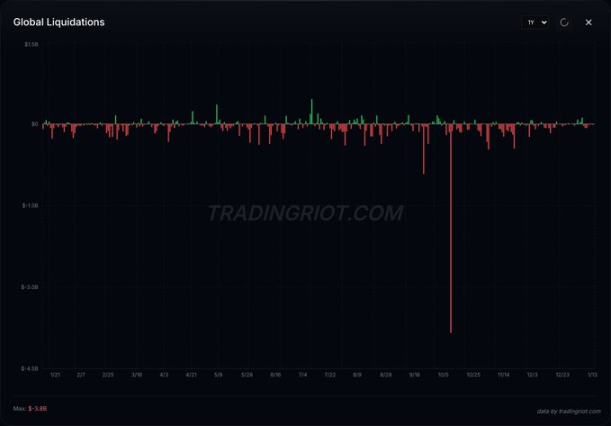
Stepping in during such chaos requires conviction and exposes you to real risk. The expected profit from mean reversion is payment for delivering that "service."
Traditional markets have similar dynamics.
Due to storage and financing costs, futures term structures are usually in contango.
But occasionally, during supply crunches or panic, they flip into steep backwardation. Backwardation tends to revert to contango over time, as the latter is the equilibrium state.
If you buy futures to bet against extreme backwardation, you’re wagering on normalization. History shows this often works.
But risk is real: the inversion may last longer than your solvency. If a real supply crisis hits, backwardation may deepen before reverting. You’re paid for taking that risk—but can still be crushed by the market.
Professional-Grade Risk Premiums
The above examples are, to some extent, accessible to retail.
But some risk premiums exist mainly in institutional markets—worth understanding even if not directly tradable.
Term premium in bonds: when you buy a 10-year Treasury instead of rolling 3-month bills for 10 years, you bear duration risk from interest rate changes. The term premium is your extra return. It varies widely—negative during QE (investors paid to hold long bonds), positive post-2022 as rate uncertainty rose. More background knowledge for retail, but relevant to bond allocation.
Credit risk premium: corporate bonds yield more than equivalent-duration Treasuries—the spread compensates for default risk. This premium spikes during crises (e.g., 2008), offering huge returns to buyers. But the risk: defaults occur during recessions, when stocks fall and you least want losses.
Liquidity premium: less liquid assets (private equity, real estate, small caps) often offer higher returns because you give up the convenience of instant exit. The challenge: liquidity dries up precisely when you need it most—during crises. The premium compensates for that risk.
Key Distinction: Risk Premium vs. Alpha
Every day on X, I see people sharing so-called "alpha," usually some technical indicator or lines drawn on charts. Clearly, this isn’t alpha at all.
- Alpha: excess returns from skill or information advantage. Once discovered, it gets copied and fades. Low capacity, temporary.
- Risk premium: compensation for bearing systematic risk. Persists even when widely known, because the underlying need for risk transfer doesn’t disappear. High capacity, persistent.
Practical test:
If your strategy works because you’re smarter than others—that’s alpha.
If your strategy works because you’re willing to do what others find uncomfortable—that’s risk premium.
Insurers earn risk premium. Everyone knows it—but they still profit, because someone must bear the risk.
Blackjack card counters earn alpha. Once casinos notice, they’re banned—the edge vanishes.
Most retail traders are better off understanding which risk premiums they’re exposed to, rather than chasing alpha. Premiums are more reliable, less likely to disappear. Chasing alpha is fiercely competitive and extremely hard.
Accepting that you may not be smart enough for that race is painful—but beneficial in the long run.
Why Most Premiums Are Negatively Skewed
This is easily overlooked: nearly every risk premium is negatively skewed.
Frequent small gains, occasional large losses.
Not a design flaw—this is precisely why the premium exists.
If harvesting premiums always felt good, everyone would do it—the premium would vanish.
Those rare large losses are the barrier keeping most people out—preserving profits for those willing to endure.
- Equity risk premium: steady gains most years, then lose 30–50% in a crash.
- Volatility risk premium: collect premiums month after month, then lose a year’s profit in a week.
- Carry premium: steadily earn spreads, then get wrecked during risk-off events.
- Credit risk premium: collect steady interest, then suffer defaults during recession.
Understanding this pattern is crucial for position sizing.
Expected value may be positive—but you must survive drawdowns to realize it. Over-leveraging destroys you before the long-term payoff arrives.
Diversifying across premiums with different skew profiles helps smooth returns. For example, combining short vol (negative skew) with momentum (positive skew) improves overall return profile.
Building a portfolio across multiple premiums—rather than concentrating on one—is usually wiser.
Correlation matters immensely: if you short VIX futures for roll yield while being long 10 different S&P 500 stocks, a 5% market drop tomorrow will hurt badly.
What This Means in Practice
Risk premium is getting paid for doing what others won’t: holding uncertainty.
- Stocks rise long-term because someone must bear their downside risk.
- Implied volatility exceeds realized because someone must sell insurance.
- Funding rates stay positive because someone must provide leveraged exposure.
- Markets trend because others are systematically buying when you try to short.
- Extreme positions eventually revert because someone must step in when liquidity dries up.
These returns persist even when widely known—making them more reliable than alpha, which decays once discovered.
The cost is return profile: you’re paid for enduring occasional severe pain.
Size positions prudently. Diversify across different risk premiums. And accept this truth: the premium exists precisely because it sometimes feels awful.
You don’t need to be the smartest person in the market.
Sometimes, just being the one willing to bear risks others find uncomfortable is enough.
Join TechFlow official community to stay tuned
Telegram:https://t.me/TechFlowDaily
X (Twitter):https://x.com/TechFlowPost
X (Twitter) EN:https://x.com/BlockFlow_News
 @abetrade