Cube Labs Strategy Implementation Guide: How to Achieve Web3 Growth?
TechFlow Selected TechFlow Selected
Cube Labs Strategy Implementation Guide: How to Achieve Web3 Growth?
Project teams need to continuously optimize content and event design, strengthen cross-platform integration, and leverage AI and on-chain data analysis to iterate strategies in real time.
 Navigating Web3 tides with focused insights
Author: Cube Labs
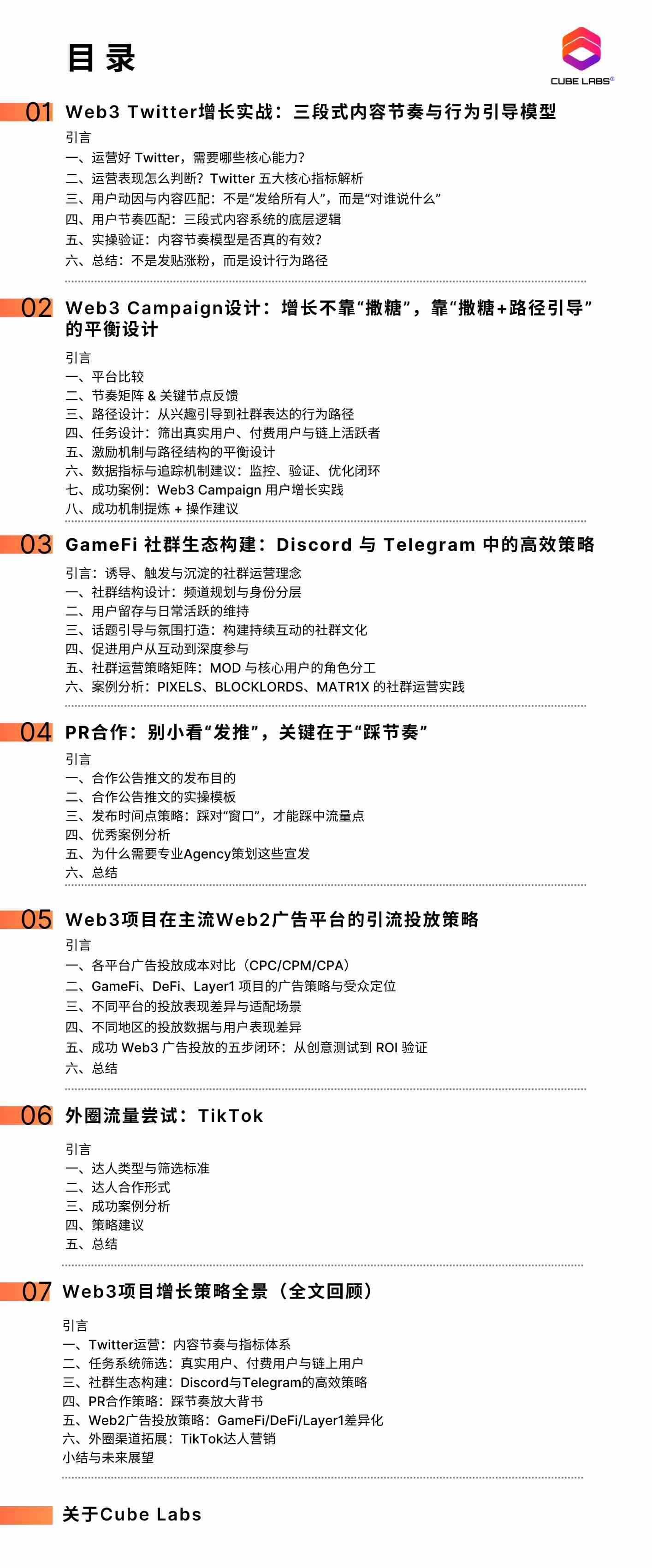
This article is divided into seven parts, systematically outlining core growth strategies for Web3 projects. Due to its length, we recommend saving it for reading. Below is the table of contents for quick navigation:
Chapter One | Web3 Twitter Growth in Practice: The Three-Stage Content Rhythm and Behavioral Guidance Model
Introduction
In the Web3 marketing ecosystem, Twitter has never been a channel where "posting frequently guarantees virality." It serves as the starting point of the entire user journey—crucial for shaping awareness, guiding actions, and cultivating lasting relationships.
For Web3 projects, Twitter fulfills three critical functions:
🔍 Awareness Building: Convince users why they should spend gas on you;
🎯 Action Guidance: Guide them from passive observation to on-chain interaction;
🤝 Motivation Activation: Inspire long-term contribution, not just one-time participation.
We believe every tweet should be more than content—it must act as a trigger for behavioral engagement. Each post must embody: ⏱️ Rhythm × 🧱 Layering × 🧭 Directionality
Based on our hands-on experience building Twitter systems for multiple Web3 projects, this article breaks down a comprehensive operational framework of "three-stage rhythm × layered content × action guidance," with the goal not being exposure, but attracting valuable users and establishing a sustainable growth loop.
1. What Core Competencies Are Required to Operate Twitter Effectively?
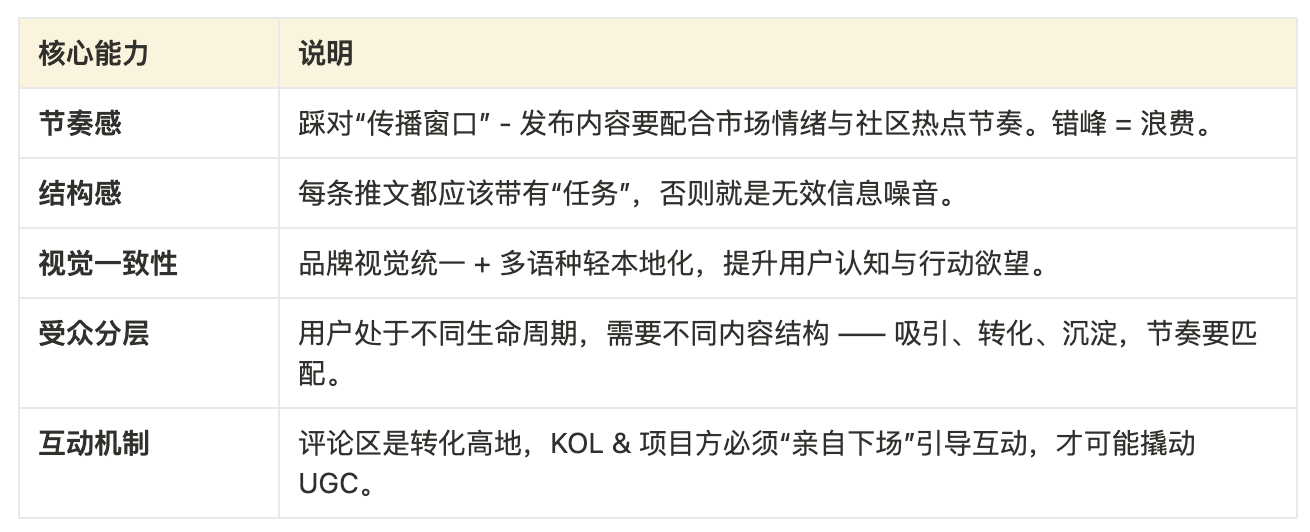
📌 Additional Notes:
"Task": Refers to prompting users to complete specific actions such as retweeting, taking screenshots, minting, or participating in tests;
"UGC": User-generated content such as shared images, feedback, comments, or derivative works—key indicators of community vitality.
In short: You're not merely publishing content—you're orchestrating repeated "user behavior design."
2. How to Evaluate Performance? Analysis of Twitter's Five Core Metrics
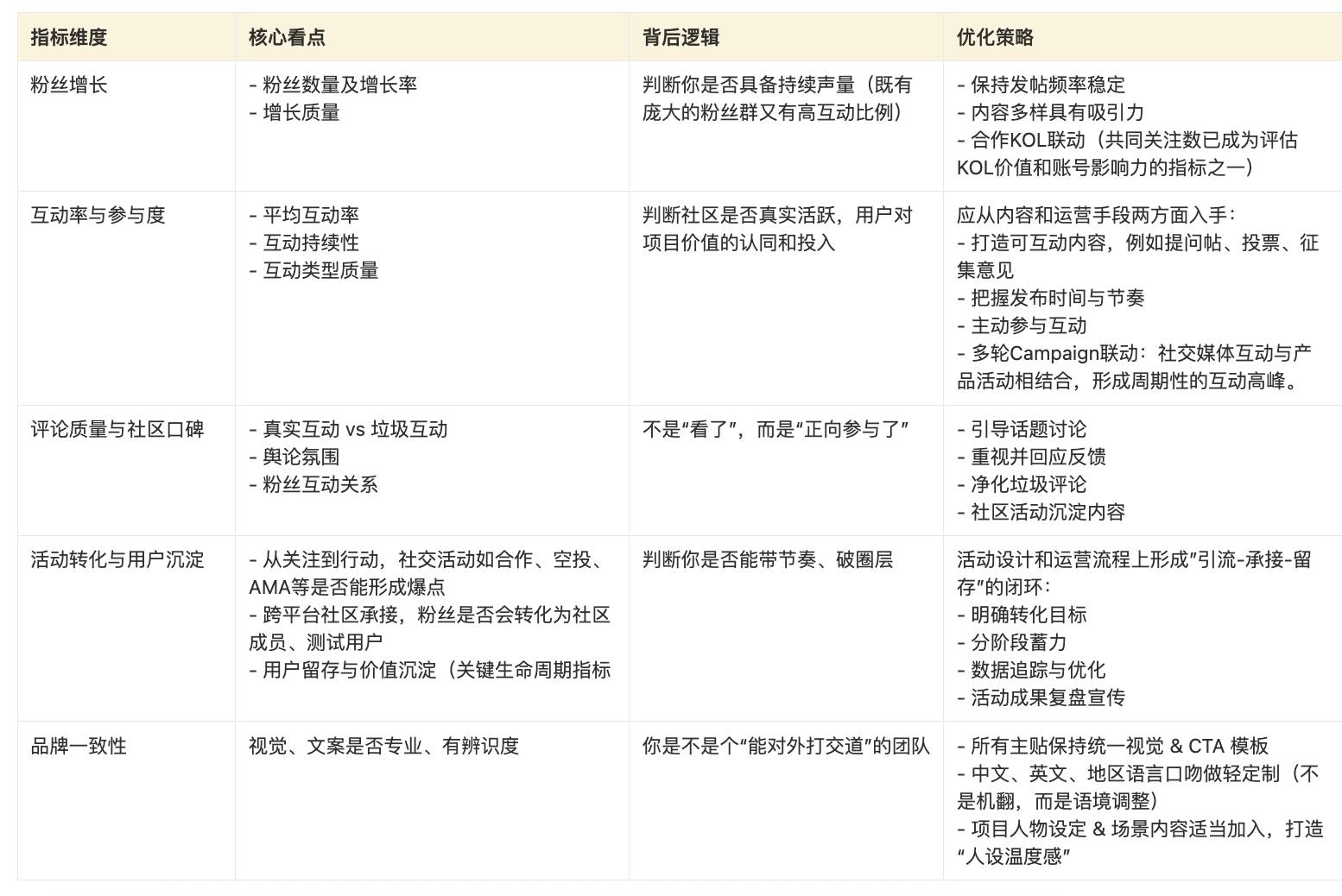 These dimensions don't just reflect Twitter performance—they serve as foundational indicators determining whether your project possesses *“coordinated listing capability.”* Project teams should establish a social metrics monitoring dashboard during strategy planning, setting alert thresholds to adjust content strategies promptly. How can these key metrics be tracked? We rely on external tools to observe real data and trends. This article will not delve into tool-specific operations, with Twitterscore serving as a primary focus tool to be detailed separately in another piece covering its principles and usage.
3. Matching User Motivations with Content: Not “Broadcasting to Everyone,” But “Saying the Right Thing to the Right Person”
To turn Twitter into a growth engine, you must first understand why users come and what stage they’re at. Web3 users aren’t just here for entertainment—their behaviors stem from motivations, barriers, and thresholds. You need targeted solutions.
Four Key User Motivations & Corresponding Content Strategies
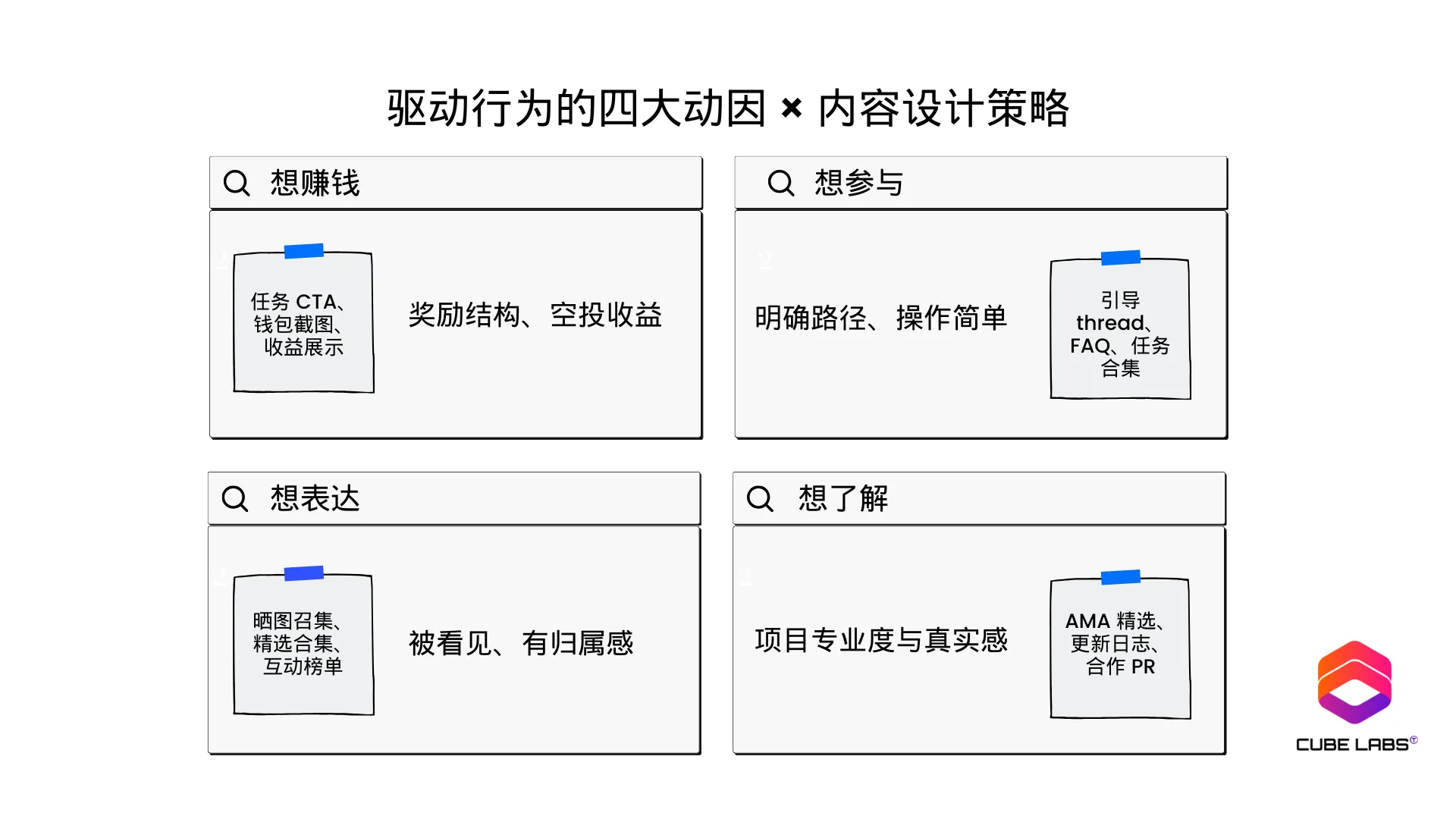
Each tweet should address at least one core motivation: “Can I earn?” “How do I participate?” “Are you trustworthy?” Answering these clearly activates user action.
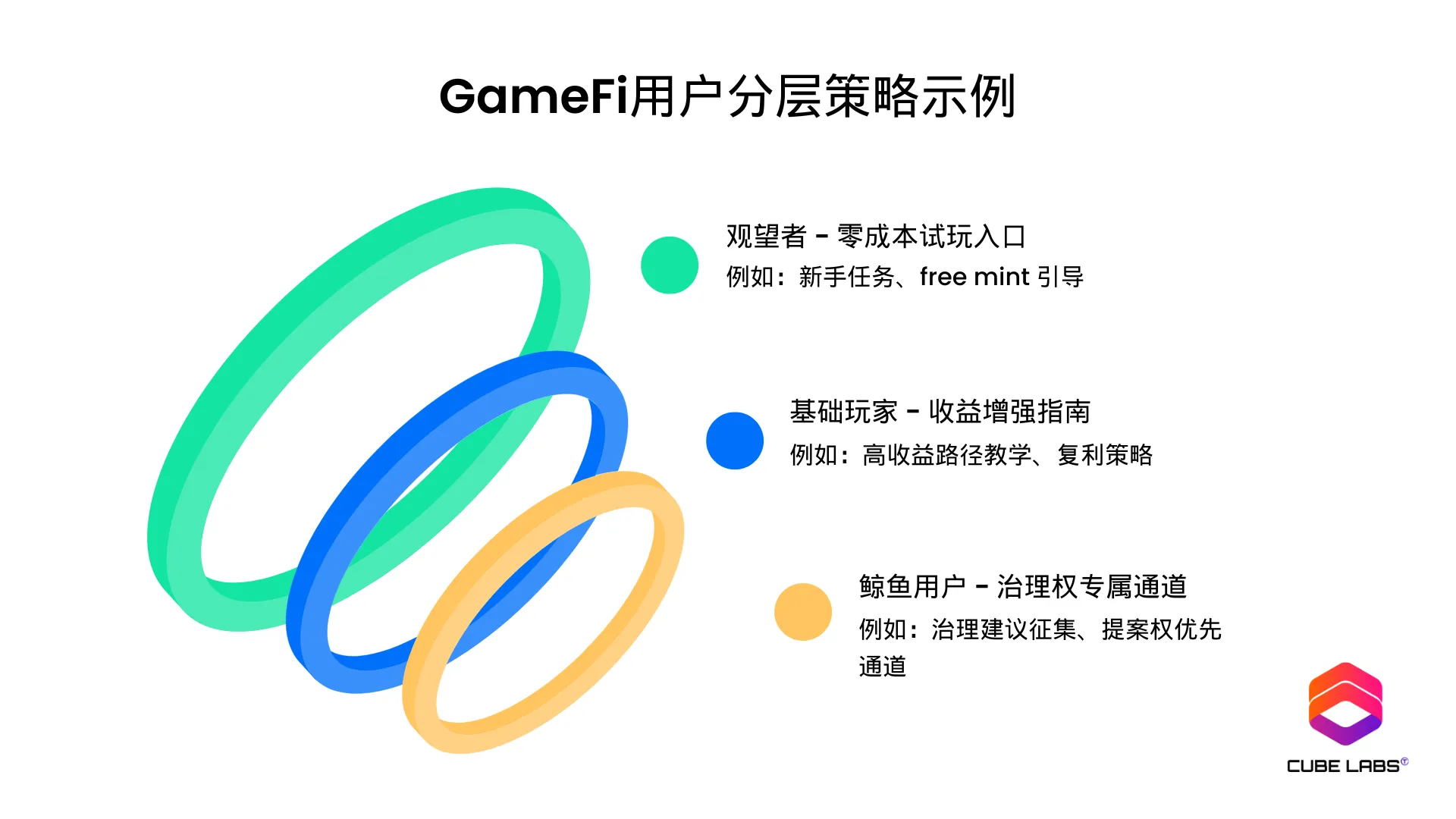
Precision Matching: Different User Asset Levels × Different Guidance Paths
Web3 user activity varies widely—not everyone wants to “stay connected,” nor does anyone casually “jump in.” If your content doesn’t align precisely with their psychological stage, it’s unlikely to truly resonate or drive action.
Below is a user segmentation template based on GameFi scenarios:
4. Aligning with User Rhythms: The Underlying Logic of the Three-Stage Content System
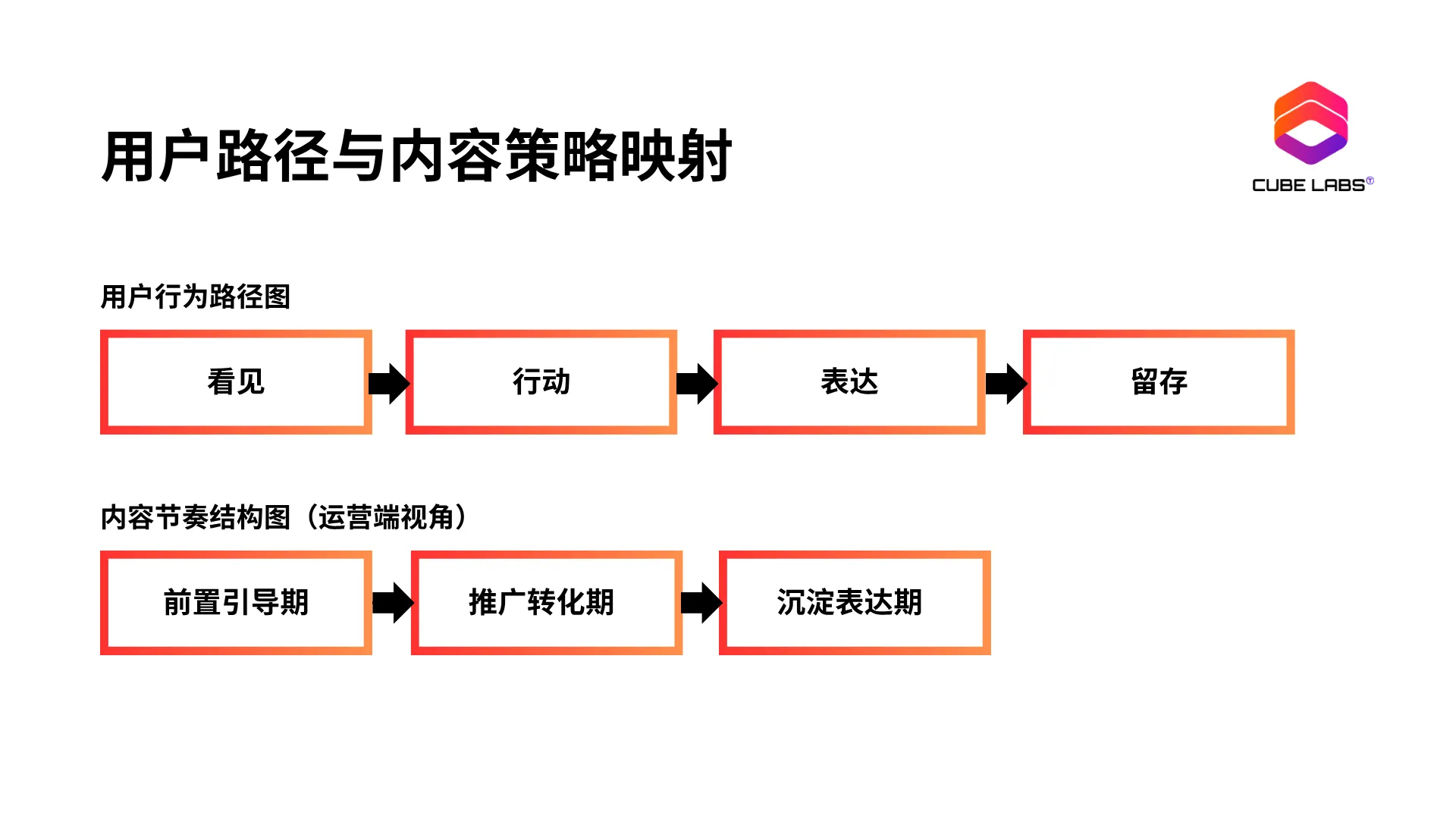
Web3 users have limited attention spans, complex motivations, and fragmented paths. Twitter isn’t just a content showcase—it’s a structured theater designed to guide user behavior. Truly effective operation aims not for “maximum visibility,” but ensuring the right people perform the right actions at the right time. From extensive campaign management, we’ve distilled a three-stage content strategy model: Rhythm × Content × Action, covering the full path from cold start to retention.
Breakdown of Content Strategy Elements
Pre-engagement Phase – Awareness (Awareness)
Focused on increasing project visibility among broad audiences, aiming for maximum reach and initial interest. Content emphasizes eye-catching elements and trending topics, with traffic acquisition as the primary goal.
Key Tactics:
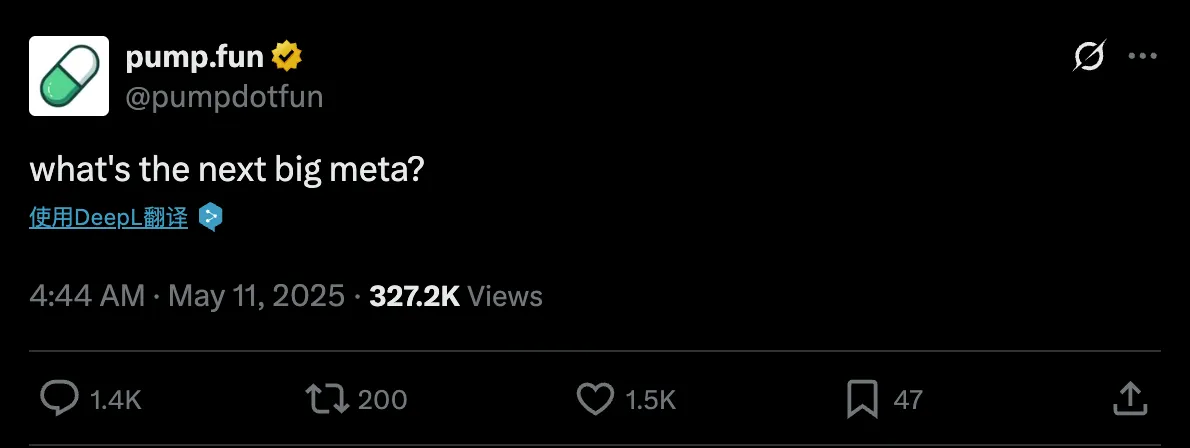
Riding Trends: Stay close to industry hotspots and memes by posting timely commentary or topic threads tied to your project, using popular hashtags. Leverage community slang and viral events to boost views. For example, Pump.fun (a Solana-based meme coin creation platform) leveraged the phrase “the next big meta” to spark discussions. The tweet quickly went viral, achieving approximately 327K views, over 1K likes, and 1K+ retweets (internal stats, official platform social media). By capturing a trending phrase and posing a simple question, the project created suspense that encouraged interactions. Combined with background facts—over 11 million tokens issued and a total fund pool market cap exceeding $4.5 billion—the post rapidly spread across crypto discussion forums, boosting brand awareness and platform engagement.
Broad Engagement: With few followers initially, actively join discussions led by influencers to capture traffic. Simultaneously, interact with potential users daily—liking relevant posts, sharing quality content, and replying to all received comments—to increase visibility within broader circles. This phase prioritizes getting seen by as many people as possible, so expanding content reach is essential.
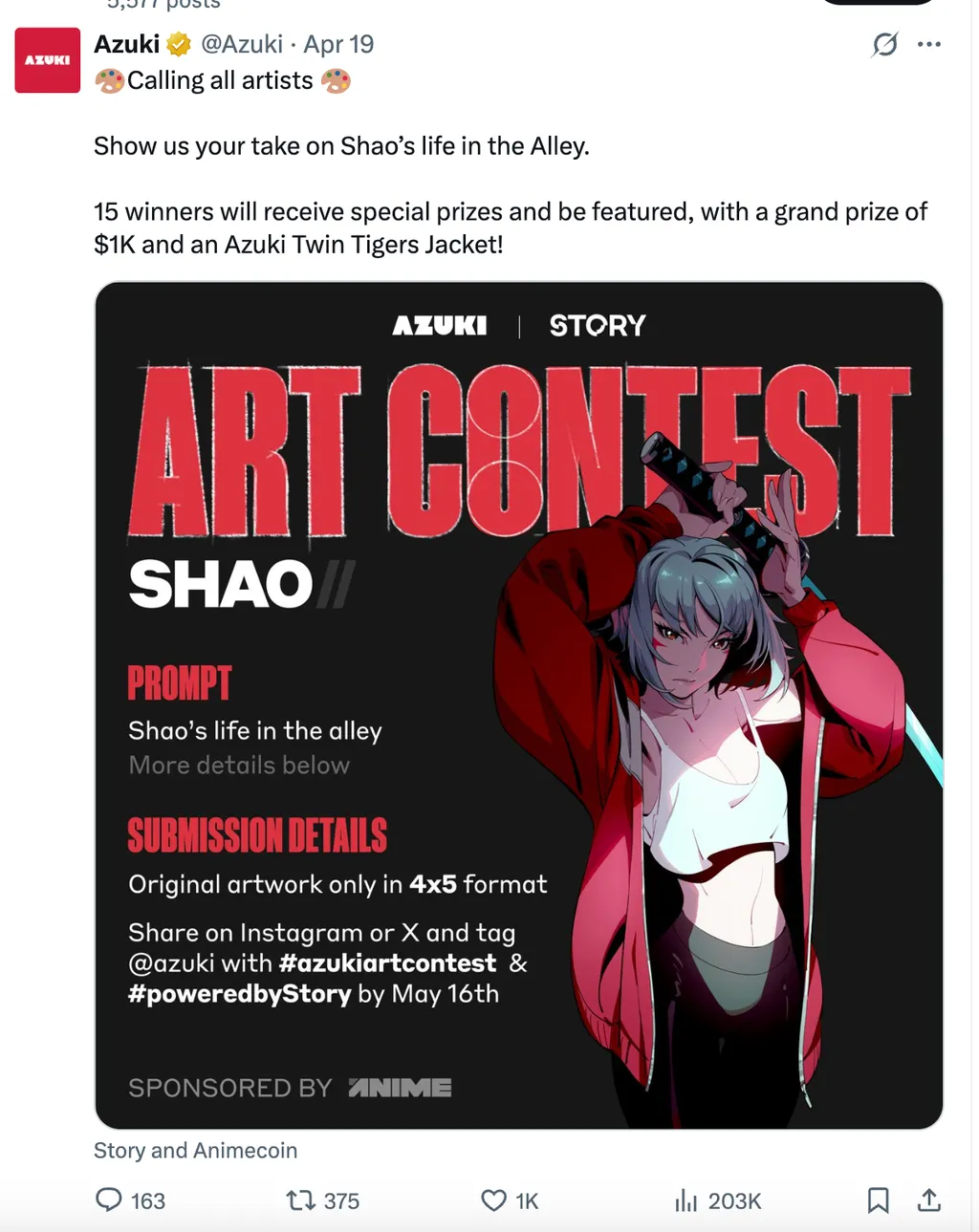
Engaging Visuals: Use images, videos, and other rich media to increase dwell time. Web3 projects can enhance appeal by sharing product screenshots, data charts, or fun memes. For instance, Azuki (a well-known NFT project) excels at attaching high-quality anime illustrations or short animations, helping their tweets stand out in crowded feeds and driving significant shares and discussions.
High-Frequency Output: Maintain a consistent and relatively high posting frequency to combat algorithmic forgetfulness. A new account posting once per week struggles to gain momentum; conversely, frequent activity increases chances of algorithmic recommendations. In practice, aim for at least 1–2 original tweets daily plus several interactive retweets. Early on, use volume to build quality, and schedule posts according to target user activity times—for example, UTC afternoon peaks for Western markets.
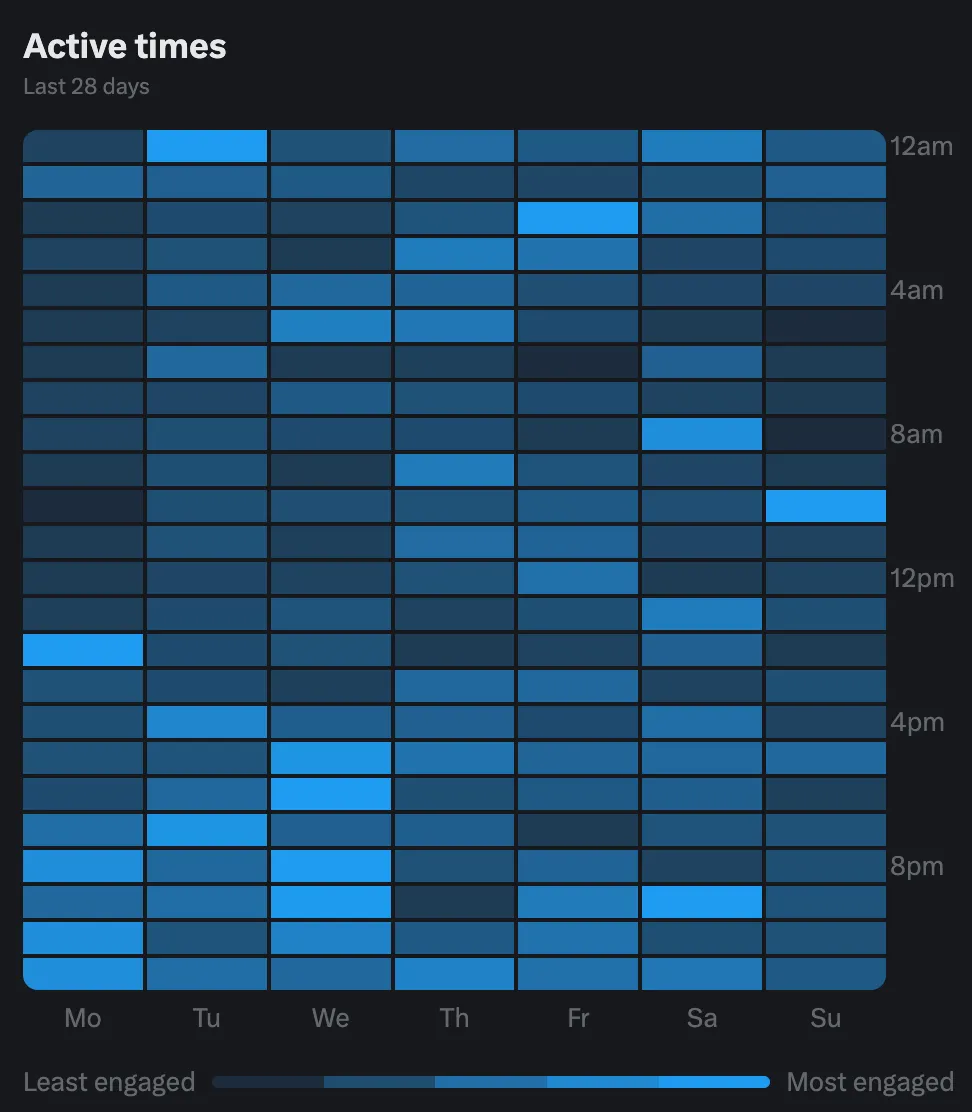
Illustration: Active hours of Twitter users for a strategy-focused GameFi project
Promotion & Conversion Phase – Engagement (Engagement/Activation)
After gaining basic exposure, shift to conversion guidance and engagement cultivation. The goal is converting casual observers into active followers while gradually building trust and stickiness. Content strategies emphasize value delivery and two-way communication, focusing on increasing participation and driving actions.
Key Tactics:
Deep Value Content: Produce highly valuable content for target users to strengthen follow-through. Examples include tutorials and detailed thread explanations addressing user curiosity. Curious Addys (an NFT project) published a thread explaining smart contract refund mechanisms, earning over 1,000 likes—far surpassing typical single-tweet engagement. Algorithms likely favor such content due to longer dwell times, improving recommendation chances. To present effectively, lead with a compelling hook to grab attention, ensure clear structure in the body, and avoid overly obscure terminology to lower reading barriers. Consistently delivering substantive content helps turn bystanders into fans.
Interactive Activities: Design content that encourages fan participation—such as chain reactions, AMAs (Ask Me Anything), polls, and guessing games—to cultivate habits of community interaction. Twitter Spaces is an excellent tool—host regular AMAs allowing team members to engage directly with users in real time. For example, hold biweekly project update sessions where attendees can speak live; or run polls to gather community input on product features. These interactions not only improve user retention but also make participants feel valued, increasing long-term interest in the project.
Action Emphasis: Clearly call to action (CTA) in tweets to convert exposure into tangible outcomes. Depending on project type, CTAs may invite users to visit websites, subscribe to newsletters, join Discord/Telegram groups, or try testnets. Keep messaging concise and impactful, highlighting benefits. For example, Layer2 project Base consistently guides users to “experience various dApps on Base.” Statistics show most of its tweets directly tell users what they can do on the Base chain—like minting NFTs or playing mini-games. This continuous behavioral guidance helped Base grow daily active users from 325K to 1.2M in three months, with most users remaining after the campaign ended. Similarly, other projects can guide audiences through targeted actions (e.g., registration, minting) by including tutorial links or step-by-step instructions in promotional posts, transforming attention into genuine user growth.
Building Brand Trust: Share team stories and milestones appropriately to enhance credibility. While maintaining core content value, sprinkle in behind-the-scenes moments to humanize the project. For example, celebrate 100 days since testnet launch or share founder insights from late-night contract debugging. Such personal details help build emotional connections, making fans more confident in the project’s long-term vision. Especially in Web3, anonymous teams often leave users feeling insecure—showing authenticity and transparency can foster trust. As seasoned practitioners note, post-bear-market users crave trust more than ever, and a “genuine, approachable persona” earns greater recognition. Therefore, beyond professional content, this phase should also shape a reliable brand identity.
Suggested content formula for engagement phase: 40% value content + 30% project updates + 20% interactive topics + 10% light/fun content
Retention & Expression Phase – Loyalty (Retention/Loyalty)
The ultimate goal is turning existing fans and users into loyal advocates who become long-term brand ambassadors and ecological pillars. This phase focuses on enhancing user loyalty and sense of belonging, preventing churn and forming a sustainable private traffic pool. Content strategies prioritize meticulous operations and relationship management, centering on community cohesion.
Key Tactics:
Strengthen community belonging: Guide users from Twitter to deeper community hubs (e.g., Discord, Telegram) and continuously deliver exclusive value. For example, regularly share community highlights or insightful discussions and invite fan participation. Privately message active fans with community invites or badge NFTs to boost honor. Also, showcase fan creations (e.g., artwork, suggestions) on Twitter, publicly recognizing core contributors’ efforts to motivate others to engage and move closer to the core.
Ongoing High-Quality Interaction: Even in the retention phase, maintain rhythmic content output—though frequency may slightly decrease, quality must rise.Refine content to reward long-term support from veteran fans, offering high-value materials like deep research reports, roadmap breakdowns, or detailed livestreams on major features. Meanwhile, closely monitor fan feedback: reply to all comments when possible, respond promptly to DM inquiries, and publicly acknowledge important inputs. This sustained, heartfelt operation makes users perceive the project’s sincerity. “Users aren’t foolish—they instantly recognize genuine effort”—when fans truly feel valued, their likelihood of staying increases dramatically, and they are far more likely to spontaneously share and promote the project. Maintain continuity to avoid losing users after a burst of activity followed by content gaps.
Data-Driven Optimization: The retention phase demands even stronger reliance on data for optimization. Focus on: ① Retention rate (watch for sudden follower drops); ② Interaction quality (proportion of high-quality interactions like retweets and long comments); ③ Conversion effectiveness (actual conversions from Twitter to registration/community entry); ④ Sentiment trends (whether brand mentions are positive). Set KPIs such as “gain X high-quality followers monthly and convert Y into the community,” conduct regular reviews, and continually refine strategies.
Incentivizing Brand Advocacy: Transform core fans into brand advocates. Launch hashtag challenges encouraging loyal users to share experiences or achievement screenshots, rewarding them with official retweets and prizes. Recognize “Community Stars” publicly to inspire broader participation. Encourage these power users to join DAOs or contributor programs to co-build the project. When users transition from observers to builders, true retention and transformation are achieved.
Additional Tips: Three Essential Elements of Tweet Content
User Positioning Clarity
Every tweet should be strategically tailored to the behavioral patterns and content preferences of the target audience, avoiding generic cross-posting.
For example, in strategy-oriented GameFi projects: Vietnamese users prefer “leaderboard-style” visuals and ranking incentives, enjoying screenshot sharing and achievements; Japanese and Korean users favor visually striking, artistically designed content; English-speaking users typically care about practical benefits, with conversion intent focused on staking, NFT rewards, etc.
Such positioning allows for more targeted content deployment.
Systematic Topic Structure
We don’t simply stack popular hashtags—we use combinations of “#ecosystem tag + #project keyword + optional task platform” to improve content discoverability and contextual coherence.
Examples:
For tasks on Base, prioritize #Base to reinforce ecosystem affiliation;
If the task platform itself has brand influence (e.g., QuestN), consider adding #QuestN to boost platform visibility;
However, for certain platforms or phases, we consciously omit platform tags to prevent user diversion to competing projects.
The essence of topic structuring lies not in “comprehensive coverage,” but in controlling user attention focus and maintaining semantic consistency and clarity.
Standardized Image-Text Format (Recommended)
Consistent visual branding (strong brand identity)
Copy structure = Question → Marketing setup → Action guidance
Include CTA link with clear description (reward amount and deadline must be unambiguous)
Extension: How to Create Viral Tweets?
Generally speaking, a viral tweet (content with explosive reach) often includes these elements:
Hits a trend or pain point: Either comment insightfully on current hot events or provide solutions to real user problems.
Eye-Catching Opening: The first few characters determine whether users expand the full text. Viral tweets often begin with suspense, shock, or questions to spark curiosity—or immediately state conclusions/benefits to attract attention.
Offers practical or emotional value: Either provides useful knowledge/rewards or evokes emotion (humor counts as emotional resonance). Pure ads rarely go viral—users prefer to share content that’s useful or entertaining to others. So always ask yourself: “What motivates a stranger to retweet this?” If the answer isn’t clear, refine the content. For example, an exchange’s security scam prevention guide gained massive shares and saves due to universal relevance; another project used humorous comics to depict industry chaos, sparking laughter while conveying brand stance—both achieving viral success.
Leverage Algorithm Preferences: Use known platform recommendation mechanisms to amplify reach. As mentioned earlier, long threads increase dwell time, potentially triggering secondary algorithmic recommendations; similarly, using 1–2 trending hashtags helps expose content to related-topic audiences. You can also encourage interactions to gain more visibility—algorithms favor “high-value interactions” like shares and comments. These tactics can indeed boost tweet weight. However, avoid excessive manipulation (e.g., constant giveaway schemes) to prevent backlash or algorithmic demotion as low-quality.
Timing and Frequency: Virality also depends on posting time and long-term account tone. Posting during peak audience activity periods doubles impact. Additionally, maintaining consistently high-quality, niche-aligned content builds platform trust.
In short, virality = the right content + the right timing + solid account foundation—all working together. No single stage relies on one tweet alone, but on a closed loop of “content → interaction → feedback.” Consider these three stages as a continuous journey:
Pre-engagement = Open the door → Conversion = Sit down and talk → Retention = Stay for dinner
If you’re planning content promotion for your Web3 project, apply this model to assess your content rhythm. By understanding the alignment between user states, content preferences, and desired behaviors, ROI can evolve from “noise” to “growth.”
5. Practical Validation: Is the Content Rhythm Model Actually Effective?
Earlier, we unpacked the complete three-stage content structure model (pre-engagement → promotion/conversion → expression/retention). So:
Does it work in real-world projects? Does it offer cross-industry applicability? The answer is yes.
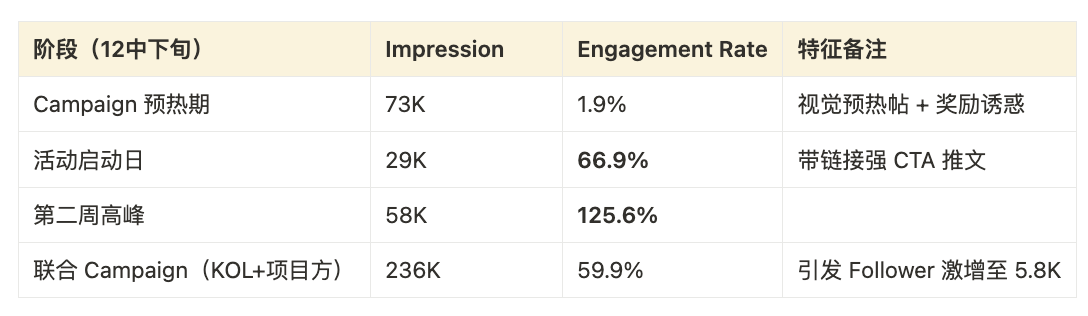
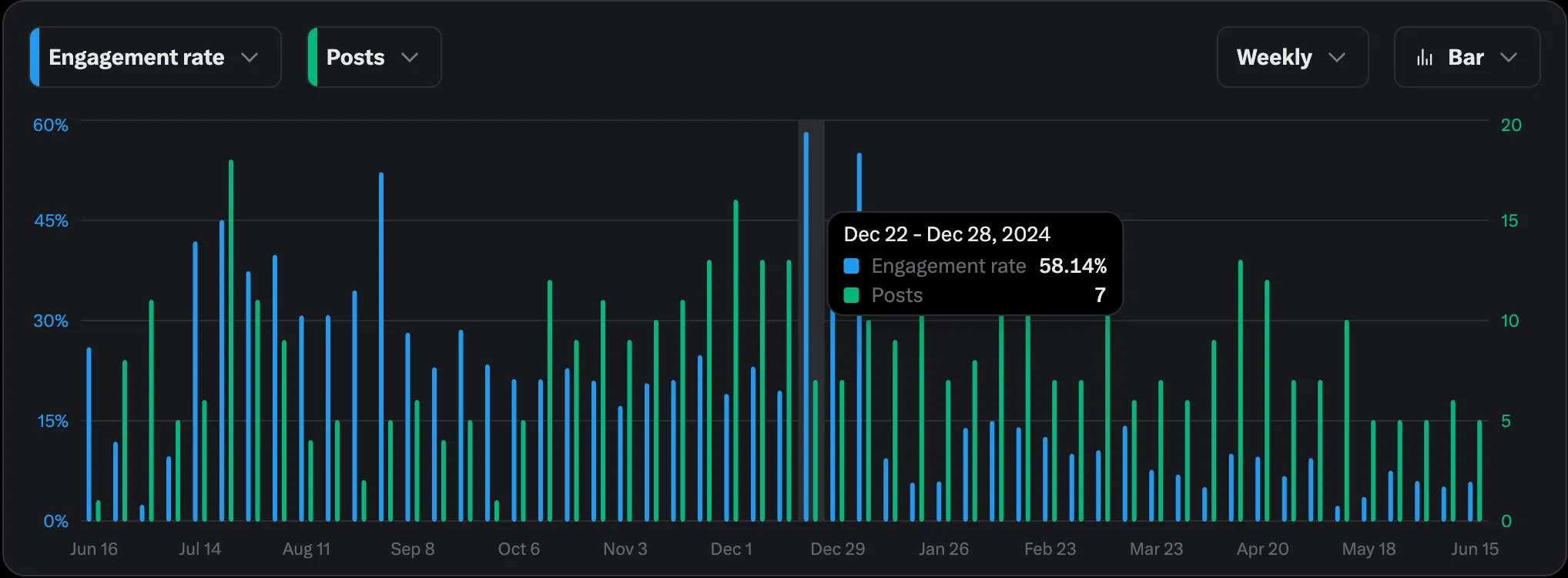
Below are results from our practical application in a GameFi project:
Structured Content + User Behavior Guidance → High-Converting Surge
We deployed a full Twitter content rhythm for this project, including:
Visually unified main task posts + teaser posts
KOL ignition + multilingual rollout
Clear-path CTA content
Community expression and interaction
Results:
🧪 Is It Universally Applicable? Cross-Industry Comparison Table for Web3 Project Twitter Operations
We further selected currently active Web3 projects for horizontal analysis of their Twitter content operations:
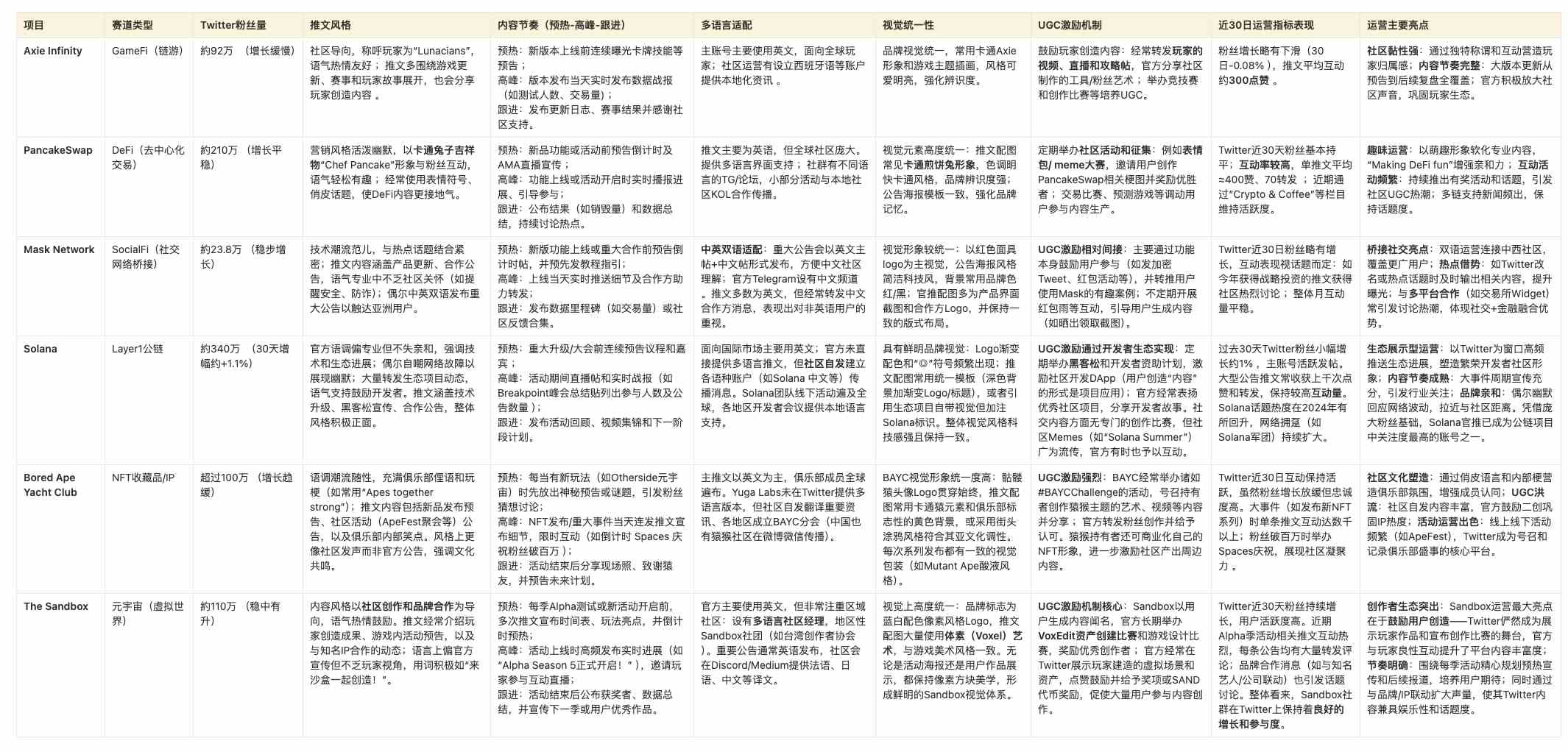
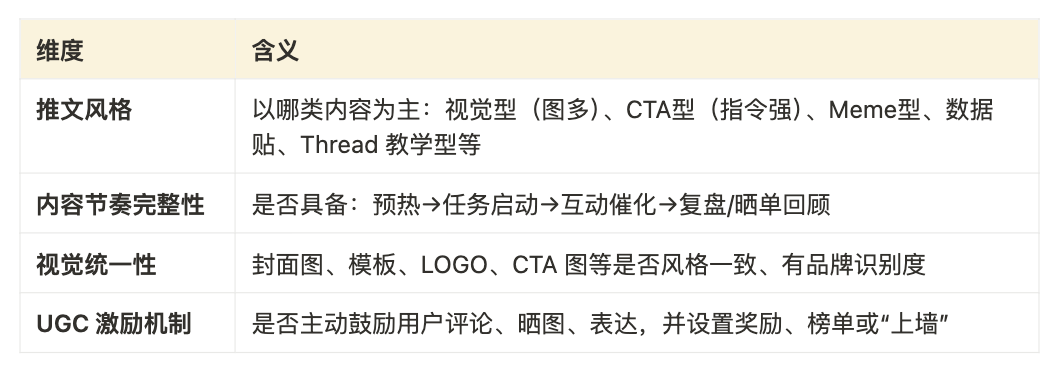
Table Notes:
6. Summary: It’s Not About Gaining Followers Through Posts—It’s About Designing Behavioral Pathways
We don’t believe “posting equals mission accomplished.” In the Web3 world, Twitter is the starting point of the user journey and a crucial battleground for raising awareness, guiding actions, and fostering loyalty.
A truly effective Twitter growth system is a holistic strategic engineering effort:
Core Principles Recap (Methodology Loop)
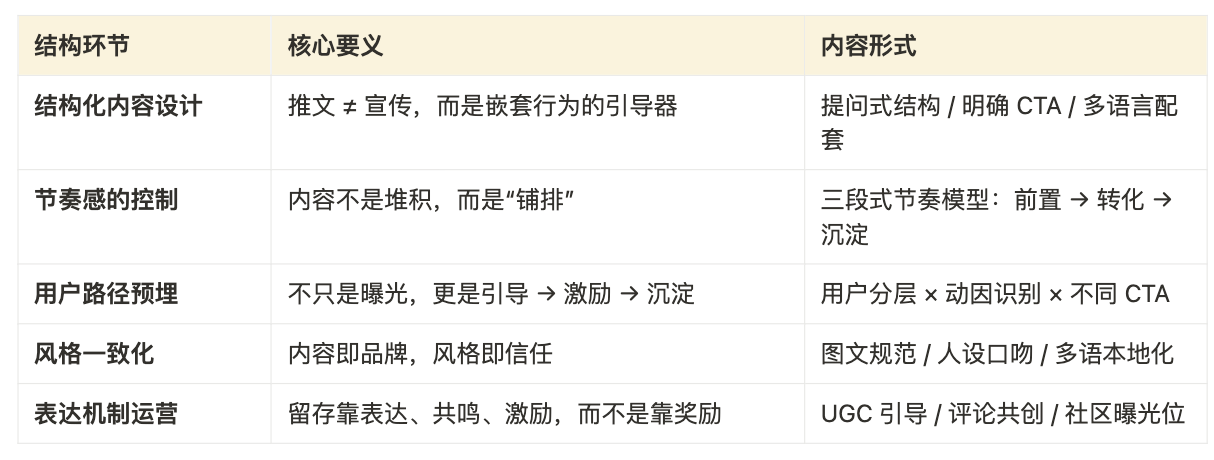
🧠 One-Sentence Summary of This Methodology:
Successful projects achieve the leap from attention to trust, and from clicks to retention, by constructing content tactics through “rhythm + structure + guidance.”
Chapter Two | Web3 Campaign Design: Growth Isn’t Driven by “Dropping Candy,” But by Balancing “Candy + Pathway Guidance”
Introduction
In designing growth for our marketing cases, we typically run multi-round campaigns via task platforms (including Galxe / QuestN / TaskOn). Past experience shows that truly effective campaigns aren’t just about “distributing rewards,” but about designing a clear “behavioral pathway”: from curiosity → to trial → to becoming a community voice. Thus, we break down and integrate aspects such as platform comparison, task structure, incentive strategy, and data monitoring:
1. Platform Comparison
Web3 task platforms serve as user growth tools, generally allowing project teams to issue tasks which users complete—social follows, on-chain actions, etc.—to earn rewards. Despite similar positioning, different platforms vary in user base, task mechanics, and growth outreach models. For easy comparison, here’s a summary table:
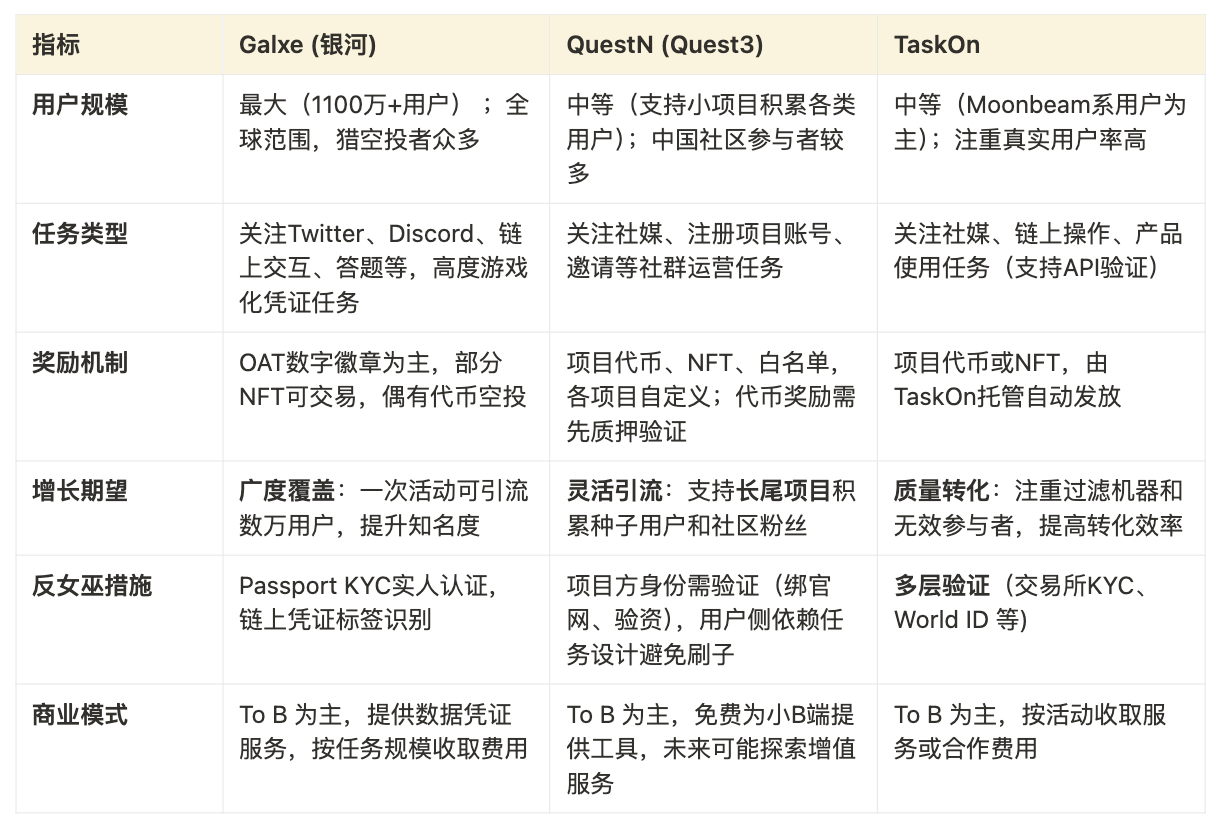
While platform types differ, the key isn’t the platform itself—but how you design the task structure. Choosing a platform is just selecting a “container”; structural design is the real engine of a campaign.
2. Rhythm Matrix & Critical Node Feedback
In a campaign combining QuestN + Galxe + TaskOn, taking a strategy-focused GameFi project as an example, we established a clear content rhythm and key action nodes—from planting seeds of interest in the game world, to driving on-chain behavior, and finally enabling community expression and retention—forming a complete user journey loop.
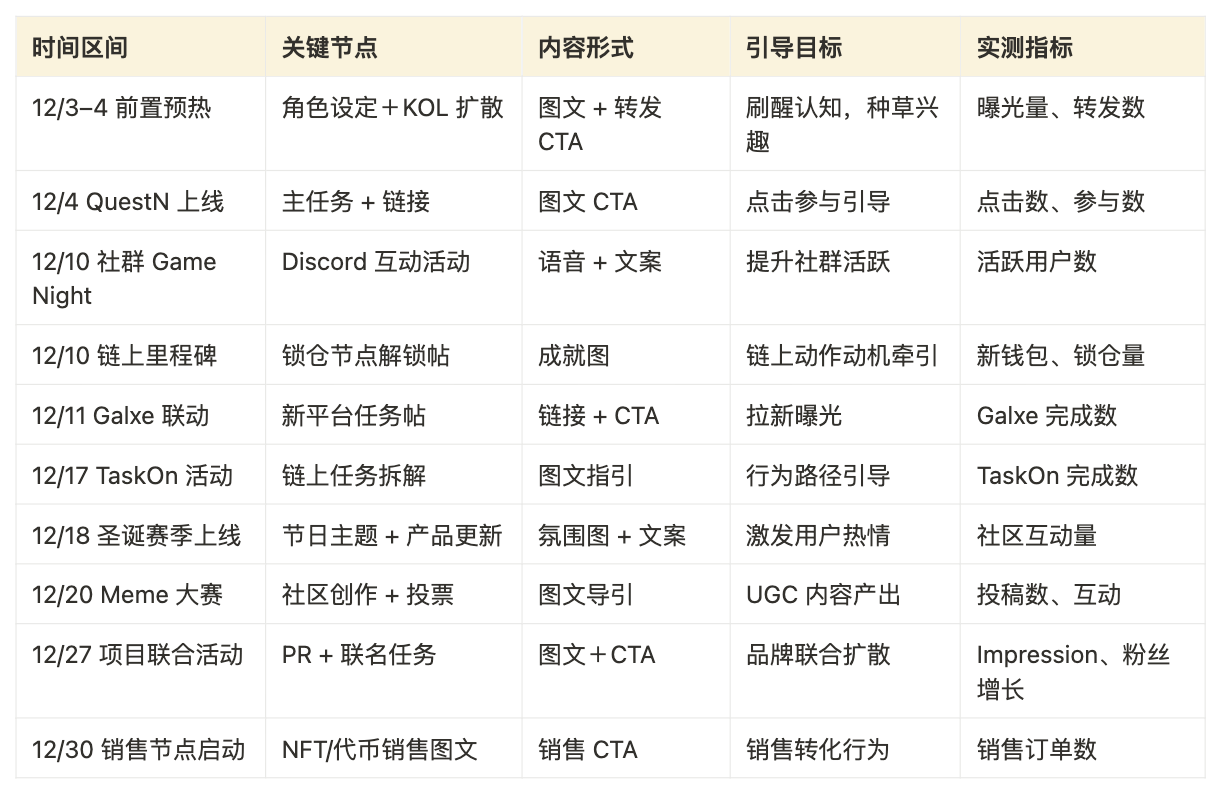
Phase Feedback Summary
Early Stage: Teasers + world-building create “visibility”
Middle Stage: Task rhythm + on-chain milestones prompt users to “try”
Late Stage: UGC and expression-driven mechanisms activate user “retention”
3. Pathway Design: From Interest to Community Expression
A well-designed campaign often achieves exponential user growth in a short time, bringing real on-chain interactions (e.g., increased trading volume, TVL). The key lies in leveraging platform tools to build a behavioral path from interest to expression.
This path consists of five stages:
1. Visual Hook: Sparking Interest
Create a strong first impression through character concept art, emotive copywriting, and visual hooks to spark curiosity.
2. Tiered Task Design: Gradual Difficulty
Light Tasks: Follow, retweet, comment → attract broad user base
Moderate Participation: Platform check-ins, minting, screenshot uploads → filter out low-quality users
Heavy Tasks: On-chain lockups, staking, UGC creation → retain core users
3. On-Chain ↔ Community Integration: Strengthening Belonging
Upon completing on-chain actions, users instantly receive Discord role tags and automatic access to dedicated task groups, reinforcing community belonging.
4. Reward Rhythm Design: Driving Progression and Exploration
Early Stage: Low-barrier rewards incentivize quick participation
Middle Stage: Conditional unlocks → further challenge mechanisms
Late Stage: Extra rewards and honors for expressive actions (e.g., sharing screenshots, posting tweets, leaderboard entries)
Introduce hidden tasks and easter eggs to stimulate exploration.
5. UGC-Driven + Leaderboard Incentives: Cultivating Ecosystem
Encourage users to express themselves through photo-sharing and leaderboards, creating a positive feedback mechanism of “you could be on the list too,” eventually embedding this into community culture.
4. Task Design: Filtering Real Users, Paying Users, and On-Chain Active Participants
Campaigns inevitably attract invalid users (e.g., script bots, sybil accounts). Therefore, task design must strategically filter for authentic, valuable users, especially focusing on three user groups: real users (no bots/sybil farmers), potential paying users (those with purchasing power willing to genuinely use products), and on-chain active users (those actually using the project’s on-chain features). Approaches include guidance flow, verification methods, and filtering logic:
1. Guidance Structure: Implement a Deepening Task Pathway
Adopt a progressive difficulty and filtering task structure to ensure later tasks better distinguish user quality. The overall task path should resemble a funnel: large inflow at the start, gradually filtering toward core target users.
First Layer: Low-barrier social media follows/retweets to reach broad audiences.
Second Layer: Form submissions, screenshot uploads—raising participation bar and cleaning up user quality
Third Layer: On-chain interactions (minting, locking, staking, etc.)—ensuring users actually use the product
As task complexity increases, only genuinely interested users continue.
2. Anti-Bot Mechanisms: Dual Verification via Identity + Behavior
Social Media Verification: Bind Twitter/X, track follow/retweet actions, T
On-Chain Verification: Filter real users via wallet interaction frequency and asset holdings
KYC & OAuth: Use Galxe Passport, World ID, TaskOn OAuth for identity verification, suitable for high-value reward stages
Behavior Pattern Recognition: Combine on-chain address usage patterns to identify bulk addresses
3. Tiered Screening: Assessing User Value
Not all participants completing basic tasks hold equal value—further tiered screening is needed to identify potential paying and high-value users:
Active Contributors vs. Speculative Arbitrageurs: Analyze user behavior patterns during the campaign. Real users often actively engage in Discord, participate in AMAs, etc., while pure reward farmers perform only minimal required actions. Project teams can use the data dashboard on task platforms to review each user’s completion status and filter out those attempting to claim rewards after doing minimal tasks.
Purchasing Power Assessment: Potential paying users usually possess assets or willingness to pay. Combine on-chain data for evaluation: tally mainstream token balances in user wallets, check ownership of high-value NFTs, etc., as purchasing power indicators.
Influence and Viral Value: For community products, screen users' social influence. Observe whether users generate secondary distribution after completing tasks (e.g., retweets generating additional clicks), and whether they actively speak in communities. Some platforms offer referral rewards or leaderboards; tracking referral numbers or tweet engagement can measure viral impact, identifying high-influence users for priority retention.
In summary, campaign design should leverage multiple task checkpoints and verification layers to filter users and combine data analytics for tiered classification.
5. Balanced Design: Incentive Mechanism vs. Pathway Guidance
In task marketing, incentive mechanisms (Reward) attract users, while pathway guidance (Guidance) educates them about the product and enables retention. Imbalance causes issues: excessive rewards attract profit-seekers unwilling to stay, while insufficient ones fail to draw users; inadequate guidance means users won’t grasp product value, while over-guidance may overwhelm and lose users. Best practice is achieving balance between incentives and guidance:
Set appropriate reward levels and distributions: Adjust reward types and amounts based on campaign target audience.
Acquisition Phase: Low-barrier rewards + sense of participation
Action Phase: High-value rewards upon overcoming threshold conditions
Expression Phase: Guide users to share screenshots, join discussions, and enter leaderboards
Diversify reward formats, emphasizing honor-based incentives
Leaderboards, OG roles, badge identities, Discord privileges—establish belonging and identity
User-friendly and educational process: Ensure task design is newcomer-friendly while conveying product value. Avoid overly complicated steps—clear, straightforward onboarding is crucial.
Data-Driven Real-Time Adjustment
Monitor drop-off rates and completion rates, dynamically optimizing reward or guidance design
Introduce variable reward mechanisms that automatically adjust reward structures as participant numbers increase
Overall, successful campaign design ensures users gain both rewards and knowledge/experience during participation. Incentives are a double-edged sword—excessive use distorts user motivation, and balancing it with guidance enables healthy growth. As advocated by platforms like RabbitHole, users should be guided to focus on contribution and value rather than pure profit-seeking. Only when users stay because they believe in the project’s value do incentive investments transform into real community assets.
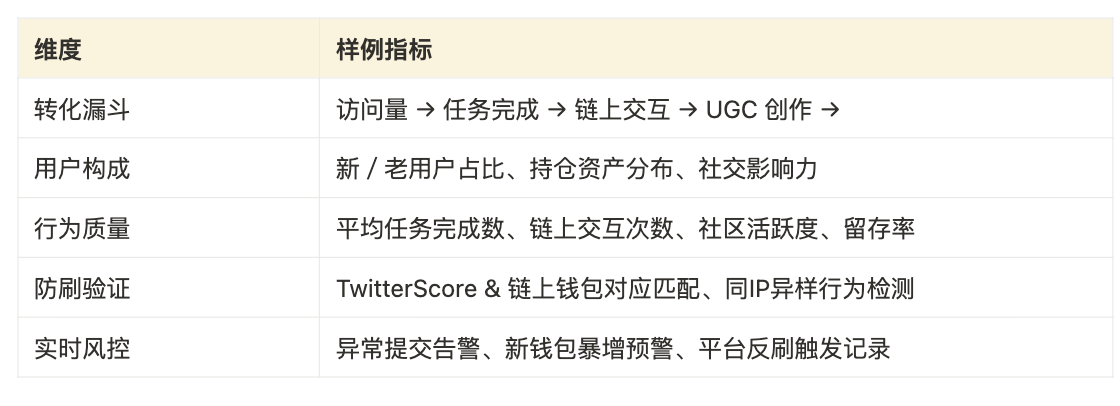
6. Recommended Data Metrics and Tracking Mechanisms: Monitoring, Verification, and Optimization Loop
To evaluate campaign effectiveness and optimize user filtering, a robust data metric system and tracking mechanism is essential. Web3 growth operations are becoming increasingly data-driven. Below are recommended metrics to monitor:
7. Success Cases: Web3 Campaign User Growth in Practice
Outstanding campaign examples vividly demonstrate the power of task-based marketing. Below are several representative Web3 project activities, analyzing their data outcomes and key tactics:
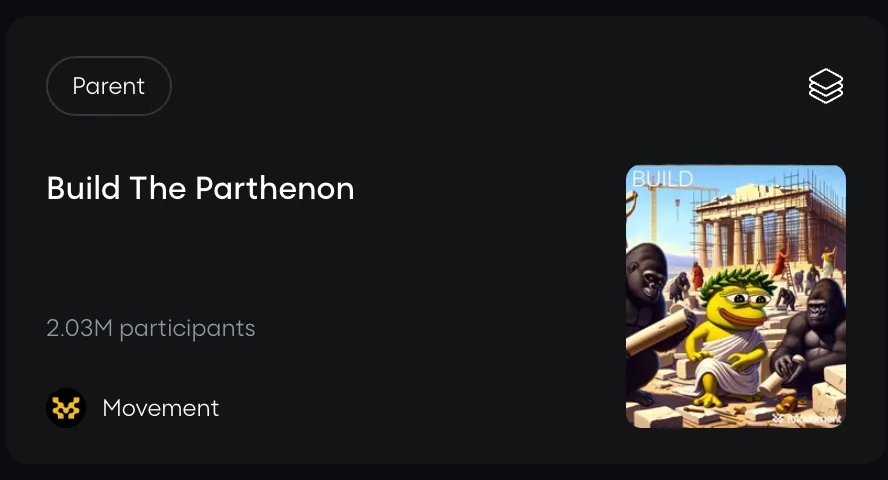
Movement Labs Parthenon (Galxe): Movement Labs partnered with Galxe to launch the “Building the Parthenon” testnet campaign, integrating over 50 DApps and 400 tasks on a unified portal, attracting over 2 million participants. This event not only provided real network stress testing but also accelerated Movement community growth—Galxe Space followers reached 2.7 million, X (Twitter) followers hit 860K, and Discord membership grew to 840K. Key Tactics: Leveraged Galxe API to consolidate multi-project tasks into a single flow, using a “Six Guilds + Individual Tasks” gamified quest format guiding users through exploratory missions and awarding badge rewards, significantly enhancing community stickiness while uncovering testnet issues.
Hashflow Decentralized Exchange Growth (Galxe): According to Galxe’s whitepaper case study, Hashflow boosted weekly active users from 3,000 to 13,000 by collaborating with Galxe on a series of Hashbot Genesis NFT events. The approach involved issuing a sequence of “Hashbot Genesis” NFT badges—users earned them incrementally by completing specified trading tasks. The campaign ran ten rounds of airdrops, resulting in 20,000 NFT badges minted and pushing Hashflow’s platform trading volume beyond $250 million. By linking trading activity with digital badge rewards, Hashflow effectively incentivized repeated platform interactions. The CEO noted that Galxe’s NFT infrastructure perfectly met campaign needs, becoming a powerful growth lever. Key Tactics: Used Galxe’s credential NFT system to gamify trading tasks, distributing rewards in stages to sustainably stimulate user retention and trading activity.
Solana Multi-Protocol Joint Campaign (Galxe): To expand Solana’s ecosystem user base, the Solana Foundation teamed up with Galxe to launch the “2022 is Gonna be SOL COOL” campaign. Spanning 27 protocols on Solana (including Port Finance, Orca, Jupiter, and other popular projects), supported by Galxe to set tasks across multiple DApps. The prize pool totaled $1 million, requiring users to explore each designated protocol and collect 27 NFT badges to qualify for a share. This large-scale collaborative campaign generated widespread community attention, ultimately bringing over 30,000 new users to the Solana ecosystem. Key Tactics: Combined high-value rewards with multi-project collaboration to generate momentum, using Galxe to interconnect tasks from different DApps, enabling users to experience Solana’s diverse applications in one go, achieving mass user acquisition.
Arbitrum Odyssey Campaign (Galxe): Ethereum Layer2 project Arbitrum launched the famous Odyssey series in 2022, setting a new benchmark for Web3 task-based marketing. Originally planned for eight weeks, the Odyssey campaign, in partnership with Galxe, featured 56 ecosystem projects across categories like bridges, DEXs, NFT markets, and games. Users earned Galxe badge NFTs weekly by interacting with specific projects, with continued participation unlocking special composite badges. Despite temporary pauses due to on-chain congestion, the campaign attracted hundreds of thousands of users during its early phase, widely recognized as a major community growth success. Odyssey enabled users to deeply experience the Arbitrum ecosystem through quest-style gameplay, laying the foundation for subsequent user surges and ecosystem prosperity. Reports indicate the relaunched Odyssey will last seven weeks with 13 carefully selected projects, offering personalized badges and potential future airdrop opportunities for explorers. Key Tactics: Large-scale, multi-phase quest-style events combined with on-chain NFT badges and potential airdrop incentives sparked organic community participation. Supported by Galxe, it unified dozens of DApp tasks under one platform, greatly improving user retention and ecosystem identification.
QuestN Joint Marketing Campaign: Beyond Galxe, large campaigns also occur on QuestN. For example, Quest3 platform invited 50 projects—including CyberConnect, Mask Network, SafePal, and other well-known names—in July 2022 to jointly release task campaigns, drawing massive user participation across different projects. These joint campaigns allow multiple projects to share traffic—users completing a series of tasks receive rewards from multiple projects, achieving a “one-stop airdrop experience.” Key Tactics: Platform-organized multi-project joint airdrops provide continuous task chains to boost engagement, with each project contributing rewards to raise overall appeal, fully leveraging QuestN’s long-tail user base for new user acquisition.
8. Extracting Success Mechanisms + Operational Recommendations
Select suitable platforms and models: Choose appropriate task platforms based on project needs.
Use joint campaigns (multi-project collaborations) to amplify impact.
Logic for Partner Selection: Audience Overlap
When screening partner projects, prioritize target user overlap to ensure precise traffic acquisition.
Effective campaigns stem from “simultaneous activation of multiple forces.” Only when project teams sincerely participate and co-promote can联动activities achieve viral effects. Simply posting on a platform and dropping a link won’t bring users. We find that every effective round shares common traits:
Partner teams simultaneously promote tasks on their website / Discord / Twitter
Official accounts retweet, explain, or even participate in interactions
Tasks are structurally guided in the community (e.g., FAQs, instructional images in groups)
Thoughtful Task Pathway Design: Task setups should serve user growth and conversion goals. Follow the “cast wide net → fine filter” structure: use low-barrier tasks to attract attention, then high-barrier tasks to filter and select. Provide clear guidance and support throughout—tutorials, customer service answers—to reduce friction for beginners completing advanced tasks.
Moderate Incentives to Prevent Excessive Farming: Rewards must be attractive without being exploitable. Balance total and per-user rewards, especially avoiding unlimited, uncapped reward structures (easily exploited by scripts). Using raffles + contribution weighting is a safer approach.
Focus on Retention and Ongoing Operations: Growth isn’t the end—retention is key. After a campaign ends, follow-up operations are vital: bring high-quality users acquired during the campaign into core communities, provide ongoing information touchpoints and special perks to convert them into long-term users. Prepare backend mechanisms for product and community handoff: such as invitation experiences, transitioning into DAOs (contributor programs with identity tiers).
Summary
In short, Web3 project user growth must shift from crude “manpower tactics” to meticulous, precision operations. Task-based campaigns offer powerful toolkits, but success hinges on whether project teams can leverage data to understand users, carefully design processes, and continuously optimize. Platforms like QuestN, TaskOn, and Galxe each have strengths—only by skillfully utilizing them in conjunction with tailored strategies can projects stand out amid fierce competition, achieving truly effective user growth and conversion. Every authentic user gained through a campaign is a precious asset to the Web3 community—through proper filtering and guidance, we enable users to gain value while turning them into loyal supporters, ultimately achieving mutually beneficial, sustainable growth.
Chapter Three | GameFi Community Ecosystem Construction: Effective Strategies on Discord and Telegram
Introduction: The Community Operation Philosophy of Induce, Trigger, and Retain
In GameFi projects, community vibrancy and cohesion often determine project viability. Instead of bluntly shouting “be active,” a more effective strategy follows the philosophy of “Induce + Trigger + Retain”: inducing users to interact through carefully designed incentive mechanisms, triggering enthusiasm with various activities and topics, and retaining valuable content and core users to form long-term community assets and culture. This article analyzes how to leverage the functional mechanisms of Discord and Telegram to build efficient GameFi community ecosystems, particularly discussing the roles of moderators (MODs) and core active users (“chatters”) in three areas: user retention, topic facilitation, and deepening user engagement.
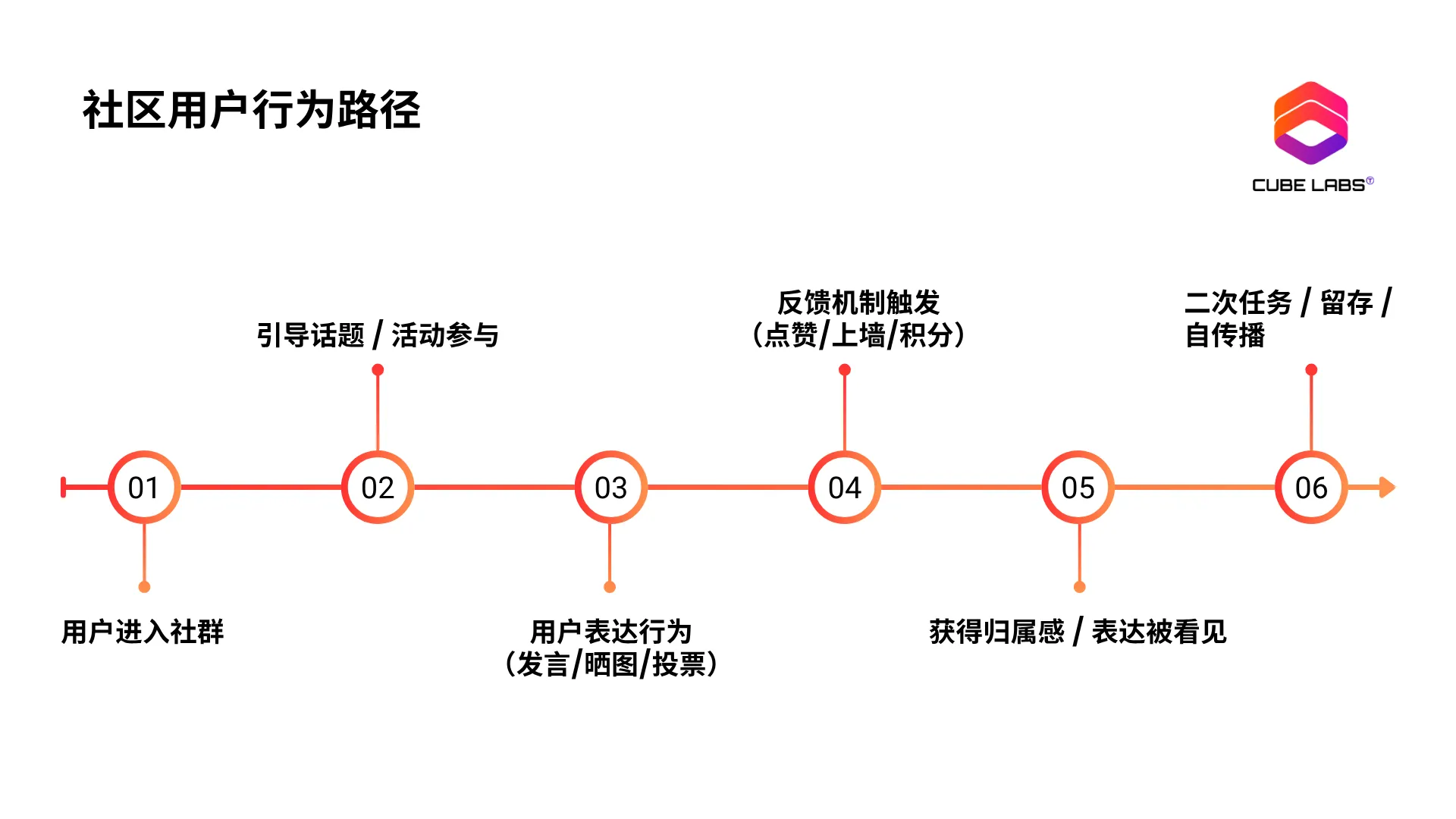
1. Community Structure Design: Channel Planning and Role Stratification
Discord and Telegram are the two core platforms for Web3 community operations, each with distinct advantages and clear roles: Discord suits structured community management, supporting multiple channels, role permissions, and bot tools—ideal for building layered, long-term interactive NFT/GameFi communities; Telegram excels in immediacy and fast dissemination, commonly used for announcements, real-time Q&A, and airdrop interactions.
Most projects adopt a “dual-platform parallel” strategy: use Telegram to quickly onboard new users and strengthen information delivery; use Discord for in-depth discussions, user retention, and task-driven engagement. A well-structured community architecture forms the foundation of a vibrant ecosystem.
On Discord, recommend setting clear channel categories such as announcements, rules, general discussion, technical support, FAQ, and exclusive holder channels. This organization keeps themed discussions orderly and avoids clutter. Simultaneously, use roles and permissions to stratify member identities (e.g., admins, mods, VIP members, newcomers), enabling targeted community management. For example, assign exclusive roles and channels for NFT/token holders, using bots like Collab.Land to verify holdings and grant special access.
On Telegram, lacking channel categorization, community structure remains simpler. Typically, one main group handles chat and interaction, supplemented by an admin-only announcement channel for information dissemination. Pin messages with rules, FAQs, etc., to help newcomers quickly understand community norms. Identity stratification on Telegram mainly relies on group admins and bot permissions (e.g., anti-spam bots), though less granular than Discord, still leveraging verification quizzes or captcha mechanisms to screen new members and reduce spam bot influx.
Regardless of platform, clear community structure and stratification enhance user experience, helping members find what they need and creating a secure, orderly discussion environment.
2. Maintaining User Retention and Daily Activity
1. Onboarding & Retention: The Critical First Impression
User retention begins with a good “first impression.” On Discord, use welcome screens and onboarding guides—let MODs proactively guide new members through community structure and participation methods to help them quickly “break the ice.” For example, set an “introduce yourself” action in the welcome interface to boost first-day posting rates, thereby enhancing “first-week retention”—i.e., the ratio of new users remaining active within 7–14 days of joining.
Simultaneously, automate onboarding and guidance via BOTs—send links to announcements, task guides, and role collection methods promptly, significantly increasing new user activation rates. Appropriately arrange simple quizzes or quick tasks as “entry-level gates” to strengthen user involvement and belonging.
2. Daily Engagement Mechanisms: Sustained Output Drives Interaction Frequency
To maintain community heat, avoid relying solely on “shouting for activity.” Instead, design ongoing content and incentive mechanisms. MODs can introduce gamification (Gamification), using bots like MEE6 to track posting frequency and implement point-based leveling systems, granting members different role tiers and corresponding privileges. Daily chat growth feedback creates a self-reinforcing motivational loop.
Leaderboard mechanisms are also worth adopting: display Top 10 most active users weekly to foster healthy competition. Schedule lightweight tasks like “daily check-ins” and “topic Q&As” to maintain steady interaction frequency. For Telegram communities, use scheduled bots to post daily questions or initiate votes, sustaining activity through light interactions.
3. Content & Event-Driven: Making the Community “Worth Talking About” Is Key
A healthy community thrives on “predictable, engaging content.” MOD teams should develop a content calendar, planning daily topics and weekly events, for example:
QOTD (Question of the Day): Light open-ended topics, e.g., “What treasure did you dig today in-game?”
Weekly AMA / Community Voice Events: Hosted by project teams or veteran players, providing information and strengthening connection
Mini-games / Polls / Check-in Challenges: Lower participation barriers and establish community rhythm
Classic examples include StepN, which regularly organizes community voice chats and running challenges—boosting stickiness and forming community traditions. MODs should consistently plan such events and standardize execution rhythms, helping users form the habit of daily check-ins.
4. Incentives & Rewards: Turning “Activity” Into “Retention”
Effective incentive mechanisms are key to shifting users from “lurkers” to “stayers.”
GameFi projects often combine “honor incentives + physical rewards.” For example, Axie Infinity awarded 2,000 tokens to the top 100 most active Discord members, directly boosting community heat. Role incentives matter too—titles like “VIP” or “Honorary Member” often come with unique privileges (e.g., early test access, hidden channel access), making them highly attractive.
In Telegram groups, use bots to run raffles or airdrop tasks—e.g., “check in for 7 consecutive days to enter a raffle,” or randomly distribute token rewards among participants asking questions during AMAs. Through consistent small rewards, gradually transform activity into retention, fostering user accomplishment and psychological belonging.
Sustainable community operations hinge not on momentary excitement, but on converting fleeting activity into lasting retention, and immediate actions into deep identity formation. When incentives cultivate identification, users truly stay and form stable community strength.
3. Topic Facilitation and Atmosphere Building: Creating a Community Culture of Continuous Interaction
An effective community isn’t measured by “number of scrolls,” but by whether it consistently produces valuable topics and fosters a positive atmosphere. High-frequency interaction doesn’t equal high-quality operation—the real art lies in structural design, rhythm planning, and cultural guidance, ensuring discussions remain centered on core interests.
As someone said: “The art of community operation isn’t forcing output, but creating atmosphere.” Many posts don’t mean good vibes; truly valuable discussions revolve around shared interests and constructive contributions.
1. Channel and Topic Design: Clear Structure Guides Discussion
On Discord, structural design is the first step in topic management. A typical GameFi community includes channels like announcements, game strategy, tech support, player creations, and off-topic chats—each with clear descriptions and defined purposes. For example:
#announcements: For official updates only;
#game-strategy: Encourage players to share guides and team compositions;
#support: Dedicated to technical issues and account queries;
#off-topic: Open chat channel to strengthen interpersonal bonds.
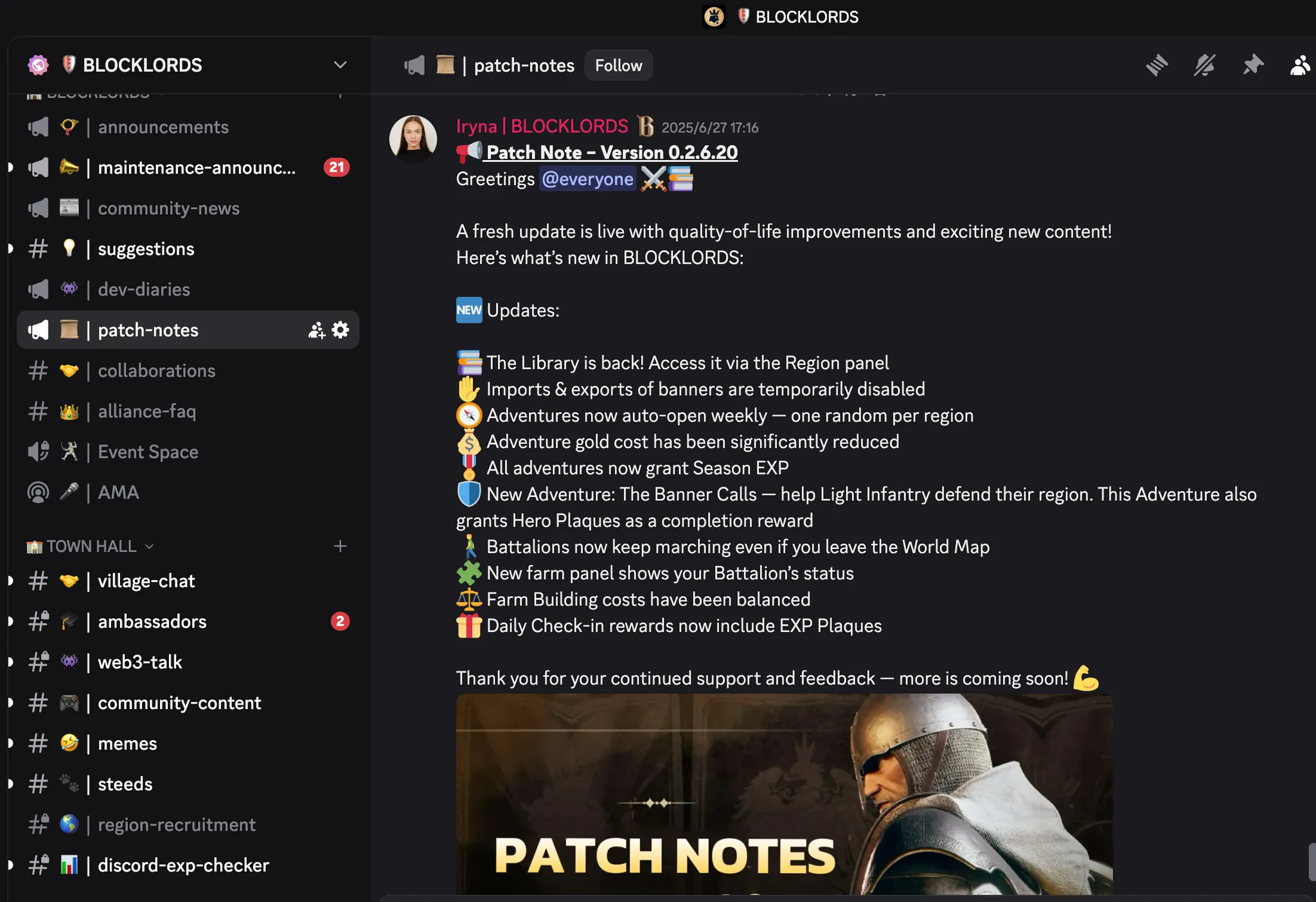
This “multi-group chat + multi-channel parallel” structure not only simplifies information management but helps members find their own discussion spaces, lowering posting barriers and boosting participation.
In contrast, Telegram lacks channel classification—topic guidance relies more on admins proactively initiating topics or using “tag + time” rituals. For example, designate Mondays as “Guide Sharing Day,” with admins launching “#GuideDiscussion” to prompt experience sharing; Fridays as “#ChitChatFriday,” encouraging lighter conversations. These fixed rhythms help members anticipate participation, a practical way to manage topics on Telegram.
2. Guiding Content Rhythm: Discussion Can Be “Designed”
A healthy community shouldn’t wait for users to “find topics”—MODs should proactively act as “hosts,” planning content rhythm and creating discussion opportunities.
The most basic method is maintaining a topic list, selecting one daily (or weekly) to spark participation. For example: “How did this update affect you?” or “Any underrated team combos that actually work well?” These lightweight, relatable, and easy-to-join topics best maintain daily activity.
Beyond that, regular themed discussion events are effective. For example, host a weekly discussion hosted by MODs focusing on a theme (e.g., economic adjustments, balance feedback, PvP experience), guiding concentrated exchanges. Pairing with voice channels, livestreams, or AMAs enhances ceremony and engagement.
To further boost motivation, add “showcase mechanisms”: institute a “Member of the Week” program—MODs compile high-quality posts weekly, recognizing “Best Guide Author” or “Most Helpful Responder,” pinning them in channels. This not only serves as honor-based incentive but also filters content and accumulates community culture.
3. Community Culture and Rules: Turn Atmosphere Into Habit
A good community atmosphere isn’t maintained by moderation alone—it requires long-term cultural accumulation. MODs’ job is to set clear rules and use tools and “soft nudges” to sustain this atmosphere.
Institutionally, prohibit spamming, insults, and personal attacks—use Discord AutoMod or Telegram Rose Bot to set banned words and warning systems, ensuring basic safety.
Culturally, encourage everyday interaction rituals—mutual “gm/good morning” greetings every morning, or collective use of specific emojis during key moments, building默契. Encourage members to share failures and real-life anecdotes, reducing toxic boasting or elitism, giving newcomers a voice.
Many successful GameFi communities have their own “memes”: classic voting scenes, collective emoji floods during price swings, or iconic quotes repeatedly referenced… Such “meme culture” fosters belonging and helps communities silently develop unique personalities.
4. Identity Systems and Honor Frameworks: From Interest Segmentation to Contribution Incentives
Discord’s Emoji reaction role feature (Reaction Role) is a lightweight yet powerful identity segmentation tool. Admins can set a “self-select role” channel, letting users customize their role tags by clicking emoji buttons, for example:
🎮 Player
🎨 Content Creator
🌍 Language Group
This not only adds fun to community interaction but also helps users cluster by interest and find relevant content. Further, set “honor roles” and “special titles” to recognize long-term contributors, such as:
“OG Member”: Early participant, witnessed growth;
“Community Mentor”: Dedicated to helping newcomers;
“Gold-Tier Chatter”: Produces quality topics and insights;
These roles often come with visible perks (e.g., special nickname colors, exclusive channels, event priority), possibly linked to future airdrops or NFT benefits. This combination of visible identity and tangible rewards effectively motivates participation and cultivates a “your effort gets noticed” positive atmosphere.
4. Promoting User Transition from Interaction to Deep Engagement
The ultimate goal of community operations is evolving users from “spectators” to “co-builders.” In GameFi projects, deep engagement means not just sustained activity, but users actively creating value for the community—through content creation, task execution, or governance participation. To achieve this transformation, project teams must systematically design participation ladders across content incentives, task mechanisms, on-chain rights, and co-creation pathways, progressively guiding users onto higher-tier engagement tracks.
1. UGC Incentive Mechanisms: From User Content to Community Assets
Encouraging UGC (User-Generated Content) enriches the community’s knowledge base and strengthens emotional investment. Common incentives include:
Launching content submission campaigns, inviting users to write guides, record gameplay videos, or create fan art;
Creating “Content Contributor” roles or badges, showcasing and honoring outstanding works;
Hosting regular “Monthly Guide Awards” or “Best Author Vote,” involving the community in selection.
For example, Frontier adopted community suggestions and encouraged players to co-create a Wiki—mechanisms like this give creators visible achievement, motivating more to contribute. When user content is officially cited or promoted, they naturally upgrade from “player” to “community creator.”
2. Automated Tasks and Stage Challenges: Providing Pathways and Rewards for Engagement
“Taskifying” interactive behaviors is an effective way to push users into deeper engagement zones. Using task bots on Discord (e.g., Zealy, Quest3), project teams can set:
Light interaction tasks like inviting friends, social media shares, or screenshot retweets;
Intermediate to advanced challenges like testnet operations or content creation.
These tasks should have progressive rhythm—start with low-barrier tasks to attract participation, then gradually guide users toward more challenging goals. Telegram can also use tools like TaskOn or Quiz Bot for quiz tasks and airdrop interactions.
Additionally, stage-based challenges like “community tournaments” or “seasonal leaderboard pushes” significantly boost engagement. For example, some projects run PvP challenge seasons or content co-creation months, rewarding standout players with NFTs, airdrops, or special identities. Such mechanisms not only deepen user understanding of gameplay but also increase daily active users and stickiness.
3. On-Chain Binding and Identity Rights: Turning Participation Into Assets
To build long-term motivation for Web3 communities, user behavior must be tied to on-chain assets. Specific practices include:
Guiding users to connect wallets, verifying NFT/token holdings via tools like Collab.Land, and automatically assigning exclusive Discord/Telegram roles like “Holder” or “OG”;
Setting on-chain tasks + off-chain identity rewards, e.g., completing staking or liquidity mining challenges grants not only on-chain earnings but also unlocks roles, badges, or leaderboard positions;
Directly allocating part of Token Allocation to community contributors—e.g., Hop Protocol airdropped early Discord active members, ENS allocated 25% to community editors.
Together, these mechanisms send a strong signal: Participation = Earnings. When users realize their actions carry economic value, deep engagement becomes a conscious choice.
4. Community Co-Creation and Governance: Turning Members Into “Collaborators”
After users complete “task-based participation,” the next step is “strategic participation”—moving into project co-governance. GameFi projects can gradually introduce DAOs or community advisory boards, for example:
Establish a core player council to communicate regularly with the team on project direction and gameplay feedback;
Open a community governance proposal system, allowing token holders to vote on major decisions;
Create a proposal discussion area in Discord to collect ideas and improvement suggestions.
Also, promote active users into roles like community mod, ambassador, or official liaison. For example, a GameFi project appointed content contributors as “community ambassadors,” granting them planning and organizational authority. This “co-creation identity” not only strengthens user belonging but also enables partial project autonomy, improving overall operational efficiency.
5. Community Operation Strategy Matrix: Role Division Between MODs and Core Users
Driving deep engagement doesn’t rest solely on project teams—core users’ demonstration effect is crucial. This is the most critical synergy between MODs and community leaders. The matrix below summarizes the main strategies and roles of community moderators (MODs) and core active users across different operational elements
Join TechFlow official community to stay tuned
Telegram:https://t.me/TechFlowDaily
X (Twitter):https://x.com/TechFlowPost
X (Twitter) EN:https://x.com/BlockFlow_News
 @cubelabs_web3