








Fantasy.top's departure: Is the Blast ecosystem on its last legs?
TechFlow Selected TechFlow Selected
Fantasy.top's departure: Is the Blast ecosystem on its last legs?
Star projects leave, Blast ecosystem loses luster: a farewell long foreseen.
 Navigating Web3 tides with focused insights
By KarenZ, Foresight News
In the early hours of July 15, Beijing time, Fantasy.top, a decentralized card game in the Blast ecosystem, announced its migration to the Base ecosystem and will support users in transferring their assets to the Base network.
The community’s reaction was not one of regret, but rather a sense of “finally”—as if turning to the last page of an ending long foretold.
Fantasy.top: The Flagbearer of the Blast Ecosystem
Fantasy.top is a decentralized social card game built on the Blast network. It converts KOLs’ social media performance in the crypto space into NFT cards and has attracted a large user base through gamified mechanisms. Since launching its mainnet on May 1, 2024, Fantasy.top rapidly became a flagship project within the Blast ecosystem.
According to DeFiLlama, Fantasy.top contributed 83% of the Blast ecosystem's protocol revenue (approximately $10,566) in the past 24 hours, 78% over the past week, and 56% over the past month. Data from Nansen also shows that over the past six months, Fantasy.top ranked third in user transaction volume on the Blast network.
Fantasy.top has been a key pillar sustaining the "activity" of the Blast ecosystem. Its departure now undoubtedly worsens the already sluggish state of Blast.
More Than Fantasy.top: The Exodus from the Blast Ecosystem
In fact, Fantasy.top is not the first project to leave Blast. From overall data and multiple migration cases, we can clearly observe the loss of projects and users within the Blast ecosystem, as well as its declining momentum.
Data-wise, according to DeFiLlama, the total value locked (TVL) in Blast’s DeFi ecosystem is currently only $87 million—over 95% lower than its peak of $2.2 billion. Nansen data also shows that daily active addresses on the Blast network exceeded 180,000 at the end of June 2024, but have since dropped sharply, hovering between 2,000 and 5,000 in recent months. Additionally, daily contract deployments have fallen to double or low triple digits, while token deployments have dropped to single digits, indicating waning developer enthusiasm.
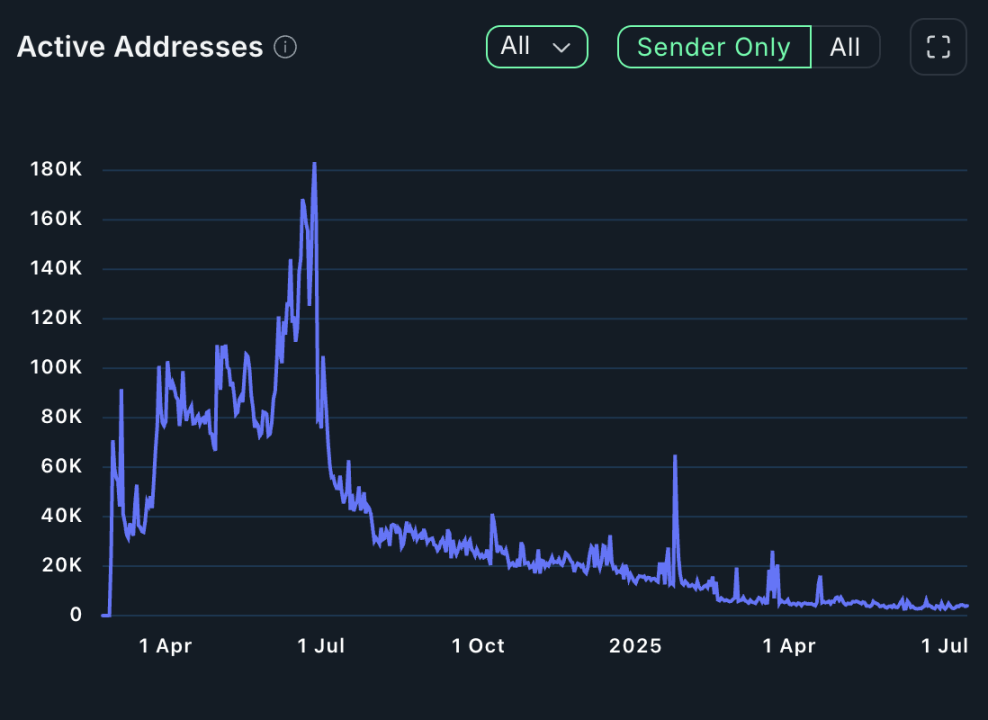
Source: Nansen
Notable Project Migration Cases
-
pump.fun: Launched on Solana in January 2024, went live on Blast a month later but received little traction and ceased operations on Blast several months after.
-
Megapot, a lottery application (gambling app, do not use), migrated from Blast to the Base ecosystem in March 2025.
-
Ethos Network: Originally planned to launch on Blast, but ultimately chose to start directly on Base. Ethos Network is now a popular reputation protocol on Base.
-
Baseline, a prize-winning project from Blast BIG BANG, later migrated to the Base ecosystem as well.
These cases collectively point to one conclusion: Blast is facing severe challenges in attracting and retaining projects. Despite being hailed as a “native yield-bearing Ethereum Layer2,” its ecosystem development has clearly failed to deliver on early promises.
Recent Turmoil in the Blast Ecosystem
Recently, negative signals and incidents within the Blast ecosystem have further intensified market concerns:
In May 2025, Blast announced it would no longer renew its service agreement with Safe, though it supports accessing multisig wallets via BrahmaFi’s frontend or self-hosted frontends. Pacman explained there were multiple reasons, including the availability of many alternative solutions supporting Blast. However, this decision was widely interpreted as a contraction of ecosystem infrastructure.
The following month, Thruster, a DEX in the Blast ecosystem, announced plans to gradually cease operations. The official statement cited a comprehensive assessment of Thruster’s current status, expectations, surrounding ecosystem, and future prospects. This reflects developers’ dwindling confidence in the Blast ecosystem.
Affected by these events, EarlyFans, a SocialFi project in the Blast ecosystem, previously stated that “given Blast’s non-renewal of the Safe service agreement and Thruster’s shutdown, the risk of keeping assets on the Blast network is increasing,” and withdrew the LP for its EARLY token (worth $70,000) from Thruster. Ultimately, EarlyFans shifted into “maintenance mode” and turned to developing its fully native mobile app, 8020.
A chain of ripple effects indicates that the trust foundation of the Blast ecosystem is unraveling. When infrastructure partnerships break down and core applications shut down, developers and users naturally opt for more stable networks.
Why Has Blast Faded from the Spotlight?
Blast’s decline from its peak results from a confluence of factors:
First, the sharp cooling of the NFT market: Blast is deeply tied to Blur, and the downturn in the NFT market has significantly impacted Blast.
Second, misalignment between points economy and real demand: Blast used “deposit-to-mine” and “points-for-airdrop” models to rapidly inflate TVL, but most addresses existed solely to farm points, lacking incentives for sustained user engagement at the protocol level.
Third, token price collapse: Both BLAST and BLUR tokens have fallen over 90% from their all-time highs, severely undermining investor and developer confidence. In the crypto market, token prices often form a positive feedback loop with ecosystem activity; prolonged price stagnation further diminishes Blast’s appeal.
Fourth, lack of ecosystem diversity: Blast’s DApp ecosystem lags far behind competitors like Base in terms of diversity. Most users cross-chain solely to earn points for potential airdrops, with extremely low willingness to engage with actual applications, leading to continuously declining network activity.
Fifth, narrative exhaustion and competition: “Native yield” was once Blast’s core selling point, but as the market grows tired of this narrative and the ecosystem fails to produce breakthrough applications, being overtaken by competitors becomes inevitable.
Conclusion
Fantasy.top’s departure is undoubtedly a footnote to the fading appeal of the Blast ecosystem. When points incentives lose their magic and narratives grow stale, developers naturally migrate to networks that are more stable, liquid, and populated by genuine users.
Looking back at Blast’s rise and fall, while its founder initially attracted top developers through strong marketing, they failed to build the infrastructure and user stickiness needed for sustainable ecosystem growth. This once again confirms the harsh rule of the crypto world: short-term speculation and traffic tricks may win temporary attention, but only solving real user needs and building a healthy ecosystem can secure long-term survival amid fierce competition.
The migration wave from Blast to Base is not merely a series of individual project decisions—it is an inevitable phase of “deflation” in the Layer2 landscape.
Join TechFlow official community to stay tuned
Telegram:https://t.me/TechFlowDaily
X (Twitter):https://x.com/TechFlowPost
X (Twitter) EN:https://x.com/BlockFlow_News
 Foresight News


