Messari: Total assets up 140% this year, here's a look at the current state of Solana's RWA sector
TechFlow Selected TechFlow Selected
Messari: Total assets up 140% this year, here's a look at the current state of Solana's RWA sector
Digital Alchemy: How Solana Turns $400 Million in Physical Assets into Gold on the Blockchain?
 Navigating Web3 tides with focused insights
Author: Matthew Nay
Translation: TechFlow
Key Insights
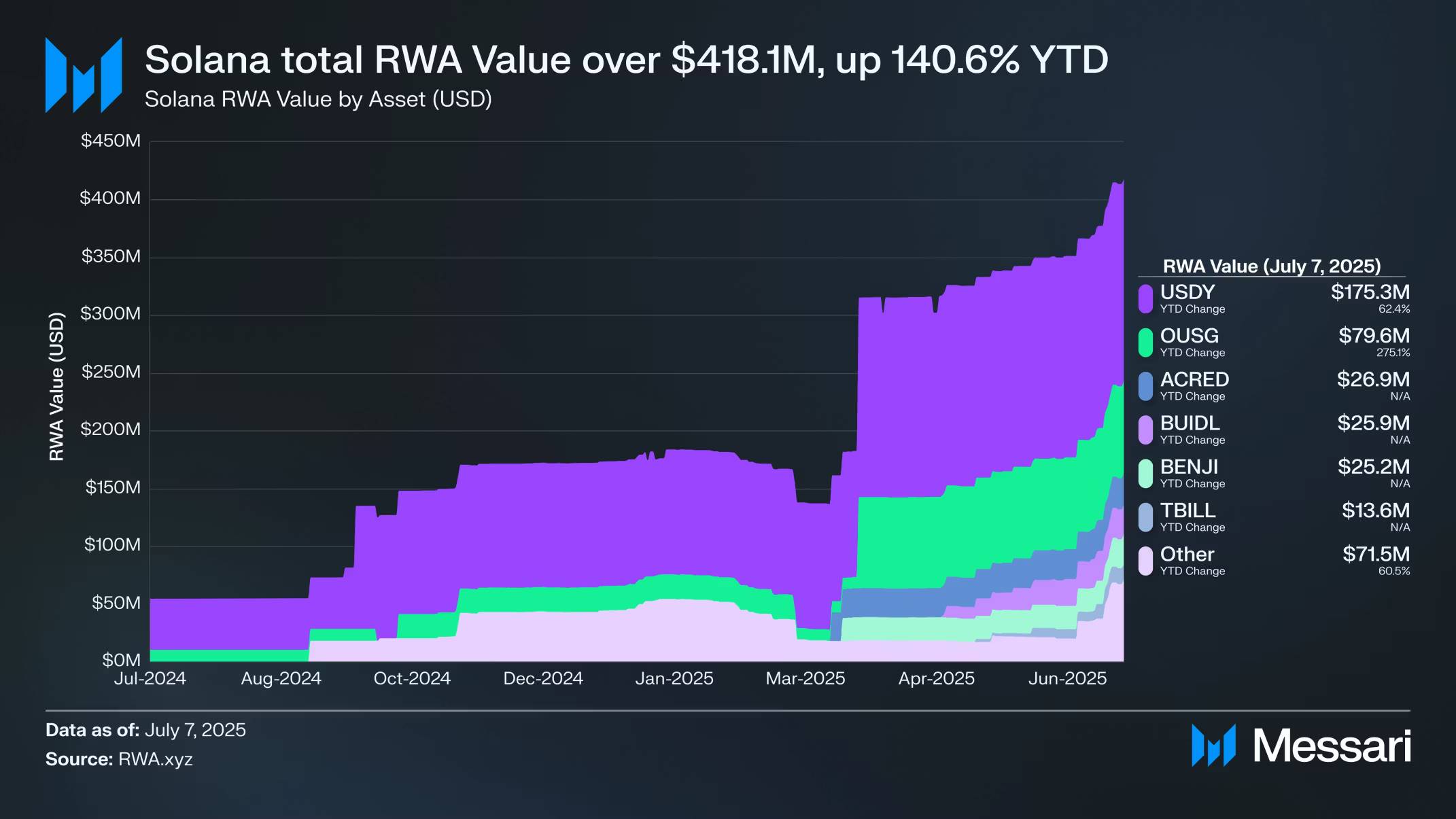
Real-world assets (RWA) on Solana are now worth over $418.1 million, a 140.6% increase year-to-date. Ondo's USDY leads with $175.3 million in value, capturing 41.9% of the market share, followed by other assets such as OUSG, ACRED, and BUIDL.
Backed has partnered with Kraken to bring tokenized stocks to Solana via xStocks on June 30, 2025, enabling over 40,000 wallets to hold xStock within one week. Superstate, Ondo, and Step Finance plan to launch tokenized equities later this year.
R3 plans to migrate over $10 billion in tokenized assets from its permissioned distributed ledger technology (DLT) platform, Corda, onto Solana. R3 supports regulated financial institutions in issuing and transferring tokenized assets.
Maple Finance’s yield-bearing stablecoin syrupUSDC rapidly grew to a market cap of $60.1 million. Since its launch in June 2025, over 54.2 million syrupUSDC tokens have been issued.
Solana hosts unique RWAs including those from BlackRock, Apollo, tokenized real estate, and distinctive physical goods and collectibles.
Introduction
Real-world assets (RWA) represent a paradigm shift in decentralized finance, bridging traditional finance (TradFi) with blockchain infrastructure by tokenizing off-chain assets such as government bonds, private credit, public equities, real estate, and even physical goods. This transformation enables higher liquidity, programmability, and global accessibility—particularly for financial instruments that were previously illiquid, restricted, or inefficiently distributed. Over the past year, Solana has emerged as a strong contender in this space and become a trusted platform for both institutional and retail users to access and interact with on-chain RWAs.
Solana’s appeal stems from its high throughput, near-zero transaction costs, and robust developer ecosystem. Technological innovations like the Token-2022 standard and fast block finality enable seamless compliance tools, yield distribution, and composable DeFi integration. These features make Solana an ideal environment for hosting a wide range of RWAs—from tokenized treasuries to on-chain stocks and commodity tokens. Its infrastructure is increasingly tailored to meet the needs of asset issuers, regulators, and end users, paving the way for adoption at both institutional and community levels.
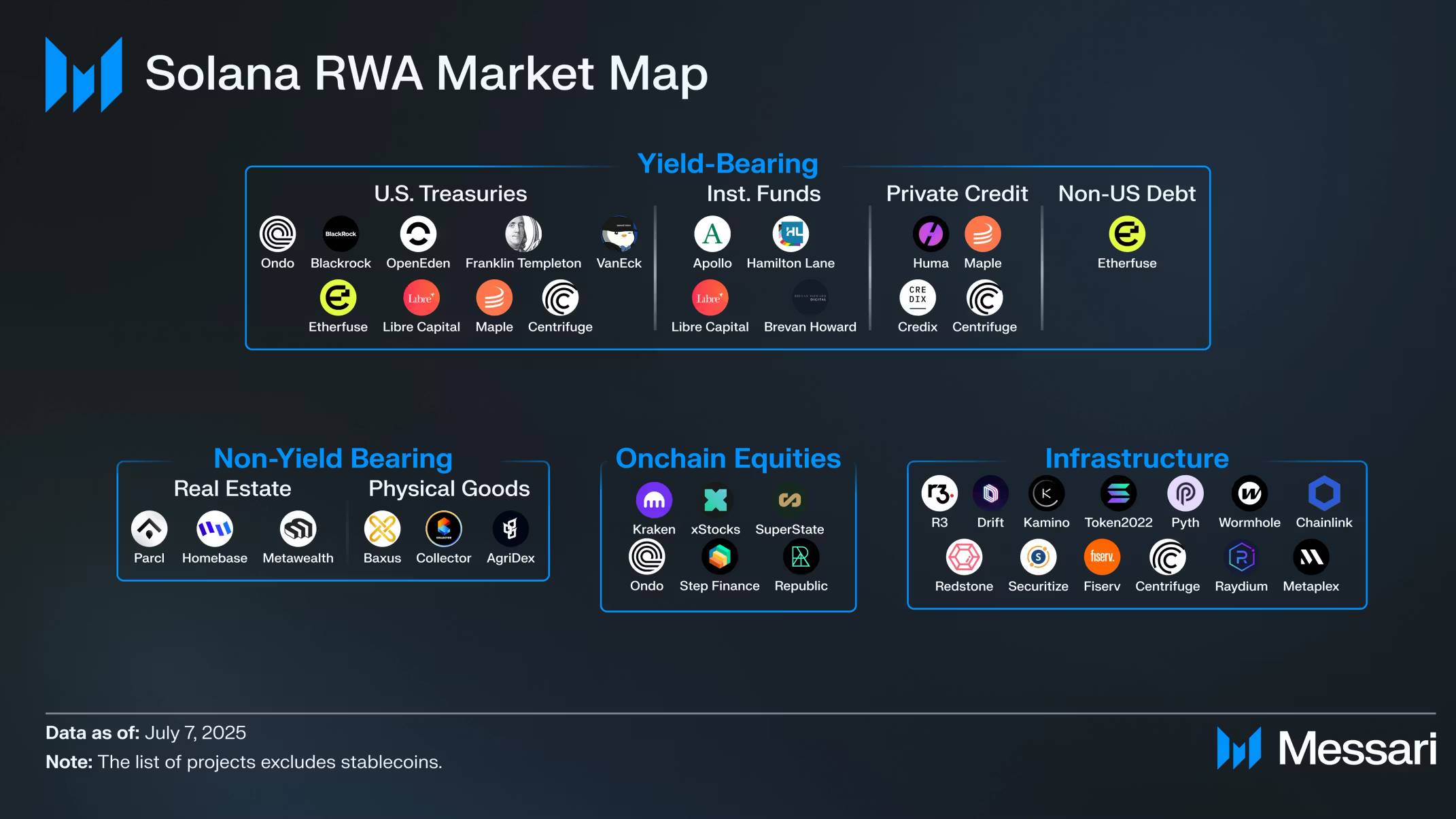
RWAs on Solana span four core categories: (1) Yield-bearing assets, including tokenized U.S. Treasuries, institutional funds, and private credit protocols from Ondo Finance, Franklin Templeton, and Maple; (2) Tokenized public equities, soon to be launched by Superstate, Kraken, and Ondo Global Markets; (3) Non-yielding assets such as tokenized real estate and collectibles offered by platforms like Parcl and BAXUS; and (4) Emerging infrastructure providers such as R3 and Securitize, which support compliance and interoperability. Through these lenses, we assess Solana’s trajectory as an emerging hub for on-chain RWAs and its implications for the future of global capital markets.
Yield-Bearing Assets
Yield-bearing RWAs constitute the most significant and fastest-growing segment of Solana’s RWA landscape, representing the vast majority of non-stablecoin RWA value (in USD). These assets include tokenized U.S. Treasuries, institutional funds, and private credit, offering on-chain investors direct exposure to off-chain yield streams—with greater composability and 24/7 accessibility compared to TradFi.
Disclaimer: All data in this report is current as of July 7, 2025.
Tokenized U.S. Treasuries
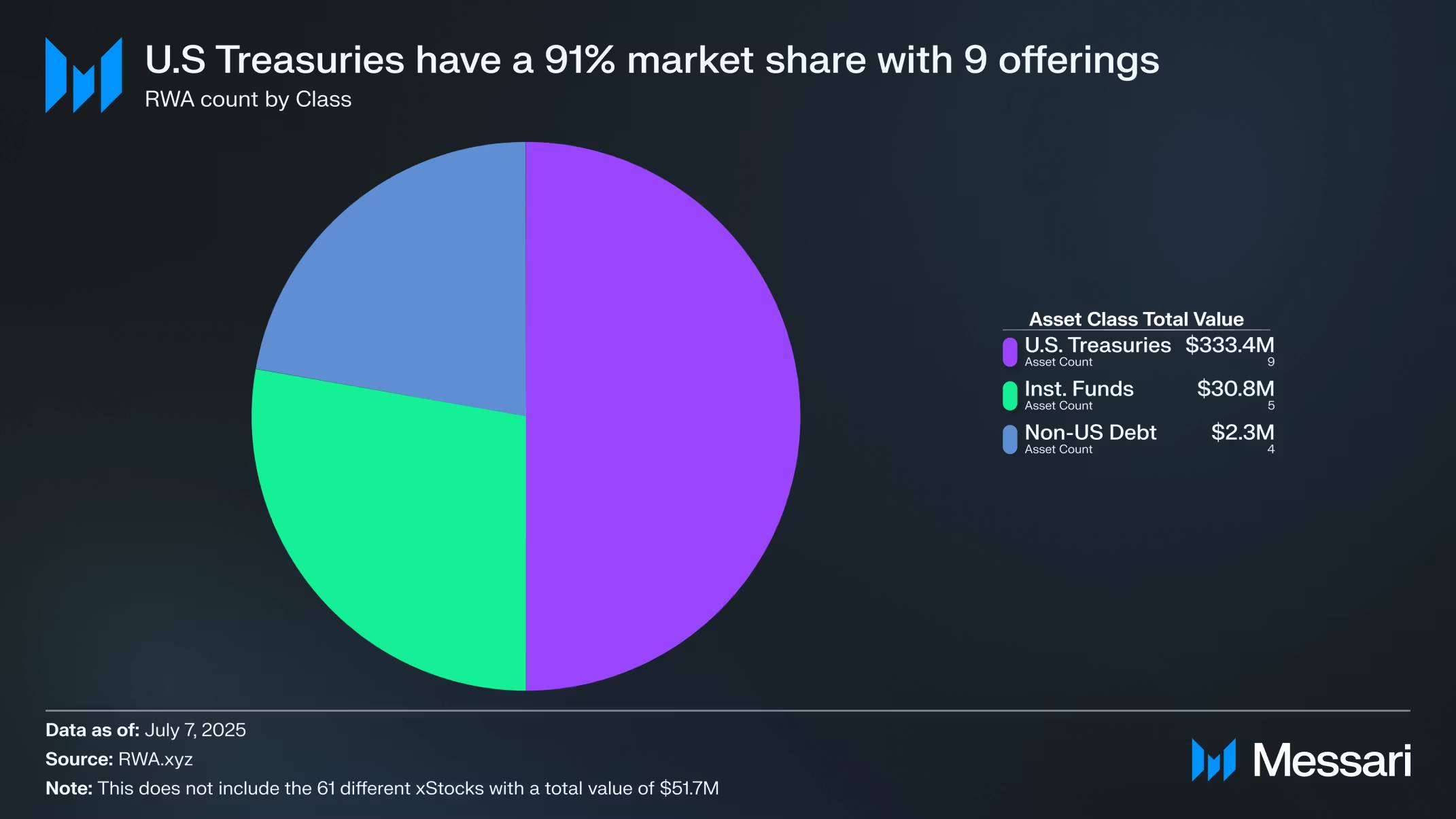
Tokenized Treasuries provide digital wrappers around the world’s most liquid and trusted yield instruments and have become foundational pillars for on-chain asset management, stablecoin collateralization, and DAO treasury operations. Solana’s tokenized Treasury market has evolved from a niche offering into a diverse suite of products from native and cross-chain issuers.
Ondo Finance – OUSG and USDY (Treasury and Yield Tokens)
OUSG and USDY represent Ondo Finance’s dual approach to tokenized U.S. Treasuries.
-
Launched in January 2023, OUSG is a tokenized fund initially structured around BlackRock’s BUIDL fund. It primarily targets qualified investors. As of July 2025, OUSG is the second-largest yield-bearing asset on Solana by market cap, with 7 holders and a market cap of $79.6 million.
-
Launched in August 2023, USDY is a token backed by U.S. Treasuries and bank deposits, designed as a yield-generating stablecoin with broad accessibility. USDY appreciates in price as interest accrues. The token is cross-chain transferable via LayerZero, making it highly composable across DeFi applications. As of July 2025, USDY is the largest yield-bearing RWA on Solana by market cap, with 6,978 holders and a market cap of $175.3 million.
BlackRock – BUIDL (USD Institutional Digital Liquidity Fund)
BUIDL is a tokenized money market fund developed by BlackRock, holding cash and short-term U.S. Treasuries. Initially launched on Ethereum in March 2024, it expanded to Solana in March 2025, marking one of the first major institutional RWA deployments on the network. The fund holds an AAA rating, maintains a stable $1 value, and pays daily dividends. Access is limited to KYC-verified accredited investors, leveraging Solana’s 24/7 settlement and low transaction fees.
BUIDL transforms traditional static financial instruments into highly accessible and composable assets. BlackRock’s launch of tokenized RWAs on Solana affirms growing institutional confidence in public blockchain infrastructure and its interoperability. As of July 2025, BUIDL is the fourth-largest yield-bearing RWA on Solana, with 3 holders and a market cap of $25.23 million.
Franklin Templeton – BENJI (On-Chain U.S. Government Money Fund, FOBXX)
BENJI represents shares in Franklin Templeton’s FOBXX money market fund, which invests in U.S. government securities, cash, and repurchase agreements. Originally launched in 2021, BENJI expanded to Solana in February 2025 as part of its multi-chain rollout, becoming the eighth supported network. It maintains a stable $1 value and offers an alternative yield source to traditional stablecoins, with interest accruing daily. BENJI is one of the first SEC-registered on-chain mutual funds available to retail investors and can be accessed through the Benji mobile app. As of July 2025, BENJI is the fifth-largest yield-bearing RWA on Solana by market cap, with 2 holders and a market cap of $25.9 million.
OpenEden – TBILL (Tokenized Treasury Bills)
TBILL is a fully collateralized token backed by short-term U.S. Treasuries, issued through a regulated trust structure. Since its initial launch in 2023, TBILL allows users to mint and redeem tokens using stablecoins like USDC 24/7, with the token price increasing as interest accrues. OpenEden was among the first platforms to offer DeFi-accessible Treasury products targeting non-U.S. investors.
The product’s low entry barrier, real-time redemption, and high transparency contributed to its success and growing adoption across Asia and Europe. TBILL gained attention after receiving a Moody’s “A” rating and has been used as yield-generating collateral for other tokens, such as Velo’s USDV stablecoin. As of July 2025, TBILL is the seventh-largest yield-bearing RWA on Solana by market cap, with 3 holders and a market cap of $11.7 million.
VanEck – VBILL (Tokenized U.S. Treasury Fund)
VBILL is the tokenized version of VanEck’s short-term U.S. Treasury strategy, launched on Solana in May 2025 through a partnership with Securitize. Unlike yield-bearing tokens such as OUSG and USDY that appreciate in value, VBILL maintains a stable $1 price and distributes yield through daily token dividends. Custody is provided by State Street, and real-time pricing is maintained by Redstone oracles.
VBILL stands out due to its atomic redemptions (TechFlow note: completing the asset redemption process in a single indivisible operation, ensuring the entire transaction either fully succeeds or completely fails, avoiding partial execution) via Agora’s AUSD stablecoin, allowing investors to seamlessly switch between yield and liquidity by utilizing AUSD’s integration with Solana DeFi protocols such as Kamino. Its structure combines traditional fund management practices with on-chain efficiency, catering to institutional cash managers. As of July 2025, VBILL is the sixth-largest yield-bearing RWA on Solana by market cap, with 5 holders and a market cap of $13.6 million.
Centrifuge – deRWA and deJTRSY (On-Chain Treasuries)
Centrifuge is known for its early work in tokenizing real-world loans on Ethereum and Polkadot, and in May 2025 announced its expansion to Solana with the launch of its deRWA token standard. The first token deployed under this framework on Solana is deJTRSY, representing shares in a $400 million short-term U.S. Treasury fund managed by Anemoy. Unlike traditional security tokens, deRWA assets can be freely transferred and immediately used within Solana’s DeFi ecosystem, including platforms like Raydium, Kamino, and Lulo.
deJTRSY will allow Solana users to earn yield from U.S. Treasuries in a fully composable manner, enhancing the on-chain utility of traditional financial instruments. Centrifuge’s approach eliminates long-standing friction in RWA liquidity and reflects its strategy of connecting institutional-grade funds with high-speed DeFi infrastructure. Beyond Treasuries, Centrifuge also supports private credit pools on Solana, enabling asset managers to underwrite real-world loans and offer tokenized tranches to on-chain investors. These pools diversify yield sources and improve credit access for borrowers in emerging markets.
Tokenized Institutional Funds
Institutional funds on Solana represent a new wave of RWA tokenization, going beyond simple debt instruments to encompass diversified private credit, real estate, and alternative asset strategies. These products emphasize compliance, transparency, and DeFi composability while offering more diversity and higher yield potential than tokenized Treasuries.
Apollo – ACRED (Apollo Diversified Credit Fund)
ACRED is the tokenized version of Apollo Global Management’s diversified private credit fund, created in collaboration with Securitize and launched on Solana in May 2025. The token represents equity in a portfolio of corporate loans and other private credit instruments and is issued as a regulated sToken under Securitize’s compliance framework.
ACRED is open to accredited investors and integrated with Solana-native DeFi platforms such as Kamino and Drift Institutional. These integrations allow users to borrow stablecoins against their ACRED holdings and implement leveraged strategies, effectively turning traditionally illiquid assets into composable DeFi collateral. The fund brings institutional-grade credit exposure (TechFlow note: the potential loss amount faced by financial institutions or enterprises when a counterparty may default) and capital efficiency to Solana. As of July 2025, ACRED is the third-largest yield-bearing RWA on Solana by market cap, with 8 holders and a market cap of $26.9 million.
Libre Capital – Tokenized Alternative Funds
Libre Capital is a platform backed by Hamilton Lane and Brevan Howard, offering institutional investors access to tokenized alternative assets. In July 2024, Libre launched its integration with Solana, becoming the first firm to bring private market credit funds to the network. Currently available tokenized funds include Hamilton Lane’s Senior Credit Opportunities Fund (SCOPE) (targeting a 9% yield), Brevan Howard’s Master Fund (BHM), and a short-term dollar fund managed by BlackRock ICS US Dollar Liquidity Fund (UMA).
Libre acts as a "tokenization gateway" for top-tier fund managers, aggregating private credit, hedge funds, and liquid alternatives. The platform emphasizes permissioned access for accredited investors and aims to unlock secondary market trading functionality on Solana, enabling real-time liquidity in traditionally illiquid markets.
Tokenized Private Credit
Private credit protocols on Solana expand the frontier of RWAs by providing direct loans to fintech companies, SMEs, and borrowers in emerging markets—all supported by on-chain transparency and risk management.
Maple Finance – syrupUSDC (Yield-Bearing Stablecoin)
syrupUSDC is Maple Finance’s on-chain yield-bearing stablecoin, launched on Solana in June 2025. The token represents funds deposited into Maple’s lending pools, which provide loans to trading firms, market makers, and fintech companies. syrupUSDC targets a 6–7% annual yield, positioning itself as a high-yield alternative to traditional yield-bearing stablecoins.
The product is designed for DeFi use and benefits from Solana’s ecosystem composability, including DEXs like Orca and lending platforms like Kamino. Maple’s approach combines transparency, rigorous underwriting, and real-time liquidity, transforming institutional credit into a stablecoin form that circulates across broader DeFi. As of July 2025, over 63.6 million tokens have been issued, with a market cap of $70.7 million, of which $47 million is deposited on Kamino.
Credix Finance – Private Credit Market
Credix Finance operates a Solana-native private credit marketplace, enabling institutional investors to fund loans originated by fintech companies in emerging markets such as Brazil and Colombia. Since its founding in 2023, Credix has focused on tokenizing accounts receivable, asset-backed loans, and revenue-sharing agreements. Its pools are typically split into senior and junior tranches to accommodate different risk-return profiles and include features such as insurance via export credit agencies and bankruptcy-remote trusts. As of July 2024, the platform had financed hundreds of SMEs in Brazil. Credix emphasizes real-world impact and localized deal flows, offering higher yields and diversification beyond U.S. markets.
Huma Institutional – PayFi Private Credit
Huma Institutional functions as a private, permissioned lending protocol similar to Centrifuge, Maple, and Credix. Huma currently supports 12 active lending pools across four different PayFi protocols, six of which are active on Solana and operated by Arf. These six pools have extended over $97 million in credit through the Huma platform.
Arf is a global liquidity platform that provides USDC-based short-term financing for cross-border payments without requiring pre-funded accounts. Leveraging on-chain liquidity, Arf enables fast, low-cost settlements while reducing counterparty risk. In April 2024, Arf merged with Huma to expand its liquidity solutions.
Other Debt-Based Protocols
Etherfuse – Stablebonds (Sovereign Bonds on Solana)
Etherfuse focuses on bringing emerging market sovereign debt and currencies on-chain. Through products like MXNe and Tesouro, the platform tokenizes Mexican and Brazilian government bonds, offering them as stablecoin-like assets on Solana and other networks. For example, MXNe is a peso-denominated stablecoin fully backed by short-term government CETES bonds. This structure allows users to trade in local currency on-chain while earning yield from sovereign debt.
Etherfuse launched its Stablebonds product in 2024 and has since targeted remittance markets and domestic financial institutions seeking FX-denominated digital tools. By combining bond-backed stability with DeFi liquidity, Etherfuse introduces a new class of low-volatility, yield-bearing assets, expanding RWA accessibility beyond dollar-centric instruments.
On-Chain Stocks
Tokenized equities on Solana represent a new evolution in capital markets, enabling 24/7 trading, fractional ownership, and seamless integration with DeFi protocols. Though still in early stages, the field is rapidly maturing thanks to advances in compliance, transfer agency technology, and cross-chain infrastructure.
Superstate – Opening Bell (On-Chain Public Stock Platform)
Opening Bell is an equity tokenization platform developed by Superstate, an asset management firm founded by Robert Leshner. Announced in May 2025 in collaboration with partners, Opening Bell enables SEC-registered companies to issue and trade common stock directly on public blockchains like Solana. These stocks are recorded via compliant digital transfer agents and are expected to qualify as fully regulated U.S. securities. Also in May 2025, the team jointly submitted a proposal titled Project Open to the SEC alongside the Solana Policy Institute and Orca, outlining how securities can be issued and traded on public blockchain infrastructure for greater efficiency, transparency, and effectiveness.
The first company planned for listing on the platform is SOL Strategies (CYFRF), a $280.6 million Solana asset management tool that also participates in the network by running its own validator. On-chain trading via Opening Bell is expected to begin later in 2025. The project aims to reduce the traditional T+2 settlement cycle to near-instant execution and make stocks fully programmable and composable within DeFi. This initiative embodies a broader vision of transforming stock exchanges into blockchain-native protocols and giving global investors 24/7 access to regulated equities.
Backed & Kraken – xStocks (Tokenized Stocks and ETFs)
xStocks is a suite of tokenized U.S. stocks and ETFs launched through a partnership between regulated Swiss issuer Backed and Kraken. Announced in May 2025 and officially launched on June 30, 2025, the product line has launched over 60 offerings, ranging from Apple and Tesla to broad index funds, and will be available to non-U.S. clients. Tokens are issued on Solana as fully collateralized representations of the underlying stocks and are held in custody by regulated institutions. Kraken users can trade these assets on the exchange or withdraw them for on-chain use in DeFi protocols.
xStocks stands out due to its compliance-first structure, backed by a European prospectus, and seamless integration with both Kraken’s exchange and Solana’s DeFi infrastructure. The platform aims to democratize access to U.S. equities, especially for users underserved by traditional brokerage services. As of July 7, 2025, xStocks has over 45,700 holders and a total market cap of $51.7 million. SPYx (S&P 500 xStock) is the highest-valued stock, with 9,692 holders and a market cap of $6.8 million. TSLAx (Tesla xStock) ranks second, with 9,914 holders and a market cap of $6.2 million.
Ondo – Global Markets Platform
Ondo Global Markets is an upcoming product suite from Ondo Finance, aiming to provide non-U.S. investors direct access to tokenized public equities and ETFs. Rather than issuing synthetic assets or ETFs, the Ondo platform acts as an on-chain broker interface, linking custodied real stocks with wallet-held onTokens like onTSLA. These tokens serve as programmable ownership representations, usable as collateral or transferable among whitelisted users.
Ondo’s architecture allows trade orders to be executed off-chain on traditional exchanges while enabling instant on-chain settlement. Ondo Global Markets is currently under development, with a planned launch by the end of 2025. Its uniqueness lies in treating tokens as messaging infrastructure rather than a new asset class, achieving compliance and liquidity without sacrificing on-chain programmability. Once live, it is expected to bring thousands of traditional equity assets into the Solana ecosystem.
Republic – Mirror Tokens (Pre-IPO Equity Investment)
In June 2025, investment platform Republic announced the launch of Mirror Tokens, a new asset class designed to provide economic exposure to high-value private companies, with the first token rSpaceX minted on Solana. These tokens aim to “mirror” the performance of private company shares upon liquidity events such as IPOs or acquisitions, without granting direct equity or ownership. rSpaceX marks the first time global non-accredited investors can access pre-IPO investment opportunities, with minimum investments as low as $50 and maximums up to $5,000. The initiative leverages Solana’s high-performance infrastructure to democratize access to traditionally illiquid private market assets. Republic plans to expand the Mirror Token program to include other prominent private companies.
Step Finance – Remora Markets (Tokenized Stock Trading)
Remora Markets, acquired by Step Finance in December 2024, plans to allow users to trade fractional stocks on Solana. Remora will be embedded within Step Finance’s broader portfolio management interface, prioritizing user-friendly design, small trade sizes, and minimal fees. All revenue generated by Remora will be used for STEP token buybacks, aligning protocol incentives with token holders. The platform will operate under regulatory licenses obtained during its acquisition and support 24/7 trading and instant settlement.
Remora adopts a retail-first approach to tokenized stock investing, positioning itself as an alternative to institution-focused platforms like Opening Bell and xStocks. The platform is still under development, with a full launch planned for late 2025.
Non-Yielding Assets
While yield-bearing assets dominate Solana’s RWA total value locked (TVL), non-yielding products play a crucial role in expanding the asset spectrum and showcasing the flexibility of Solana’s infrastructure. These include tokenized real estate, unique physical goods, and collectibles.
Tokenized Real Estate
-
Parcl: Parcl enables users to invest in price movements of specific geographic real estate markets (e.g., major U.S. cities) without owning physical property. By tracking price indices (price per square foot) and creating tradable markets for these metrics, Parcl offers a liquid, convenient, and low-cost way to gain exposure to real estate trends.
-
Homebase: Homebase issues tokenized NFTs representing fractional ownership of single-family rental properties in the U.S., emphasizing regulatory compliance (KYC (TechFlow note: a series of processes and mechanisms used by financial institutions such as banks to verify customer identity and understand business activities, typically associated with anti-money laundering, corruption prevention, and financial security systems), custody, lock-up periods). Investors can directly buy and sell shares on the Homebase platform, lowering entry barriers, improving market liquidity, and ensuring legal enforceability.
-
MetaWealth: MetaWealth is a Solana-based investment platform focused on fractional real estate ownership in European markets. Since launch, MetaWealth has facilitated over $36 million in tokenized real estate investments across assets in Romania, Spain, Greece, and Italy, serving over 50,000 investor accounts and 138 tokenized assets.
Tokenized Physical Goods and Collectibles
-
BAXUS: BAXUS operates a peer-to-peer marketplace for premium rare spirits, where bottles are authenticated, priced, and tokenized as NFTs on Solana. Users can trade, store, and insure their collections, with NFTs serving as proof of ownership and redemption mechanisms for physical assets.
-
CollectorCrypt: CollectorCrypt brings real-world collectibles (e.g., Pokémon trading cards) onto Solana, allowing users to deposit items for verification, tokenization, and DeFi integration. This model expands the use of NFTs as representatives of physical value.
-
AgriDex: AgriDex tokenizes agricultural commodities on Solana, enabling crops to be bought and sold as NFTs, with NFTs containing key transaction details. By partnering with agricultural organizations and leveraging DeFi tools, AgriDex aims to enhance transparency and efficiency in commodity markets.
RWA Infrastructure
Solana’s RWA ecosystem is built on a rapidly evolving stack of technical standards, data oracles, compliance tools, and market infrastructure.
R3
R3 is a UK-based fintech company providing enterprise-grade distributed ledger solutions for regulated financial institutions. While not a direct RWA issuer or investor, R3 acts as a technological enabler. It offers middleware and compliance tools to support the issuance of tokenized assets and their transfer from permissioned environments to high-performance public networks like Solana.
Its flagship product, Corda, is a permissioned distributed ledger technology (DLT) platform used in capital markets, payments, and central bank digital currency (CBDC) projects. Designed for regulated environments with privacy and compliance as priorities, Corda facilitates direct transactions. R3’s clients include top-tier financial institutions such as HSBC, Bank of America, and Banca d’Italia. As of June 2025, R3 supports over $10 billion in tokenized assets across multiple asset classes.
Drift Institutional
Drift Institutional, announced by Drift in May 2025, aims to help institutions bring RWAs to Solana. The product streamlines the tokenization of traditional assets like credit, real estate, and commodities using DeFi-native tools, enabling leverage and composability for more efficient capital use, automated yield strategies, and transparent risk management.
Drift Institutional debuted by partnering with Securitize to bring Apollo’s $1 billion Diversified Credit Fund (ACRED) to Solana. This integration allows verified institutional investors to deposit sACRED into institutional liquidity pools (ACRED-USDC/ACRED-USDT) and borrow stablecoins against their positions.
Kamino Finance
Kamino Finance is a Solana-based lending protocol offering users automated strategies for lending and liquidity provision. As a key platform for RWA integration, Kamino allows investors to use tokenized real-world assets as on-chain collateral. A notable use case is investors holding shares in Apollo’s tokenized credit fund (ACRED) depositing them on Kamino to borrow stablecoins like USDC as collateral. This feature unlocks liquidity from traditionally illiquid assets and deepens their integration with Solana’s DeFi ecosystem.
Fiserv
In June 2025, payments and fintech company Fiserv announced a strategic partnership with Circle to enhance stablecoin payment capabilities for its clients. The collaboration integrates Circle’s USDC infrastructure with Fiserv’s extensive global network, covering thousands of financial institutions and millions of merchants. This enables Fiserv to leverage the Solana blockchain for high-speed, low-cost USDC payment settlements, connecting traditional commerce and banking systems to modern internet-native financial layers. The move marks a significant step forward for blockchain payment technology within mainstream financial infrastructure.
Other Infrastructure
-
Token Standards: SPL tokens and Token-2022 standards provide the foundation for fungible and non-fungible assets on Solana. Token-2022 introduces extensions tailored for RWAs, such as confidential transfers, interest accrual, programmable transfer restrictions, and compliance hooks.
-
Oracles: Pyth Network delivers high-frequency, decentralized price data for assets on Solana, supporting everything from Parcl’s real estate indices to yield-bearing Treasuries. Switchboard and Redstone provide additional oracle options, enhancing data redundancy and reducing manipulation risks.
-
Bridges: Wormhole and Chainlink’s CCIP enable seamless cross-chain transfer and settlement of RWAs, enabling composability with ecosystems like Ethereum, Polygon, Avalanche, and others. Projects like Centrifuge and Backed use Wormhole to bring institutional-grade assets into Solana’s DeFi stack.
-
Compliance and Identity Solutions: Securitize provides KYC/AML enforcement, investor onboarding, and transfer agent services, ensuring regulatory compliance for tokenized funds and equities.
Conclusion
Solana’s RWA ecosystem has undergone significant expansion, evolving from a few experimental projects into a robust, diversified, and institutionally credible sector. Yield-bearing products—especially tokenized Treasuries and institutional funds—form the backbone of this ecosystem, while composable DeFi integration and programmable compliance set Solana apart. The concurrent rise of tokenized equities, real estate derivatives, and physical goods demonstrates the network’s flexibility and innovation, driven by advanced infrastructure and growing institutional partnerships.
Looking ahead, Solana’s unique combination of speed, composability, and developer-driven innovation positions it as a powerful platform for the next wave of RWA adoption. As new asset classes go live and partnerships deepen, Solana is not only poised to compete with Ethereum in the institutional RWA market but also to define the standard for programmable, global, and democratized finance in the blockchain era.
Join TechFlow official community to stay tuned
Telegram:https://t.me/TechFlowDaily
X (Twitter):https://x.com/TechFlowPost
X (Twitter) EN:https://x.com/BlockFlow_News
 @NaytheForceBwU