From mAsset to xStocks: A Five-Year Rollercoaster of Tokenizing U.S. Stocks
TechFlow Selected TechFlow Selected
From mAsset to xStocks: A Five-Year Rollercoaster of Tokenizing U.S. Stocks
This time, can tokenization of U.S. stocks go further?
 Navigating Web3 tides with focused insights
In July 2025, Robinhood announced that users could trade U.S. stocks on the Arbitrum chain 5×24 hours; Bybit and Kraken launched xStocks, powered by Swiss-compliant asset tokenization platform Backed Finance; Coinbase even filed an application with the SEC to issue tokenized securities. Market discussion surged, and trading U.S. stocks on-chain became a focal point for users.
Is this the first time U.S. stocks are being brought on-chain?
As early as the DeFi summer of 2020, Mirror Protocol introduced synthetic assets called mAssets on the Terra blockchain, enabling users to "hold" U.S. stocks like Apple and Tesla without KYC or opening a brokerage account. At that time, Mirror was thriving—yet ultimately collapsed alongside Luna’s implosion and the SEC’s aggressive regulatory crackdown.
Five years later, a new generation of U.S. stock tokenization products such as xStocks has returned. How do they differ from Mirror in terms of asset structure, compliance, and technical architecture? This time, can tokenized U.S. stocks go further?
1. Asset Structure Comparison: From On-Chain Mapping to Real-World Backing
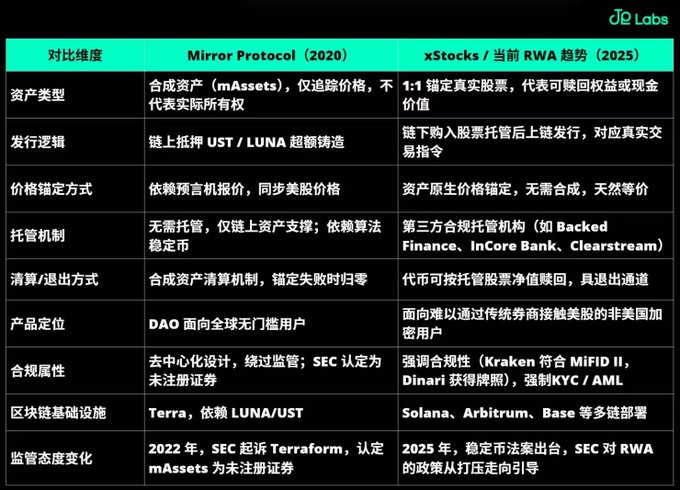
Mirror Protocol’s mAssets were essentially price-based synthetic assets created on-chain. They did not represent any real-world equity ownership or asset claims. Instead, they used oracles to mirror real-world stock prices and relied on smart contracts to simulate synthetic instruments that tracked prices but lacked actual asset backing. The issuance of mAssets depended on over-collateralized algorithmic stablecoin UST. Once the underlying stability mechanism faced systemic risk—as seen during the May 2022 Terra ecosystem collapse (UST depeg)—the entire asset system cascaded into zero value. The core problem here is that it anchored only “price,” not “ownership rights” or “assets.” In essence, mAssets resembled derivatives more than ownership certificates.
In contrast, xStocks adopts a fundamentally different asset-backing model. Initiated by Swiss-regulated entity Backed Assets, its underlying asset structure is clear and off-chain verifiable: real stocks are first purchased through brokers like Interactive Brokers, then held and custodied by regulated institutions including Clearstream, InCore Bank, and Maerki Baumann. Tokens are issued using a “buy-first, tokenize-later” approach, ensuring each xStock token corresponds to a real stock position—one-to-one alignment between on-chain tokens and off-chain holdings. In short, every on-chain purchase is backed by an actual stock transaction.
xStocks tokens are issued on the Solana public chain using the SPL standard, supporting 5×24-hour on-chain trading and instant settlement—breaking free from traditional securities markets’ constraints of business days and fixed trading hours. More importantly, compared to the fragility exposed by DeFi synthetic asset systems like Mirror under extreme market conditions, xStocks leverages real assets, compliant custody, and on-chain auditability, moving beyond the fragile mirage of purely synthetic DeFi constructs.
2. Compliance Logic Comparison: From Gray Zones to Regulatory Focus
Mirror Protocol emerged during the 2020 DeFi boom, a period marked by regulatory vacuum and experimental fervor. At that time, KYC/AML practices were uncommon; anonymity, censorship resistance, and borderless access were default assumptions. Users could mint mAssets by collateralizing UST or LUNA without identity verification and freely trade synthetic versions of TSLA, AAPL, and other U.S. stocks, enabling 24/7 global access to U.S. equities.
However, this model—built on synthetic assets and algorithmic stablecoins without regulatory oversight or real asset backing—planted the seeds of future risks. In 2022, following the global shock caused by the LUNA/UST collapse, the SEC filed charges against Mirror and Terraform Labs, explicitly classifying mAssets as “unregistered securities.” This ushered in a regulatory winter for on-chain synthetic assets. The Mirror model became a textbook case of failed experimentation, marking the end of Web3’s first attempt at mapping real-world finance.
Today, xStocks is driven by hybrid TradFi+Web3 players such as Kraken, Robinhood, and Backed Finance—all equipped with compliance infrastructure and traditional financial expertise. Kraken complies with EU MiFID II regulations; Backed Assets and Dinari hold licenses for security token issuance. Transactions require KYC/AML verification, and off-chain settlement processes are traceable. In 2025, newly appointed SEC Chair Paul Atkins referred to tokenization as a “digital financial revolution,” signaling a policy shift from suppression toward guidance.
It's important to note that xStocks are not equity tokens but rather tracking assets structured as debt instruments—functionally closer to transferable stablecoins combined with yield receipts. While this structure helps avoid stringent securities regulations, it also means they lack voting rights or corporate governance privileges. Dividend distribution and payout structures are more complex, requiring intermediaries (e.g., Kraken’s Bermuda subsidiary PDSL) for distribution. Although the bond-like structure offers tax and registration benefits (such as no stamp duty and bearer eligibility), it distances xStocks from the narrative of true “on-chain ownership of U.S. stocks.” Some users have remarked, “On-chain stock tokens feel like tax-optimized, watered-down versions of real stocks.”
3. Tech Stack Comparison: Closed Ecosystem vs. Protocol Interoperability
Mirror Protocol operated solely within the Terra blockchain ecosystem, heavily dependent on internal loops involving LUNA and UST. Despite relatively mature tools like Terraswap and Anchor Protocol, its major limitation was ecological isolation, lacking cross-chain synergy.
In contrast, xStocks deploys across high-performance multi-chain public networks such as Arbitrum, Solana, and Base, enabling cross-chain asset mobility. xStocks tokens can be used in Solana DeFi protocols for lending, liquidity provision (LP mining), gradually approaching composability on-chain.
Nonetheless, xStocks still faces challenges related to insufficient liquidity. Currently, on-chain liquidity is highly concentrated in a few top-tier assets such as TSLAx and SPYx. Many asset pools see fewer than 20 trades, suffer from severe slippage, and lack robust liquidity support mechanisms. Moreover, xStocks lacks deep integration with perpetual DEXs similar to those found in centralized exchanges, resulting in a noticeable gap in trading experience compared to CEX-based futures or U.S. stock CFD products. It remains difficult to accommodate large-scale user migration or high-frequency trading demands in the near term.
-
According to DefiOasis on-chain data, on June 30, 2025—the day of product launch—on-chain trading volume reached $1.338 million, with 1,225 unique trading users and 2,510 transactions.
-
On July 1, trading volume spiked significantly to $6.64 million, with 6,565 new unique users and 17,879 transactions, though activity remained concentrated among a small number of assets.
-
Trading was primarily focused on leading assets: TSLAx ($1.71M), SPYx ($1.53M), and CRCLx ($940K). Most other listed assets saw minimal activity, with some pools having zero liquidity, making effective order matching difficult.
4. Current Landscape of On-Chain U.S. Stock Tokenization
-
StableStocks: A CeDeFi company focused on the onchain stock ecosystem, StableStocks aims to create a complete闭环 for onchain stock operations. Its tokenization path relies on a proprietary compliant brokerage system and asset mapping technology, allowing users to invest in high-quality real-world stocks directly via stablecoins. Its core goal is to enable holding, borrowing, trading, and derivative creation of traditional stock assets on-chain while enhancing cross-platform liquidity for identical onchain stocks to improve depth and efficiency. The product allows entry into U.S. equities using stablecoins and plans to expand coverage to blue-chip stocks, ETFs, and thematic assets.
-
xStocks: Currently the largest on-chain U.S. stock trading project, xStocks holds nearly 90% of on-chain liquidity. Its compliance framework leverages Switzerland’s DLT Act and a dual SPV (Special Purpose Vehicle) structure based in Liechtenstein and Jersey, ensuring legal compliance at the issuance level. xStocks tokens are issued on the Solana public chain using the SPL standard and incorporate Chainlink price feeds for high-frequency synchronization with off-chain markets.
-
Robinhood: Representing traditional brokers entering Web3, Robinhood emphasizes “compliance-first” and “ecosystem closure.” Its European operations are regulated by the Lithuanian Central Bank and hold MiFID II and MiCAR crypto asset licenses, qualifying it to issue security tokens across the EU. Robinhood has currently deployed a stock tokenization prototype on the Arbitrum Layer 2 network and plans to launch a proprietary L2 chain to achieve technological self-containment under regulatory compliance.
-
Coinbase: As a dominant infrastructure player in the U.S. market, Coinbase’s tokenization roadmap is directly influenced by the pace of SEC policy development. Currently awaiting regulatory exemptions, Coinbase aims to activate its licensed subsidiaries to handle clearing, custody, and compliance reporting, targeting natively compliant issuance of U.S. stock assets on-chain. Its tokenization module is deployed on its self-developed Base Layer 2 network. The initial rollout is expected to include 50–100 U.S. stocks and ETFs, covering major blue-chip and select thematic assets, with support for dividend payouts and on-chain settlement.
Against the backdrop of gradually implemented stablecoin legislation, market attention toward compliant tokenization remains extremely high. Stock tokenization does not aim to replace traditional stock markets. Its greatest value lies in connectivity—opening the door to the crypto world for traditional investors while providing crypto users with tools tied to real-world assets. Just as Bitcoin and Ethereum ETFs enabled mainstream capital to enter the crypto market, stock tokenization may become the next key channel for capital inflow.
Author: @crypto_crane888
Powered by: @JELabs2024
Join TechFlow official community to stay tuned
Telegram:https://t.me/TechFlowDaily
X (Twitter):https://x.com/TechFlowPost
X (Twitter) EN:https://x.com/BlockFlow_News
 @JELabs2024