Trump's "Big Beautiful Bill": Presidential Authority Overriding the Vote
TechFlow Selected TechFlow Selected
Trump's "Big Beautiful Bill": Presidential Authority Overriding the Vote
President Trump's "mega bill" has made many Republicans uneasy, but that may not be enough to prevent it from becoming law.
 Navigating Web3 tides with focused insights
By Jess Bidgood & Catie Edmondson
Translation: TechFlow
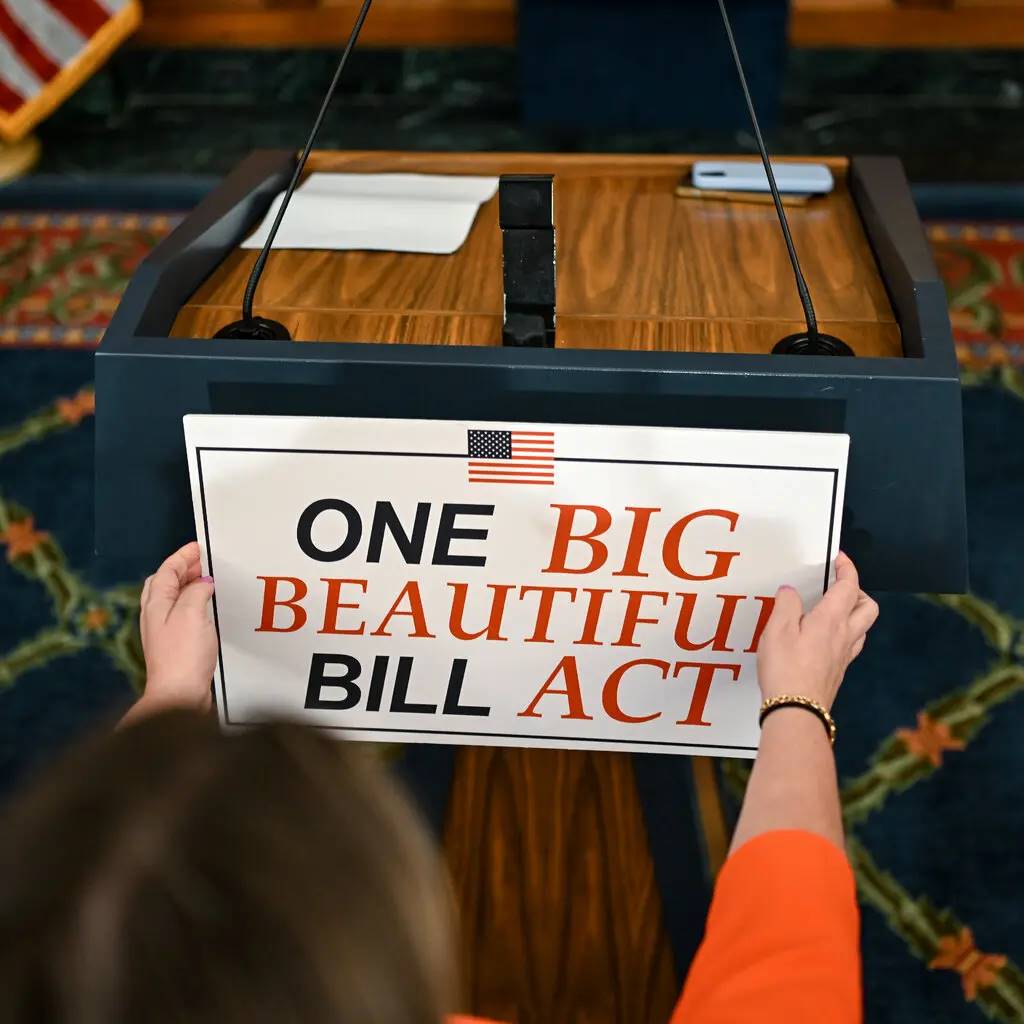
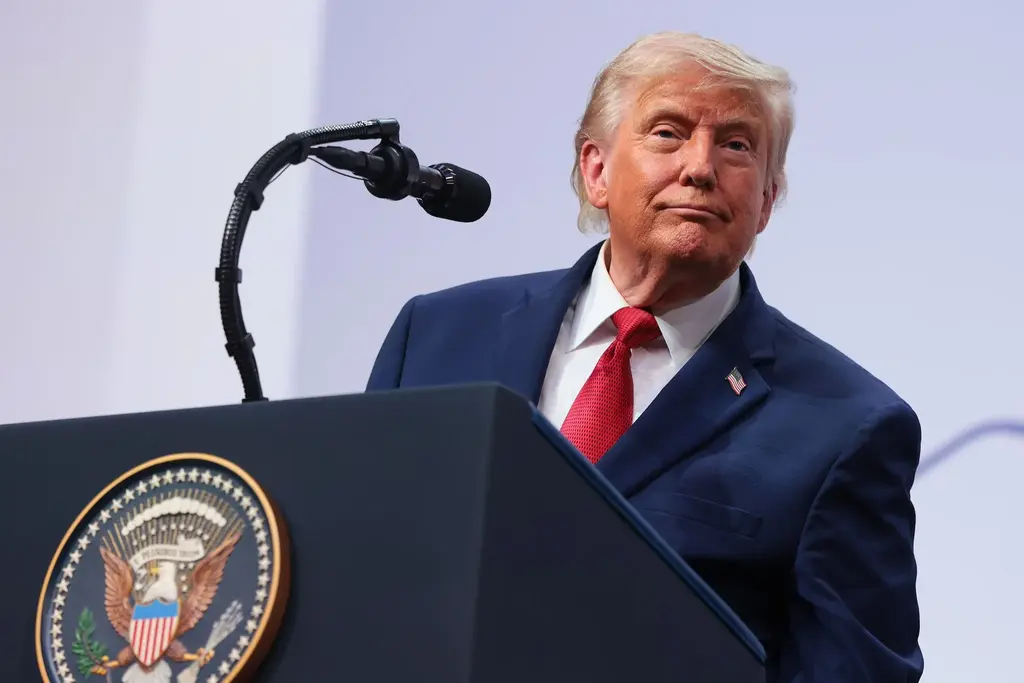
President Trump’s signature legislation may make progress this weekend.
Photo: Kenny Holston/The New York Times
President Trump calls his signature domestic legislation “One Big Beautiful Bill,” but its path forward has been anything but smooth.
The bill aims to extend the 2017 tax cuts and pay for them by cutting funding for the social safety net. In the House, it barely passed; in the Senate, it was heavily revised. In recent days, a key Senate official responsible for enforcing budget rules rejected multiple provisions, forcing senators into a frantic scramble to reinsert parts of the legislation.
Moreover, as my colleagues Carl Hulse and Catie Edmondson wrote today, nobody really likes the bill.
But this is Washington under Trump. There, minor issues like not knowing exactly what's in the bill or lacking enthusiasm for it might not be enough to stop Senate Republicans from voting yes—even possibly finishing the vote this weekend.
I asked Catie about the bill’s winding journey—how it became a policy “kitchen sink,” why it makes many Republicans uneasy, and why those concerns may have little impact on its chances of becoming law.
Republicans are scrambling to salvage portions of the bill that the Senate parliamentarian ruled violate budget rules. You’ve covered Congress since Trump’s first term and seen many legislative sausage-making processes. Is this kind of chaos normal?
To some extent, yes—this is a common feature of the legislative process, one both parties have faced before. For example, when Democrats used budget reconciliation to pass President Biden’s Inflation Reduction Act and pandemic stimulus packages, the parliamentarian also struck down major provisions, including a proposal to raise the federal minimum wage.
But I do think this back-and-forth reflects how the legislation has become a sprawling “kitchen sink” of policies, some of which have little to do with the budget. The bill includes tax cuts, reductions to Medicaid and nutrition assistance programs, but also bans on state regulation of artificial intelligence, looser gun laws, and the sale of public lands.
What role is Trump playing? Are his actions—or inaction—making things more chaotic?
Yesterday, President Trump publicly backed the bill at the White House, but we haven’t yet seen him deeply involved in vote-counting efforts. The usual Capitol Hill playbook is to bring him in late during critical votes to pressure holdouts.
At the same time, a familiar dynamic is playing out: lawmakers with reservations call the president, hoping he’ll endorse their position. President Trump often tells them he agrees. This leaves legislators unsure of his true stance, as his position can shift depending on whom he speaks with.
This is especially evident regarding Medicaid. Some senators believe the Senate version cuts too deeply. Missouri Senator Josh Hawley, among others, brought these concerns to the president. Afterward, Hawley said Trump told them he preferred the House version, which preserves more Medicaid funding.
The Medicaid debate is one of several internal Republican conflicts exposed by the bill. What other divisions have emerged?
The Medicaid issue is part of a broader disagreement over the scale of spending cuts. Early in the process, fiscal conservatives in both the House and Senate said they wouldn’t support any legislation that increases the deficit, insisting new spending cuts must offset the revenue loss from tax cuts. But that hasn’t happened—both chambers’ versions would add trillions to the deficit. That’s clearly not the fiscal path these conservatives envisioned while controlling Congress and the White House.
Does anyone actually like this bill?
Republicans argue they must pass the legislation because failing to extend the 2017 tax cuts would mean higher taxes for everyone. It also includes new tax breaks for tips and overtime pay—promises Trump made during his campaign. But beyond that, they’re largely preserving the status quo—the 2017 tax framework—while making deep cuts to widely popular social welfare programs.
If you’re running for re-election in a politically moderate state or district, you know Democrats will hammer you over the bill’s Medicaid and food aid cuts. Many Republican members have already heard voter concerns at town halls.
So, do these factors—the GOP’s dislike of the bill and the difficulty keeping it intact—actually threaten its passage?
I don’t think so, though it may complicate their timeline and alter the final details. Since the House passed its version, the bill has seemed inevitable.
They might pass a bill with major political risks that nobody loves. Why?
It’s a vote with significant political risk, but it’s not driven by a grand ideological vision, unlike some difficult bipartisan votes we’ve seen in the past. But it’s something Trump wants.
I think there’s a widespread sense among Republicans that they could lose the House majority in the midterms—a historically likely outcome—which means their window for passing major legislation is narrow. They also feel an ideological urgency to extend the 2017 tax cuts. Combined with the fact that this bill has essentially become a simple up-or-down vote on the president’s agenda, the chances of total failure are extremely slim.
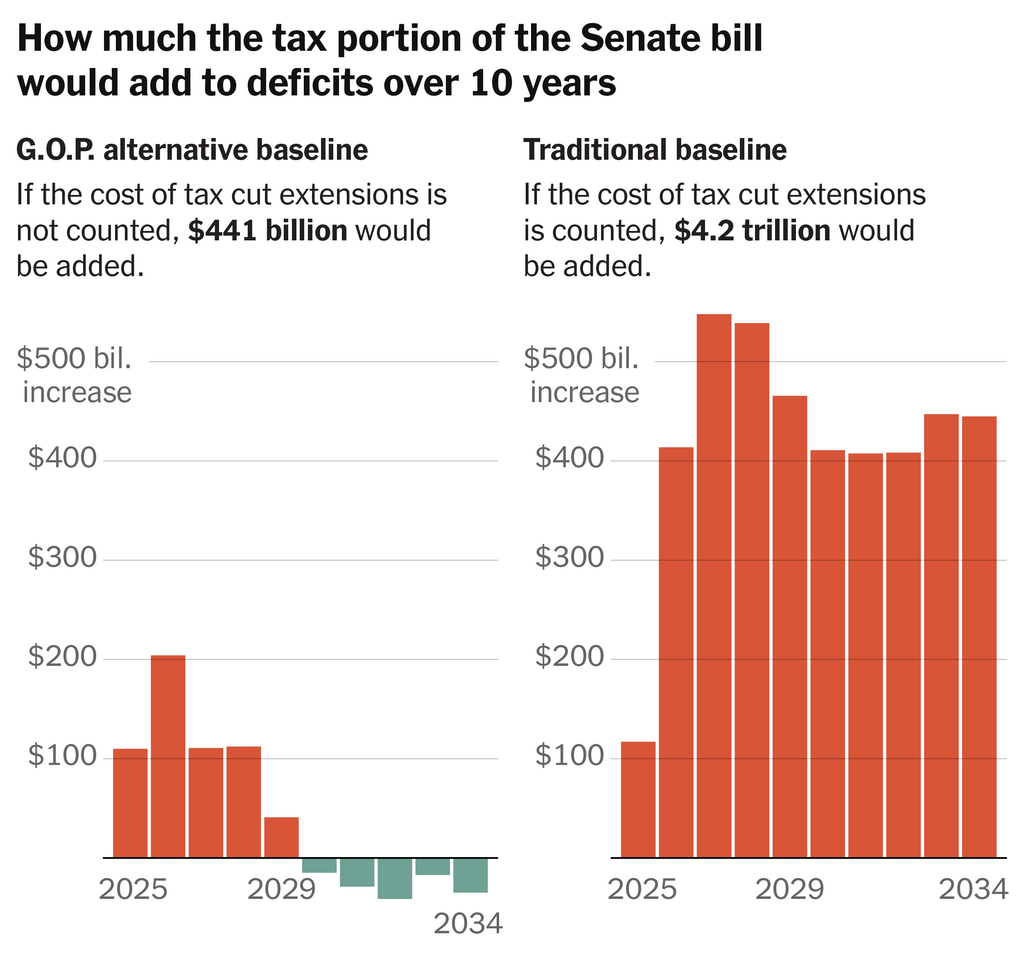
How much will the “Big Beautiful” bill cost? That depends on how you calculate it—and where you start. I asked my colleague Andrew Duehren, who covers tax policy, to explain. He swears researching this stuff is actually fun. He walks through the budgetary "gimmicks" Republicans are using to make the numbers look better.
Every budget relies on assumptions about the future. Next month, how much will I spend on groceries? Will I get a raise at work? These answers help determine whether I can afford a vacation.
Washington works similarly, just on a much larger scale. For years, Republicans and Democrats have agreed on baseline assumptions about the nation’s future budget—assuming no additional policy changes. They use this baseline to judge whether policies like tax cuts are affordable.
Senate Republicans want to change how Washington sets these future assumptions. For decades, temporary tax cuts have been treated as one-off expenses, typically assumed to expire in the long run, allowing taxes and government revenue to return to previous levels.
But Senate Republicans argue this assumption is flawed. They want to build the 2017 temporary tax cuts into long-term budget projections. By redefining them this way, extending the cuts—as they aim to do through this bill—wouldn’t appear as new spending.
It’s like assuming you only rented a luxury car temporarily as a special expense, but when the lease ends, instead of switching to a cheaper option, you tell yourself: I always planned to pay the higher rate, so I can easily rent another luxury car.

Haiyun Jiang/The New York Times
Arrivals and Departures
Haiyun Jiang, The New York Times’ newest photojournalist, loves capturing images that tell stories of power. This week, she followed President Trump to The Hague and seized such moments.
On Tuesday night, Haiyun waited with other photographers for Trump’s arrival at Huis ten Bosch, a Dutch royal palace where he would meet the king and queen and stay overnight. Such ceremonial, high-profile events involving royalty are exactly the kind of occasion Trump enjoys.
When Trump arrived in his armored limousine, Haiyun saw a perfect opportunity to capture presidential authority.
“I tried to frame him through the car window, because I knew the Secret Service would open the door for him—I thought that would be a powerful way to show power,” Haiyun told me.
Later, she captured another moment. As Haiyun and other photographers were hurried away from the scene, she noticed palace guards already removing symbols of power and ceremony.

Haiyun Jiang/The New York Times
Join TechFlow official community to stay tuned
Telegram:https://t.me/TechFlowDaily
X (Twitter):https://x.com/TechFlowPost
X (Twitter) EN:https://x.com/BlockFlow_News
 @nytimes