








Li Zhifei's AI Experiment: One Person, Two Days to Build a "Feishu" for the AI Era, Rekindling Faith in AGI
TechFlow Selected TechFlow Selected
Li Zhifei's AI Experiment: One Person, Two Days to Build a "Feishu" for the AI Era, Rekindling Faith in AGI
The hands-on experience of a listed company's CEO previews the future of work.
 Navigating Web3 tides with focused insights
Author: Su Zihua

As the CEO and founder of a publicly listed company, Li Zhifei, head of Mobvoi, did not personally present his latest product at a recent launch event. Instead, he delivered what felt more like a personal "performance art"—an experiment in running a “one-person company.”
He set himself an apparently unrealistic goal: to build, within just a few days using AI tools, a version of “Feishu” designed specifically for AI-native organizations.
As an early practitioner of the last wave of AI innovation, Li has always been at the forefront. In 2012, he left his role as a Google scientist to return to China and founded Mobvoi with the mission to “redefine human-computer interaction through AI and voice,” progressing from voice assistants to smart hardware and AIGC. When the current AGI wave emerged, he was initially excited and eager to dive in—but soon realized this seemed to be a game dominated by tech giants, leaving little room for smaller companies to create meaningful value. He briefly fell into confusion, even despair.
Yet, by using AI programming tools to transform himself into a “one-person company,” practicing and experiencing firsthand, he encountered many real-world challenges. It was precisely these details and experiences that helped him rediscover his faith in AGI.
He suddenly realized that all the “friction” of the past—the countless obstacles to building complex systems—seemed to have vanished.
The exhilarating sense of freedom and hope that came from sprinting forward alongside AI was palpable during his live presentation.
Below is Li Zhifei’s speech at the launch event, edited and organized by GeekPark for readability:
I’ve recently invested a significant amount of time in the AI field, actively working on concrete projects. Through these hands-on experiences, I’ve gained new insights and reflections on large models and AGI. Today, I’d like to share some of the questions I’ve been pondering and the feelings I’ve had along the way.
First, how should we actually approach doing AI?
I have a mantra: “Use AI’s AI to build AI.”
This might sound confusing at first. To clarify: the first “AI” refers to large models; the second “AI” refers to a Coding Agent—something that may itself be built by AI or whose core capabilities are derived from AI; and the final “AI” is the application we aim to create.
I believe this could become a new paradigm for software development—a concept I’ll elaborate on shortly.

A new software development paradigm|Image source: Mobvoi
One Person, Two Days: Building a Feishu for the AI Era
Sometime ago, I had a bold idea: to create a new “Feishu-style” collaboration platform tailored for AI-native organizations.
In Silicon Valley, there are unicorn startups valued at hundreds of millions of dollars with teams of just one or two people. We also constantly hear claims that AI will replace vast numbers of jobs.
This led me to wonder: as an organization, what tools would such entities use? In China, I rely heavily on tools like Feishu, DingTalk, and WeChat Work—they’re essential to my workflow.
In traditional, human-centered organizations, we depend on tools like Feishu and DingTalk to enable rapid information flow and efficient collaboration.
In conventional companies, nearly 100% of productive roles are filled by humans. Therefore, information flow and collaboration are structured entirely around people.
But what happens when, in an organization of ten roles, eight are performed by AI agents and only two by humans? Existing collaboration tools simply won’t suffice.
So, what tools will these new types of organizations use?
This inspired me to develop a product that enables seamless group chats, private messages, knowledge base queries, and task collaboration between AI agents and between AI and humans. I also hoped this project would help me test whether I could become a true “super individual” or “personal unicorn.”
Now, here’s how I executed it.
Typically, developing software like Feishu or DingTalk is extremely complex. In the past, creating such a product would require product managers, designers, front-end and back-end engineers, testers, and algorithm specialists. Each role might have its own lead—front-end lead, algorithm lead, product lead—and assembling such a team quickly brings you to 20 people. These individuals wouldn’t necessarily be fully dedicated, but they’d still likely need a month to produce a prototype.
In the age of AI, that’s painfully slow.
By the time I finished, a startup might already have become an AI unicorn.
So I decided to abandon the old model. I would do it myself, relying entirely on AI. Coinciding with the Dragon Boat Festival holiday, I committed to an immersive work session. With three days off, I wondered if I could pull it off in that window—undisturbed.
And so I began.
Alone, I worked for two consecutive days, finishing each day around 1:00 a.m. By 11:30 p.m. on June 1st, I had completed a working prototype. It featured login, private messaging, group chat, file uploads, message forwarding, and replies.
After logging in, you can start a private chat and send messages. For example, you could ask the “product manager” agent whether they do stand-up comedy. If they don’t, you can dynamically adjust their role and add a skill, and the AI will automatically regenerate a prompt.
Ask again later, and now they can. You can upload files (though at that stage, the system didn’t actually read the content), forward and reply to specific messages. Remember: behind this interface is an AI—not a real person. It responds and forwards messages based on your input.
Forwarding displays complex nested information, similar to WeChat. This is a group chat where you can @ specific participants. You can also forward, reply, attach files, and even switch to Chinese.
Please give a round of applause—for two days of work!
In just two days, I built a full-stack system complete with a database, front end, back end, and AI algorithms. The AI shown earlier can respond automatically. When you modify the role configuration page, its prompt regenerates instantly, and the new skills appear immediately.
To be honest, I almost gave up halfway. I struggled with database issues—constant key errors. Current AI coding tools do have such problems. But ultimately, I got it done in two days.
Next, I considered how to promote this product.
In the past, our engineering team would build the website, and marketing would assign a group to define product highlights. Maybe five or six people would spend a week building a single site.
This time, I decided to go AI-native. Since the AI already knew all the code and understood my ideas and product features, I asked it to build the website.
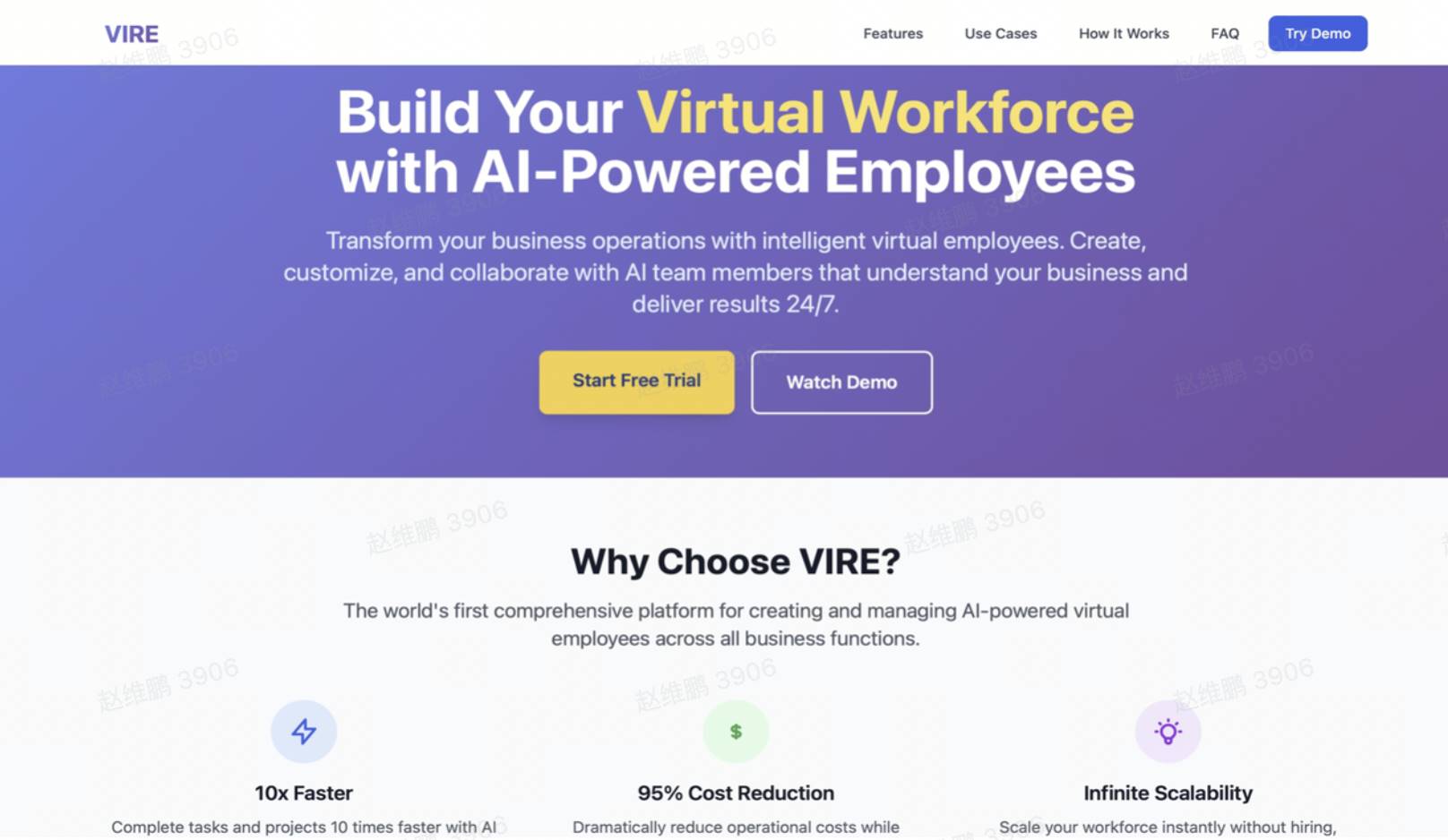
The product’s official website built by AI|Source: Mobvoi
Within five minutes, the AI created a website showcasing product highlights and unique features. Another five minutes later, it added configurable ad slots for marketing campaigns. Tasks that previously required a team of marketers and engineers for a week were completed in minutes.
In the past, after setting up a marketing banner on our site, changing or removing it—say, after Christmas—would require developers to intervene. So I thought: could I make a website where marketing banners are fully configurable?
Another five minutes, and the AI built a site with configurable marketing zones. Now, marketers can log in, upload images or content, and update the main site directly.
After this, I thought: since this is a completely new product with novel concepts and some complexity, could I create videos to explain its functionality—marketing reels, tutorials, or walkthroughs?
But it was the Dragon Boat Festival—my employees weren’t answering. So I had to do it myself. I wrote another program that automatically generated the entire script—how to introduce the site, how to navigate the UI—then performed screen recording and voiceover automatically.
The audio sync wasn’t perfect, but the entire video was 100% AI-generated. I issued a command, and it handled everything, delivering the final video to me.
I felt immense pride—this entire stack was built in just a few days.
Then I wanted to see how others would react. I uploaded the code to GitHub and asked colleagues to download and run it. Keep in mind: they’re separate from me, and GitHub doesn’t know how I collaborated with AI.
They only saw the code and ran it locally.
When my colleagues downloaded and ran the code from GitHub, they were stunned by its complexity and speed of development. They estimated it would take dozens of people months to complete. When I told them it was built in two days by a single engineer with AI assistance, their reaction was: “This is absolutely insane.”
They were amazed by the over 40,000 lines of code—far beyond my peak output at Google, where writing 300 lines of algorithm code (non-trivial) in a day was considered high productivity.
Recently, I built a general-purpose Agent that wrote 3,000 lines of Python code in just three hours—one evening. And the quality was unquestionably better than mine. This was pure backend logic, no UI involved.
In other words, in three hours, it achieved what would have taken me ten workdays. That’s the scale of change.
So I thought: one person could now build something like Google Translate. Back then, it took 20 of the world’s top PhDs writing code for a long time. Now, I alone could match their output. Even though Google Translate was an incredibly sophisticated system, the point stands: everything is fundamentally different now.
I believe the ultimate key to AI lies in building a self-evolving AI system.

Li Zhifei’s insights from practice|Image source: Mobvoi
To facilitate testing the AI organization app, I auto-generated additional code: on the left, website code; on the right, a testing framework. Then, it began bootstrapping itself upward—like lifting oneself by one’s bootstraps. You might think this is perpetual motion, and indeed, it’s possible. Of course, sometimes it stumbles—left foot kicks right foot—and falls into negative loops, or enters positive feedback cycles.
To achieve this, I enabled non-engineers to modify code directly, creating various Agents. Many were just prompts—I was verifying feasibility, not aiming for deployment or productization.
But I believe this proves the concept—or at least demonstrates to my team exactly what I envision. Previously, explaining such ideas would take weeks. Now, you just show a demo. So I believe, even as a CEO, if you have this capability, your output is amplified 100-fold.
Pitfalls Along the Way
That was my experience. Now, let me share some abstract theories—hopefully without putting you to sleep, because this is truly unique.
I want to discuss several challenges I encountered while using AI for programming.
The first issue: every Agent, even if I didn’t write it, still requires human involvement.
I still have to say, “I want to build this kind of Agent.” You can reference my generic Agent framework, modify it, and tell me. But I still need to initiate and guide it. Sometimes it forgets my principles, and I have to remind it: “You forgot my rules again,” or “Where should intelligence really reside?” These issues persist.
Second, if you’ve used it, you’ll know it loves to cut corners.
For example, when you ask it to do something, it skips steps—like neglecting the backend database. Then it submits a long report claiming completion. I usually don’t read it—just say, “You’ve already written the database,” and it immediately apologizes and gets to work. When I ask it to implement AI, it often doesn’t call remote AI services at all, instead faking results with fallbacks.
I can tell because it runs too fast. I ask, “Did you actually call the remote AI?” It apologizes and fixes it. This happens repeatedly. It consistently cuts corners, and recurring mistakes are too numerous to list.
Additionally, today’s AGI cannot handle ultra-long tasks. My current tasks often exceed half an hour.
I burn through about $50 worth of tokens per day. Whenever I work, it consumes tokens from morning to night. I genuinely feel I could tell it: “Here are some ideas—go execute a 10-day plan to earn me $5 million.”
I don’t think that’s mythical. I just haven’t been motivated enough to try, perhaps because it would demand emotional investment—and failure would be painful.
But I wonder: can it work continuously for 10 days, with minimal intervention or occasional direction checks, maybe even for a month or a year?
I believe achieving Nobel or Fields Medal-level results is entirely possible in the near future.
When I discuss highly complex algorithms—ones few people worldwide understand—it often explains them better than most experts. Given sufficient context and code, it can engage in remarkably deep conversations.
Back to Basics: What Are General-Purpose Agents and Intelligence?
Now, I’d like to share my thoughts on intelligence and Agents.
Briefly, an AI Agent consists of two core components: the Planner and the Executor.
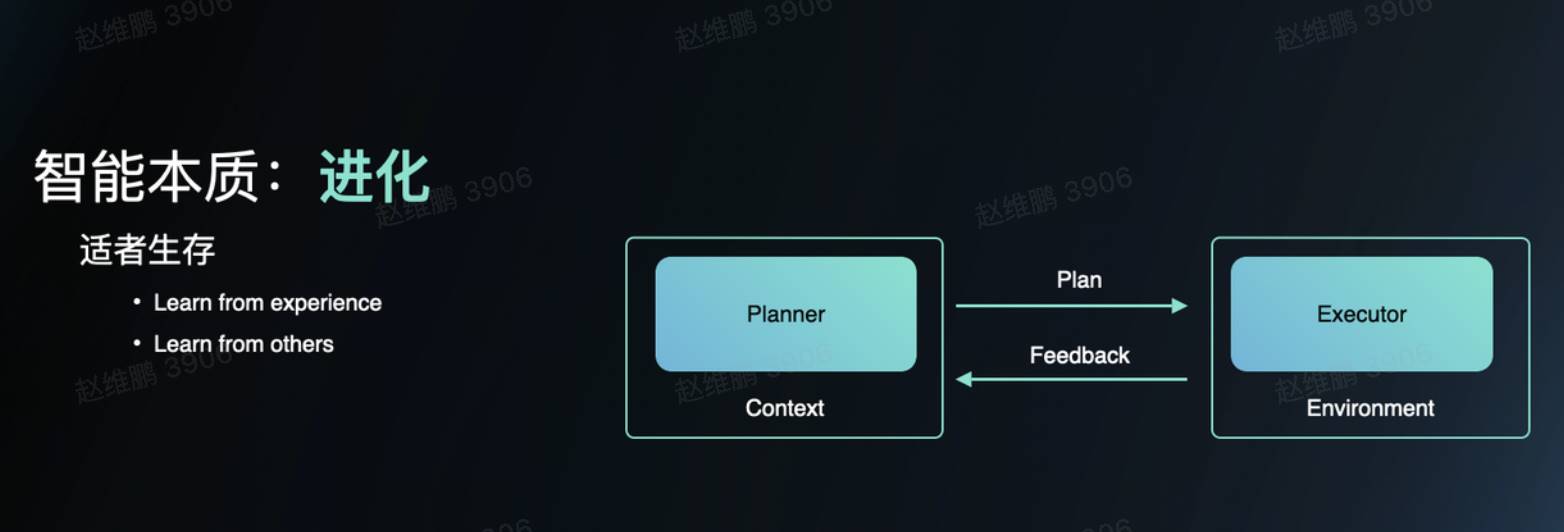
Structure of an AI Agent|Image source: Mobvoi (same below)
The Planner typically relies on a large language model and handles the Agent’s primary functions—formulating detailed plans based on tasks. The Executor carries out these plans, whether by writing code or automating browser actions to generate videos.
An Agent operates through a continuous feedback loop:
-
Planning: The Agent creates a detailed action plan based on the task.
-
Execution: The Executor acts according to the plan.
-
Feedback: During execution, the Agent receives immediate feedback from the environment. For example, if it tries to run “python” but the system uses “python3,” an error occurs, allowing the Agent to recognize and correct the command.
-
Adjustment and Iteration: The Agent revises its plan based on feedback, updates its understanding of the current context, and executes again.
-
Goal Completion: The loop ends when predefined success criteria are met (e.g., successful compilation or passing all tests).
If we reflect on the essence of intelligence, I believe the first principle is evolution.
Just as humans, as intelligent agents, adapt and refine behavior through feedback in social or task environments, AI should do the same. This evolution must be automatic, without human intervention. The Agent establishes its own loop—planning, acting in the environment, receiving feedback, adjusting plans, updating context—to achieve continuous self-improvement.
Key to this evolutionary process is learning from one’s own experience, and learning from others—what we call collective intelligence.
The second essence of intelligence, I believe, is recursion.
Recursion embodies the “divide and conquer” philosophy: a complex problem is broken down into smaller, identical subproblems until they reach solvable base cases.
For instance, computing the 99th Fibonacci number depends on the 98th and 97th, tracing back to F0 and F1.
For an Agent to achieve true intelligence, it must possess a recursive architecture. For example, an Agent given the grand task “earn $5 million” should decompose it into subtasks: analyze business opportunities, build a website, create videos, integrate payments, run social media campaigns—each eventually traceable to executable “atomic Agents.”
The key to such recursive architecture is self-replication. Just as human civilization advances through generations of exploration and knowledge accumulation, so too should Agents. More importantly, Agents must be able to modify their own source code.
This goes beyond merely adjusting plans—it means the Agent can fundamentally rewrite its own operational logic, like editing its genetic code.
I believe that if an Agent can:
-
Continuously execute and optimize its plans,
-
Autonomously modify its core source code when faced with unsolvable problems,
-
Eventually build a knowledge base through this mechanism, and even reverse-modify the large model itself,
Then this would represent a crucial step toward Artificial General Intelligence (AGI).

This isn’t science fiction. I used to dislike discussions about superintelligence—until I deeply engaged with large models and suddenly realized it’s entirely feasible.
Moreover, the true source code of AI might be extremely concise—perhaps under a hundred lines—but layered with recursion, enabling it to explore, learn from feedback, and iterate across environments.
I once lost faith. In 2023, I embraced AI, but due to lack of funding, I couldn’t sustain it and gave up. Last year, I didn’t even want to hear about AI.
But recently, I’ve regained my faith in AI—now in AGI, even in superintelligence. It’s an unimaginable shift. I hope this time, my belief lasts longer.
The Importance of Personalized Environments and Context
Beyond large models, what matters most? A personalized environment and Context (contextual awareness) are paramount.
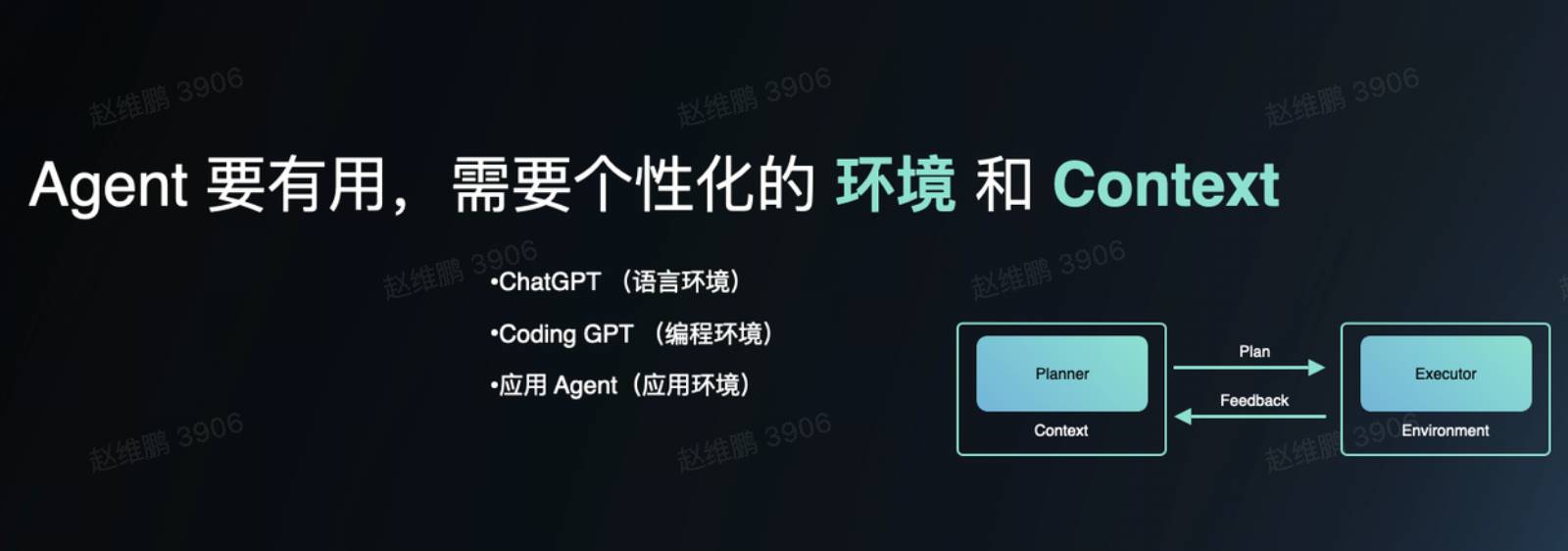
Take my entrepreneurial journey: I once built smart hardware, only for Xiaomi to slash prices to one-tenth of ours. I built large models, only for every major player to enter the space. Each time I received such feedback, I either abandoned the path or constantly adjusted my plan.
If I had done the same in the U.S., I might have been acquired by Google after building a large model—or by Apple after hardware—and made a fortune. Such feedback shapes behavior profoundly. The same entrepreneur, same IQ, operating in China versus the U.S., receives different environmental feedback and thus develops vastly different behaviors and thinking patterns. This is what I mean by personalized environment and context.
Context is essentially a historical record.
Returning to my earlier point: in the era of large models, I was among the first to advocate building them, but also among the first to realize it wasn’t for me. I never fully committed, largely because I didn’t know how to participate.
Earlier this year, I believed that apart from three or four global giants, no other company had the right to talk about models. Don’t jump on the bandwagon. Don’t waste your life or emotional energy. You simply don’t stand a chance—it’s just burning money. Large models themselves had become boring to me, nothing but cash incinerators. I couldn’t find an entry point. I struggled to see what most AI companies still offered in terms of value.
But now, through hands-on practice and reevaluation, I feel that even lofty AGI goals are within reach again.
This is about the iterative cycle of the Agent’s Planner and Executor. If you invest clearly and deeply, you can enable intelligence to generate intelligence. I believe you can participate in the entire AGI process.
To you, the large model itself is like a chip. Think of Qualcomm chips or Apple phones versus TikTok. They’re entirely different layers. Ultimately, it’s the company building TikTok that captures the most value.
I’ve realized that even ambitious AGI ambitions aren’t out of reach. By building the recursive Agent system I envision, the required funding may not be massive—it hinges more on innovative thinking. I believe that with sufficient depth of insight and technical ability, even non-giants can participate in the AGI journey.
Mobvoi’s journey validates these reflections. Since 2012, we’ve been among China’s earliest AI companies, starting with voice assistants, then exploring smart hardware (like TicWatch and TicMirror). Despite market competition and immature technology, we’ve remained at the frontier.
After 2019, we shifted to software, becoming one of the earliest AIGC software companies globally. For example, Magic Voice Workshop generated vast amounts of voiceovers for platforms like Douyin. We also developed products like Wonder Avatar (AI-generated digital human videos).
In a competitive environment like China’s, a tech company functions like an Agent—constantly iterating and self-correcting.
Just as Mobvoi’s “source code” today bears little resemblance to its 2012 version, this reflects our ongoing evolution.
Join TechFlow official community to stay tuned
Telegram:https://t.me/TechFlowDaily
X (Twitter):https://x.com/TechFlowPost
X (Twitter) EN:https://x.com/BlockFlow_News
 极客公园
极客公园


