Interview with Tether CEO: Unveiling the "Four Stabilities" Vision and the $14 Billion Investment Landscape
TechFlow Selected TechFlow Selected
Interview with Tether CEO: Unveiling the "Four Stabilities" Vision and the $14 Billion Investment Landscape
Why would a stablecoin company invest in AI, agriculture, and brain-computer interfaces?
 Navigating Web3 tides with focused insights
Original: The Block
Compiled/Translated by: Yuliya, PANews
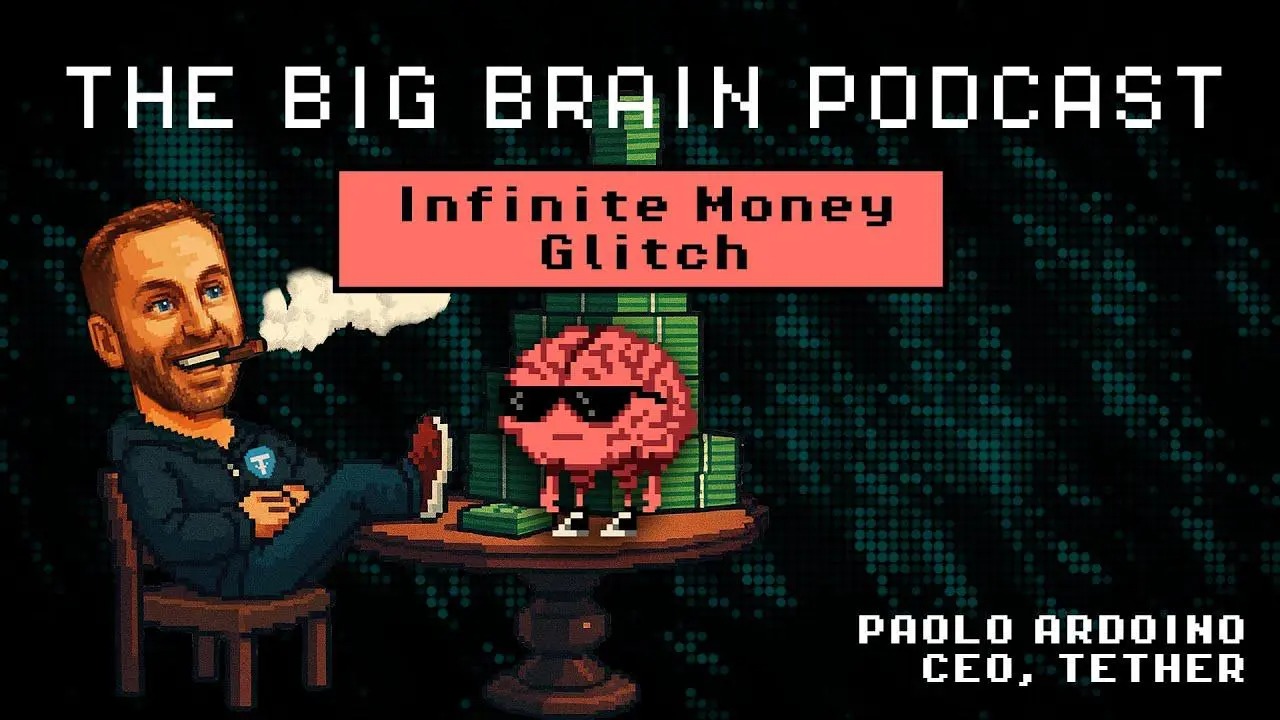
At a time when stablecoins are gradually permeating the global economy and AI converges with blockchain technology, one highly controversial yet influential company is quietly building its "infinite money loophole" strategy. This episode of The Block features Paolo Ardoino, CEO of Tether, sharing Tether’s on-chain strategic layout, its multibillion-dollar investment directions, systematic strategies for AI and energy, and even its long-term ambition to build an open-source brain-computer interface system. PANews has compiled and translated this dialogue.
Tech geek turned stablecoin leader calls for stronger U.S. regulatory safeguards for USDT
Host: Welcome, Paolo. Could you introduce yourself and share how you became CEO of Tether?
Paolo: I'm a tech geek—I've been coding for 32 years now. I started as a senior developer at Bitfinex, then became CTO of both Bitfinex and Tether, and finally became CEO of Tether in 2023. My philosophy has always been to build technology that holds up under worst-case scenarios, not just systems that work perfectly in ideal conditions.
Host: A few years ago, Tether faced heavy criticism. Now it's one of the most profitable companies globally, earning $13 billion last year alone. How do you view this transformation?
Paolo: Our entire industry is still in its early stages. Tether was founded in 2014, introducing the concept of “stablecoin”
—for nearly ten years, almost no one cared. But now, 2025 is being called the “Year of the Stablecoin,” and governments in the U.S. are drafting regulations, which speaks volumes.
This journey hasn’t been easy. We’ve built an entirely new industry from scratch, inevitably clashing with traditional financial systems and facing significant obstacles—especially from the banking sector. But our team never backed down. We’ve always believed in providing dollar access to people excluded from mainstream finance.
For me personally, this was also my first real entry into the United States—I came here for the first time at age 40. Regulatory actions like “Chokepoint 2.0” were very damaging in recent years, but lately, through conversations on Capitol Hill and within executive agencies, I can sense attitudes beginning to shift.
The global impact of stablecoins is undeniably growing, especially in developing countries where their role is particularly pronounced. To illustrate: America’s financial system is already highly efficient—say 90%. Stablecoins might push that to 95%. But in countries like Nigeria, Argentina, or Turkey, financial efficiency may only be 10% to 20%. With stablecoins, that could jump to 50%. So for these nations, stablecoins are far more transformative.
Regulatory frameworks should reflect this reality and provide appropriate safeguards for offshore issuers like USDT. While USDT is considered a foreign stablecoin to the U.S., its significance remains immense—even critical—for maintaining the dollar’s global standing and purchasing U.S. Treasuries.
Host: Do you think the U.S. will launch its own stablecoin in the future?
Paolo: Even if the U.S. launches its own digital currency, privately issued stablecoins will still play a vital role. The success of USDT proves precisely that privately issued stablecoins can greatly benefit the U.S. We hold large amounts of U.S. Treasuries through domestic institutions like Cantor Fitzgerald, with extremely transparent processes. The U.S. can closely monitor us without bearing the burden of issuance and management.
Using USDT and XAUt to improve lives in high-inflation countries; education is a long-term battle
Host: You once shared an example of a convenience store pricing goods in USDT. Can you explain how USDT improves lives in high-inflation countries? Do you think this will become widespread?
Paolo: Sadly, the success of USDT isn’t due to how well we’ve performed, but rather because so many economies are failing. Take Turkey: annual inflation reached 50%, and its local currency lost 80% against the dollar over recent years. Argentina is worse—their currency has depreciated over 90% and they’ve defaulted multiple times. USDT offers these populations a risk-hedging channel.
We found that smartphone penetration and young demographics are key drivers of digital dollar adoption. From 2017 to 2020, youth were the first to learn about cryptocurrency. After the global pandemic hit in 2020, these young people began teaching their parents how to use digital dollars to survive economic hardship. For decades, their parents had resorted to risky black-market cash dollar purchases—but during the pandemic, that became even more dangerous and inefficient. Young people learned from each other on platforms like Discord, then taught their parents how to securely hold digital dollars via smartphones.
Host: How do you see Tether’s role in today’s geopolitical landscape, particularly regarding the expansion of “Western values”?
Paolo: To me, money is the ultimate social network, and the change driven by Tether has threefold impact.
First, we’ve achieved greater financial inclusion than many international organizations, NGOs, or charities ever have. That shocks me—if a small company can accomplish what they failed to do in decades, they really need to reflect. We’re genuinely bringing financial services to hundreds of millions of people still excluded globally.
Second, Tether is expanding the global use of the U.S. dollar, reinforcing dollar dominance. This isn’t exaggeration—we’ve established millions of offline touchpoints across emerging markets, from convenience store networks and phone top-up kiosks in Central America to village markets in Africa. We engage directly with them. These distribution channels can also deliver financial education or sell other products.
Third, we’re building our own energy and financial infrastructure in Africa—a continent where electricity access is extremely low. Of 1.4 billion people, 600 million lack power at home. We’ve deployed solar-powered financial service kiosks. In these villages, Tether kiosks offer rechargeable batteries for just 3 USDT per month. Residents learn how to set up USDT and Bitcoin wallets, save, and transfer funds. We’ve already deployed 500 such kiosks, serving 500,000 users with 10 million battery swaps recorded. We aim to scale to 10,000 kiosks by 2026 and 100,000 by 2030, reaching approximately 30 million African households. This isn’t just financial distribution—it’s light distribution. We’ll illuminate the heart of Africa, visible from space.
Host: Besides USDT, you also have Tether Gold. In high-inflation countries, could we see a return to the gold standard? Why did you launch Tether Gold?
Paolo: We approach every product from utility. If fiat currencies are the lowest-quality tools, the U.S. dollar is the best among them, above it is gold, and at the top is Bitcoin.
Bitcoin, as a mathematically governed currency, is unique because it’s fully determined by algorithms and code—not influenced by any nation or individual. In contrast, gold has been humanity’s recognized money for 5,000 years. It resists manipulation and its supply is largely governed by natural laws, unlike fiat currencies that lose value through inflation. Even with technological advances increasing gold mining, supply growth remains constrained by nature—it can only rise slowly, never doubling in a few or even ten years.
That’s why we launched Tether Gold—because beyond Bitcoin, it’s the best asset tokenization we can offer. Right now, gold prices have tripled in three years, partly because BRICS nations are preparing a gold-backed digital currency and building infrastructure across Africa and South America. Such a currency isn’t yuan or ruble-based—it’s simply “gold-backed”—making it highly attractive in emerging markets. We want to offer an alternative before they do.
Host: What do people really care about? Do they just want a tool to send and pay, regardless of underlying tech like blockchain?
Paolo: They don't care about blockchain itself. All they care about is one thing—fees must be low, nearly zero.
We recommend certain partner digital wallets and encourage users to keep USDT in them. But we’ve noticed a problem: many wallets promote flashy features—using USDT to invest in some token, staking, buying NFTs. These behaviors harm household savings.
So we decided Tether should build its own wallet focused on savings for these markets. We’re creating an open-source SDK called Wallet Development Kit (WDK), allowing anyone to build wallets using it. The interface will be extremely simple—just two accounts: a daily USDT account and a savings account for holding Bitcoin or connecting to decentralized yield protocols. Developers can add new features, but our default version is a minimalist design made specifically for African users. We’re collaborating with Opera’s MiniPay team and seeking more partners.
Globally, we conduct the most extensive Bitcoin education, yet often hear feedback in these regions: “I understand Bitcoin, but I still prefer USDT.”
It’s not because people are ignorant—they simply lack time or resources to deeply study Bitcoin. Many “Bitcoin maximalists” overlook this, assuming everyone has the capacity to research crypto, which isn’t true.
So we start with what they know—like USDT—to build trust, then gradually guide them toward Bitcoin. Education is a long-term battle. It’s not won through talk, but action. Tether is investing real capital and resources on the ground to drive this process.
Maintaining ecosystem neutrality, delivering optimal on-chain paths for users
Host: Most of Tether’s on-chain activity happens on Ethereum and Tron. Now we’re seeing rising trends in “stablecoin-dedicated blockchains.” How do you view these developments?
Paolo: Tether has never created and will never create its own blockchain. I believe it’s important not to encroach on our partners’ businesses. There should be an open market and fair competition among different blockchains. But the issue is that chains like Ethereum have extremely high transaction fees. I’d like to see more activity migrate to blockchains offering better user experience and lower costs.
Therefore, Tether plans to experiment in its new wallets and products by developing an algorithm that allows users to automatically route part of their funds via USDT to the blockchain with the “lowest transaction fee” and “fastest confirmation speed.” This initiative aims to provide users with a fairer ecosystem, especially helping those who cannot afford high fees. Additionally, the system will support multi-chain QR code recognition to foster accountability among blockchain developers.
Host: So your vision is for Tether to remain completely neutral across all chains—users won’t even need to know which chain their money is sent on, and it will work seamlessly across multiple blockchains. You’ll select the optimal path based on fees and other factors. Is that correct?
Paolo: Yes. And actually, I don’t think even *we* should choose. We want a highly open, transparent, public algorithm that every blockchain can see. I don’t want to be the referee or accused of bias. As long as the algorithm is public and visible to all, everyone should be satisfied. It simply routes transactions to the cheapest and fastest chain—that’s all.
Deploying multibillion-dollar investments, trading independence for long-term strategic advantage
Host: How do you approach investment strategy? What do decision-makers prioritize?
Paolo: Over the past two to three years, Tether has earned roughly over $20 billion. Less than 5% has been distributed to shareholders. Our thinking is to retain most of these funds within Tether’s investment arm. As you mentioned, part of our reserves back the stablecoin’s overcollateralization, but the remaining $14 billion or more is now being invested in various ways.
One portion expands our distribution network—such as terminals and payment infrastructure in Africa and Latin America. We currently hold stakes in 50 to 60 portfolio companies spanning education, mobile phones, app distribution, and more. We’re not just distributing digital dollars—we can also distribute Tether Gold, educational content, apps, etc. This builds a comprehensive distribution network, further expanding USDT’s monetary base.
A second focus is digital distribution networks, like Rumble—a video platform with 70 million users. Interestingly, Rumble creators sold $850 million worth of gold between 2023 and 2024. Imagine the opportunity if Rumble launched a wallet supporting Bitcoin and Tether Gold. We aim to combine digital infrastructure with asset distribution.
We also make longer-term, highly stable investments. For instance, we invested in Adecoagro, the largest single landowner in South America, with vast agricultural holdings across Brazil, Argentina, and Uruguay, producing dairy, rice, bioethanol, and more. We view land as approaching Bitcoin and gold in scarcity—less interchangeable, but still a robust long-term asset. More importantly, Adecoagro is exploring commodity trade using stablecoins like USDT. We believe commodity trading will become the biggest driver of USDT’s market cap growth. We’re negotiating with major global commodity traders—all highly interested in settling oil, gold, and other commodities in USDT due to its efficiency and cost savings.
We’re also investing in Bitcoin mining and energy. The Tether Group currently holds over 100,000 Bitcoin. Given this exposure, we feel responsible for contributing to Bitcoin’s network security. Hence, we’ve made substantial investments in Bitcoin mining. Economically, $1 million might buy more Bitcoin than mining equipment, but we mine to participate in network security. By year-end, Tether may become the world’s largest Bitcoin miner.
Finally, in AI, we’ve invested in Northern Data, a leading AI infrastructure firm with over 24,000 H100 GPUs and its own AI R&D team. We’re also developing a P2P inference and federated learning platform called "CUAC," inspired by Isaac Asimov’s short story “The Last Question,” which poses the ultimate question: “Can entropy be reversed?” Philosophically, if one day we want AI to answer this, it must be embedded in the fabric of the universe—not controlled by a centralized data center owned by a single corporation.
Host: This structure, independent of external funding, frees Tether from IPO pressures and shareholder profit demands. You call this an “infinite money loophole.” Can you elaborate on this logic?
Paolo: Tether’s business model and stablecoin structure allow us to remain private indefinitely. We don’t need to go public, raise funds, or report quarterly earnings. This independence enables ultra-long-term planning and investment.
For example, we’ve invested in Blackrock Neurotech (soon to be renamed), a company focused on brain-computer interfaces. We believe that within 15 to 30 years, the human brain will become the next intelligent terminal—equivalent to today’s smartphones.
We don’t want this technology monopolized by centralized platforms, so we’re building an open-source brain operating system. If one day I need a chip implanted in my brain, I want it to be open-source—not controlled by a tech giant. Yes, I’m paranoid, but that’s the foundation of fair competition.
Currently, over 40 patients are testing the first-generation BCI chip, and the next-gen capabilities are “insane.” We’re incredibly excited.
Host: Tether also invested in Juventus Football Club. Was that emotional or strategically motivated?
Paolo: Giancarlo (another Tether executive) and I have been die-hard Juventus fans since childhood, so yes, it’s an “investment of passion.”
But we also believe Italy’s football system is outdated—almost bureaucratic. Football clubs shouldn’t just run on sentiment; they should operate like businesses—with profits, proper management, ability to sign better players, improve broadcasting, and grow fanbases.
Tether can help Juventus achieve these goals. With our global digital and physical distribution network, we can expand Juventus’ brand worldwide. Plus, many of our portfolio tech companies can support Juventus directly.
So while this investment began with love, we’re progressively injecting rationality and strategy into it.
More than a stablecoin: Tether’s “Four Stabilities” philosophy
Paolo: When people ask me “What kind of company is Tether?”, I say “Tether is a stability company.” We aim to provide society with three forms of “stability”:
-
Monetary Stability: For emerging markets, stablecoins represent a massive leap forward; for developed markets, Bitcoin may matter more.
-
Communication Stability: This means freedom of speech. A stable society requires free communication. Losing control over information flow destabilizes societal structures.
-
Intelligence Stability: As AI develops, centralization could create an intelligence gap far worse than current monetary or communication divides. For example, if the Italian government heavily relies on OpenAI, and suddenly the U.S. cuts ties, Italy could effectively “go dumb.”
We’ve also built decentralized energy systems in Africa. Some suggested “building nuclear plants,” but we believe the most practical path is distributed deployment via small renewable energy nodes.
Adding this dimension, our vision has evolved from “Three Stabilities” to “Four Stabilities”: stable money, stable communication, stable intelligence, and stable energy. Only when these four converge can society truly achieve stability.
Host: It sounds like you’re doing many philanthropic things. Is this aligned with “effective altruism”? Or are shareholders simply wealthy enough to pursue societal progress?
Paolo: I don’t want to be labeled an “effective altruist”—everyone knows where that movement ended up. But we do believe that once a company accumulates sufficient resources, it doesn’t need to monetize every single thing.
In the future, every AI agent will have a wallet—and it should be self-custodial. In 15 years, there will be one trillion AI agents. They can’t all connect to PayPal or JPMorgan servers. I believe AI agents will transact using stablecoins and Bitcoin. If we embed a self-custodial wallet into every AI agent, there’s a strong chance they’ll adopt USDT as one of their primary currencies.
That was the point I made at Token2049. Tether is fortunate because we possess three things:
-
Technical capability: We’ve built the world’s most widely used stablecoin system and developed peer-to-peer platforms like Holepunch. Our tech stack is highly open and scalable.
-
Philosophy: We come from the Bitcoin world. We believe freedom is the ultimate goal. Tether’s ultimate mission is defending freedom.
-
Capital: Here, we enjoy immense autonomy, free from venture capital. VCs typically only fund products they can control and monetize quickly. Products like Keet and Holepunch—by design—are uncontrollable. Thus, we use our own capital to build truly open systems.
Tether is committed to preserving independence and avoiding becoming a negative force. Even if circumstances change, we hope the technologies we create can exist independently. That’s the core appeal of peer-to-peer technology.
Join TechFlow official community to stay tuned
Telegram:https://t.me/TechFlowDaily
X (Twitter):https://x.com/TechFlowPost
X (Twitter) EN:https://x.com/BlockFlow_News
 The Block