








Mastercard Opens On-Chain Channel for Buying Crypto, Advancing Three-Pillar Cryptocurrency Strategy into Practical Implementation
TechFlow Selected TechFlow Selected
Mastercard Opens On-Chain Channel for Buying Crypto, Advancing Three-Pillar Cryptocurrency Strategy into Practical Implementation
Another giant enters the arena!
 Navigating Web3 tides with focused insights
By Nancy, PANews
Traditional financial institutions are accelerating their entry into the crypto space. On June 24, payments giant Mastercard announced it will offer on-chain cryptocurrency purchasing services, further advancing the mainstream adoption of crypto payments.
In fact, in recent years Mastercard has been deepening its strategic footprint in crypto, transitioning from experimental exploration to practical implementation—making it a key component of its global financial landscape.
Buy Crypto with a Swipe? Mastercard Opens On-Ramp to Blockchain
Yesterday, Chainlink and Mastercard officially announced a strategic partnership that will allow over 3 billion cardholders worldwide to directly purchase cryptocurrencies on blockchain using credit cards. This marks another major move by Mastercard in the crypto arena and represents a deep integration between traditional financial networks and core DeFi components via fiat on-ramps—potentially opening a new pathway for mass adoption of on-chain finance.
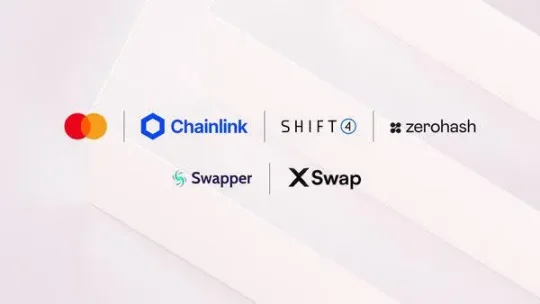
According to the announcement, users no longer need to register accounts on centralized exchanges (CEX) or navigate complex cross-chain bridging processes. Instead, they can initiate transactions through Swapper Finance—a decentralized exchange (DEX) integrated with this functionality—and use their Mastercard to buy digital assets.
Swapper Finance serves as the user-facing front end, enabling initiation of credit card payment requests; traditional payment gateway provider Shift4 Payments handles seamless card processing, verifying and settling users’ fiat currency payments (e.g., USD, EUR); ZeroHash, a crypto and stablecoin infrastructure provider, converts fiat into cryptocurrencies (such as BTC, ETH), ensuring compliance while supplying liquidity and on-chain services; Chainlink’s decentralized oracle network and interoperability standard (CCIP) ensure transaction security and data reliability, while its ecosystem DEX XSwap leverages protocols like Uniswap to source liquidity and execute on-chain crypto swaps.
Ultimately, the purchased crypto assets are delivered directly to users’ on-chain wallet addresses via smart contracts. The entire process abstracts away complexities such as trading pairs, gas fees, and slippage parameters, eliminating the need to switch to centralized trading platforms.
For several years, traditional payment firms like Visa and Mastercard have primarily focused on the spending side of crypto—enabling users to spend digital assets via crypto debit cards, where backend systems automatically convert holdings into fiat for everyday purchases. Examples include crypto debit cards launched by Uphold and Worldcoin.
However, Mastercard’s latest collaboration with Chainlink shifts focus from spending crypto off-chain to enabling direct fiat-to-on-chain asset conversion. Now, non-crypto-native users can obtain on-chain assets simply by swiping their card—just as they would shop on Amazon—without needing to understand any DeFi concepts, all within a compliant and transparent framework. This breakthrough not only removes long-standing barriers to DeFi onboarding but also offers the traditional financial system a compliant, secure, and controllable path onto the blockchain.
Raj Dhamodharan, EVP of Blockchain and Digital Assets at Mastercard, said: "People want to easily connect to the digital asset ecosystem, and vice versa. That's why we continue leveraging our global payment network and expertise to bridge the gap between on-chain commerce and off-chain transactions. By partnering with Chainlink, we're unlocking a secure and innovative way to transform on-chain commerce and drive broader adoption of digital assets."
"This is a classic example of convergence between traditional finance and decentralized finance. I'm very excited that Chainlink is enabling this critical link from traditional payment networks to on-chain DEX environments. It’s a complex, multi-layered collaboration, and I’m deeply pleased to see the power of the Chainlink community making it happen," added Sergey Nazarov, co-founder of Chainlink.
Driving New Business Models Through Crypto: Three Key Focus Areas for 2025
"The key barrier preventing crypto from going mainstream is that users struggle to identify and transfer funds to each other using familiar methods. Mastercard aims to act as a connector between traditional finance and blockchain networks, fostering new business models under a compliant framework," said Raj Dhamodharan, Mastercard's head of Crypto & Blockchain, noting that the company has now moved beyond experimentation to delivering real-world crypto solutions.
Unlike many traditional financial institutions that still view crypto as peripheral or risky, Mastercard is actively integrating digital assets, stablecoins, and tokenized assets into everyday payment experiences.
In a February filing with the U.S. Securities and Exchange Commission (SEC), Mastercard reported significant progress toward building an “innovative payment ecosystem,” including transaction tokenization, developing blockchain-based business solutions, and simplifying access to digital assets. The document explicitly acknowledged that digital currencies could disrupt traditional financial markets and challenge existing products. Due to their accessibility, immutability, and efficiency, stablecoins and cryptocurrencies may gain wider popularity as regulatory clarity improves—positioning them as emerging competitors in the payments industry.
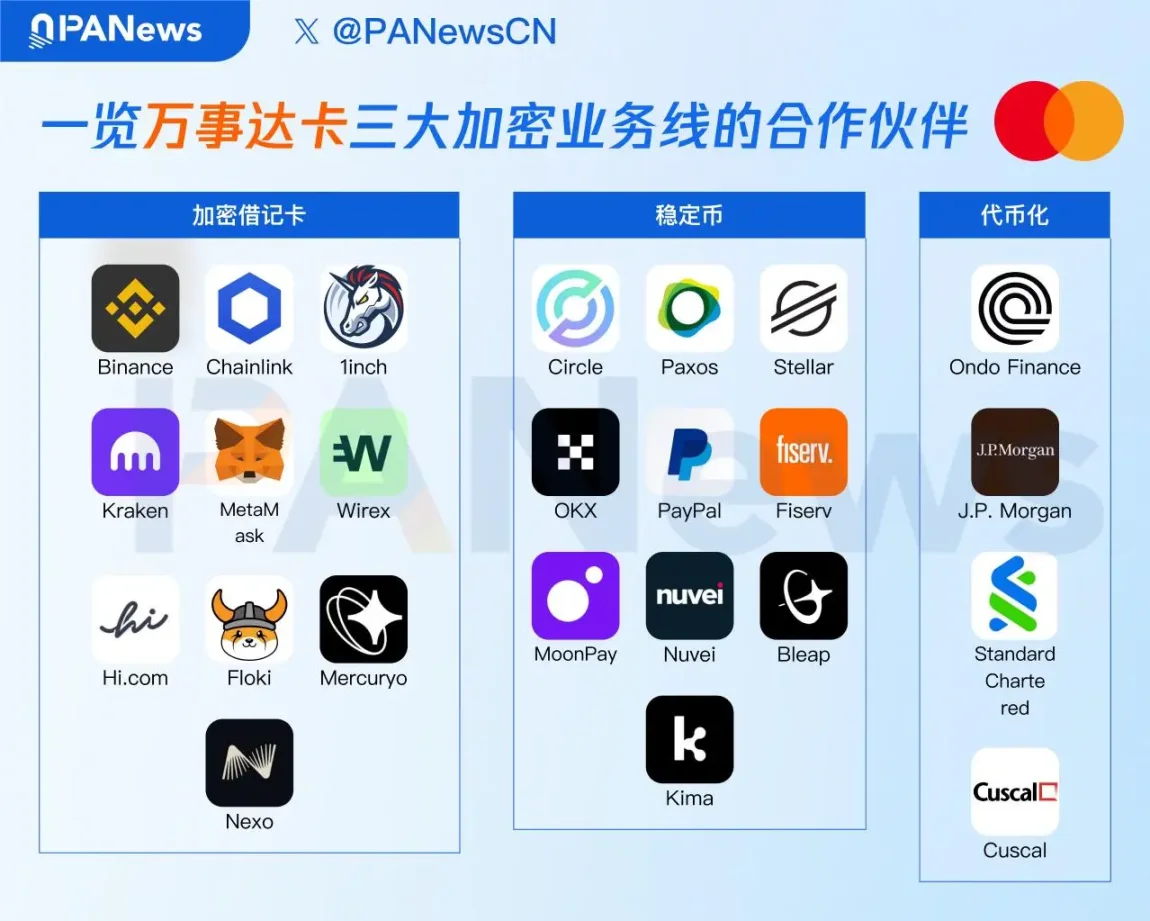
Prior to enabling card-based crypto purchases, Mastercard had already advanced commercialization of crypto payments through partnerships with Binance, Kraken, MetaMask, 1inch, and Floki to launch co-branded crypto debit cards, allowing cardholders to spend crypto directly with automatic fiat conversion in the background.
Beyond consumer spending, stablecoins are becoming central to Mastercard’s on-chain settlement strategy.
Recently, Mastercard joined the Global Dollar Network—a stablecoin consortium initiated by Paxos—enabling joint issuance and shared interest income from USDG, a stablecoin backed by U.S. Treasuries. Mastercard is also supporting PayPal’s PYUSD and Fiserv’s FIUSD stablecoins, integrating them into its cross-border payment network, Mastercard Move. In May, Mastercard partnered with crypto payments firm MoonPay to launch a new stablecoin payment card, enabling stablecoin spending across more than 150 million merchants globally, with transactions automatically converted into fiat. In April, Mastercard unveiled a comprehensive stablecoin payment solution in collaboration with Nuvei, Circle, and Paxos, enabling merchants to settle transactions directly using stablecoins such as USDC. That same month, Mastercard teamed up with OKX to launch the OKX Card, supporting stablecoin payments across its vast merchant network, and entered a strategic partnership with Bleap—a fintech founded by former Revolut employees—to further embed stablecoin payments into traditional financial infrastructure.
These密集 moves indicate Mastercard is embedding stablecoins into daily consumer spending, settlements, and transfers. To enhance security and usability in crypto transactions, Mastercard previously introduced the Crypto Credential—a user-friendly alias system replacing complex wallet addresses, reducing errors during crypto transfers.
Beyond stablecoins, Mastercard is also pushing forward with asset tokenization. In April, Mastercard revealed it is developing the Multi-Token Network (MTN), aiming to replicate its traditional payment network by providing digital asset transaction infrastructure for consumers, merchants, and financial institutions. The system integrates on-chain and off-chain asset flows, ensuring compliance and optimizing user experience. Mastercard has collaborated with JPMorgan and Standard Chartered to explore use cases such as cross-border payments and carbon credit tokenization. Since 2015, it has filed over 250 blockchain-related patents. In February, Ondo Finance joined the Mastercard network to improve cross-border payments, making its short-term U.S. Treasury fund (OUSG) available to enterprises on Mastercard’s MTN, enabling yield generation via tokenized assets. In November last year, Mastercard connected its blockchain-based tokenized asset transfer system (MTN) with JPMorgan’s digital asset platform Kinexys to strengthen B2B cross-border payments, offering greater transparency, faster settlement, and reduced time zone friction. In August of the same year, to combat rising online fraud, Mastercard began planning to phase out traditional credit card numbers and expand its tokenization program using biometric authentication such as fingerprint or facial recognition. In May 2024, Mastercard completed a proof-of-concept test for tokenized deposits through Hong Kong’s Monetary Authority regulatory sandbox. According to Mastercard, it had already achieved 30% transaction tokenization by 2024.
"We believe the future financial system will encompass both bank deposits and stablecoins. Deposits serve as the foundation of money, while stablecoins provide efficient on-chain settlement capabilities. If regulatory clarity allows deposits to be represented on public blockchains in some form, that would be the key to large-scale tokenization expansion," Dhamodharan revealed months ago, adding that Mastercard has set its 2025 strategic priorities around three pillars: on-chain/off-chain onboarding and off-ramping, promotion of Crypto Credentials, and stablecoin applications. Mastercard already supports financial institutions using stablecoins for transaction settlement and plans to announce more partners and use cases this year to advance crypto integration.
As the convergence between traditional finance and the crypto world accelerates, Mastercard is breaking through in these three key areas, shaping its own crypto business landscape.
Join TechFlow official community to stay tuned
Telegram:https://t.me/TechFlowDaily
X (Twitter):https://x.com/TechFlowPost
X (Twitter) EN:https://x.com/BlockFlow_News
 PANews











