








Xu Mingxing's ultimate test: Is OKX going public in the U.S.?
TechFlow Selected TechFlow Selected
Xu Mingxing's ultimate test: Is OKX going public in the U.S.?
In 2025, global crypto giant OKX plans to go public in the U.S., sparking market buzz and causing its platform token OKB to surge rapidly in price.
 Navigating Web3 tides with focused insights
Author: Luke, Mars Finance
Is OKX Heading for a U.S. IPO?
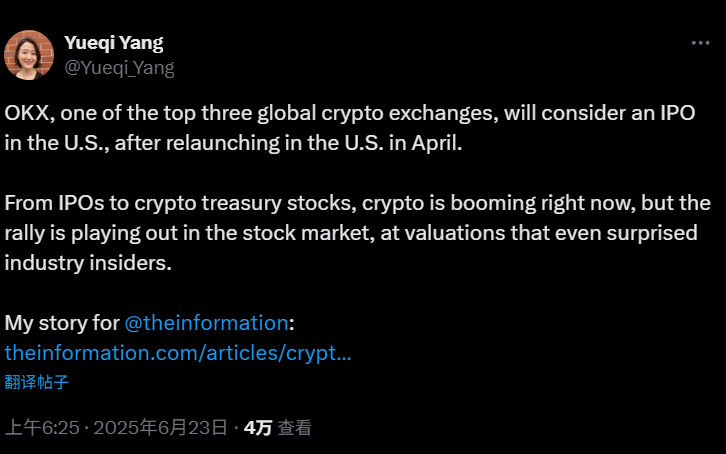
On June 23, 2025, when The Information's crypto reporter Yueqi Yang revealed that global crypto giant OKX was considering a U.S. IPO, the entire market’s nerves were instantly triggered. The news struck like lightning, cutting through the calm of the crypto world. The market reacted almost instinctively—OKB, the platform token deeply intertwined with OKX's ecosystem, surged over 15% within an hour, breaking through the psychological resistance level of $55.
This rumor-driven rally reveals a logic far deeper than any chart pattern. It clearly shows that, in investors’ eyes, the valuation of OKX as a company has become inseparably linked to the fate of its native cryptocurrency OKB, a digital asset now worth over $3 billion. A company seeking listing on the NYSE or Nasdaq should traditionally be valued using Wall Street metrics such as P/E ratios and revenue growth. Yet the market’s frenzy declares that the lead actors in OKX’s capital-market drama are not just the corporate entity itself, but also the token empire it built from the ground up.
This is precisely the unique dilemma and ultimate gamble facing OKX. As a firm attempting to embed itself into the world’s most mature and stringent capital markets, will its inherent “crypto-born” DNA serve as a ticket to the future—or become shackles binding its progress? Especially for a company like OKX, still bearing the scars of recent regulatory storms, knocking on Wall Street’s door now is not only the ultimate test of its transformation resolve, but also signals that the entire crypto industry stands at a crossroads—transitioning from the “Wild West” toward institutionalized finance.
The Road Back from the Shadows
Why is OKX putting IPO on the agenda now?
Not long ago, OKX’s operating entity reached a staggering settlement with the U.S. Department of Justice (DOJ). It admitted to “willfully violating anti-money laundering (AML) laws” and “operating an unlicensed money transmission business” over a seven-year period, paying more than $500 million in penalties. Investigation documents painted a disturbing picture: OKX’s platform had been used to process massive suspicious transactions, and employees even explicitly instructed U.S. users on how to bypass KYC procedures.
This costly settlement could have marked the end of OKX’s U.S. ambitions, much like its rival Binance, which paid an even larger fine before being forced to fully exit the American market. But OKX chose a harder path—rebirth from the ashes. In April 2025, just two months after paying the penalty, OKX boldly announced its return to the United States.
This move was less about commercial expansion and more a meticulously orchestrated “reputation rehabilitation campaign.” OKX deployed nearly every textbook crisis management tactic: appointing Roshan Robert, former Barclays executive with deep traditional finance experience, as CEO of its U.S. operations; establishing its new regional headquarters in San Jose, at the heart of Silicon Valley; and having its leadership—including the usually reclusive founder Star Xu—publicly reaffirm their commitment to compliance, aiming to set a “global gold standard” for regulation.
Viewed this way, OKX’s comeback strategy forms a coherent chain, with one ultimate goal in sight. The IPO is not merely about raising capital—it is the final chapter of this reputation overhaul. Successfully going public would mean passing a joint “final exam” administered by the SEC, top-tier investment banks, and public auditors—an irrefutable “clean bill of health” issued by the very system it once defied.
Betting Precisely on Regulatory Evolution
If OKX’s internal compliance transformation represents the “internal push” behind its IPO consideration, then the subtle shift in the broader U.S. regulatory landscape provides the crucial “external pull.” OKX’s decision to launch its IPO plan in 2025 is no impulsive act, but a precise bet on policy trends.
The most notable change comes from the political sphere. In 2025, the incoming U.S. administration adopted a noticeably softer stance toward the crypto industry, moving away from the previous “enforcement-first” approach and creating a relatively more accommodating external environment. However, for a complex platform like OKX, whose core revolves around financial derivatives, a mere softening of enforcement is insufficient. What it truly needs is fundamental reform at the legal framework level.
This is exactly what the Financial Innovation and Technology for the 21st Century Act (FIT21), and its updated version—the 2025 Clarity for Digital Asset Markets Act (CLARITY Act)—aim to achieve. The CLARITY Act seeks to establish a clear, comprehensive regulatory framework for the fragmented U.S. digital asset market, primarily by defining jurisdictional boundaries between the SEC and the Commodity Futures Trading Commission (CFTC). Under the draft legislation, “digital commodities” would fall predominantly under CFTC oversight. For a derivatives-focused platform like OKX, this is nothing short of a lifeline.
Connecting these dots reveals a clear strategic picture. OKX’s IPO plan is not a passive response to the current legal climate, but a highly forward-looking maneuver. It is betting that the CLARITY Act—a pivotal piece of legislation for the industry—will ultimately pass. Given the lengthy and complex nature of the IPO process, OKX’s decision to start preparations now ensures it can be among the first compliant exchanges to cross the finish line once legislation is finalized.
Standing on the Shoulders of Predecessors
Of course, OKX is not the first crypto firm to attempt entry into Wall Street. The IPO journeys of Coinbase and Circle have already provided valuable lessons for those who follow.
Coinbase, as an industry pioneer, exposed several issues during its direct listing in 2021: dual-class share structures raised corporate governance concerns; its reliance on retail trading fees created a fragile business model; and its stock price remained tightly coupled to the volatile crypto market—all contributing to a hard valuation ceiling.
In contrast, Circle, issuer of the stablecoin USDC, delivered a textbook example of success with its traditional IPO in June 2025. Circle’s triumph hinged on a compelling compliance narrative—positioning itself as a “regulated digital dollar” issuer. Strong on-chain data clearly demonstrated the utility and demand for its product, providing solid justification for its high valuation. As Bybit’s analysis report noted, traditional investment banks “severely underestimated Circle’s valuation,” signaling that Wall Street’s conventional valuation models are beginning to fail when assessing crypto-native businesses.
Placing OKX between these two cases highlights its distinct position. Its business model is more diversified than Coinbase’s, particularly in high-margin derivatives. Yet its regulatory history is far more complicated than either Coinbase or Circle. Most critically, its inseparable integration with its native token OKB creates a challenge unlike any faced by its predecessors—the ultimate test awaiting it on Wall Street.
Valuation Balancing Act and the Final Exam
Overall, OKX’s path to IPO is a delicate balancing act across three dimensions: compliance, token economics, and founder legacy.
First, its core strengths lie in its dominant global market presence and product depth. As one of the world’s largest exchanges by trading volume, OKX serves over 50 million users and boasts exceptional market liquidity. Its true competitive moat lies in derivatives—offering futures contracts with up to 100x leverage and sophisticated trading tools, making it the platform of choice for professional traders and generating more stable revenue streams. Estimated annual revenue ranges from $1 billion to $10 billion.
Yet its greatest strength—its deeply integrated OKB token ecosystem—is also its biggest challenge. OKB is far more than a simple utility token; it permeates every corner of the OKX ecosystem, used for fee discounts, governance, and staking. Crucially, OKX commits to using 30% of its spot trading fee revenue to regularly buy back and burn OKB tokens from the open market, creating deflationary pressure to boost token value.
This creates an unprecedented valuation dilemma in the context of an IPO. How can a public company justify to shareholders a business model so deeply entwined with an independent, highly speculative crypto asset? When a company diverts revenue that could otherwise go to dividends to prop up a token’s price in public markets, how should that expenditure be accounted for? This setup creates a potential conflict of interest between public shareholders and OKB holders. According to SEC guidance, OKX’s “buyback and burn” program could easily lead regulators to classify OKB as a security.
Finally, no matter how hard OKX works to rebuild its image, its past remains a sword of Damocles hanging overhead. The $500 million settlement and the controversies surrounding founder Star Xu will be scrutinized repeatedly in prospectuses and due diligence processes, becoming significant liabilities in a public market that demands pristine executive backgrounds.
When Crypto Giants Embrace Wall Street
From being hit with record fines for serious violations to now contemplating a Wall Street listing, OKX’s journey mirrors the broader trajectory of the crypto industry. It marks the end of an era of unchecked growth and the beginning of a new chapter seeking order and legitimacy.
This IPO will be the ultimate test of OKX’s self-transformation. If successful, OKX won’t just redeem itself—it will offer a replicable compliance blueprint for other global exchanges. If it fails, it will serve as a stark warning: the bridge from crypto’s freewheeling culture to Wall Street’s rigid rules remains perilously incomplete.
No matter the outcome, OKX’s bold push toward Wall Street sends a clear message: the “Wild West” era of crypto exchange expansion is ending. Only two paths remain: either follow OKX’s lead—voluntarily entering the regulatory framework and trading transparency for survival—or face marginalization or expulsion, as some competitors have already experienced in the U.S. market. OKX’s Wall Street “final exam” is destined to become a landmark moment in the history of cryptocurrency.
Join TechFlow official community to stay tuned
Telegram:https://t.me/TechFlowDaily
X (Twitter):https://x.com/TechFlowPost
X (Twitter) EN:https://x.com/BlockFlow_News






