








Wall Street’s “Trojan Horse”: Deconstructing the Power Restructuring and Infrastructure Convergence Behind ICE’s Investment in OKX
TechFlow Selected TechFlow Selected
Wall Street’s “Trojan Horse”: Deconstructing the Power Restructuring and Infrastructure Convergence Behind ICE’s Investment in OKX
Penetrating the underlying logic of this infrastructure reconstruction, this is not a simple zero-sum game, but rather a balance-sheet swap across economic cycles.
 Navigating Web3 tides with focused insights
Author: @BlazingKevin_, Researcher at Blockbooster
In spring 2026, Intercontinental Exchange (ICE), the parent company of the New York Stock Exchange (NYSE), completed a strategic investment in cryptocurrency exchange OKX at a $25 billion valuation. This transaction marked a departure from Wall Street’s prior experimental approach—relying solely on spot ETFs to establish “funding conduits.” A closer look at the publicly disclosed collaboration framework reveals that the partnership centers squarely on foundational operational infrastructure of financial markets: from licensing spot price data and establishing a joint venture entity to co-distributing tokenized equities.
Licensing spot market data aims to provide traditional institutional capital with a regulated pricing anchor for entry; meanwhile, the joint venture and advancement of tokenized stocks seek, in practice, to bridge the physical divide between the legacy fiat system and crypto-native liquidity pools. This systemic strategic alignment signals that mainstream traditional capital’s approach to the crypto ecosystem has formally shifted—from peripheral “asset allocation” to an “absorption” phase, wherein capital directly intervenes in foundational infrastructure.
This is not merely a routine financial transaction, but rather a top-down power reconfiguration of the emerging crypto market by the established financial system, leveraging capital and regulatory architecture.
Power Reconfiguration: The Cession of Pricing Authority and Mutual Infrastructure Assimilation
The core anchor of this deal lies in foundational pillars of the financial system: pricing authority and clearing infrastructure.
As a traditional market oligopolist, ICE monopolizes benchmark pricing across core assets—from NYSE equity data to Brent crude oil and the U.S. Dollar Index. This pricing authority, rooted in regulated trading hours and centralized clearing, forms the bedrock of its business model. Yet against the backdrop of a multi-trillion-dollar crypto asset network—operating 7×24, highly fragmented, and deeply liquid—ICE’s conventional price discovery mechanisms suffer from pronounced structural dislocation.
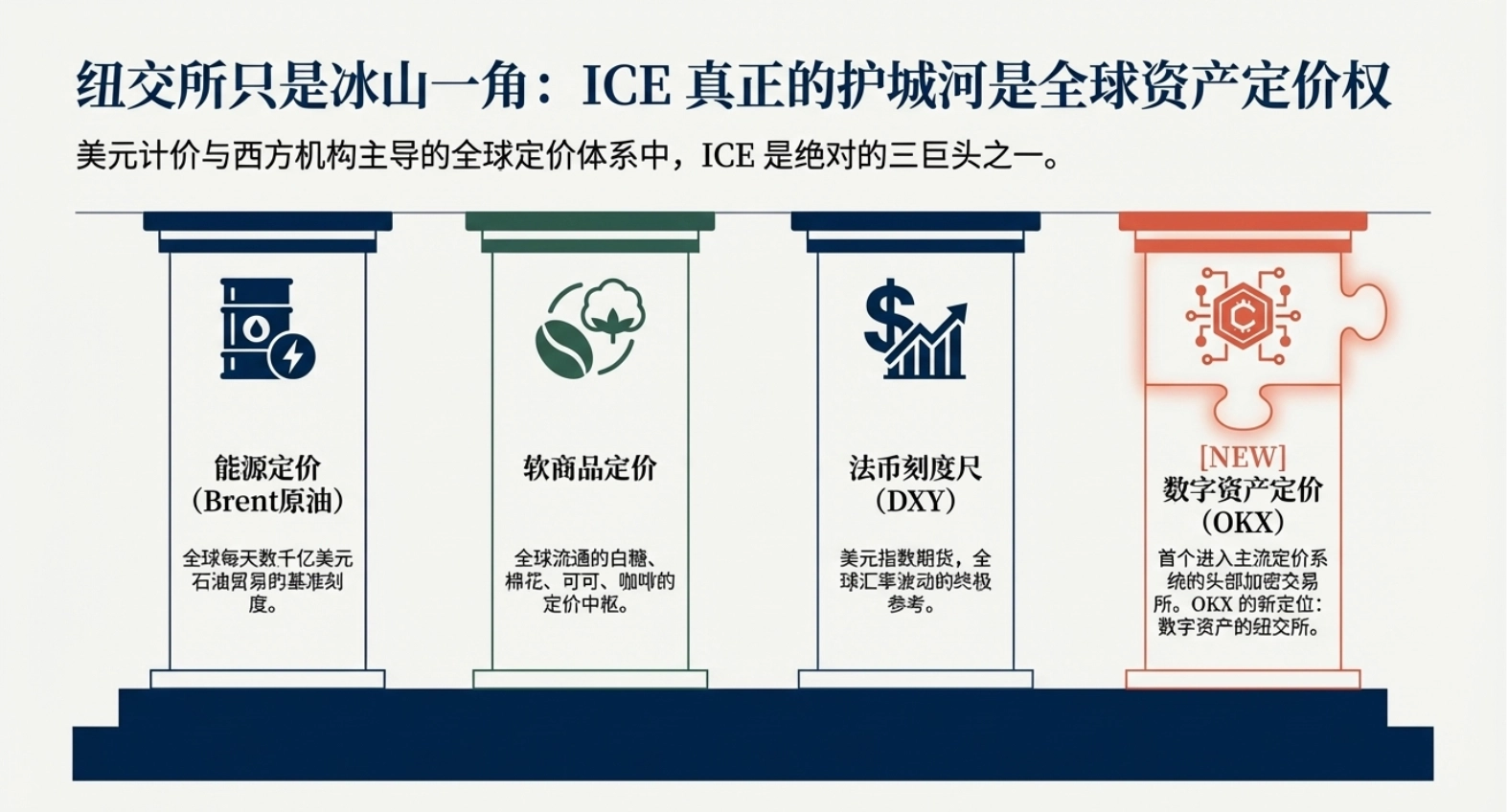
Securing spot data licensing from OKX represents ICE’s concrete step to close this gap. Currently, the Chicago Mercantile Exchange (CME) has secured partial institutional pricing dominance through its regulated Bitcoin futures contracts. By deepening its capital tie with a leading spot platform, ICE gains direct access to offshore markets—and with it, first-hand, granular trading and depth data. This allows ICE to bypass prolonged cold starts and rapidly build its own suite of crypto derivatives compliant with U.S. regulatory standards, aiming to reclaim ultimate interpretive authority over crypto liquidity within Wall Street’s traditional infrastructure.
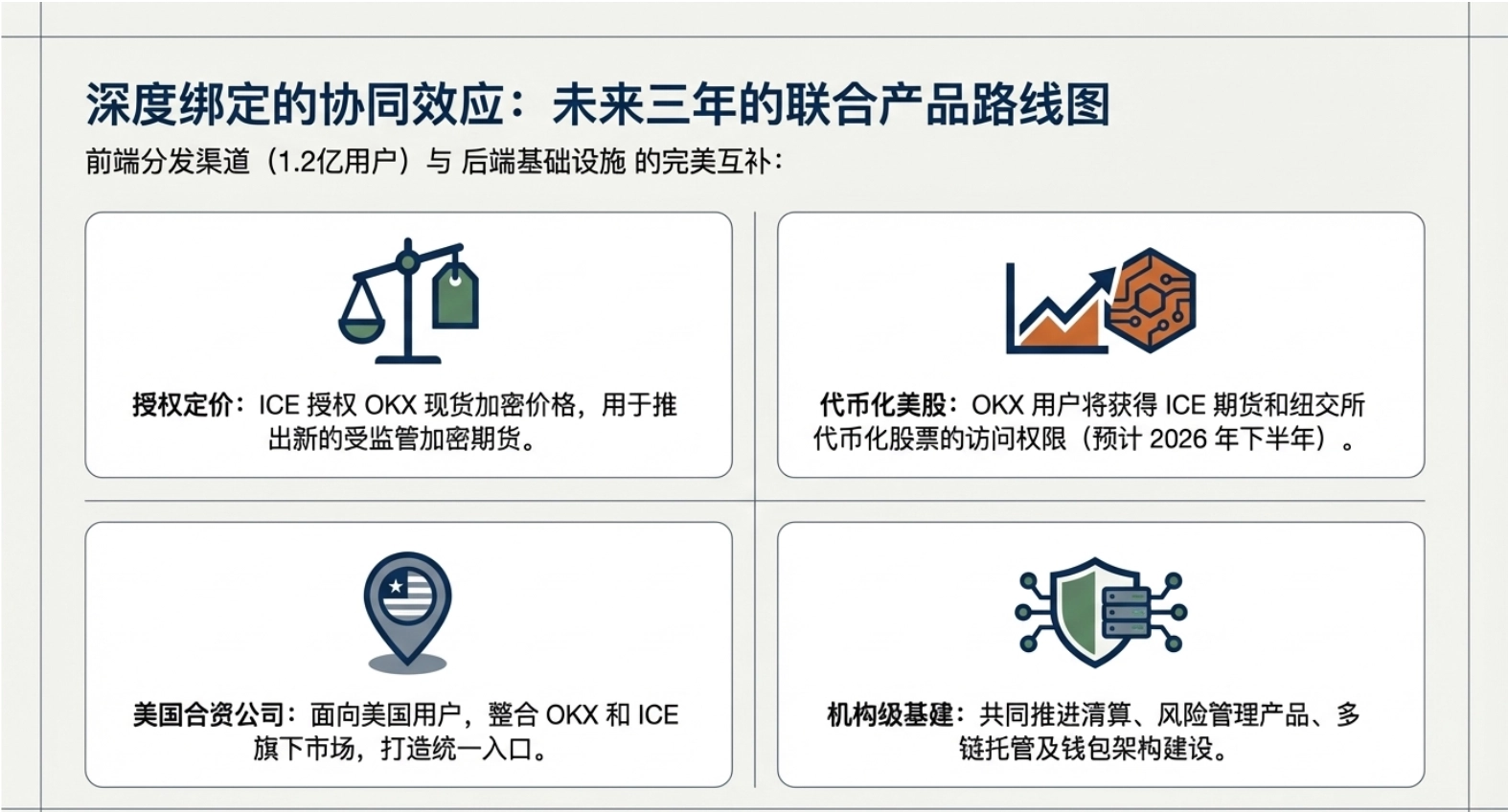
For OKX, ceding control over core spot pricing data constitutes the price it pays to break through existing business bottlenecks. Today, pure-play crypto exchanges face intensifying存量 competition, rising per-user acquisition costs, and diminishing growth potential from fee-based revenue models reliant solely on spot and perpetual contracts. By integrating into ICE’s foundational compliance architecture, OKX effectively transforms its business model—from a single-purpose crypto-asset matching engine into a bidirectional distribution network linking 120 million native crypto users with Wall Street–compliant financial products.
Evolution of Strategy
Tracing ICE’s expansion history in crypto reveals a strategic pivot grounded in real-world market feedback.
In 2018, ICE launched Bakkt—a physically delivered Bitcoin futures platform. Its early logic followed a classic “compliance infrastructure-first” playbook: building clearing and delivery channels meeting the highest institutional regulatory standards to attract and standardize crypto trading volume. However, Bakkt’s subsequent prolonged stagnation confirmed a structural truth: in crypto markets, compliance frameworks alone cannot generate liquidity ex nihilo. Traditional trading systems, divorced from native retail communities and crypto market-making ecosystems, risk becoming “compliance islands”—regulatory-compliant yet devoid of genuine trading depth.
Bakkt’s cold-start struggles prompted ICE’s leadership to reassess its operational logic. They recognized that, in a bilateral trading market governed by powerful network effects, rebuilding trading habits among millions of crypto users—and reconstructing underlying liquidity—is far costlier than writing institutional-grade clearing code. Rather than investing years in internal incubation, ICE opted instead for external capital capture.
Thereafter, ICE’s resource allocation adopted a clear pattern of strategic node embedding. In 2025, ICE invested in decentralized prediction market Polymarket—not as a speculative bet, but to preemptively secure on-chain, event-driven data sources and non-standard asset pricing gateways. Its current heavy investment in OKX pushes asset capture directly into crypto’s core: the bidirectional liquidity network spanning spot and derivatives markets.
From promoting Bakkt’s “self-built closed loop” to today’s capital-driven embedding via stakes in Polymarket and OKX, ICE’s evolution reflects a broad consensus among Wall Street giants: abandon capital-intensive attempts to rebuild crypto rules from scratch, and instead deploy capital as a “Trojan horse,” directly integrating scale-proven, crypto-native infrastructure into their vast global clearing and distribution networks.
The “Second Half” of Tokenized Assets
The large-scale onchain migration of Real World Assets (RWAs) serves as the immediate commercial catalyst for this infrastructure convergence.
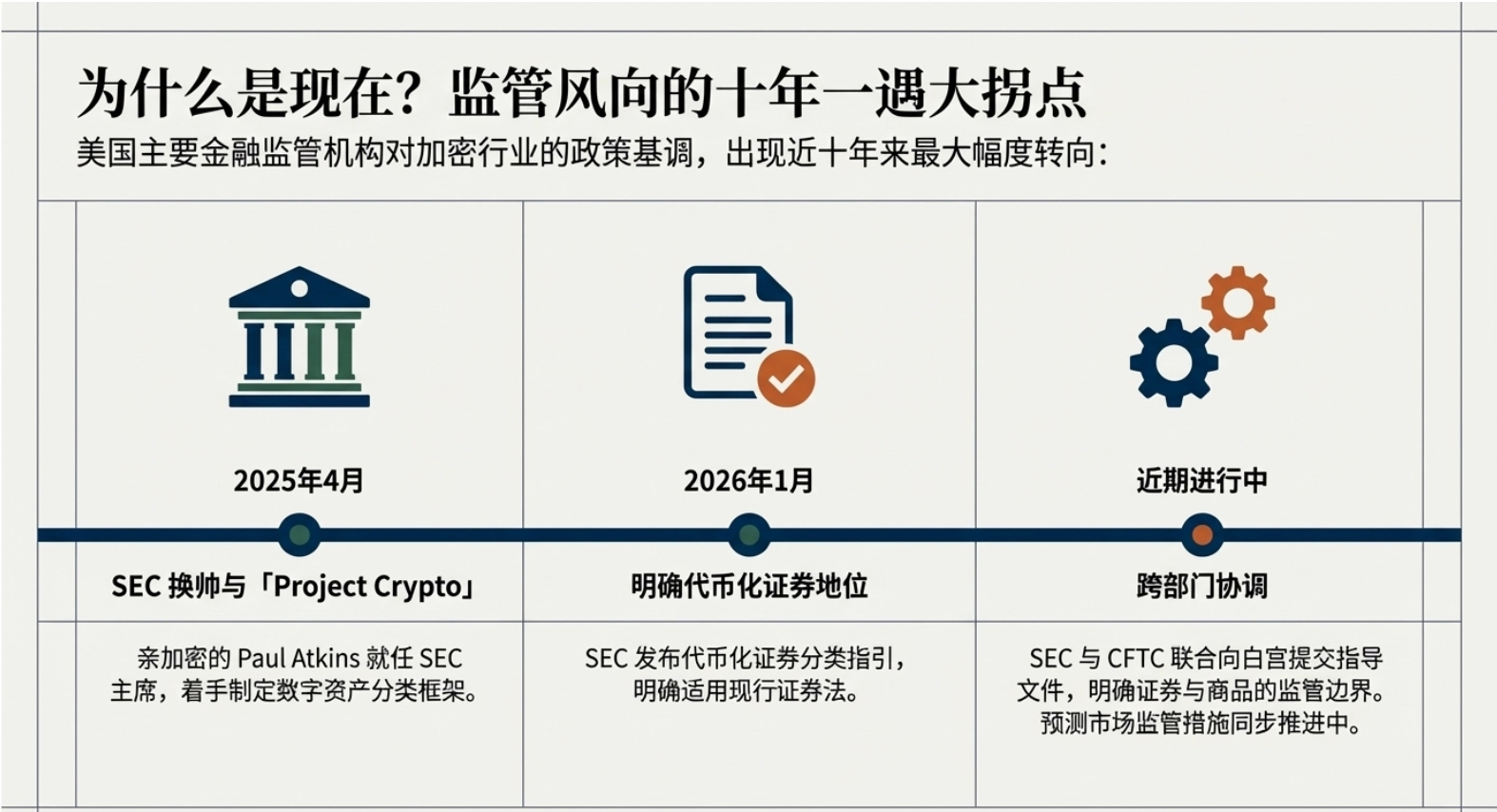
Starting in the second half of 2025, as U.S. regulators clarified preliminary classification and ownership frameworks for tokenized securities, onchain mapping of underlying equities saw a structural surge. Faced with this incremental space—capable of reshaping the foundational settlement protocols of traditional securities markets—core Wall Street institutions are accelerating their race to dominate issuance and circulation hubs for tokenized assets.
Within infrastructure roadmaps for asset tokenization, two distinct evolutionary paths have emerged. Nasdaq favors reformism: leveraging legacy clearing centers like DTCC (Depository Trust & Clearing Corporation) to register and transfer tokenized assets within the existing regulatory framework. ICE, by contrast, pursues explicit vertical integration—aiming to reconstruct a full-stack, end-to-end closed loop from asset packaging to end-user distribution:
On the supply side, the NYSE is advancing a tokenized securities engine supporting Delivery-versus-Payment (DVP) and 7×24 settlement; on the clearing side, ICE seeks to eliminate cross-chain settlement friction between fiat and digital assets via tokenized deposits; and on the distribution side, OKX’s accumulated base of over 100 million native crypto accounts provides the missing liquidity outlet to global retail endpoints.
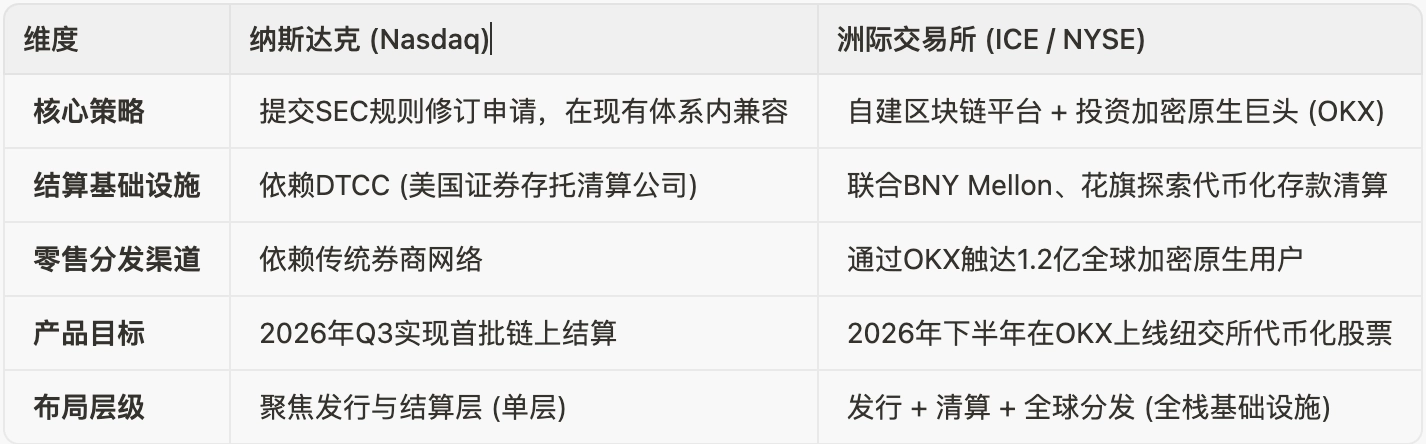
This hybrid infrastructure architecture—“licensed underlying assets + native onchain distribution”—poses a tangible threat to traditional T+1 settlement cycles in terms of transaction efficiency. Industry-wide, the long-term moat in the RWA赛道 is shifting from standalone “onchain asset capability” toward integrated “compliance channel + global liquidity orchestration.” Following this systemic consolidation, smaller crypto platforms lacking high-quality fiat asset pipelines—and traditional financial institutions constrained by legacy distribution channels—will both face liquidity siphoning risks. Composite infrastructure providers capable of cross-domain asset clearing and global network reach will wield de facto dominance in next-cycle asset pricing.
Deep Strategic Friction
Returning from strategic vision to execution, this infrastructure integration faces significant structural friction. Capital-level alignment does not automatically erase fundamental misalignments between the legacy fiat system and crypto-native ecosystems—in regulation, clearing mechanisms, and governance structures.
First, the end of regulatory arbitrage and the compliance burden of multi-jurisdictional oversight. After early, rapid offshore expansion, OKX seeks regulatory rehabilitation in the U.S. market by adopting ICE’s traditional licensing framework. Yet U.S. regulation of crypto and tokenized assets remains fractured—split between the SEC (emphasizing securities attributes) and the CFTC (emphasizing commodity attributes). Cross-jurisdictional classification of tokenized equities, extraterritorial scrutiny of offshore liquidity flows, and protracted compliance procedures required under multilateral regulatory regimes will materially inflate operating expenses. Whether ICE’s lobbying leverage on Capitol Hill can translate into tangible licensing advantages for OKX amid still-unformed crypto legislation remains highly uncertain.
Second, liquidity mismatch risk arising from asynchronous clearing mechanisms. Though the cooperation framework includes joint development of tokenized deposits, traditional banks remain bound by weekday-only and statutory trading-hour fiat settlement cycles—creating unavoidable physical time lags versus crypto networks’ 7×24 high-frequency matching. During macroeconomic data releases or onchain black swan events, fiat channel closures or delays could easily trigger liquidity fragmentation on the crypto side. Building market-making and buffering mechanisms resilient enough to withstand margin calls during extreme volatility—across non-synchronous clearing networks—constitutes the core technical hurdle to foundational system integration.
Third, substantive incompatibility between governance architectures and risk preferences. Governance in traditional regulated financial institutions rests on extreme risk aversion and absolute procedural compliance; crypto-native platforms, by contrast, thrive on agile iteration and deliberate exposure to high volatility. When traditional capital’s compliance committees gain material influence over product launch workflows and asset listing decisions at crypto platforms, decision-making timelines inevitably lengthen. This ongoing tension between risk tolerance and business expansion velocity will drive persistent governance attrition at the joint venture’s board level—potentially eroding the platform’s competitive edge in purely crypto-native arenas.
Full-Asset Flow in a “Frenemy” Landscape
Viewed horizontally against the broader macro-financial cycle, ICE’s collaboration with OKX marks a landmark node in the “convergence of TradFi and crypto infrastructure.”
This systemic convergence is now accelerating industry-wide: from BlackRock designating Coinbase as the core custodian and prime broker for its spot ETF, to traditional market-making giant Citadel Securities penetrating order flow at platforms like Kraken, to JPMorgan’s institution-grade intraday repo clearing built atop its Onyx blockchain—physical isolation between fiat capital networks and decentralized protocols is being systematically dismantled.
Within this process, markets are evolving a “non-symmetric symbiosis” based on functional exchange. Traditional Wall Street oligopolists no longer aim to build crypto trading engines from scratch; instead, they inject capital and grant access rights to precisely capture crypto’s high-frequency, global, low-friction retail trading flows. Native crypto infrastructure, in turn, surrenders partial equity and foundational data sovereignty to obtain balance sheet backing from traditional finance, fiat clearing whitelists, and institutional moats against extreme regulatory risk. This comparative-advantage–driven asset restructuring is decisively stripping away crypto’s early “anti-establishment” label—fully weaving it into the operational fabric of global financial capital.
Projecting along this infrastructure-convergence trajectory, the form and flow boundaries of global capital market assets are dissolving. The endgame for next-generation financial infrastructure points toward a universal asset clearing network possessing “unified ledger” properties. Within this architecture, heterogeneous asset issuance vehicles—whether native Proof-of-Work Bitcoin, smart-contract-wrapped tokenized U.S. equities, or RWAs mapping real-world yield rights—will exit traditional settlement silos. Instead, they’ll trade in a shared global liquidity pool, enabling round-the-clock instant settlement and cross-asset, atomic margin transfers. This is not merely a structural boost to clearing efficiency—it is a complete paradigm shift in global liquidity pricing.
Conclusion
Marked by ICE’s investment in OKX, the capacity rationalization phase in the crypto trading sector has reached its conclusion. Over the foreseeable macro cycle—as Basel Accord–style regulatory frameworks begin substantively covering crypto exposures, and soaring compliance costs continue squeezing platform P&Ls—global crypto liquidity will irreversibly concentrate among a handful of oligopolistic nodes combining “legacy licenses + native infrastructure.”
In this evolving landscape, fringe exchanges lacking quality fiat clearing channels, core regulatory licenses, or access to mainstream institutional order flow will confront severe liquidity drought. In bilateral market存量 competition, they may either be passively purged due to inability to bear exponentially rising compliance expenditures—or reduced to discounted acquisition targets for traditional capital completing its end-to-end infrastructure puzzle.
For top-tier native platforms that have completed capital binding, their business models have undergone a fundamental transformation: in exchange for access to traditional finance’s multi-trillion-dollar balance sheets and compliant distribution channels, they must fully internalize Wall Street’s stringent KYC/AML standards, anti-manipulation surveillance systems, and capital adequacy requirements. Pure “technological neutrality” no longer applies—replaced instead by a highly privileged, gatekept financial intermediation model.
Peeling back the layers of this infrastructure reconstruction, this is not a simple zero-sum game—but a cross-cycle balance sheet swap. Traditional financial oligopolists leveraged capital to cheaply capture next-generation distributed ledgers and 7×24 clearing networks; while the crypto-native industry, by meaningfully surrendering its early “decentralization and censorship-resistance” dogma, secured a perpetual license to tap into the global fiat liquidity main artery.
About BlockBooster: BlockBooster is a next-generation alternative asset management firm built for the digital age. We invest in, incubate, and manage core digital-age assets—ranging from blockchain-native projects to Real World Assets (RWA)—using blockchain technology. As value co-creators, we strive to uncover and unlock the long-term potential of assets, capturing exceptional value for our partners and investors amid the tides of the digital economy. Disclaimer: This article/blog is for informational purposes only and reflects the author’s personal views—not those of BlockBooster. It is not intended to provide: (i) investment advice or recommendations; (ii) offers or solicitations to buy, sell, or hold digital assets; or (iii) financial, accounting, legal, or tax advice. Holding digital assets—including stablecoins and NFTs—carries extremely high risk, substantial price volatility, and the possibility of total loss. You should carefully consider whether trading or holding digital assets is appropriate for your financial situation. For specific questions, consult your legal, tax, or investment advisor. Information provided herein—including market data and statistics, if any—is for general reference only. Reasonable care has been taken in preparing such data and charts; however, no responsibility is accepted for any factual errors or omissions contained therein.
Join TechFlow official community to stay tuned
Telegram:https://t.me/TechFlowDaily
X (Twitter):https://x.com/TechFlowPost
X (Twitter) EN:https://x.com/BlockFlow_News


