








Hotcoin Research | "Crypto Dad" Atkins' First 60 Days: A Reversal in SEC Regulatory Stance and Analysis of Cryptocurrency Policy Direction
TechFlow Selected TechFlow Selected
Hotcoin Research | "Crypto Dad" Atkins' First 60 Days: A Reversal in SEC Regulatory Stance and Analysis of Cryptocurrency Policy Direction
This report will review the key policy signals issued by Atkins to date, provide an in-depth analysis of its regulatory approach and policy direction, and examine the potential systemic impacts on the industry going forward.
 Navigating Web3 tides with focused insights
Author: Hotcoin Research
1. Introduction
On April 22, 2025, Paul S. Atkins was sworn in as the 34th Chair of the U.S. Securities and Exchange Commission (SEC), sending an unprecedented pro-crypto policy signal to the industry. In his inaugural speech, he clearly stated that establishing a clear and reasonable regulatory framework for digital assets would be his "top priority" during his tenure—aiming to make the United States the world’s most innovative and attractive hub for crypto asset development.
In contrast to the “high-pressure enforcement” approach under former Chair Gary Gensler, Atkins is seen as the “Crypto Dad,” advocating for “common-sense regulation” and “supporting innovation.” To date, Atkins has expressed clear policy positions on cryptocurrencies, DeFi, stablecoins, PoW and PoS tokens across multiple public appearances. The SEC has also successively issued clarifying statements, actively delineating the scope of securities law applicability, aiming to enhance industry confidence through greater regulatory transparency. Meanwhile, a series of high-profile enforcement cases have been dropped or settled, signaling a significant shift toward softer, rules-based oversight—indicating that the SEC is transitioning from an “enforcement-first” to a “rules-first” model.
Since Atkins took office, major investment institutions have raised their allocation expectations for the U.S. compliant market, and DeFi protocols and token markets have regained growth momentum. This report will summarize the key policy signals sent by Atkins so far, deeply analyze his regulatory philosophy and policy direction, and explore the potential systemic impacts on the industry.
2. Comparative Analysis of SEC Policies Under Two Chairs
The SEC’s posture has shifted dramatically under Atkins—from enforcer to guide and rulemaker—marking a stark contrast with the previous administration’s heavy-handed stance.
-
Divergence in Regulatory Philosophy: During Gary Gensler’s tenure, the SEC adopted a strong enforcement and “regulate first, innovate later” conservative strategy. Gensler expanded the Crypto Enforcement Unit and aggressively sued exchanges and token issuers, earning criticism as “suppressive regulation.” In contrast, Atkins promotes a “new paradigm,” leveraging a dedicated Crypto Task Force to formulate clear policies aimed at ending years of industry stagnation and confusion. While Gensler introduced virtually no new crypto-specific regulations, Atkins has issued multiple guidance documents within just two months, clarifying legal boundaries and advancing new rulemaking. In short, the former favored case-by-case enforcement to “make an example,” while the latter prefers proactive rule-setting to define behavioral boundaries upfront.
-
Differences in Enforcement Approach and Tone: Gensler emphasized deterrence through strict enforcement, pursuing even non-fraudulent projects for technical non-compliance. Atkins, by contrast, emphasizes prudence and restraint, showing tolerance for technological experimentation absent fraud and preferring negotiation over litigation. This shift is evident in personnel and organizational changes: prior to Atkins’ appointment, Acting Chair Uyeda began scaling back crypto enforcement, renaming the Crypto Enforcement Group to the “Cyber and Emerging Technologies” group and reallocating staff toward rulemaking. Republican commissioners Uyeda and Hester Peirce (“Crypto Mom”) have publicly criticized Gensler’s litigious approach, advocating new rules instead of endless legal battles.
-
Specific Policy Differences: On the issue of security classification, Gensler rigidly adhered to the Howey Test, asserting that most tokens—except Bitcoin—qualify as “investment contracts,” and implying many are unregistered securities. Atkins’ camp leans in the opposite direction: Commissioner Peirce stated in May 2025 that “most crypto assets in today’s market are not securities.” Atkins himself has effectively excluded PoW tokens, common stablecoins, and decentralized issuance tokens from securities regulation through supportive statements.
-
Enforcement Case Differences: Under Gensler, the SEC filed lawsuits against Ripple, Coinbase, Binance, Kraken, and others, attempting to set legal precedents via court rulings. After Atkins assumed office, the SEC swiftly withdrew or suspended these non-fraud-related “non-compliance” lawsuits—including dropping the Coinbase case, settling with Ripple, and pausing action against Binance—amounting to a complete 180-degree policy reversal.
3. Atkins’ Regulatory Stance Toward the Crypto Industry

Atkins stresses the need for a “reasonable market regulatory framework” in the crypto space, offering clear rules to guide issuance, custody, and trading of digital assets rather than resorting to enforcement crackdowns. He notes that securities are migrating from traditional off-chain databases to blockchain-based systems, and the SEC must keep pace with innovation by evaluating whether existing regulations require adaptation. He stated that under his leadership, the SEC will “no longer rely on controversial enforcement actions,” but instead use its existing rulemaking, interpretive, and exemption authorities to provide precise standards for market participants. Atkins’ remarks mark a fundamental shift in SEC’s regulatory approach—from prior ambiguity and aggressive enforcement toward transparent rulemaking and a clear compliance roadmap.
3.1 Crypto Asset ETFs
The SEC approved the first spot Bitcoin ETF and spot Ethereum ETF in 2024. Since 2025, dozens more crypto ETF applications have emerged. Data shows that at least 31 “altcoin” ETFs were filed in the first half of 2025, including proposals for XRP, BNB, SOL, DOGE, and even TRUMP (Trump’s personal token), reflecting market optimism about the new regulatory climate. Analysts believe around ten of these ETFs may be approved, potentially ushering in an “altcoin summer” of compliant product launches.
3.2 Decentralized Finance (DeFi)
Atkins remarked that “economic freedom, private property rights, and innovation—core American values—are inherently embedded in the DNA of the DeFi movement.” At the June 9, 2025, roundtable titled “DeFi and the American Spirit,” he emphasized that century-old regulations should not stifle blockchain’s transformative potential, stating we “should not fear the future by default.” He highlighted that unlike recent failures among centralized platforms, many on-chain protocols continued operating stably according to open-source code during crises, demonstrating resilience. Atkins believes DeFi requires a distinct regulatory framework—not simply applying traditional financial intermediary rules. He proposed exploring conditional “innovation exemptions” allowing qualified registered or unregistered entities to rapidly launch on-chain products, providing DeFi projects with legal testing grounds before formal rules are finalized—a move widely seen as regulatory relief for the entire sector.
3.3 Trading Platforms and Token Listings
Regarding crypto exchanges and securities trading platforms, Atkins advocates dismantling past unreasonable bans and enabling compliant institutions to offer broader product offerings based on market demand. He noted that some brokers aim to build integrated “super apps” combining securities and non-securities services, and current laws do not prohibit registered broker-dealers with Alternative Trading Systems (ATS) from facilitating non-security transactions, including cross-asset pairings. Therefore, he has directed the SEC team to modernize ATS regulations to better accommodate crypto trading, and to assess whether further guidance or rules are needed for national securities exchanges to list crypto assets. This suggests traditional exchanges could soon list certain digital assets (e.g., Bitcoin ETFs, tokenized securities) under compliance, ending the era where “mainstream markets couldn’t touch crypto.” Additionally, during the transition to a comprehensive regulatory framework, he aims to prevent innovators from relocating overseas due to outdated rules, considering conditional exemptions for new products or services otherwise hindered by current regulations—keeping innovation within U.S. borders.
3.4 Miners, Validators, and Staking Services
On crypto infrastructure, Atkins has also signaled leniency. He stated that “voluntarily participating as a miner, validator, or staking service provider in PoW or PoS networks falls outside the scope of federal securities law.” This statement is viewed by the industry as a “get-out-of-jail-free card” for mining and staking: protecting everyone from Bitcoin miners to Ethereum validators and various staking providers, indicating that merely participating in network consensus and receiving rewards does not constitute a securities offering. This marks a sharp departure from the Gensler era, when the SEC targeted staking services and even labeled liquid staking tokens like stETH (Lido) and rETH (Rocket Pool) as unregistered securities, taking legal action against such projects. Atkins made clear that the new SEC will no longer target compliant projects lacking fraudulent intent.
3.5 Self-Custody Wallets and Infrastructure
Atkins publicly supports giving market participants greater flexibility to self-custody digital assets, “especially when intermediaries impose unnecessary costs or restrict on-chain activities like staking.” In other words, investors should have the right to store crypto in their own wallets rather than being forced to use third-party custodians. He criticized the prior administration for stifling innovation in self-custody and other on-chain technologies. As such, the SEC has rescinded Staff Accounting Bulletin No. 121 (SAB-121)—a Gensler-era guideline requiring banks and public companies to include customer crypto assets on their balance sheets, which had posed major obstacles to custody services. Atkins advocates clearly defining “qualified custodian” standards under the Advisers Act and Investment Company Act, and providing reasonable exemptions for common crypto market practices. For instance, allowing investment advisors and funds to self-custody client assets under certain conditions—since advanced institutional self-custody solutions may actually offer superior security compared to custodial firms. He also proposes abolishing the current “special purpose broker-dealer” framework and replacing it with a more rational system.
4. Crypto Assets Explicitly Not Considered Securities by SEC Statements
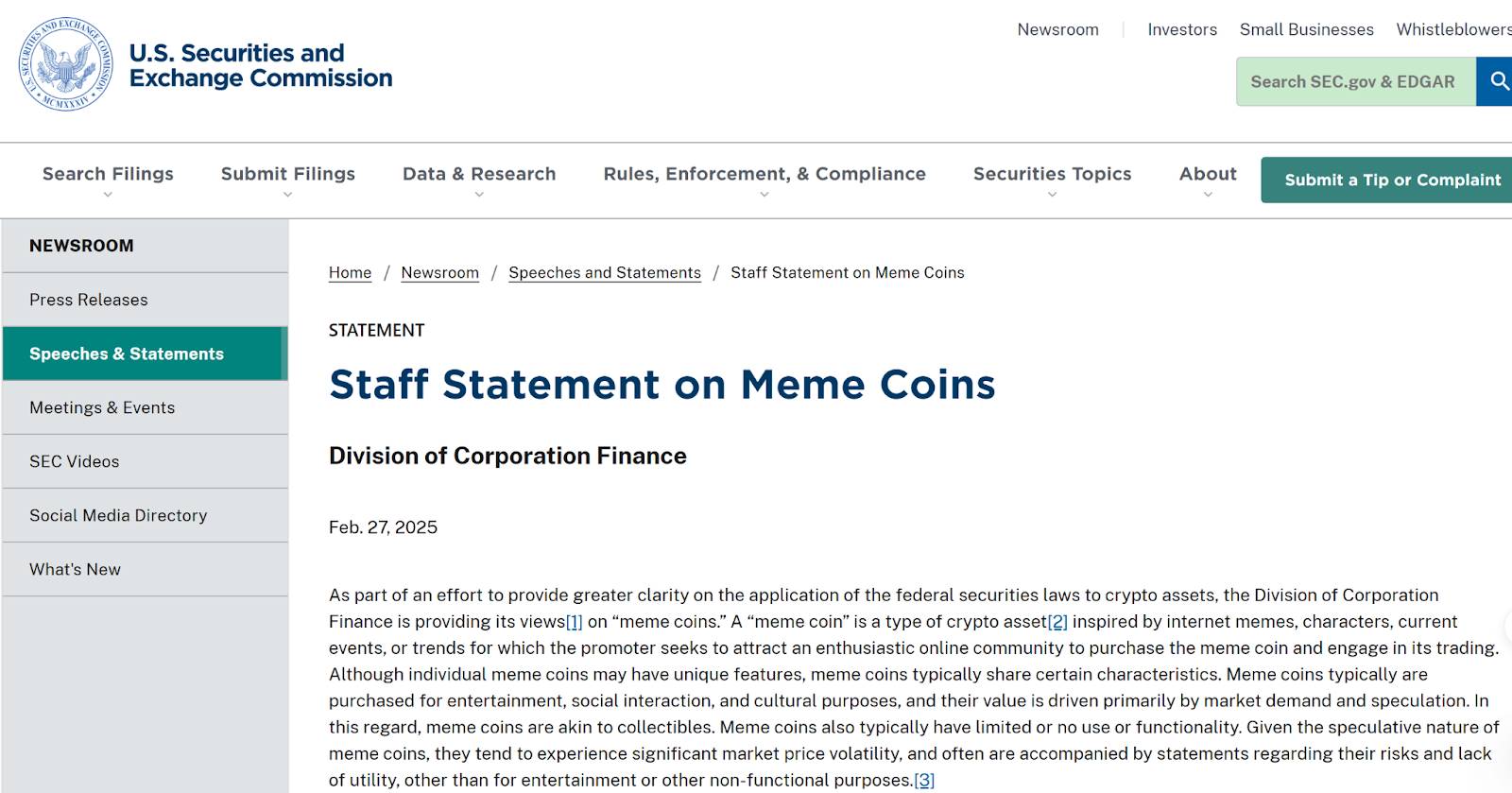
Source: https://www.sec.gov/newsroom/speeches-statements/staff-statement-meme-coins
Since Atkins became SEC Chair, the agency has released multiple official statements, staff guidance, and explanatory documents clarifying the regulatory boundaries of digital assets, specifying that the following types of crypto assets generally do not constitute securities:
-
Meme Coins: On February 27, 2025, the SEC’s Division of Corporation Finance issued a staff statement on meme coins—the first concrete clarification since President Trump’s executive order on digital assets and the formation of the Crypto Task Force. It stated that most meme tokens are not securities and their issuance and trading fall outside federal securities law. Meme coins are described as tokens created based on internet memes, pop culture, or trends, marketed via social media to drive community speculation. They are typically used for entertainment, social, or cultural purposes, lack functional utility, and derive value primarily from market sentiment and speculation. The SEC emphasized that typical meme coins do not generate holding returns nor grant claims to corporate profits, revenues, or assets—distinguishing them fundamentally from traditional securities like stocks and bonds. However, the SEC cautioned that each case must be assessed based on economic substance; if a token branded as a “meme coin” offers investment returns or involves issuer capital deployment to generate profits, it may still be deemed a security.
-
PoW Tokens: On March 20, 2025, the SEC’s Division of Corporation Finance released a statement on certain Proof-of-Work mining activities, clarifying that crypto tokens generated through PoW mining are not securities, and such mining does not constitute a securities offering. This applies to public, permissionless blockchains where miners receive block rewards through independent or pooled mining. The covered assets are limited to native tokens procedurally tied to the operation of the blockchain network—for example, those used in consensus mechanisms or awarded as mining incentives. Miners and mining pool operators engaging in such activities are not required to register with the SEC.
-
Stablecoins: On April 4, 2025, the SEC’s Division of Corporation Finance issued a stablecoin statement, determining that fiat-backed stablecoins meeting specific criteria are not securities. A “compliant stablecoin” is defined as a digital asset that: (i) is designed to maintain a stable 1:1 value with the U.S. dollar and can be redeemed at par; (ii) is fully backed by sufficient low-risk, highly liquid reserves, with reserve value equal to or exceeding the total face value of circulating supply; and (iii) is used solely for payment and value storage, without offering interest, dividends, or passive returns to holders, and not marketed as an investment opportunity. For such stablecoins, SEC staff concluded that their issuance and circulation do not involve offers or sales of securities and therefore do not require registration. Note: this exemption applies only to USD-backed, fully reserved stablecoins; algorithmic stablecoins, non-USD-pegged stablecoins, or those promising fixed returns are not included and may not qualify for this exemption.
-
PoS Staking Tokens: On May 29, 2025, the SEC’s Division of Corporation Finance issued a statement stating that staking activities within Proof-of-Stake (PoS) networks do not constitute securities offerings or sales and are not subject to federal securities registration. The statement defines “protocol-staked crypto assets” as native blockchain tokens intrinsically linked to the operation and security of a public, permissionless network—used in or rewarded for participation in consensus—and which do not grant holders any passive income rights. Staff determined that when token holders stake their tokens directly per network rules, delegate to third-party validators, or use custodial staking platforms, they retain ownership and control. The newly minted rewards are essentially compensation for resources contributed to securing the network, not investment returns derived from the entrepreneurial efforts of others. Therefore, whether through self-staking, delegated staking under self-custody, or custodial staking via exchanges, as long as the staked tokens meet these criteria, the staking process and resulting rewards do not satisfy the Howey Test’s definition of an investment contract, and thus do not involve securities transactions.
-
DeFi Tokens: The SEC has not yet issued a formal statement excluding “DeFi tokens” entirely from the definition of securities. However, on June 9, 2025, Atkins announced at a special SEC crypto roundtable that he would direct staff to study a conditional “innovation exemption” framework for DeFi projects, allowing qualifying decentralized platforms to operate with reduced regulatory burden. Atkins emphasized that U.S. law should protect the public’s right to participate in blockchain innovation—such as self-custodying digital assets or directly engaging with on-chain protocols—without undue restrictions. This reflects the new SEC’s philosophy of fostering market dynamism through flexible regulation. While not binding law, these remarks suggest a favorable policy direction toward truly decentralized, non-investment-purposed DeFi tokens. Future SEC guidance or rulemaking may further clarify their legal status.
5. Outlook on Potential Policy Measures
Based on Atkins’ statements and the current U.S. regulatory landscape, several key policy initiatives are likely during his tenure:
1. Restarting and refining reviews of products like Bitcoin ETFs: Crypto ETFs repeatedly stalled under Gensler, but the new SEC team has shown greater openness. Following the early 2024 approvals of Bitcoin and Ethereum ETFs, the rise in altcoin ETF applications after Atkins’ appointment signals a shift. The SEC is likely to accelerate review processes and issue dedicated guidelines for crypto ETFs. Beyond ETFs, other innovative financial products—such as DeFi yield-based funds or NFT-backed investment vehicles—may also be re-evaluated.
2. Clarifying crypto asset securities classification standards: The long-standing industry dilemma—“which tokens are securities?”—may finally be addressed under Atkins. While the Howey Test remains foundational, the SEC could issue additional guidance or rules interpreting its application to digital tokens. For example, defining what level of decentralization removes a token from securities classification; how token utility (payment vs. consumption) affects securities determination; and whether secondary market trading constitutes a securities offering. Indeed, since 2025, the SEC has begun issuing piecemeal clarifications: “pure-payment” stablecoins are not securities; “meme coins” without issuers may fall outside securities law; “PoW/PoS rewards” are not securities transactions. These scattered signals need to be consolidated into binding rules or formal guidance. Ultimately, on this core legal question, the new SEC favors clear written rules over enforcement settlements to end regulatory arbitrage and uncertainty.
3. Advancing legislation to clarify regulatory jurisdiction: Although the SEC oversees securities, crypto assets also involve commodity and monetary characteristics, leading to longstanding disputes over authority between the SEC, the Commodity Futures Trading Commission (CFTC), and banking regulators. Pending congressional bills like the *2025 Digital Asset Market Clarity Act (CLARITY Act)* and the *Stablecoin Innovation and Regulation Act (GENIUS Act)* aim to define regulatory boundaries and establish stablecoin legality. If passed, these laws could create a unified U.S. crypto regulatory framework, resolving overlapping jurisdictions and regulatory gaps once and for all.
4. Other potential reforms: Beyond the above, Atkins’ SEC may introduce internal governance and inter-agency cooperation measures. For instance, he might restructure internal crypto divisions, elevate the status of the Crypto Task Force, or establish a dedicated Office of Crypto Policy. On enforcement, he is expected to continue pursuing serious fraud and investor harm cases—even coordinating with the Department of Justice for criminal charges—to maintain credibility and counter accusations of being “too soft.” Simultaneously, to prevent misinterpretation of his pro-innovation stance, Atkins may issue regular policy statements reaffirming that the SEC will neither be a “roadblock” nor a “free-for-all,” but a responsible, adaptive regulator. Such communication will help stabilize market expectations and guide lawful innovation.
6. Impact and Outlook: A New Course for the Crypto Market
The policy boost under Atkins has already delivered an immediate positive impact on market sentiment. The broad rally in DeFi tokens and Coinbase’s 3.5% stock surge following the dismissal of its lawsuit show that improved regulation is being positively priced in. Some analysts called the resolution of the Coinbase case “removing a boulder that had weighed on investors’ minds for nearly two years.” U.S. trading volumes and capital flows are also showing signs of recovery, indicating that regulatory relief is revitalizing the industry—plans previously shelved due to compliance concerns are restarting, and innovators’ confidence in the U.S. market is returning.
If the SEC formally approves a wave of crypto ETFs in the coming months, it could trigger a further “ETF effect,” drawing in new capital. More broadly, clear regulation can dispel years of market uncertainty, attracting traditional institutional investors to allocate to digital assets. For example, Wall Street giants like JPMorgan are already building digital asset trading platforms, signaling their expectation of sustained regulatory improvement. Meanwhile, regulatory easing could spark a revival and upgrade in DeFi. Developers may feel emboldened to launch new decentralized financial products, spawning more diverse use cases and accelerating the evolution of the entire Web3 ecosystem.
Despite the optimistic outlook, potential challenges remain:
-
The pace and strength of policy implementation remain uncertain: Many of Atkins’ proposals require formal rulemaking or congressional legislation, which may face delays or opposition. Will the Democratic-controlled Senate support crypto legislation? Will Democratic commissioners on the SEC vote for certain reforms? These questions remain unanswered.
-
External shocks cannot be ignored: Another major scandal or market collapse—similar to Luna or FTX in 2022—could trigger public and political pressure forcing the SEC to tighten its stance again.
-
State-level regulators and other agencies may still exert influence: For example, the New York Attorney General has indicated intentions to fill any “enforcement vacuum” at the federal level. Even if the SEC eases up, state regulators and prosecutors may maintain pressure on the industry.
Conclusion: Paul S. Atkins’ appointment marks the beginning of a crypto-friendly era in U.S. securities regulation. Within just two months, through speeches, statements, and actions, he has outlined a preliminary regulatory roadmap centered on supporting innovation, prioritizing rules, combating fraud, and fostering collaboration. While debates around his policies will continue, this regulatory paradigm shift has already prompted a reevaluation of the boundaries between crypto technology and financial oversight. With rational participation and balanced policymaking, a regulatory framework that protects investors while embracing innovation is likely to emerge—offering valuable lessons for the global community.
About Us
Hotcoin Research, the core investment research hub of the Hotcoin ecosystem, is dedicated to providing professional, in-depth analysis and forward-looking insights for global crypto investors. We have built a “triple-integrated” service system of “trend analysis + value discovery + real-time tracking,” delivering deep industry trend analysis, multi-dimensional project evaluations, and round-the-clock market monitoring. Through our weekly《Top Coin Selection》strategy livestreams and daily《Blockchain Headlines》news briefings, we offer precise market insights and practical strategies tailored to investors at all levels. Leveraging cutting-edge data analytics models and an extensive industry network, we empower novice investors to build solid knowledge frameworks and help institutional clients capture alpha, jointly seizing value growth opportunities in the Web3 era.
Join TechFlow official community to stay tuned
Telegram:https://t.me/TechFlowDaily
X (Twitter):https://x.com/TechFlowPost
X (Twitter) EN:https://x.com/BlockFlow_News
 @HotcoinAcademy






