Infini Card suddenly announced shutdown, possibly due to compliance pressures—Is the U card still a good business?
TechFlow Selected TechFlow Selected
Infini Card suddenly announced shutdown, possibly due to compliance pressures—Is the U card still a good business?
Compliance risk remains the biggest obstacle for U cards.
 Navigating Web3 tides with focused insights
By: WuShuo Blockchain
All content in this article is compiled from publicly available information. It does not represent the views of WuShuo, nor does it constitute any investment advice. Readers are reminded to strictly comply with local laws and regulations and refrain from participating in any illegal financial activities.
In early June, the founder of Infini was still giving interviews promoting the U Card. But just days later, a sudden announcement of service termination sparked widespread discussion:
At noon on June 17, Infini suddenly announced: "We have decided to discontinue the Infini Card service. Effective immediately, Global Cards, Lite Cards, and Tech Cards will all be suspended from use and new applications. We sincerely apologize for any inconvenience caused. Core functions such as top-ups, withdrawals, and Earn yields remain unaffected—your assets remain secure and under your control. To properly manage this transition, we will automatically refund the actual card issuance fees (excluding any discounts) paid by all affected users to their Infini account balances. The refund will arrive within 10 business days without requiring any action from you. Pending refunds will also be returned to your Infini account, expected to complete within 5–21 business days. Your funds remain safe."
Junzhu, co-founder of Infini, explained: "Infini is exiting the consumer-facing (to C) card business. The reason is that compliance costs are extremely high, profit margins are razor-thin, and operations are overwhelmingly burdensome. Currently, the to C card business consumes 99% of our time and resources while generating zero revenue. Our focus will now shift to wealth management and asset management services. The current crypto card model still relies on offramping USDT and USDC, then using traditional payment networks to convert stablecoins into fiat—this path is too convoluted, slow, and expensive. Without subsidies, it's nearly impossible to match Web2-level fees and cashback rewards. The U Card is not the ultimate solution for Web3 payments with stablecoins. At present, Infini is a centralized product, but we will fully embrace decentralization in the future—exploring and adopting decentralized payment solutions. We absolutely will not go back down the centralized path."
Junzhu also mentioned that when developing the U Card, they had sought advice from OneKey—only to end up with the same fate. Hardware wallet provider OneKey had previously launched its own U Card, which was also abruptly discontinued.
There is speculation that the shutdown may be linked to the recent WildCard incident. WildCard is a platform specializing in virtual credit card services, enabling users to easily register and subscribe to overseas services. It notably optimized the OpenAI experience, including automated registration and ChatGPT Plus upgrades. The platform is rumored to be under investigation.
Christian, founder of Infini, recently highlighted the unique features of the Infini Card during a live Space session: "The Infini Card has always focused on serving the general public and retail users—this was our original mission. Unlike crypto cards offered by exchanges that target VIPs, our card is designed for everyday users, making it more accessible and practical. Crypto cards are inherently a thankless product, but we've remained committed to improving user experience. Our fee structure is transparent and highly competitive. Particularly in USD-denominated transactions, our current swipe fee is just 0.1%, the lowest in the market. We plan to further optimize and reduce costs to maintain long-term pricing advantages. Most uniquely, we offer yield on card balances—a rare feature in the industry. Many users keep some USDT on their cards for daily spending, so we provide flexible理财 yield to offset transaction-related value erosion. These yields come from proprietary strategies we're building, some of which are unique and difficult to find on other DeFi platforms—and we're happy to share them with our users."
@knowyourself518 tweeted: "For U Card businesses, a single internal whistleblower report could trigger an investigation, leading to fines far exceeding the cost of obtaining licenses. One heavy penalty could be fatal. Add to that the ambiguity around on-chain fund flows—for example, proving the origin of funds—and compliance costs escalate exponentially. There are endless cases of U Cards being exploited by telecom fraud gangs. Yet these platforms lack the 'trading fee' revenue engine of exchanges, while being forced to directly absorb retail-level risks. Long-term operations inevitably lead to problems."
"Even more harshly," the tweet continued, "card networks and upstream banks pass all AML violation fines directly onto the issuing entity—light penalties wipe out deposit guarantees; severe ones result in license revocation. Meanwhile, intermediaries simply collect their fees. Buying a bank doesn't solve the problem either—if the card network isn't satisfied, the fine recipient remains the bank. Failure to pay means expulsion from Visa/Mastercard networks. So owning a bank doesn't fix the root issue. The real cost borne by users goes well beyond 1–2% transaction fees: card issuance fees, exchange rate losses, friction during top-ups... Without subsidies, the true industry average rate is 3–5%. Compared to giants like Visa and Mastercard, who benefit from massive transaction volumes, U Cards have no competitiveness in small-transaction scenarios. Without heavy subsidies, ordinary users simply won't adopt them. Crypto Cards are low-margin ventures requiring huge transaction volume and asset deposits to turn a profit. They're resource-intensive. As operations scale, both compliance and operational costs rise sharply. Therefore, achieving scale is crucial—and ideally, synergy with core business lines."
Notably, card networks, upstream banks, and payment gateway providers collect fees and fines, while startups bear all operational risks—asset management failures, regulatory penalties, telecom fraud losses. This setup essentially turns U Cards into a gambling ground where compliance arbitrage players prey on Web3 VC funding. Ultimately, U Cards aren't good businesses. Payment services themselves aren't profitable, and highly regulated consumer finance is especially unsuitable terrain for early-stage startups.
Despite Infini’s eventual exit, the U Card sector remains hot. On March 14, 2025, RedotPay announced a successful $40 million Series A round led by Lightspeed, with significant participation from HSG and Galaxy Ventures following a commitment made in December 2024. DST Global Partners, Accel, Vertex Ventures (a Temasek-backed venture firm), and others also joined the round.
At the June State of Crypto conference, Coinbase announced a partnership with American Express to launch the "Coinbase One Card" credit card, offering Bitcoin cashback and staking rewards. The company also teamed up with Shopify and Stripe to expand USDC payment adoption, bringing stablecoins into real-world spending.
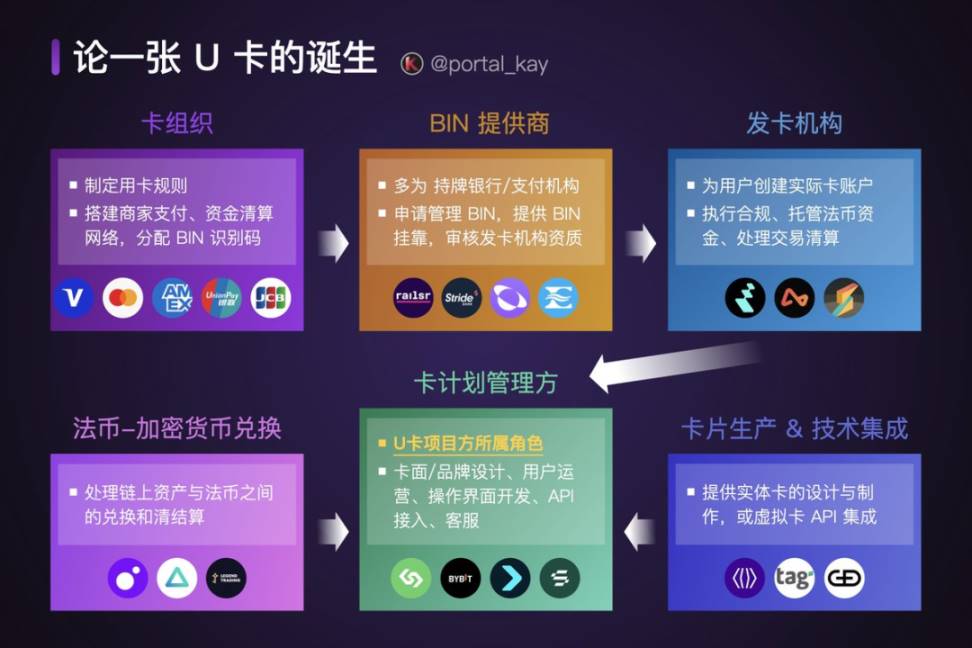
@portal_kay once dissected how a U Card comes to life, identifying key players: card networks, BIN providers, issuing institutions, card program managers, fiat-crypto exchangers, and card production & technology integration service providers. In the U Card (virtual credit card or payment tool) ecosystem, upstream and downstream roles are clearly divided:
- Card Networks (e.g., Visa, MasterCard): At the top of the chain, they set rules, build global payment clearing networks, and allocate Bank Identification Numbers (BINs—the first six digits of card numbers) to licensed financial institutions.
- BIN Providers (e.g., Evolve Bank, Railsr): Licensed banks or payment institutions that apply for and manage BINs, vet partner qualifications, allow projects to piggyback on their licenses for card issuance, and assist with regulatory and settlement processes.
- Issuing Institutions (e.g., REAP, Airwallex): Create user card accounts, conduct KYC/KYT checks, hold fiat funds, and process transaction settlements—typically not handling crypto directly.
- Card Program Managers (e.g., Bybit Card, Bitget Card): The core of U Card projects, responsible for product design, user operations, API development, risk control strategies, coordinating KYC with issuers, and marketing with card networks.
- Fiat-Crypto Exchangers (e.g., MoonPay, Circle): Handle conversions between on-chain assets and fiat, such as turning users’ USDT top-ups into USD deposited into custodial accounts.
- Card Production & Technology Integration Service Providers (e.g., IDEMIA, G+D): Supply physical card manufacturing or virtual card API integrations, support bindings with wallets like Google Pay and Apple Pay. Modern BaaS companies offer SDK integration solutions.
All these parties work closely together to support the operation and compliance of U Card services.
Compliance risks remain the biggest hurdle for U Cards. FinTax points out several legal risks associated with their use. For instance, in countries with strict foreign exchange controls, although U Cards do not limit individual deposits or withdrawals of USDT, moving funds abroad exceeding foreign exchange quotas may violate foreign exchange regulations. If detected, individuals may face administrative fines—or even criminal charges. Additionally, the legal status of cryptocurrencies remains unclear in some jurisdictions, with outright bans in place. In such regions, using crypto U Cards for transactions could itself be deemed illegal. Therefore, users must understand the basic compliance requirements in their respective countries before using U Cards. Moreover, U Cards should never be used as tools for criminal activities. Engaging in high-frequency, large-value transactions or assisting others in cashing out illicit funds via U Cards may be classified as illegal business operations or money laundering, resulting in criminal liability.
Due to perceived anonymity or minimal KYC requirements, some users attempt to use U Cards for tax evasion—such as concealing income sources to reduce taxable amounts. However, such practices are impractical. First, despite some level of anonymity, most U Cards still rely on international payment networks (Visa, Mastercard, etc.), which meticulously record every transaction—including amount, merchant details, and timestamps. Tax authorities can trace fund flows through these records. Second, for cross-border transactions, tax agencies can monitor capital movements via foreign exchange surveillance systems and interbank data sharing. Many countries have signed the Common Reporting Standard (CRS) for automatic tax information exchange, making cross-border flows increasingly transparent. Through CRS, tax authorities can access transaction data linked to U Cards. Finally, in practice, payment platforms often conduct stricter identity verification for large transactions. Users involved in frequent high-value transfers may be required to submit proof of legitimate fund sources. Thus, attempting tax evasion via U Cards is not only ineffective but also likely to trigger tax audits and penalties.
Join TechFlow official community to stay tuned
Telegram:https://t.me/TechFlowDaily
X (Twitter):https://x.com/TechFlowPost
X (Twitter) EN:https://x.com/BlockFlow_News
 吴说区块链
吴说区块链