CEX New Token Effect Data Analysis: Listing Boom and Platform Differences
TechFlow Selected TechFlow Selected
CEX New Token Effect Data Analysis: Listing Boom and Platform Differences
The "new coin effect" gives rise to myths of instant wealth, but also harbors significant risks.
 Navigating Web3 tides with focused insights
After a phase of market recovery marked by an influx of new institutional players, newly launched tokens have surged rapidly, becoming focal points for speculative capital and hot money. Particularly in recent weeks, with numerous projects conducting token generation events (TGE) and distributing airdrops followed by consecutive exchange listings, there has been growing discussion within the crypto community about strategies for new tokens—specifically, whether the traditional short-term mindset of "sell at listing" should persist, or if a more long-term, value-driven approach is now warranted.
To unpack this question, this article focuses on the post-listing price performance of new tokens across centralized exchanges (CEXs), providing crypto traders with a more comprehensive and realistic basis for decision-making. Through comparative data analysis, we aim to establish a quantitative framework that offers meaningful guidance for observing new token dynamics in the market.
Overview of Recent New Token Listings on Major CEXs
We analyzed the period from May 1 to June 12, 2025—a span of nearly six weeks—comparing initial token offerings on five major exchanges: Bybit, OKX, Bitget, Gate, and LBank. The analysis covers metrics such as the number of new listings per platform and price performance across different timeframes (5 minutes, 1 hour, 24 hours, 7 days), along with trading depth.
-
Bybit, OKX — traditionally considered “first-tier” platforms, known for strict project screening and conservative listing rhythms;
-
Bitget, Gate — emerging platforms whose user base and liquidity have risen to the forefront of the industry, qualifying them as “new first-tier”;
-
LBank — a representative “latecomer” among second-tier exchanges, having gained prominence through high-frequency initial listings.
From May to June 2025, the crypto market experienced another wave of new token listings, with significant divergence in listing strategies across major centralized exchanges.
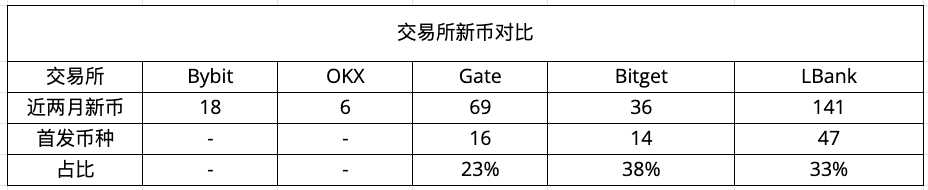
Based on our review of official listing announcements, X (Twitter) updates, and community activity, the new token listing statistics for these five exchanges between May and June 2025 are as follows:
-
LBank ── 141 new tokens, adopting a "machine-gun" style listing strategy; offering abundant opportunities but with highly mixed quality—around 90% of projects showed strong divergence within seven days.
-
Gate ── 69 new tokens, maintaining its "daily update" pace, characterized by high volatility and inconsistent liquidity depth; ample room for short-term speculation, yet accompanied by risks of liquidity gaps.
-
Bitget ── 36 new tokens, driven by both spot and derivatives trading; intense bullish-bearish confrontations on listing day; some thematic tokens doubled against the trend, though leveraged positions carry reversal risks.
-
Bybit ── 18 new tokens, tightly controlling listing volume with clear “pump-and-dump” patterns; missing the opening surge often means narrowly limited profit windows thereafter.
-
OKX ── 6 new tokens, prioritizing quality over quantity with the strictest standards; controlled volatility but concentrated profitability, requiring precise timing to capture gains.
In general, LBank and Gate generate numerous trial-and-error opportunities via frequent listings; Bybit and OKX compress risk through selective curation; Bitget occupies the middle ground, using derivative instruments to amplify short-term trading opportunities.
In terms of rhythm, platforms like LBank exhibit high-frequency, dispersed listings—averaging 2–3 new token launches per day—continuously injecting "fresh blood" into the market. This machine-gun listing strategy gives LBank a leading edge in project diversity. Meanwhile, some exchanges opt for batch releases—launching multiple tokens simultaneously to attract attention. In contrast, mainstream platforms like OKX listed only a handful of new tokens during May–June, favoring rigorous selection and a slower listing pace. While Bybit and Bitget list fewer tokens than LBank, they maintain a weekly rollout frequency, actively tracking market trends.
Bybit: High Open, Low Close – Initial Volatility Masks Subsequent Weakness
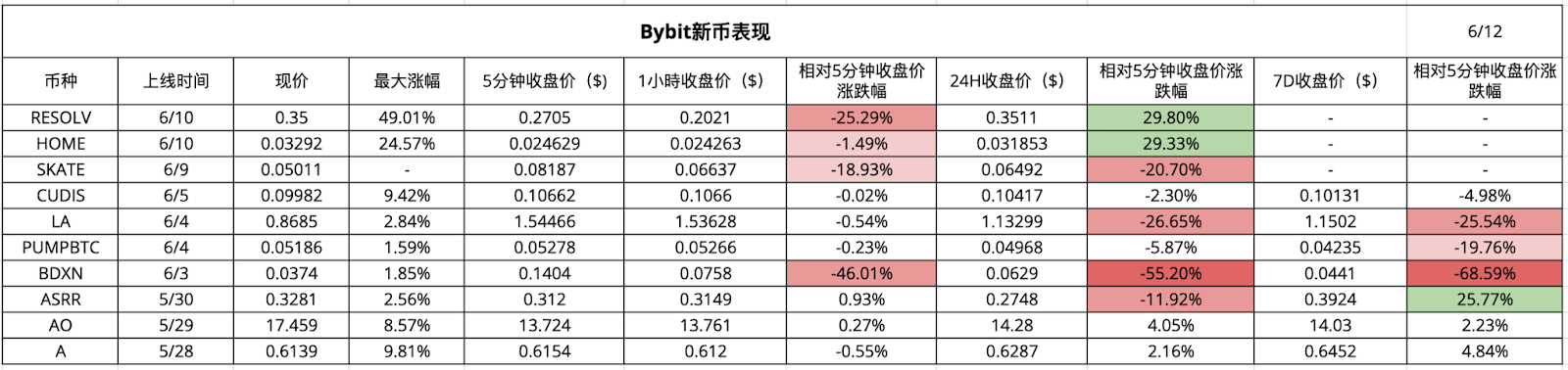
Between May 1 and June 12, 2025, Bybit globally or concurrently launched 18 new tokens—an average of roughly one every two to three days. Most were meme coins or ecosystem tokens from new blockchains, accounting for nearly 70%. In this sample, Bybit’s new tokens continued to show classic “pump-and-dump” behavior: RESOLV and HOME rebounded nearly 30% within 24 hours compared to their 5-minute closing prices, but rallies were largely confined to the first few candles after listing. Once buying pressure faded, prices quickly retraced. BDXN exemplifies a typical rollercoaster—priced at $0.1404 five minutes after launch, it dropped to just $0.0441 after seven days, a decline of 68.6%. Except for ASRR (+25.8%) and AO (+2.2%), all other tokens turned negative over seven days, indicating that Bybit's new token momentum leans heavily toward ultra-short-term speculation. Failure to realize profits within the first hour often results in a stepwise erosion of holding value.
OKX: A Selective Listing Pace Does Not Guarantee Profits

OKX listed only six new tokens from May to June, continuing its cautious approach. However, returns suggest that “quality over quantity” does not equate to guaranteed gains. RESOLV managed a 48.8% late surge within 24 hours thanks to deeper market support—the sole bright spot. SOPH, KMNO, and HUMA lost ground within 24 hours and retreated 14–45% over seven days, showing even vetted projects struggle to withstand liquidity withdrawal. JITOSOL, a high-priced asset, traded in a narrow range, gaining only 1.4% over seven days relative to its 5-minute price. Overall, OKX’s new tokens exhibited lower volatility than peers, but profit concentration was extremely high. Missing early outperformance leaves limited follow-up opportunities.
Gate: High Listing Frequency Comes With Broader Drawdowns
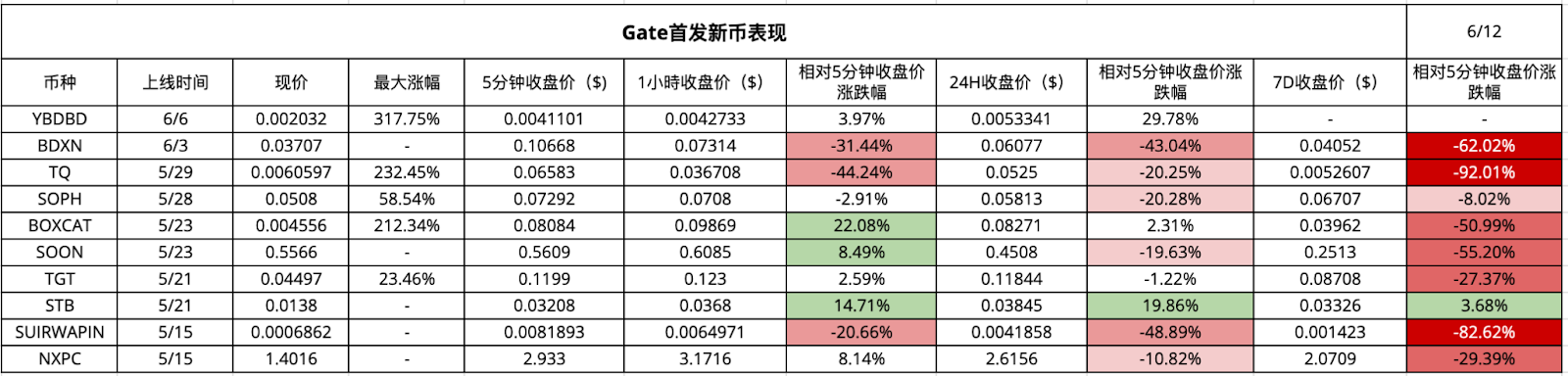
With 69 new listings in the past two months, Gate ranks among the most active. Yet the data reveals pronounced “side effects”: TQ and SUIRWAPIN fell 92% and 82% respectively over seven days from their 5-minute closing prices; BDXN and BOXCAT also declined over 50%, while only STB posted a marginal gain (+3.7%). Though occasional short-term spikes occurred—like YBDBD (+29.8%)—most tokens swiftly broke key support levels after initial surges. Gate suffers from relatively shallow market making, where price moves are easily exaggerated by isolated trades. High-frequency listings create dramatic short-term pumps but magnify waterfall risks amid next-day liquidity vacuums.
Bitget: "Ice and Fire" Under the Derivatives Lens
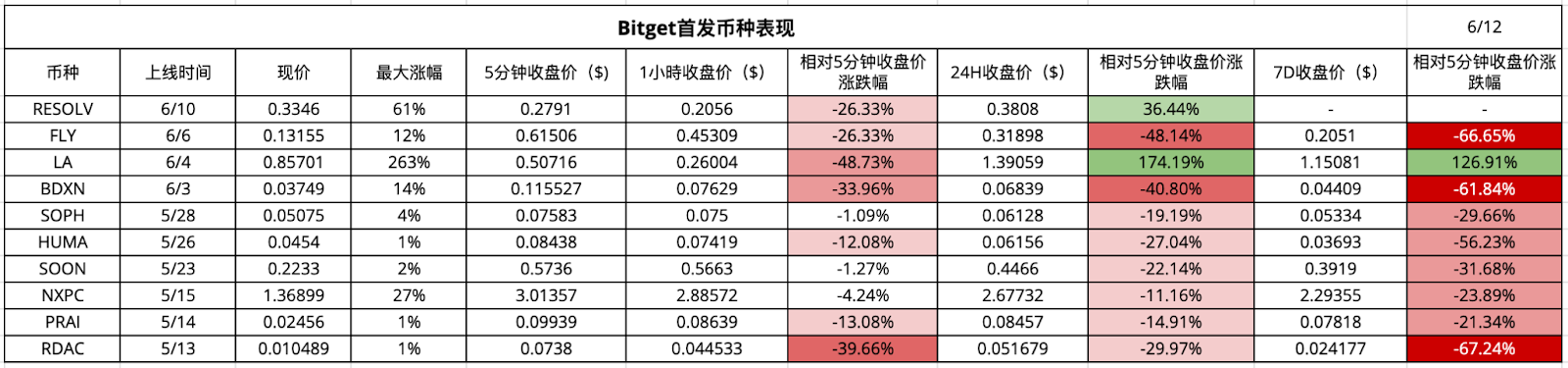
Overall, Bitget’s 36 new tokens from May–June displayed a right-skewed return distribution: only LA maintained a ~1.3x gain over seven days, barely entering the “doubler club”; a small fraction (~15%) saw modest gains of 0–30%; about a quarter fell between –10% and –30%, representing mild underperformance; more than half suffered deep drawdowns of –30% to –70% in the first week, including notable cases like FLY, BDXN, and RDAC. Estimated average and median weekly losses were around –28% and –31% respectively, with less than 25% of tokens ending the week green. This indicates that profitability was concentrated in very few popular assets. Most new tokens quickly sank under dual pressure from futures shorting and evaporating liquidity, effectively completing a “survival-of-the-fittest” elimination within the first week.
LBank: Extreme Divergence – Massive Winners Alongside Deep Retreats
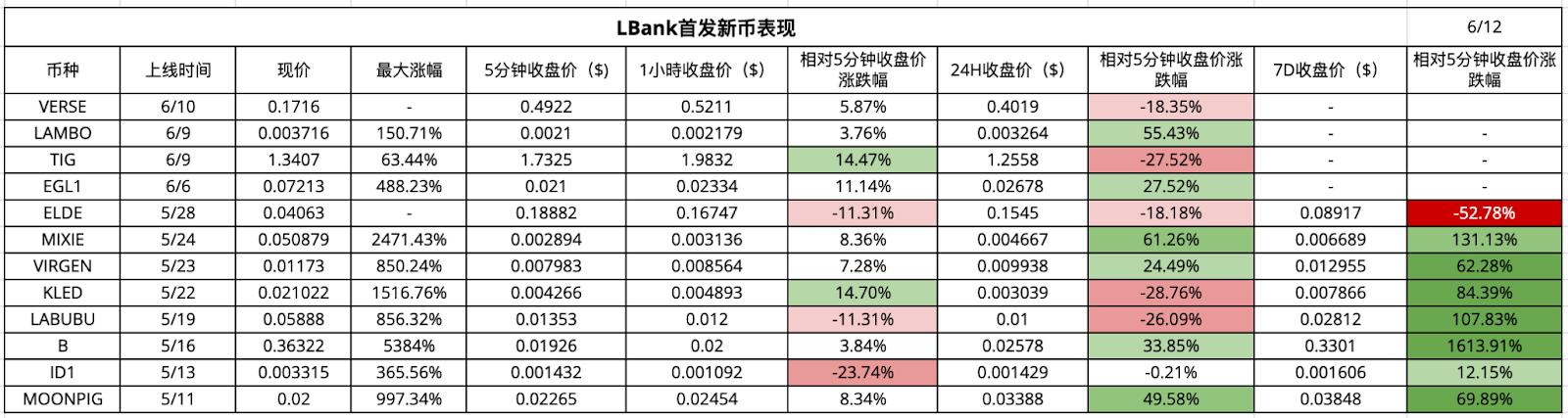
LBank led the industry with 141 initial listings. Within 24 hours, standout performers like LAMBO (+55.4%) and MIXIE (+61.3%) posted rapid gains. As the market cooled, however, most tokens settled into a “dumbbell” pattern over seven days—one end featuring multi-baggers like B (+1,613.9%), LABUBU (+107.8%), and KLED (+84.4%); the other, deeply underwater tokens like ELDE (–52.8%). On average, the sample declined ~24% over seven days (median ~–27%), with only a 3% doubling rate. Thus, while loose listing criteria increased the odds of hitting extreme outliers, the majority of tokens quickly faded into obscurity. Without agile take-profit strategies, investors are more likely to be gradually eroded by persistent negative returns—only a lucky few positions cash in on hundredfold myths.
Cross-platform comparison
The four platforms display distinctly different risk-return profiles: Bybit’s “flash rally” demands lightning-fast entry and exit; OKX trades smaller volatility for reduced overall upside; Gate amplifies downside risk through frequent listings; LBank uses volume to increase outlier hits but at higher failure rates. Investors must align platform choice with their own trading horizon and risk tolerance: those seeking quick arbitrage may focus on Bybit and Gate’s high-volatility windows; stability seekers might wait for OKX’s low-beta launches; while those willing to “pan for gold” in vast pools will find LBank’s expansive universe increases hit probability—but only with disciplined position sizing and risk controls.
Short-, Medium-, and Long-Term Performance After Listing
New token listings are typically accompanied by sharp volatility, with vastly different outcomes depending on holding duration. Drawing from recent data, we examine three representative tokens—B (BUILDon), LABUBU, and LAUNCHCOIN—to compare the merits of short-term speculation versus medium- to long-term holding.
-
B (BUILDon) – The “Long-Hold Winner”: Launched on LBank on May 16, B opened at ~$0.019 (5-minute close). It rose slightly to ~$0.020 (+~4%) within the first hour, then reached ~$0.0257 after 24 hours (~+34% from open). More impressively, B continued climbing: reaching ~$0.330 after one week (about 17x the opening price) and currently hovering near $0.363—nearly an 18x gain. While short-term traders profited, it was the medium-to-long-term holders who captured the lion’s share. Notably, B briefly spiked to 53x its opening price intra-day, suggesting early participants could achieve extraordinary single-day returns if exiting at the peak. However, such extreme moves are hard to capture for most; patience over weeks proved more reliably rewarding.
-
LABUBU – “Rollercoaster Followed by New Highs”: LABUBU debuted on May 19 (simultaneously on LBank and others) at ~$0.0135. Like many new tokens, it surged and plunged immediately: peaking at 8.56x its launch price intraday, then retracing sharply to close near $0.0135 at 5 minutes. Over the next hour it dipped further to ~$0.012 (down ~11%), closing 24 hours later near $0.0100 (~–26% from open). Day-one buyers were mostly underwater. However, LABUBU bottomed and reversed: rising to ~$0.0281 after one week (>2x launch price). Momentum continued into June, reaching ~$0.0589—up ~3.4x from launch. This trajectory shows that selling early avoids intraday drawdowns but forfeits subsequent multi-bagger gains. Medium-to-long-term holders, despite enduring initial volatility, ultimately earned higher returns. While such a V-shaped recovery isn’t common, LABUBU illustrates the possibility of “getting rekt early, then doubling later.”
LAUNCHCOIN – “The Miracle of Instant Hundredfolds”: One of May’s most hyped meme tokens, LAUNCHCOIN rocketed after launching on April 29 (first on LBank, MEXC, etc.). Official data shows a cumulative monthly gain of 15,194% (~152x), topping May’s leaderboard. If launched at ~$0.001, it soared to ~$0.15 within days. The token spiked on day one, corrected afterward, but remained far above launch levels. As of mid-June, LAUNCHCOIN still fluctuates around $0.20—over 100x its initial price. For such rare cases, short-term traders locking in gains during the initial explosion could secure hundredfold profits; long-holders, even if missing the top, still enjoy massive unrealized gains. However, such “hundredfold tokens” are exceedingly rare—LAUNCHCOIN’s success stemmed largely from riding the meme coin frenzy. For most new tokens, post-launch declines are the norm. For example, BDXN on Bybit halved in price within an hour and fell to ~30% of its launch price after seven days, now below 27%. In contrast, only a few projects like AO steadily climbed, gaining over 20% in a week and holding ~27% gains today. Clearly, in new token investing, “few win, many lose,” and investment horizon is critical.
Combining these three cases with broader data, holding period significantly impacts returns:
-
Short-term (T+0 ~ 1 day): Many new tokens experience violent swings in the first few hours—offering instant tens-of-fold gains but also deep pullbacks. The advantage of quick arbitrage lies in locking in explosive gains or cutting losses before overnight uncertainty. Only short-term traders could capture LAUNCHCOIN’s near-hundredfold intraday run. However, timing is crucial—buying the top can lead to immediate losses, as seen when LABUBU’s early spike trapped buyers with >20% paper losses on day one.
-
Medium-term (several days to 1 week): After the initial chaos, many tokens either reverse course or continue declining. Medium-term holding filters out noise and allows for larger-scale value plays. Some tokens find bottoms days after launch and rebound (e.g., LABUBU’s recovery on days 5–7); others keep bleeding once hype fades (e.g., BDXN losing >70% over a week), worsening losses. Thus, medium-term effectiveness varies by token, testing investors’ judgment of a project’s staying power.
-
Long-term (weeks or longer): For a rare few high-potential projects, long-term holding yields astronomical cumulative gains. B and LAUNCHCOIN delivered dozens-of-fold returns over weeks. However, most tokens fail to sustain momentum beyond months, eventually fading to zero. Holding newly listed tokens long-term is essentially betting they’ll become black swans. Winners are scarce, but rewards are life-changing.
Overall, the typical new token path involves short-term pump-and-dump, followed by gradual normalization. Most reach highs shortly after launch, then fall—many never recovering their opening prices. Thus, short-term strategies often lock in unique early gains and avoid deep corrections; long-term holds only pay off for select fundamentals-backed or narrative-sustained projects, while for most tokens they mean steadily shrinking value. Hence, the dilemma between “in-and-out fast” vs. “hold for the long haul” remains central to new token investing.
Cross-Platform Trading Differences for Key New Tokens
Different trading platforms often show starkly divergent price and trading data for the same new token—across both spot and derivatives markets. Taking B, LABUBU, and LAUNCHCOIN as recent hot assets, we compare their spot and perpetual contract performances across multiple exchanges (LBank, Gate, Bitget, etc.) to explore platform differences and underlying causes.
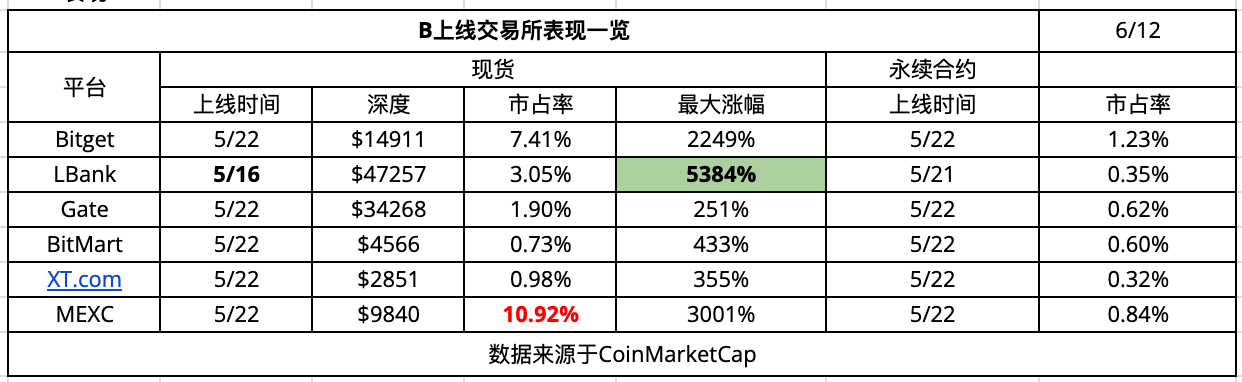
B (BUILDon) Cross-Platform Performance: B was first globally launched on LBank on May 16, with Gate, Bitget, MEXC, and others following within a week. On launch day, B saw an astonishing intraday spike—peaking at 53.8x its opening price on LBank. As the earliest listing venue, LBank attracted a flood of initial speculative capital, resulting in significantly higher trading activity and volatility compared to later entrants. At launch, LBank’s order book depth reached ~$47,257 in outstanding orders—far exceeding contemporaneous platforms (Gate: ~$34,268; Bitget: ~$14,911). Greater depth provided stronger absorption during the surge, possibly preventing B from spiraling into uncontrolled one-sided movement. In contrast, platforms like Gate, which listed B on May 22, faced a market where price discovery had already occurred—B’s daily high on Gate reached only ~2.5x opening price. This shows listing timing directly affects performance: earlier platforms capture greater upside, while latecomers face rationalized pricing.
In derivatives trading, disparities also emerged. Bitget launched B’s perpetual contract on May 22 and quickly became the hub for leveraged trading, dominating in both volume and open interest. Data shows Bitget captured ~1.23% of global B contract market share, ahead of Gate (~0.62%), while LBank held only ~0.35%. This anomaly—lower contract share for the launch platform—may stem from: (1) LBank users preferring direct spot exposure; (2) Bitget’s user base being more inclined toward leverage-based speculation. Additionally, LBank launched its B contract slightly later (May 21) with potentially less aggressive leverage settings, prompting risk-seeking traders to migrate. Overall, B’s cross-platform story reflects: LBank led in spot momentum and depth, while Bitget seized the derivatives initiative, attracting speculative flows.
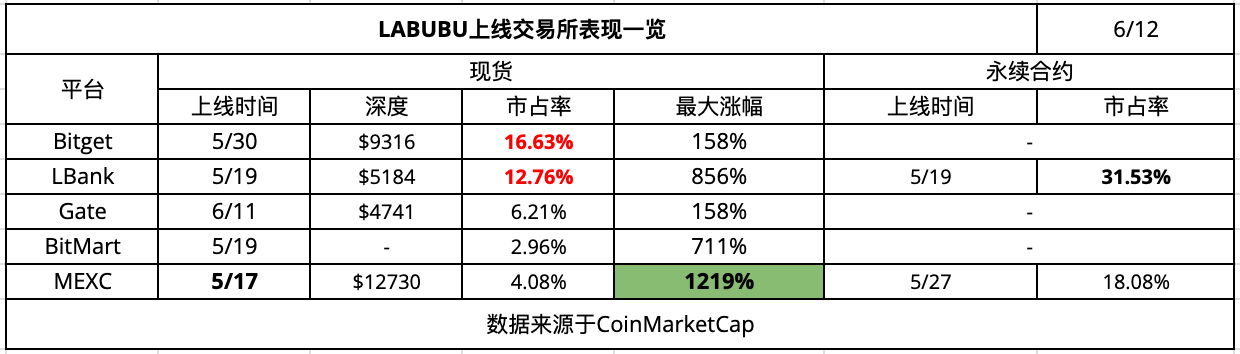
LABUBU Cross-Platform Performance: LABUBU went live on multiple exchanges in mid-to-late May, but with divergent outcomes. MEXC led the charge on May 17, recording a peak intraday gain of 12.19x. Two days later, on May 19, LBank and BitMart jointly launched it: LBank, backed by experienced users and solid liquidity, saw LABUBU peak at ~8.56x launch price; BitMart, with shallower depth, paradoxically achieved a higher 11.11x spike—suggesting thin markets allow small capital to drive outsized moves. Bitget joined much later on May 30, by which time enthusiasm had waned—its peak was only ~1.58x, a muted move. Gate followed even later on June 11, showing similar ~1.58x fluctuations. Timing again proved decisive: later entries saw smaller gains.
In spot volume, contributions varied. By mid-June, Bitget led in trading share (~16.63%), followed by LBank (~12.76%), then MEXC (~4.08%). Despite late entry, Bitget captured substantial volume, surpassing early mover LBank—likely due to concentrated user activity upon official listing. Meanwhile, part of LBank’s LABUBU trading shifted to derivatives. LBank was among the first to offer LABUBU perpetual contracts (launched May 19), capturing 31.53% of total contract volume—far ahead of peers. This indicates many speculators used LBank to open leveraged positions, either to amplify gains or hedge spot exposure, giving LBank dominance in LABUBU derivatives. In contrast, Gate and BitMart never launched LABUBU contracts, letting momentum pass. Likely, LBank’s simultaneous spot and derivatives rollout offered richer strategic options, helping it attract high-frequency and hedging demand, cementing leadership in LABUBU trading.
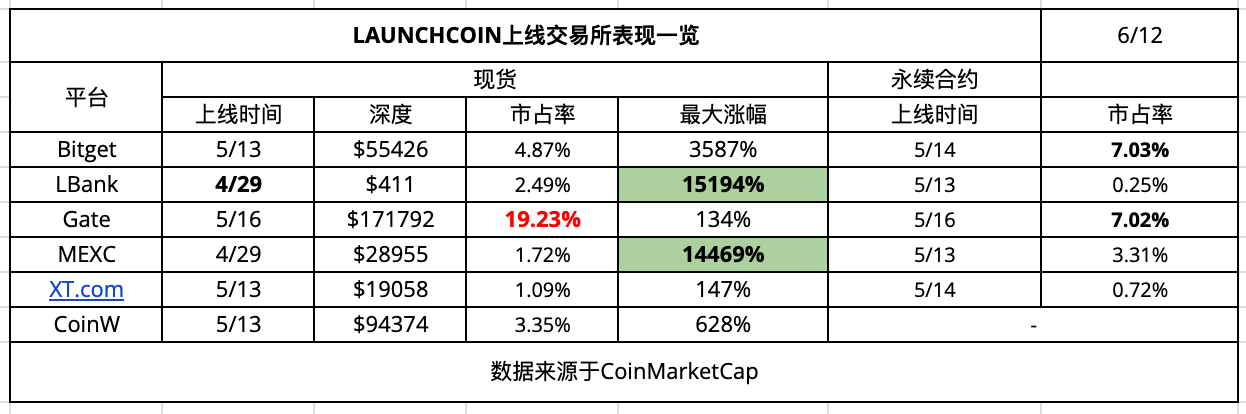
LAUNCHCOIN Cross-Platform Performance: LAUNCHCOIN’s cross-platform journey highlights an extreme contrast—“early entrants feast, latecomers get crumbs.” As a meme sensation, LAUNCHCOIN debuted on April 29 on LBank and MEXC, triggering a hundredfold myth (LBank peak: ~151.94x; MEXC: ~144.69x). Early platforms, fueled by raw market euphoria, sent prices skyward. But this wasn’t replicated later: Bitget joined on May 13, with LAUNCHCOIN peaking at ~35.9x—still impressive, but dwarfed by initial highs. Gate began trading on May 16. By then, price discovery was complete—LAUNCHCOIN opened near fair value, spiking only 34% (1.34x) before stabilizing, with little speculative heat. These differences also reflect user composition and market-making styles: LBank and MEXC users are known for chasing hype, pushing prices aggressively; Gate’s user base and market makers prioritize deep liquidity (order depth at launch: $171,792, highest among platforms), curbing excessive spikes.
In perpetual contracts, rollout timing shaped the trading landscape. LBank and Bitget launched LAUNCHCOIN futures around May 14 (day after spot), while Gate synchronized contract launch with spot. From mid-phase onward, most major platforms offered shorting tools. As rational traders deployed hedges, LAUNCHCOIN avoided replaying its early irrational surges. Data shows Gate and Bitget secured relatively large shares (~7% each) in the contract market, reflecting active professional participation; LBank, despite capturing most early speculative flows in spot, saw its contract share diluted to just ~0.25%. This suggests differing user preferences: LBank users favor spot speculation; Gate/Bitget users lean toward derivative tools. Moreover, since top-tier platforms (e.g., Binance, OKX) hadn’t listed these tokens, each exchange operated in its own ecosystem—some focused on “early hype,” others on “late-stage execution.” Collectively, LAUNCHCOIN’s journey shows that mature, stable platforms tend to list later with milder initial moves, while newer platforms dare to go first, reaping extreme volatility and volume. These strategic differences directly affect opportunity access: LBank users enjoyed over a hundred “first looks” in recent months, while OKX users saw only a handful of new projects—setting the stage for divergent investment experiences.
In this new-token wave, some platforms achieved standout results through aggressive listing policies. According to official reports, LBank led globally in new token performance in May: its listed tokens averaged ~90% higher first-day gains than peers. CoinGecko data also shows LBank ranked first in the number of hundredfold tokens. This demonstrates that proactive listing strategies have delivered outsized returns and attracted high-risk-seeking investors.
In summary, the cases of B, LABUBU, and LAUNCHCOIN reveal significant inter-platform differences in new token performance. Key influencing factors include:
-
Listing Timing: First-mover platforms typically enjoy the highest price surges and trading heat; later entrants face more transparent information and tamer price action.
-
User Composition: Platforms dominated by speculative retail users are more prone to extreme moves; those with more institutional or rational traders see smoother price discovery.
-
Liquidity Depth: Deeper order books help absorb volatility (e.g., Gate’s deep LAUNCHCOIN book limited its upside).
-
Derivatives Availability: Earlier contract launches provide hedging tools, reducing bubble formation (e.g., LBank/MEXC delayed LAUNCHCOIN contracts, fueling spot mania; Gate’s synchronized launch promoted price stability).
-
Project Recognition: As awareness grows, later-listing platforms see more balanced supply-demand dynamics, reducing blind speculation.
For investors, this means engaging in new token trading across different exchanges exposes them to distinct market ecosystems and risk-return profiles. Choosing a first-listing platform means embracing maximum opportunity—and maximum risk; waiting for larger venues may mean missing windfalls but enjoying more controlled volatility.
Conclusion and Strategic Recommendations
The analysis above shows that the “new token effect” harbors both rags-to-riches stories and grave risks. In the current market climate, whether to pursue quick arbitrage or hold long-term depends entirely on individual risk appetite and conviction in specific projects.
Short-Term Strategy (T+0 In-and-Out): Data suggests short-term trading best captures the unique upside of new token launches. For instance, LBank’s new tokens posted average first-day gains far exceeding industry norms, with many achieving multi- or even tens-of-fold surges within hours. However, fleeting opportunities demand exceptional execution: constant monitoring, swift entries/exits, and strict profit-taking and stop-loss discipline. If misjudged, short positions should be cut decisively to prevent small errors from becoming large losses. In the current environment—where themes emerge and fade rapidly—this agile, nimble approach minimizes prolonged exposure to volatile assets and reduces black swan risk. For investors unfamiliar with project fundamentals, taking profits early is often wise. As the saying goes: “Gains aren’t real until you sell.” The core of short-term strategy is timely realization of profits.
Long-Term Strategy (HODL): Conversely, holding new tokens long-term is a high-risk, high-reward gamble. A select few fundamentally sound or well-timed projects (e.g., LAUNCHCOIN, B) keep rising post-launch, delivering cumulative returns far exceeding short-term plays. Long holding also avoids trading costs and the stress of constant monitoring. However, most new tokens don’t make new highs—they gradually drift down or die after hype fades. Therefore, HODLing new tokens requires careful selection, ideally based on fundamental analysis or long-term thematic logic (e.g., tech innovation, community strength). One must also brace for deep drawdowns. Given today’s fickle market sentiment, blind long-term holding is rarely optimal unless one has deep confidence in a project.
Balanced View: For most investors, a hybrid strategy may work best: splitting new token investments into “two layers”—a portion allocated for short-term speculation to lock in early gains, and a smaller portion kept as a long-term base position to capture potential future growth. This approach uses realized profits to fund long-shot bets, preserving principal while gambling on home runs. Additionally, leveraging platform tools enhances strategy. For example, LBank’s rich selection and strong liquidity allow diversified exposure to increase the odds of catching a “black swan,” while its co-launched derivatives enable partial risk hedging (e.g., shorting perpetuals to hedge spot profits after a pump). Combining diversification with hedging can balance returns and risk management.
Conclusion: The recent new token frenzy reminds us once again—high returns always come with high risks. Whether day-trading or long-term holding, decisions must be grounded in honest self-assessment of trading skill and risk tolerance. Faced with tempting “first-mover advantages,” rational investors should rely on data-driven analysis and choose platforms and entry points wisely. For skilled short-term traders, platforms like LBank—with diverse, active listings—offer ideal battlegrounds; for value believers, selecting genuinely promising new projects and holding patiently makes sense, provided one watches for shifts in market sentiment. Overall, in the current climate, leaning toward short-term plays for assured gains is a safer bet—but keeping a small hope for long-term winners isn’t unreasonable. The key is finding your own balance between speculation and conviction.
Join TechFlow official community to stay tuned
Telegram:https://t.me/TechFlowDaily
X (Twitter):https://x.com/TechFlowPost
X (Twitter) EN:https://x.com/BlockFlow_News